


Why University Students Struggle: The Hidden Role of ADHD

What if the sudden academic decline your child is experiencing isn't a sign of lost motivation, but the first time their brain has been truly tested without the safety net of home? It's incredibly distressing to watch a student who excelled at A-levels suddenly falter. You aren't alone in asking why so many of my first year university students struggle with exams - the hidden role of ADHD is often the missing piece of this painful puzzle. For many, the transition to independent living removes the "scaffolding" of family life, revealing neurodivergent traits that were previously masked by strict routines.
We understand the anxiety of seeing tuition fees feel like a mounting risk and the frustration of university support services that seem slow to respond. This article explains how the unique pressures of university life unmask ADHD and why a professional clinical assessment is the key to reclaiming academic potential. You'll discover how a private diagnosis can unlock essential support like the Disabled Students’ Allowance (DSA), which offers up to £27,783 in funding for the 2026/27 academic year. We'll explore clear strategies for exam success and provide a path toward the clarity and confidence your child deserves.
Table of Contents
The Transition Crisis: Why First Year is the Ultimate ADHD Litmus Test
Beyond Procrastination: How Executive Dysfunction Sabotages Exam Preparation
Coping vs. Thriving: Why High Intelligence Often Masks ADHD Until University
Identifying the Red Flags: Is it Exam Stress or Undiagnosed ADHD?
Securing Clarity: The Path to a Private ADHD Assessment and Support
The Transition Crisis: Why First Year is the Ultimate ADHD Litmus Test
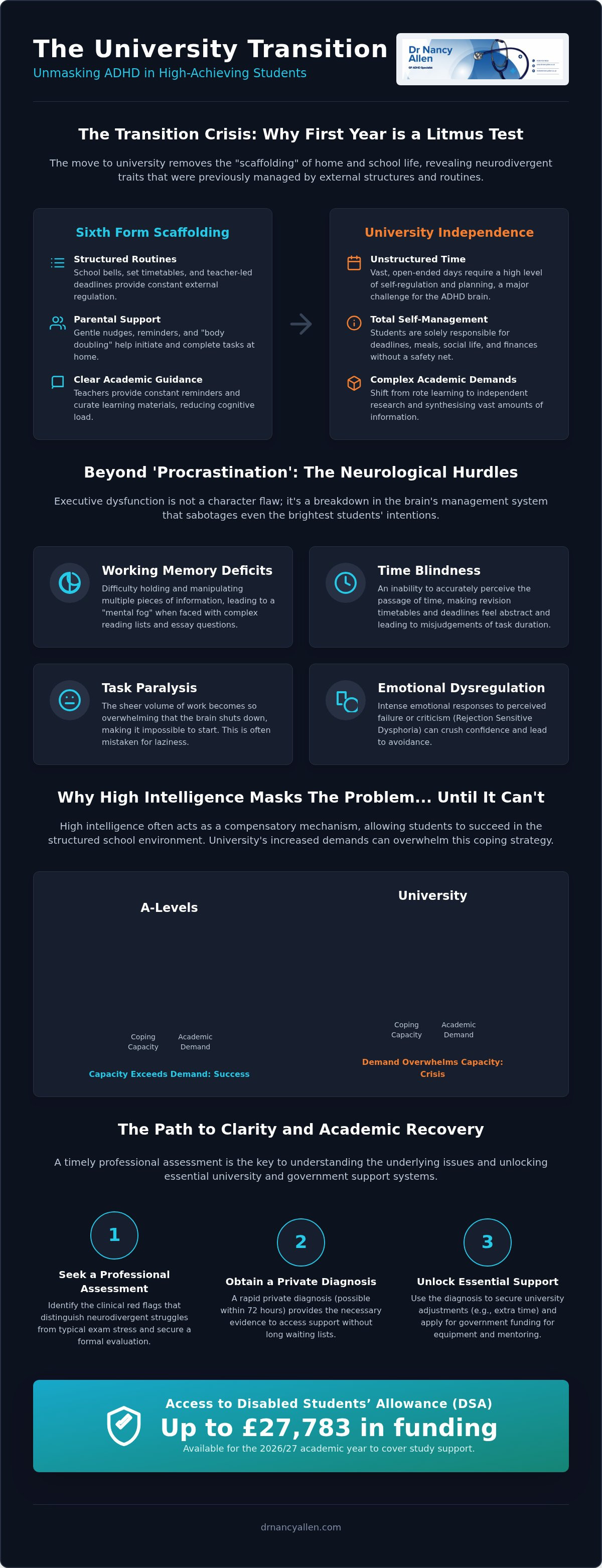
The jump from sixth form to university is more than just an academic step; it's a complete environmental overhaul. For many young people, the rigid structure of secondary school acts as a protective "scaffolding" that keeps them upright. When this scaffolding is removed, we often begin to see Attention deficit hyperactivity disorder (ADHD) symptoms emerge for the first time. This transition serves as a litmus test for executive function, as students are suddenly expected to manage their own schedules, meals, and academic deadlines without external pressure. The leap in maturity required is significant, and for a neurodivergent mind, the sudden absence of a safety net can be catastrophic.
The Loss of External Structure
A-levels are highly regulated. Teachers provide constant reminders, and the school bell dictates every movement. At home, parents often provide "body doubling," where their mere presence or gentle nudges help a student initiate tasks. At university, this disappears. Students find themselves with vast amounts of unstructured time, which is notoriously difficult for the neurodivergent brain to navigate. Failing for the first time in an unfamiliar city, away from their usual support network, can lead to a rapid decline in mental well-being and a sense of total overwhelm. They aren't just struggling with books; they're struggling to regulate their entire existence.
The Myth of the "Lazy" Student
Parents often wonder why so many of my first year university students struggle with exams -the hidden role of ADHD is frequently misinterpreted as a lack of discipline. What looks like excessive socialising or avoidance is often a desperate attempt to find dopamine or a result of total task paralysis. When an ADHD brain cannot find a clear starting point for independent research, it can simply shut down. This isn't laziness. It's a genuine inability to organise complex thoughts into a coherent plan. These students often feel an intense sense of shame, knowing they're capable of the work but unable to "just do it" like their peers. The shift from rote learning to independent study requires a level of self-regulation that many simply haven't had to develop until now. Without the external "clocks" of home life, they aren't just losing track of time; they're losing their sense of agency.
Beyond Procrastination: How Executive Dysfunction Sabotages Exam Preparation
Labeling a student as a procrastinator often overlooks the complex neurological hurdles they face. For a neurodivergent mind, the difficulty isn't a lack of desire to succeed; it is a breakdown in the brain's "management system." Many parents contact me asking why so many of my first year university students struggle with exams -the hidden role of ADHD is frequently found in the way executive dysfunction disrupts the transition from reading a syllabus to actually sitting the paper. This biological barrier makes the leap to self-directed degree study feel like climbing a mountain without a map.
Working Memory and Information Synthesis
University-level exams require students to synthesise vast amounts of data, contrasting theories, and complex case studies. This relies heavily on working memory, which acts like a mental jotting pad. Students with ADHD often experience a "mental fog" when faced with uncurated reading lists because their brain struggles to hold multiple concepts simultaneously. In the context of academic planning, executive dysfunction is the neurological impairment of the brain's management system that prevents a student from translating their knowledge into a structured revision plan. These challenges for college students with ADHD often lead to total analysis paralysis, where the sheer volume of work causes the brain to shut down entirely.
Time Blindness in Revision Timetables
Time blindness is a core trait of ADHD that makes estimating the duration of tasks nearly impossible. A student might believe they can summarise a three hundred page textbook in an afternoon, leading to the inevitable and exhausting "all-nighter" cycle. This isn't a choice; it's a physiological hurdle where "starting tomorrow" feels like a distant, abstract concept that never arrives. Hyperfocus adds another layer of complexity. A student might spend ten hours perfecting the font and layout of a single revision card whilst completely ignoring the core syllabus. This intense focus on minor details is a dopamine-seeking behaviour that provides a temporary sense of achievement whilst the actual deadline looms closer.
The resulting emotional dysregulation can be devastating. When the "all-nighter" fails to produce the expected results, the student is hit with a wave of shame and anxiety that further impairs their ability to perform on exam day. If these patterns of burnout and last-minute panic have become the norm for your child, exploring a private ADHD assessment can provide the clinical clarity needed to replace these self-sabotaging cycles with effective, evidence-based strategies.
Coping vs. Thriving: Why High Intelligence Often Masks ADHD Until University
Many students who reach university have spent years unknowingly using high intelligence to bypass the typical markers of neurodiversity. This "High-Functioning ADHD" isn't a milder form of the condition; it simply means the individual has developed sophisticated compensatory mechanisms. Whilst their peers might have struggled with basic organisation in primary school, these bright students used their quick thinking to "wing it," often performing well despite a lack of consistent study habits. However, this reliance on raw intellect has a ceiling. When parents ask me why so many of my first year university students struggle with exams -the hidden role of ADHD often becomes clear when the sheer volume of degree-level work exceeds what can be managed by intelligence alone. This "Twice-Exceptional" profile means the student's high IQ effectively hides their disability, often until the pressure of independent university life becomes too great to bear.
The Gifted Student Trap
Bright children often survive school by relying on last-minute adrenaline. This "crisis-mode" revision works for GCSEs because the syllabus is relatively contained. At university, the workload increases tenfold, and the complexity of the material requires sustained synthesis rather than just memorisation. According to research on university students with ADHD, this leads to unsatisfactory academic performance and a profound sense of failure. The shame felt by a "formerly gifted" child is acute. They begin to believe they have simply "become stupid" or lost their edge, when in reality, their brain's management system is simply overwhelmed. It's a painful shift from being the student who "sails through" to the one who can't seem to start a single essay.
Masking and Mental Health
The mental energy required to appear "normal" and high-achieving is exhausting. This "masking" often leads to an internalised presentation of symptoms, which is particularly common in women and high-achievers. Instead of outward hyperactivity, they experience internal restlessness and chronic anxiety. Because they seem capable on the surface, university health centres frequently misdiagnose their struggles as simple exam stress or low mood. This oversight is dangerous, as it leaves the root cause unaddressed whilst the student edges closer to burnout. Seeking a comprehensive adult ADHD assessment is vital. It allows for a clinical investigation that looks beyond surface-level achievement to identify the genuine cognitive hurdles beneath, providing a path toward restoration of confidence and academic success.
Identifying the Red Flags: Is it Exam Stress or Undiagnosed ADHD?
Every student experiences a degree of pressure during their first year, but there is a distinct line between typical adjustment stress and the neurological hurdles of neurodiversity. Understanding why so many of my first year university students struggle with exams -the hidden role of ADHD requires looking beyond the library desk and into the student's daily life. Clinical ADHD isn't just about a lack of focus; it's a persistent difficulty in regulating attention, emotions, and physical energy. If your child is faltering, consider this five-point checklist of clinical indicators:
Chronic Task Paralysis: An inability to start an assignment even when the consequences of failure are high.
Rejection Sensitive Dysphoria (RSD): Experiencing intense, almost physical emotional pain in response to constructive feedback or perceived failure.
Inattentive "Drifting": Sitting through a full hour of a lecture and leaving with no memory of the content discussed.
Circadian Disruption: A consistent "night owl" pattern where the brain only feels alert after midnight, leading to chronic exhaustion.
The "ADHD Tax": Frequent financial or social costs from forgotten appointments, lost keys, or uncancelled subscriptions.
Physical signs often manifest as a chaotic living environment. A messy room or a pile of unopened post isn't necessarily a sign of "laziness" but a symptom of an overwhelmed executive system that cannot prioritise small tasks whilst facing academic pressure.
Academic Red Flags
In a university setting, the most common red flag is a significant gap between verbal ability and written output. These students are often the most articulate in seminars, yet they consistently receive "incomplete" grades or fail to submit work. They suffer from "blank page" syndrome, where the transition from a complex mental idea to a structured essay feels impossible. If a student is requesting multiple extensions or missing deadlines despite clearly understanding the material, it's rarely a lack of effort. It's a failure of the brain's "on switch."
Social and Lifestyle Indicators
The ADHD brain often seeks to "quiet" internal restlessness through impulsive spending or increased substance use, particularly caffeine or nicotine. Social withdrawal is also common. When managing a basic schedule feels like a full-time job, maintaining friendships becomes an exhausting chore. This isolation, combined with the shame of academic struggle, can quickly spiral into a mental health crisis. If these red flags resonate with your child’s experience, you can book a private ADHD assessment to gain the clinical insight needed to move from crisis to a structured plan for success.
Securing Clarity: The Path to a Private ADHD Assessment and Support
The realisation that a student is faltering can be a moment of intense anxiety for families. However, it's also the first step toward a solution. When parents finally uncover why so many of my first year university students struggle with exams -the hidden role of ADHD, the immediate priority becomes speed. Waiting 12 to 36 months for an NHS referral is rarely a viable option when a degree and tuition fees are at stake. A private assessment provides the rapid, expert intervention needed to "level the playing field," ensuring that a student's academic future isn't derailed by a treatable neurological condition.
Unlocking University Support
A formal diagnosis is a powerful administrative tool that moves a student from being seen as "underperforming" to being legally protected under the Equality Act 2010. This status requires UK universities to make "reasonable adjustments" to accommodate their neurodiversity. These adjustments often include:
Extra time in exams: Typically 25% additional time to help with processing and focus.
Quiet rooms: Access to individual spaces to reduce sensory overwhelm during assessments.
Deadline flexibility: Extensions on coursework to manage executive function hurdles.
Assistive technology: Software for note-taking and organising research.
Crucially, a specialist report is the key to accessing the Disabled Students’ Allowance (DSA). For the 2026/27 academic year, this non-repayable grant provides up to £27,783 in funding for specialist equipment and non-medical helpers. This support can be the difference between a student withdrawing from their course and achieving a first-class degree. It's about more than just a prescription; it's a holistic plan that combines clinical insight with practical strategies for success.
The Dr Nancy Allen Approach
Speed and empathy are at the heart of our service. We offer a 72-hour turnaround for diagnoses and treatment plans, providing an urgent lifeline for students in the middle of an academic crisis. Secure online consultations mean your child can access expert care from their university accommodation, avoiding the stress of travel during term time. With 25 years of clinical experience, Dr Nancy Allen understands why so many of my first year university students struggle with exams -the hidden role of ADHD is something we handle with both professional authority and deep-seated compassion. We don't just provide a label; we provide a path toward restoration, validating the student’s experience whilst giving them the tools to thrive in a neurotypical world.
Reclaiming Academic Confidence and Success
Academic decline during the first year is rarely a reflection of a student's potential; instead, it's often the result of a neurodivergent mind losing the vital "scaffolding" of home life. We've explored how high intelligence can mask ADHD for years, only for the symptoms to surface when independent study and complex exam syntheses are required. Gaining clarity on why so many of my first year university students struggle with exams -the hidden role of ADHD is the most important step in preventing academic exclusion and restoring a sense of self-worth.
A formal diagnosis doesn't just provide a label; it unlocks legal protections, university adjustments, and essential funding through the Disabled Students’ Allowance. With over 25 years of clinical expertise, Dr Nancy Allen provides a compassionate, evidence-based approach through secure online consultations across the UK. We provide comprehensive diagnosis and treatment plans within 72 hours, ensuring that help arrives when it's needed most.
Don't let undiagnosed hurdles overshadow your child's hard-earned place at university. You can book a private ADHD assessment with Dr Nancy Allen today to secure the expertise and support they deserve. With the right clinical guidance, your child can move from a state of overwhelm to a future of academic excellence.
Frequently Asked Questions
Can ADHD symptoms appear for the first time at university?
ADHD symptoms don't technically appear for the first time in adulthood, but they often become clinically significant during the transition to university. High intelligence often acts as a compensatory mechanism during school years, masking the underlying struggle. When the external structure of home life disappears, the brain's management system can fail under the increased pressure. This unmasking is why so many of my first year university students struggle with exams -the hidden role of ADHD is often the missing piece of the puzzle.
How do I know if my child has ADHD or is just struggling with university life?
Clinical ADHD is distinguished from typical adjustment stress by the persistence and severity of executive dysfunction. Whilst many students find the first term difficult, a neurodivergent student often experiences total task paralysis or Rejection Sensitive Dysphoria (RSD). Look for a significant gap between their verbal brilliance in seminars and their inability to produce written work. If they're struggling to manage basic life tasks like laundry or food shopping alongside their studies, it's time to consider a professional assessment.
Will a private ADHD diagnosis be accepted by my UK university for exam adjustments?
Most UK universities fully accept private diagnoses that adhere to NICE guidelines. Under the Equality Act 2010, institutions must provide "reasonable adjustments" for students with disabilities. A specialist report from Dr Nancy Allen provides the clinical evidence required for extra time, quiet rooms, or deadline extensions. This formal recognition protects the student from academic exclusion and ensures they receive the support they're legally entitled to during their degree, providing much needed clarity and security.
What is the Disabled Students Allowance (DSA) and how does an ADHD diagnosis help?
The Disabled Students’ Allowance (DSA) is a non-repayable government grant designed to cover the extra costs of studying with a disability. For the 2026/27 academic year, eligible students in England can receive up to £27,783. A formal ADHD diagnosis is the prerequisite for this funding. It can pay for specialist equipment, assistive technology, and non-medical helpers, which are essential for managing the increased executive function demands of university life and ensuring long term academic success.
Is it worth getting an ADHD assessment in the middle of the academic year?
Seeking an assessment mid-term is often the best way to prevent a total academic breakdown. Our 72-hour turnaround for diagnosis and treatment plans means we can intervene quickly, even during the pressure of revision season. Waiting years for an NHS appointment whilst failing modules isn't a sustainable path. An immediate private assessment provides the clarity needed to secure extensions and implement strategies before the final exam period begins, saving both tuition fees and student confidence.
How long does a private ADHD assessment take with Dr Nancy Allen?
A private assessment with Dr Nancy Allen is designed to be both thorough and efficient. We provide a diagnosis and a comprehensive treatment plan within 72 hours of your consultation. Our secure online sessions are available across the UK, making it easy for students to access expert care without leaving their university campus. This rapid turnaround is specifically designed to support families who are facing urgent academic deadlines or exam crises, reducing the anxiety of a long wait.
Can ADHD medication help with university exam performance?
Medication can be a transformative tool for improving focus, reducing impulsivity, and managing executive dysfunction. It helps by "levelling the playing field," allowing a student to apply the knowledge they've worked hard to acquire. However, medication is most effective when it forms part of a wider support strategy. This includes university adjustments and specialist coaching, ensuring the student has both the biological and environmental support needed to succeed in a high-pressure exam setting without burning out.
What happens if my child is diagnosed with ADHD but also has anxiety?
It's very common for ADHD to coexist with other conditions; 25% of young people with ADHD also experience an anxiety disorder. We take a holistic approach that treats the individual, not just the symptoms. By identifying the root cause of the struggle, we can reduce the secondary anxiety caused by academic failure. Our treatment plans are personalised to address both neurodiversity and emotional well-being, restoring the student's confidence and ensuring they feel both informed and heard throughout their journey.


Comments