


ADHD and Trauma: Understanding the Link and Symptoms

Did you know that adults with ADHD are nearly four times more likely to develop PTSD than those without? This startling connection highlights why the intersection of adhd and trauma is one of the most misunderstood areas of modern mental health. You might feel exhausted from years of "masking" your symptoms or frustrated by treatments that never quite seem to hit the mark. It's common to feel like you're fighting a battle on two fronts, especially when the symptoms of hypervigilance and executive dysfunction feel almost identical.
We'll help you untangle this complex relationship, showing you how to distinguish between these overlapping conditions and why a specialised clinical perspective is vital for your well-being. We will explore the specific symptoms that bridge these two worlds and provide a clear roadmap toward a private assessment that bypasses long wait times. You don't have to stay stuck in a cycle of uncertainty. Instead, you can find the validation and expert insight needed to finally move forward with confidence and clarity.
Table of Contents
The Complex Relationship Between ADHD and Trauma
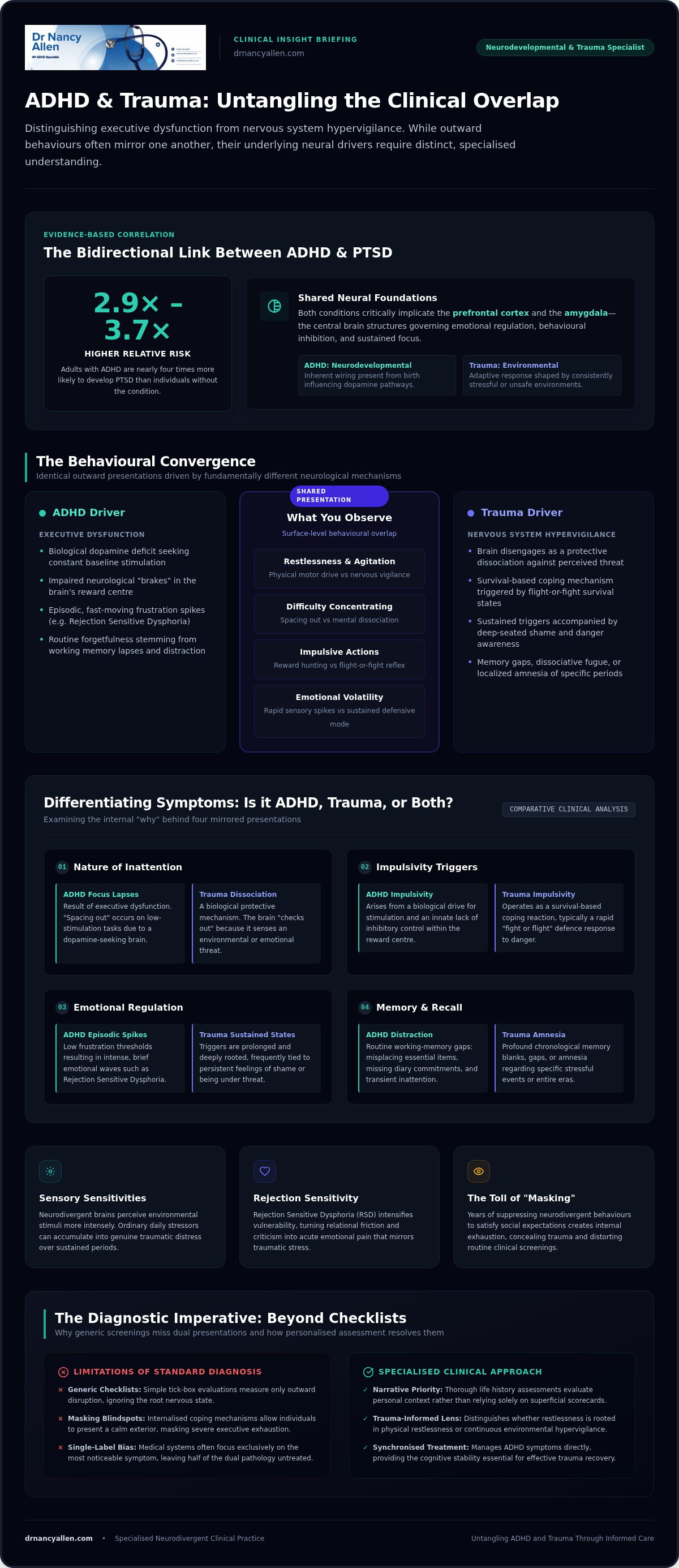
Understanding the connection between adhd and trauma isn't just a clinical exercise; it's a vital step for anyone who feels their symptoms aren't fully explained by a single label. Research suggests that the relationship is bidirectional. Individuals with ADHD have a 2.9 to 3.7 times higher relative risk of developing PTSD compared to those without the condition. Conversely, chronic trauma can mimic or intensify the core traits of attention deficit hyperactivity disorder, creating a cycle that is difficult to break without specialist insight.
Imagine a Venn diagram where one circle represents executive dysfunction and the other represents hyper-vigilance. In the middle, you'll find shared symptoms like restlessness, difficulty concentrating, and emotional volatility. Whilst the outward behaviours look the same, the internal drivers are often very different. In the UK, the standard medical system often struggles to differentiate these drivers, frequently focusing on the most disruptive symptoms rather than the root cause. This is why a trauma-informed approach is essential for accurate care.
To better understand how these two experiences interact, watch this helpful video:
What is the ADHD-Trauma Overlap?
Both conditions involve the prefrontal cortex and the amygdala, which govern our ability to regulate emotions and focus. Whilst ADHD is a neurodevelopmental condition present from birth, developmental trauma occurs when a child's environment is consistently stressful or unsafe. This overlap is a clinical entanglement that requires expert unravelling. A trauma-informed perspective recognises that a neurodivergent brain perceives the world more intensely, making even "ordinary" stressors feel potentially traumatic over time.
Why a "Standard" Diagnosis May Fall Short
A simple tick-box exercise can't capture the nuance of a lived experience. Many people become experts at "masking" their neurodivergence or their trauma, presenting a calm exterior whilst struggling internally. Generic checklists often miss these subtleties, especially when symptoms are suppressed to fit social expectations. A thorough private assessment looks at your entire life history. It prioritises your narrative over a standard form, ensuring that your diagnosis reflects your reality rather than just surface-level behaviours.
Distinguishing Symptoms: Is it ADHD, Trauma, or Both?
Untangling the threads of adhd and trauma is a delicate process because the outward behaviours often mirror one another. You might find yourself struggling with a restless mind, sudden bursts of impulsivity, or emotions that feel impossible to contain. Whilst these experiences are common to both conditions, the internal "why" behind them is often distinct. Recognising these subtle differences is the first step toward finding a treatment path that actually works for your unique nervous system.
The Overlapping Symptom Checklist
When we look at differentiating ADHD from trauma symptoms, we must examine the nature of inattention. In ADHD, "spacing out" is typically a result of executive dysfunction and a dopamine-seeking brain that struggles to sustain focus on low-stimulation tasks. In contrast, trauma-induced dissociation is a protective mechanism; the brain checks out because it perceives a threat, even if that threat isn't immediately obvious.
Impulsivity: ADHD impulsivity is often a biological drive for stimulation or a lack of "brakes" in the brain's reward centre. Trauma-informed impulsivity is frequently a survival-based coping mechanism, such as a "fight or flight" response to perceived danger.
Emotional Regulation: Those with ADHD often have a low threshold for frustration, leading to quick, episodic spikes like Rejection Sensitive Dysphoria. Trauma triggers tend to be more sustained, often accompanied by deep-seated shame or a persistent sense of being in harm's way.
Memory: ADHD forgetfulness usually involves misplacing keys or missing appointments due to distraction. Trauma-related memory issues can manifest as "gaps" or amnesia regarding specific events or time periods.
Key Differentiators for Clinical Clarity
Consistency is one of the most reliable indicators for clinicians. ADHD symptoms are neurodevelopmental, meaning they are typically present from early childhood and remain relatively consistent across different settings, such as school, home, and work. Trauma symptoms may emerge or dramatically escalate following specific adverse events, and they are often tied to environmental cues that trigger a nervous system response.
Another clue lies in how the brain responds to intervention. For many, stimulant medications provide a sense of calm and focus by balancing dopamine levels. However, for someone whose primary issue is trauma-based hyperarousal, stimulants can sometimes amplify physical anxiety or hypervigilance. If you feel your current support plan isn't quite reaching the root cause, a private Adult ADHD Assessment can provide the specialised clinical insight needed to move forward with confidence.
Why Neurodivergent Individuals are More Vulnerable to Trauma
Living with an ADHD brain often means navigating a world that isn't designed for your nervous system. This inherent friction creates a heightened vulnerability to trauma. Research indicates that children exposed to four or more Adverse Childhood Experiences (ACEs) have 3.44 times higher odds of receiving an ADHD diagnosis. This suggests that the overlap between ADHD and trauma symptoms is often rooted in early developmental environments. When your brain processes information differently, the world can feel like a consistently overwhelming place.
Social Rejection and the Trauma of Not Fitting In
For many, the most enduring trauma stems from social exclusion. Rejection Sensitive Dysphoria (RSD) causes an intense, almost physical pain in response to perceived criticism or failure. When you spend years being corrected, shamed, or excluded for traits you can't control, it results in chronic invalidation. This isn't a single catastrophic event; it's a "death by a thousand cuts" that shapes your self-worth and triggers long-term interpersonal trauma. This social trauma builds up over decades. It leads to a persistent belief that you're fundamentally "broken," which is a hallmark of complex trauma.
The Physiological Toll of Chronic Stress
The ADHD brain often exists in a state of autonomic hyperarousal, similar to a "fight or flight" response. This physiological tension is exacerbated by sensory processing sensitivities. A crowded shopping centre or a loud office isn't just a nuisance; for a neurodivergent person, it can be experienced as a traumatic sensory overload. Over time, these daily struggles, often called the "ADHD Tax," accumulate into complex trauma (C-PTSD). This is a distinction now formally recognised in the ICD-11, which helps clinicians understand symptoms that go beyond standard PTSD.
Hormonal shifts provide another layer of complexity. During perimenopause or menopause, falling oestrogen levels significantly impact dopamine regulation. This often unmasks previously managed ADHD symptoms and can cause past traumatic experiences to resurface with new intensity. Dr Nancy Allen emphasises that addressing hormonal health is a critical component of trauma-informed neurodivergent care. By understanding these intersections, we can move away from shame and toward a holistic model of restoration. You deserve a care plan that acknowledges every aspect of your experience.
The Diagnostic Challenge: Untangling the Threads
Untangling the threads of adhd and trauma requires a level of clinical nuance that standard "tick-box" exercises simply cannot provide. Whilst a general practitioner is a valuable first point of contact, they often lack the specialist training or the time required to conduct a deep, qualitative exploration of your life history. For those with complex presentations, a private assessment is frequently the most effective way to ensure that symptoms aren't misattributed or overlooked. This process isn't just about identifying a condition; it's about understanding how your unique brain has adapted to the world around it.
A specialist clinician looks beyond current behaviours to evaluate your childhood history whilst acknowledging the profound impact of adult trauma. They rely on collateral information, such as reports from family members or old school records, to build a comprehensive picture of your development. This evidence-based approach helps determine if your challenges have been present from birth or if they emerged as a response to adverse life events. When these two experiences coexist, the diagnostic process must be handled with extreme care to avoid ineffective treatment plans.
The Importance of a Compassionate Clinical Interview
A specialist assessment should feel like a safe space rather than an interrogation room. The clinical interview is the cornerstone of this process, allowing a practitioner to tease out whether a symptom like impulsivity is a neurodevelopmental trait or a trauma-informed survival strategy. This requires a high level of clinical expertise and empathy to ensure you feel validated throughout the conversation. Ultimately, a diagnosis is about understanding the person, not just the labels. This holistic view ensures that the resulting treatment plan respects the complexity of your journey and supports your long-term well-being.
Preparing for Your Assessment
Preparation can help reduce the anxiety often associated with seeking a diagnosis. Gathering evidence before your appointment allows for a more focused and productive consultation. You might find it helpful to look for:
Primary school reports that mention "daydreaming," "distractibility," or "not reaching full potential."
Feedback from previous work reviews or appraisals that highlight struggles with organisation or focus.
Personal journals or notes that document your internal patterns rather than just isolated events.
Reflecting on these documents helps distinguish between lifelong neurodivergence and the subsequent layers of trauma. Seeking a private ADHD assessment often provides much faster access to this specialised care. Dr Nancy Allen typically provides comprehensive assessments and treatment plans within 72 hours, bypassing long wait times for the clarity you need. If you're ready to find answers and begin your journey toward restoration, you can book your private ADHD consultation here.
Personalised Support and the Journey to Recovery
Healing from the complex intersection of adhd and trauma requires more than a one-size-fits-all solution; it demands a dual-track approach that respects the nuance of your lived experience. Whilst traditional models often treat neurodivergence and trauma as separate entities, a modern, specialist-led strategy understands that these two forces are deeply intertwined. By addressing both simultaneously, we can move beyond mere symptom management and toward a genuine restoration of your quality of life. This integrated path ensures that your treatment plan is as unique as the symptoms you're navigating.
Integrated Treatment Strategies
For many individuals, medication plays a pivotal role in creating the mental space necessary for deeper psychological work. When the constant internal noise and distractibility of ADHD are quieted, you often find it easier to engage with trauma-informed therapies such as Cognitive Behavioural Therapy (CBT) or somatic experiencing. This isn't about fixing your brain, but rather providing it with the stability it needs to process past events without becoming overwhelmed. A holistic management plan also prioritises physical well-being, focusing on sleep hygiene, balanced nutrition, and hormonal stability to support a sensitive nervous system.
Creating a lifestyle that supports a sensitive nervous system involves more than just clinical appointments. It's about organising your environment to reduce sensory overload and establishing routines that provide a sense of predictable safety. Empathetic validation from a specialist who understands the cumulative impact of the ADHD Tax can be transformative, shifting the narrative from one of personal failure to one of neurobiological adaptation. When you feel heard and understood, the anxiety associated with seeking help begins to dissolve, making way for a collaborative relationship focused on your long-term restoration.
Finding Clarity with Dr Nancy Allen
The journey toward recovery begins with a clear, expert assessment that validates your experiences rather than just ticking boxes. Dr Nancy Allen brings over 25 years of clinical experience to her practice, offering a compassionate lens that considers your whole life-view, including the often-overlooked impact of hormonal health on neurodivergent traits. This holistic perspective is essential for untangling how perimenopause or other life stages might be exacerbating both ADHD symptoms and past traumatic responses.
Recognising the urgency for answers and the exhausting nature of living in uncertainty, her practice provides comprehensive assessments and personalised treatment plans within 72 hours. These secure online consultations are accessible nationwide, ensuring you can receive specialist care from the comfort of your own home without the stress of travel or long waiting lists. Taking the first step by booking a private consultation is an investment in your future clarity and a commitment to finding the support you truly deserve.
Finding Clarity and Restoration
Living with the combined weight of adhd and trauma is exhausting, but it doesn't have to be your permanent reality. You now understand that these conditions aren't just overlapping; they're deeply intertwined experiences that require a specialised lens to resolve. By identifying the root causes of your restlessness or emotional spikes, you can finally move away from the fatigue of masking and toward a treatment plan that actually works for your nervous system. Clarity is the first step toward genuine restoration.
Dr Nancy Allen offers the quiet confidence of a practitioner with over 25 years of specialist experience. Through secure, nationwide online consultations, she provides the empathetic validation and clinical precision you need to find answers quickly. You won't be left waiting for months; instead, you can receive a comprehensive diagnosis and treatment plan within 72 hours. If you're ready to untangle your symptoms and start your journey toward recovery, Book a Private ADHD Assessment with Dr Nancy Allen today. It's time to find the clarity you deserve.
Frequently Asked Questions
Can trauma cause ADHD-like symptoms in adults?
Yes, trauma can mirror ADHD symptoms such as inattention, restlessness, and impulsivity. Chronic hypervigilance keeps the nervous system in a state of high alert, which disrupts focus and executive function in ways that look identical to ADHD on the surface. This is why a specialist assessment is essential to identify whether these behaviours are neurodevelopmental or a survival response to past adverse experiences. Understanding the root cause is the key to effective care.
Is it possible to have both ADHD and PTSD at the same time?
Yes, it's very common for both conditions to coexist. Research indicates that individuals with ADHD have a significantly higher risk of developing PTSD compared to those without the condition. When adhd and trauma occur together, they often exacerbate one another, creating a complex clinical picture. Treating one without acknowledging the other often leads to incomplete recovery, making a dual-track management plan the most effective approach for your long-term well-being.
How does a specialist tell the difference between ADHD and trauma?
Specialists look for the origin and consistency of symptoms over time. ADHD is a lifelong neurodevelopmental condition that must be present in early childhood, whereas trauma symptoms typically emerge or escalate following specific events. A clinical interview explores your entire life history, looking for patterns of behaviour in various settings. They also assess whether symptoms are triggered by environmental cues or are a constant, baseline experience for your nervous system.
Will ADHD medication help if my symptoms are actually caused by trauma?
Medication may not be as effective if the root cause is purely trauma-based hyperarousal. Whilst stimulants can improve focus for those with ADHD, they can sometimes increase physical anxiety or hypervigilance in individuals with untreated PTSD. However, for those with both conditions, medication can provide the mental space required to engage effectively in trauma therapy. A precise diagnosis ensures that any pharmacological support aligns with your specific neurobiology and recovery goals.
What is the link between ADHD, trauma, and menopause?
Menopause involves significant hormonal shifts that can unmask previously managed ADHD traits and cause past trauma to resurface. Falling oestrogen levels impact dopamine regulation, often making executive dysfunction feel much worse. Dr Nancy Allen specialises in this intersection, providing a holistic view that considers how your hormonal health taxes an already sensitive nervous system. This integrated perspective is vital for women navigating these complex symptoms during midlife, ensuring support is truly personalised.
How long does a private ADHD assessment take with Dr Nancy Allen?
The diagnostic process is designed to be thorough yet efficient. Dr Nancy Allen provides comprehensive assessments and personalised treatment plans within 72 hours of your consultation. These secure online sessions are accessible across the UK, allowing you to bypass long wait times and find clarity quickly. This rapid turnaround ensures you don't have to stay stuck in a cycle of uncertainty whilst waiting for the specialist clinical support you need to move forward.
Can I get a diagnosis if I don’t have childhood school reports?
Yes, you can still receive a diagnosis without original school reports. Whilst childhood records are helpful collateral information, a specialist can use other evidence to establish a lifelong pattern of symptoms. This might include personal journals, work appraisals, or interviews with family members who remember your early behaviour. The clinical interview is the most critical tool, allowing the doctor to reconstruct your developmental history through your own lived experience and detailed narrative.


Comments