


Why Top Students with ADHD Struggle at University
- Dr Nancy Allen

- Jul 29
- 13 min read
How can a student be bright enough to secure straight As at A-level, yet find themselves completely unable to start a 1,000-word essay just months into their first term? It's a distressing paradox that many high-achieving individuals face, often leading to a cycle of severe procrastination and a heavy sense of wasted potential. You might feel that your sudden academic decline is a personal failure, but the truth is often found in the sudden removal of the external structures that previously kept you afloat. Understanding why students with ADHD struggled at university despite good A-level results is the first step toward reclaiming your academic journey and your self-esteem.
We recognise the emotional exhaustion that comes from years of masking and the guilt of hitting a wall when the stakes are highest. This article explains how the transition to independent study exposes hidden executive function gaps and offers a clear path toward expert clinical support. We'll explore the neurological reasons for this shift, the reasonable adjustments you're entitled to under the Equality Act 2010, and how a private diagnosis can provide the clarity you need to move forward with confidence.
Table of Contents
The Paradox of High Achievement: Why A-Levels Often Mask ADHD
It's a confusing, often heartbreaking experience to transition from being a "top-tier" student to someone who feels completely out of their depth. Many individuals arrive at university with a history of academic success, only to find their world suddenly unravelling. You've always been "the bright one," yet now you find yourself unable to focus on a single lecture. This is a common pattern in Adult attention deficit hyperactivity disorder, where high intelligence often acts as a cloak for underlying neurological challenges.
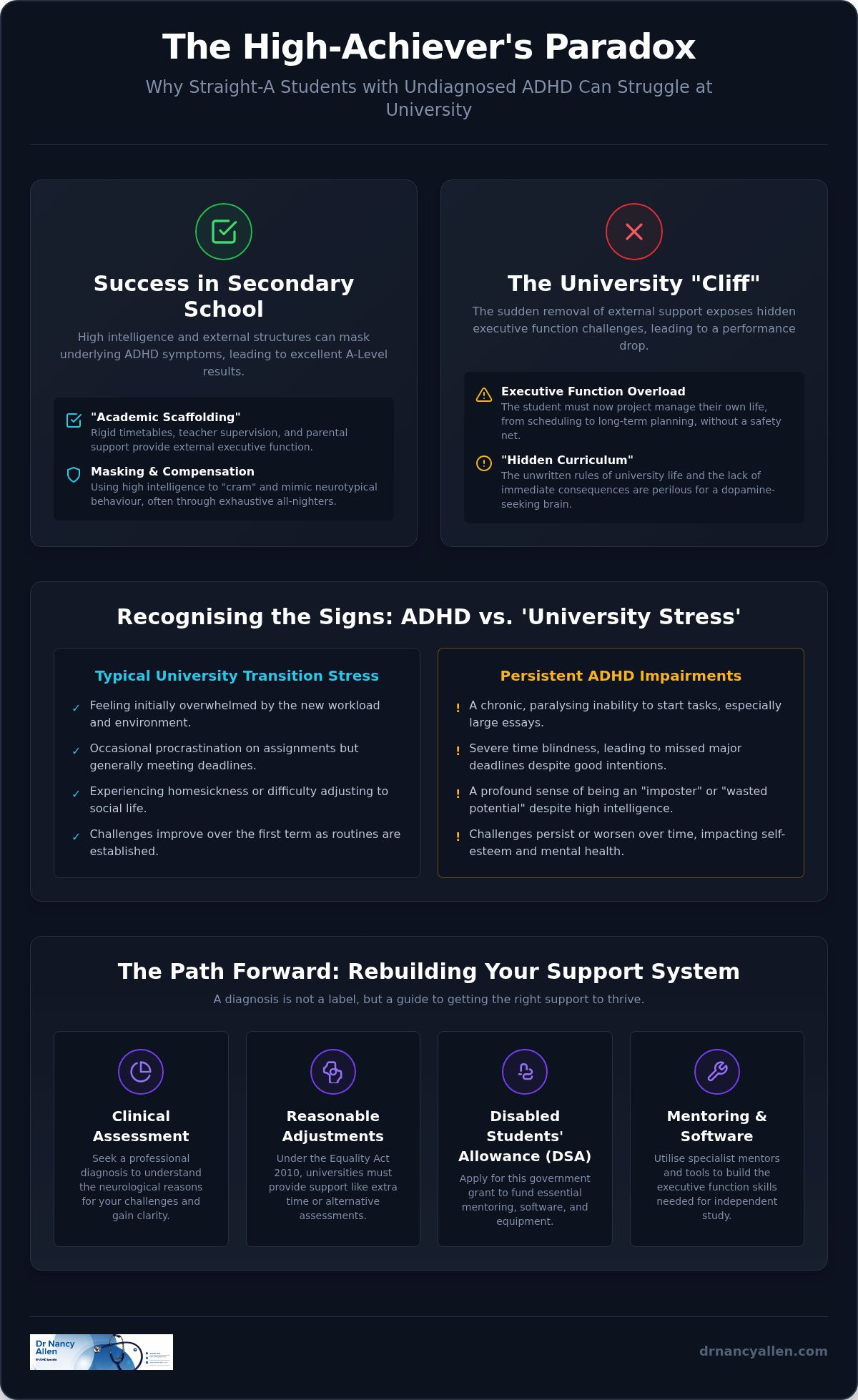
School environments are designed with high levels of structure. Teachers check in daily, and bells tell you exactly where to be. This "Academic Scaffolding" essentially functions as an external frontal lobe for the student. For many, this support system is so effective that it entirely hides the symptoms of ADHD until the safety net is removed. High-achieving students also rely heavily on "masking" to fit in. This is the exhausting, manual process of mimicking neurotypical behaviours through sheer willpower. You might have spent years over-preparing or staying up until 3 am to finish assignments, appearing successful whilst being internally drained.
The Role of External Scaffolding in School
In a school setting, your time is rarely your own to manage. This rigid framework provides the executive function that a student with ADHD might internally lack. Key elements of this scaffolding include:
Managed Timetables: The school day is segmented into predictable blocks, reducing the need for self-initiated transitions.
Parental Involvement: At home, parents often handle the logistical "mental load," from organising study spaces to tracking exam dates.
Immediate Feedback: Small class sizes allow for close supervision, providing the dopamine hits of praise or the urgency of a teacher's reminder.
The "all-nighter" strategy often works for A-levels because the volume of information is still manageable through short bursts of hyperfocus. However, this approach is fundamentally unsustainable for a three-year degree programme where the work is cumulative.
The Intelligence Compensation Trap
Many "gifted" students use their high verbal or logical reasoning to compensate for a lack of focus. They can understand complex concepts instantly, which allows them to skip the process of developing actual study habits. This creates a false sense of security that eventually leads to a crisis. The hidden cost of this compensation is immense, manifesting as chronic anxiety and a constant fear of being "found out" as an imposter.
Intelligence Compensation is a temporary bridge that collapses when academic complexity increases. This is a core reason why students with ADHD struggled at university despite good A-level results; the sheer volume of independent work eventually outpaces even the sharpest intellect. Without the external scaffolding of school, the internal executive function gaps finally become impossible to ignore.
The Executive Function Cliff: What Changes at University?
The transition to higher education is often described as a step up, but for the neurodivergent brain, it feels more like a sudden drop-off. In the previous section, we discussed how the external scaffolding of school keeps students on track. When you move to university, that scaffolding is dismantled overnight. This is fundamentally why students with ADHD struggled at university despite good A-level results; the burden of organisation shifts entirely from the institution to the individual. You're no longer just a student learning a subject; you've become the project manager of your own life, a role that demands the very executive functions that ADHD makes difficult to access.
University life relies on a "Hidden Curriculum" of unwritten rules. It assumes you can naturally prioritise tasks, filter out distractions in a busy library, and navigate complex social hierarchies without clear guidance. For a brain that struggles with dopamine regulation, the lack of immediate consequences is perilous. In school, a missed homework assignment was noticed by a teacher within 24 hours. At university, you might not realise you're failing until a major deadline passes three months later. According to an expert consensus on ADHD in university students, this lack of immediate feedback loops is a primary driver of academic crisis in high-achieving neurodivergent adults.
The Loss of Routine and Structure
The danger often lies in the "gaps" between lectures. Whilst a neurotypical peer might use a three-hour break to visit the library, a student with ADHD may find this unstructured time becomes a black hole of productivity. Without a bell to signal the next task, task initiation becomes a mountain to climb. This often leads to "ADHD paralysis," where the sheer volume of choices results in doing nothing at all. The absence of a forced morning routine also triggers a spiral; if no one is waking you up for a 9 am seminar, it's easy for your sleep cycle to drift, leading to missed commitments and a growing sense of shame.
The Cognitive Load of Independent Living
We must also consider the "survival" tasks that now compete for your limited mental energy. Managing laundry, grocery shopping, and budgeting are all executive-function-heavy activities. When you're exhausted from simply trying to feed yourself and keep your room tidy, there's often nothing left for academic research. The sensory environment of university halls, with constant noise and fluorescent lighting, can also lead to emotional dysregulation. If you're finding this transition overwhelming, exploring a private ADHD assessment can help you understand your brain's specific needs and secure the support you deserve.
Socially, many students experience heightened Rejection Sensitive Dysphoria (RSD). In a new environment where you're trying to build a peer group from scratch, every perceived slight or missed social cue feels amplified. This can lead to self-isolation, further removing the social body-doubling that many ADHD students unknowingly relied on during their A-level years to stay motivated and engaged.
Gifted Kid Burnout and the Psychological Toll of Underperformance
When you've spent years being praised for your intellect, hitting a wall at university doesn't just feel like a setback; it feels like a betrayal of who you are. This is the heart of why students with ADHD struggled at university despite good A-level results. It isn't just about missing deadlines. It's about the heavy psychological weight of failing to meet your own high standards. This phenomenon, often called "Gifted Kid Burnout," occurs when a bright individual’s ability to compensate for neurodivergence finally reaches its limit.
Many students fall into the trap of the "Moral Model." They believe their inability to start an essay or attend a seminar is a character flaw. They tell themselves they're just "lazy," "unmotivated," or "not cut out for this." In reality, this is a neurological blockage, not a moral one. Chronic underperformance frequently leads to secondary anxiety and depression. The brain struggles to reconcile past academic success with current failure, creating a state of constant internal conflict that drains your remaining energy reserves.
The Identity Crisis of the High-Achiever
For those whose identity is built on being "the smart one," a low grade or a missed assignment feels like an existential threat. This often triggers a cycle of deep shame. You might start avoiding tutors because you're embarrassed, or stop seeing friends because you don't want to admit you're drowning. Rejection Sensitive Dysphoria (RSD) plays a massive role here. A simple piece of constructive feedback from a lecturer can feel like a devastating personal attack, leading to further withdrawal and academic paralysis. You aren't just failing a module; you feel like you're failing at being yourself.
The Burnout Cycle: Hyper-focus vs. Paralysis
High-achievers with ADHD often rely on an "All or Nothing" approach to get things done. You might work for 14 hours straight in a state of intense hyper-focus, only to spend the next week in total physical and mental exhaustion. Whilst this might have got you through a short A-level exam season, it's completely unsustainable for a three-year degree where the workload is constant. Burnout is the brain’s way of forcing a shutdown when compensation is no longer possible. It's a physiological limit, not a lack of effort. Recognising this cycle is the first step toward moving away from shame and toward a clinical solution that respects your intelligence whilst supporting your needs.
Identifying the Signs: Is it ADHD or Just 'University Stress'?
Every student feels the pressure of finals, but there's a distinct difference between situational stress and a neurodevelopmental impairment. Whilst your peers might struggle with a specific module, you might find that your entire life feels like a house of cards. This distinction is central to understanding why students with ADHD struggled at university despite good A-level results; whilst stress is temporary and usually linked to a specific event, ADHD is a persistent barrier to the executive functions required for daily life. If your struggle feels constant and disproportionate to the task at hand, it's time to look closer at the underlying cause.
High-achieving students often present with the "Inattentive" type of ADHD, which is frequently missed during childhood. Because you weren't disruptive in class and your grades were high, teachers likely overlooked your internal restlessness or your tendency to daydream. You may have developed complex "masking" strategies that allowed you to pass exams, but these manual workarounds often fail under the weight of a degree. Reflecting on your younger years might reveal subtle signs, such as a chronic struggle to keep your bedroom tidy or a tendency to leave every project until the absolute last second, which were previously mitigated by the structure of home life.
The Red Flags of ADHD in Students
In a university setting, ADHD symptoms often manifest in ways that look like "poor discipline" to the untrained eye. These red flags include:
Chronic Time Blindness: You consistently lose track of hours whilst online or working on a hobby, leading to a perpetual state of being late or rushing.
The 'Messy Room, Messy Mind' Link: An inability to organise your physical environment often mirrors an inability to categorise and prioritise digital files or academic thoughts.
Productive Procrastination: You might find yourself hyper-focusing on "low-value" tasks, such as deep-cleaning your kitchen or reorganising your bookshelf, specifically to avoid a high-stakes deadline.
Why a Diagnosis is the First Step to Restoration
Seeking a diagnosis isn't about collecting a label; it's about moving from the painful question of "What is wrong with me?" to the empowering understanding of "How does my brain work?" Clinical validation is essential for reducing the internalised shame that many high-achievers carry. It provides a biological explanation for your struggles, proving that your difficulties are neurological rather than a lack of character or effort.
A formal diagnosis also opens the door to essential legal protections. Under the Equality Act 2010, universities are required to provide reasonable adjustments, such as exam extensions or specialist mentoring. If you're ready to move away from the cycle of burnout and toward a clearer path, a private Adult ADHD Assessment can provide the insight and documentation you need to restore your academic confidence and secure your future.
Seeking Support: Assessments, Adjustments, and the Path to Success
Acknowledging that your academic struggle is neurological rather than a failure of character is a transformative moment. Once you understand why students with ADHD struggled at university despite good A-level results, the focus shifts from self-blame to practical restoration. Reclaiming your education requires a combination of clinical insight and the formal support structures provided by your institution. Fortunately, the UK has robust systems in place to ensure neurodivergent students can thrive, provided they have the correct documentation and guidance.
One of the most significant resources available is the Disabled Students' Allowance (DSA). For the 2026/27 academic year, eligible students in England can receive up to £27,783 in support. This funding isn't a loan; it's a grant that provides essential tools such as specialist mentoring, study skills coaching, and assistive software. These resources are specifically designed to bridge the executive function gap, helping you manage the complex projects and independent study that previously felt impossible. A personalised treatment plan, which may include medication or therapy, further helps in regulating dopamine levels and improving task initiation.
Academic Adjustments and Rights in the UK
Under the Equality Act 2010, universities have a legal duty to provide "reasonable adjustments" for students with ADHD. These adjustments are designed to level the playing field, ensuring you aren't penalised for the way your brain processes information. Common examples include:
Exam Modifications: Extra time (typically 25%) and the option to take exams in a smaller, quiet room to reduce sensory distractions.
Deadline Extensions: Flexible submission windows to account for periods of "ADHD paralysis" or executive dysfunction.
Lecture Support: Access to lecture recordings and copies of presentation slides in advance to help with information processing.
To access these rights, you must register with your University Disability Service. They will require a formal report from a specialist. Securing an Adult ADHD Assessment is the essential first step in obtaining this documentation and unlocking the support you're entitled to.
The Dr Nancy Allen Approach: Clarity in 72 Hours
Timing is critical when you're in the middle of a difficult semester. As of late 2025, over 562,000 people were on NHS waiting lists for an ADHD referral, with many facing waits of several years. For a student facing academic exclusion or severe burnout, waiting years isn't a viable option. Dr Nancy Allen provides a vital "emergency brake" for those in crisis, offering a private assessment and a comprehensive treatment plan within 72 hours.
The process involves a secure, unhurried online consultation that prioritises empathy and clinical precision. This assessment provides more than just a diagnosis; it serves as an "Instruction Manual" for your own brain. It allows you to move past the confusion of your university experience and start building a life that works with your neurodiversity, not against it. If you're ready to stop struggling in silence and start your journey toward academic success, you can book your private ADHD assessment with Dr Nancy Allen today.
Reclaiming Your Academic Potential and Peace of Mind
You've seen how the removal of academic scaffolding and the onset of "Gifted Kid Burnout" can derail even the most promising university career. Understanding why students with ADHD struggled at university despite good A-level results is a vital step toward healing the shame of underperformance. You don't have to navigate this transition alone or wait years for the clinical support you're entitled to.
Dr Nancy Allen provides a compassionate, expert-led path forward with secure online consultations. By offering a diagnosis and treatment plan within 72 hours, she provides the vital "emergency brake" needed for students facing academic exclusion. This clarity allows you to access the Disabled Students' Allowance and reasonable adjustments that will transform your university experience. As a specialist in neurodiversity and academic struggle, Dr Allen focuses on restoring your quality of life through a personalised approach.
Your intelligence remains your greatest asset. Now is the time to provide your brain with the specific tools it needs to flourish. Book a Private ADHD Assessment with Dr Nancy Allen today and start your journey toward a more confident, focused future.
Frequently Asked Questions
Can I have ADHD if I got straight As in my A-levels?
Yes, high academic achievement does not rule out ADHD. Many bright students use their high intelligence to compensate for executive function gaps during their school years, often relying on the rigid structure provided by teachers and parents. This is a primary reason why students with ADHD struggled at university despite good A-level results; once the external "scaffolding" of school is removed, the internal struggle to organise and focus becomes impossible to ignore.
What is the difference between ADHD and just being a procrastinator?
Procrastination is often a choice to delay a task, but ADHD involves "task paralysis," where you feel a desperate urge to start but cannot engage your brain's "on" switch. Whilst everyone delays work occasionally, ADHD is a persistent, neurological inability to regulate focus and manage time. It's often accompanied by internal restlessness and a chronic sense of being overwhelmed by tasks that your peers seem to handle with ease.
How do I tell my parents I think I have ADHD after failing my first year?
Frame the conversation around the sudden loss of structure rather than a lack of effort. Explain that whilst you succeeded in the controlled environment of school, the total autonomy of university has highlighted specific neurological challenges with task initiation and organisation. Emphasising that this is a medical issue, not a moral failure, helps them understand that you need an expert assessment rather than just "trying harder."
What support can I get at university with an ADHD diagnosis?
A formal diagnosis entitles you to "reasonable adjustments" under the Equality Act 2010, such as 25% extra time in exams and deadline extensions. You can also apply for the Disabled Students' Allowance (DSA), which provides funding for specialist mentoring and assistive software. These tools are designed to bridge the executive function gap, helping you manage the complex, independent projects that define a university degree.
How long does a private ADHD assessment take with Dr Nancy Allen?
Dr Nancy Allen provides a streamlined, empathetic service that delivers a formal diagnosis and a comprehensive treatment plan within 72 hours. This rapid turnaround is essential for students who are currently failing a semester or facing academic exclusion. Unlike the years-long waiting lists often found elsewhere, this 72-hour window acts as an "emergency brake," allowing you to secure the support you need to save your academic year.
Will an ADHD diagnosis affect my future career prospects?
A diagnosis is a confidential medical record and will not be disclosed to future employers without your consent. In reality, understanding how your brain works often improves your career prospects by allowing you to implement effective strategies and seek workplace adjustments. Many high-achieving professionals find that their diagnosis is the key to finally reaching their full potential and avoiding the burnout that previously hindered their progress.
Is it worth getting diagnosed in my final year of university?
Yes, seeking clarity in your final year is highly beneficial. A diagnosis can provide the necessary adjustments for your dissertation and final exams, which are often the most credit-heavy components of your course. Furthermore, understanding why students with ADHD struggled at university despite good A-level results prepares you for the transition into professional life, ensuring you enter the workplace with the self-awareness and tools needed for long-term success.
Can I get medication for ADHD immediately after my assessment?
Medication can be discussed as part of your personalised treatment plan as soon as a diagnosis is confirmed. Whilst medication is not the only path to success, it is a highly effective tool for many students when combined with specialist coaching or therapy. Dr Nancy Allen's 72-hour turnaround includes the creation of this clinical plan, ensuring you can begin your journey toward academic restoration without any unnecessary delay.


Comments