


Lisdexamphetamine vs Methylphenidate: Key Differences

Updated: 2 hours ago
You've finally received your ADHD diagnosis, but the relief is often quickly replaced by a new wave of anxiety: which medication is right for you? It's a daunting crossroads, especially when you're faced with a list of unfamiliar brand names like Elvanse, Concerta XL, and Medikinet. You might find yourself wondering, how is lisdexamphetamine different to methylphenidate? and why does the UK's NICE guidance suggest one over the other depending on your age? Choosing the wrong path can lead to the dreaded "medication crash" or a subtle loss of your spark, making this decision feel incredibly heavy.
We understand that this journey is deeply personal and often feels overwhelming. It's completely natural to worry about personality changes or the complex titration process. In this guide, you'll gain clarity on the fundamental differences in mechanism, duration, and suitability between the UK's two primary stimulant families. We'll explore why one medication might fail whilst the other succeeds, focusing on how your unique metabolism interacts with these treatments. By the end, you'll have the clinical insight and reassurance needed to find your path to clarity with confidence.
Key Takeaways
Understand the fundamental metabolic distinction between a prodrug and an active stimulant to see why your body processes these medications at different speeds.
Discover how is lisdexamphetamine differnet to methylphenidate? by comparing the release profiles and effective durations of leading UK brands like Elvanse and Concerta XL.
Learn to identify common side effects and why "emotional blunting" or a "zombie" feeling may occur with one medication family but not the other.
Gain insight into the expert titration process and why finding your specific "therapeutic window" is a highly personalised journey based on your unique biology.
Explore how current UK medication supply levels might influence your initial treatment plan whilst you work towards long-term symptom management.
Table of Contents
The Two Families of ADHD Stimulants: An Overview
In the United Kingdom, the clinical approach to managing ADHD is guided by evidence-based protocols that prioritise both safety and long-term efficacy. The National Institute for Health and Care Excellence (NICE) identifies methylphenidate and lisdexamfetamine as the primary first-line pharmacological treatments for adults. While these medications belong to different chemical groups, they share a fundamental goal: improving the signalling of dopamine and norepinephrine within the prefrontal cortex. This specific area of the brain governs executive functions such as planning, sustained focus, and impulse control. Understanding the Management of attention deficit hyperactivity disorder involves recognising that these stimulants don't create "new" focus; they simply help your brain's existing messaging system function with greater clarity and consistency.
Patients often ask their specialist, how is lisdexamphetamine differnet to methylphenidate? and the answer begins with their chemical lineage. One belongs to the phenidate family, while the other is an amphetamine. NICE guidelines recommend these specific treatments because they've been rigorously tested and shown to provide the most significant symptom relief for the majority of people. However, everyone's neurobiology is unique. Starting the titration phase can feel like a period of trial and error, which is why we prioritise a supportive, expert-led journey. It's a process of discovery where we work together to find the specific "therapeutic window" that offers maximum benefit with minimal side effects.
Methylphenidate: The Phenidate Family
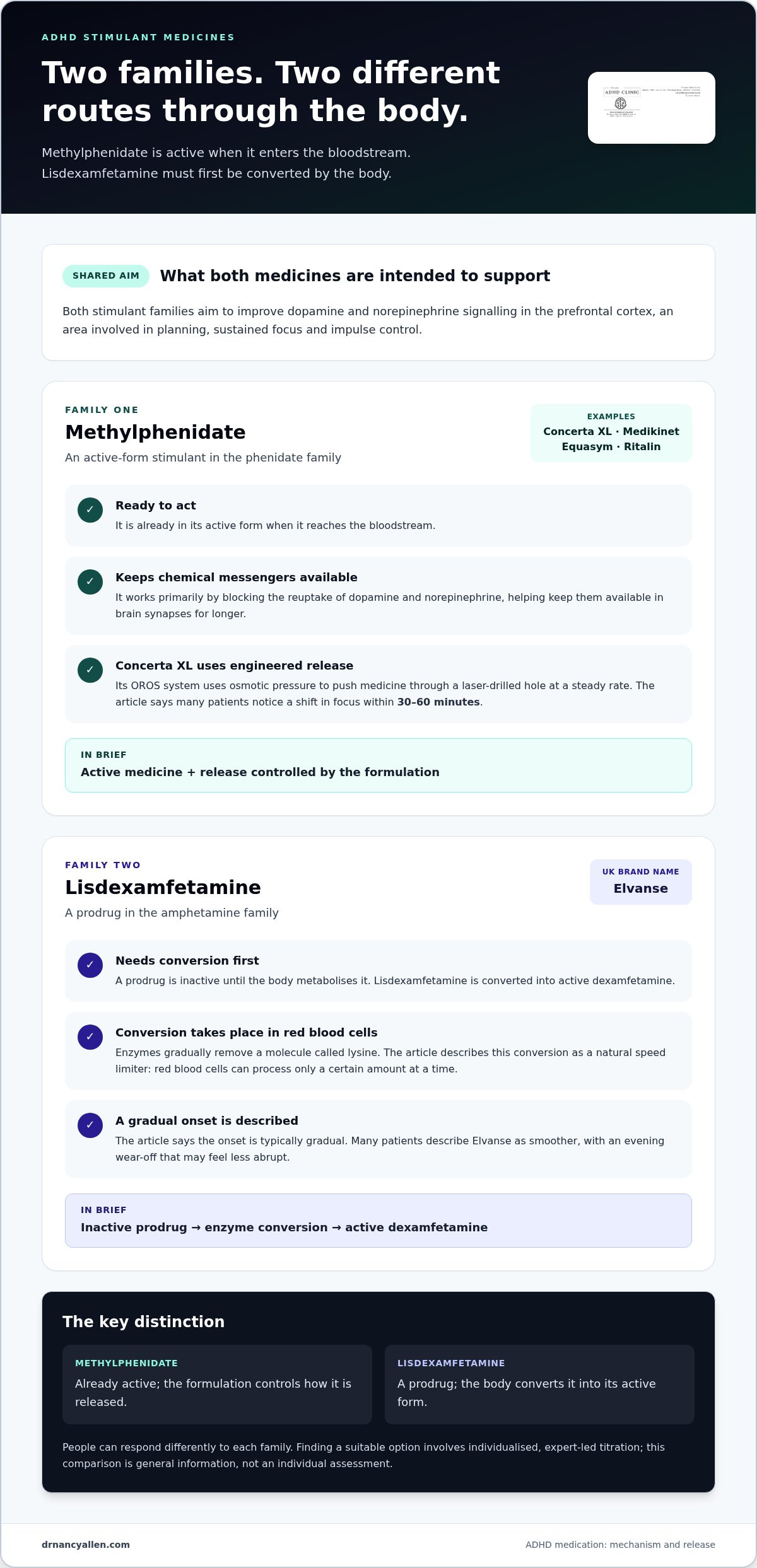
Methylphenidate has served as a foundational ADHD treatment for decades, building a robust track record of safety. In the UK, you'll encounter this medication under several brand names, including Concerta XL, Medikinet, Equasym, and the immediate-release Ritalin. It works primarily by blocking the reuptake of dopamine and norepinephrine, effectively keeping these chemicals available in the brain's synapses for longer periods. Many patients describe the "feeling" of methylphenidate as a sharp sense of alertness. It often provides a "locked-in" focus that helps individuals cut through the daily mental noise and stay on task with greater ease.
Lisdexamfetamine: The Amphetamine Family
Lisdexamfetamine, widely known in the UK by the brand name Elvanse, represents the amphetamine class of stimulants. It's a sophisticated evolution from older treatments like Dexedrine because of its unique delivery system. Whilst both families increase neurotransmitter levels, the way they are processed by your body varies significantly. Elvanse has gained a strong reputation amongst patients for providing a "smoother" experience. Because of the way it's metabolised, the onset is typically gradual, and many find the "offset" or "wear-off" period in the evening to be less abrupt than other stimulants, reducing the likelihood of a late-afternoon mood crash.
Mechanism of Action: Active Form vs Prodrug
To understand the clinical nuances of these treatments, we must first look at how they're activated within your body. The most significant way to answer how is lisdexamphetamine differnet to methylphenidate? is to examine their metabolic paths. Methylphenidate is an active drug, meaning it's ready to interact with your brain's receptors the moment it enters your bloodstream. In contrast, lisdexamfetamine is a prodrug. A prodrug is a medication that remains inactive until metabolised by the body’s internal chemistry. This distinction isn't just a technicality; it directly influences how you'll feel in the first few hours after taking your morning dose.
For lisdexamfetamine (Elvanse) to become effective, it must undergo a biological transformation. Once swallowed, it travels through the digestive system and into the blood, where it encounters specific enzymes within your red blood cells. These enzymes gradually "snip" a molecule called lysine away from the drug, finally releasing the active dexamfetamine. This conversion process acts as a natural speed limiter, as your red blood cells can only process a certain amount of the medication at any given time. A Clinical Trial Comparing Lisdexamfetamine and Methylphenidate highlights how these differing metabolic requirements lead to distinct onset and safety profiles for each family of medication.
How Methylphenidate Hits the System
Since methylphenidate is already in its active form, its delivery is controlled entirely by the pill's engineering. Modern UK formulations like Concerta XL use a sophisticated OROS (Osmotic Release Oral System) delivery method. This involves a laser-drilled hole in the capsule that uses osmotic pressure to push the medication out at a steady rate. Despite this clever design, the drug is available to your brain almost immediately upon release. This typically results in a faster "come-up," with many patients noticing a shift in their focus within 30 to 60 minutes. It's a more direct route to alertness that suits those who need their medication to kick in quickly to start their day.
The Elvanse Difference: The Slow-Release Chemistry
The rate-limiting enzyme conversion of lisdexamfetamine provides a level of consistency that's hard to replicate with active-form drugs. Because the body's ability to convert the medication is capped, there's a much lower risk of the "jittery" spikes sometimes associated with stimulants. This mechanism also provides an inherent layer of safety; the drug is significantly harder to misuse because it cannot be fast-tracked into the brain by alternative methods. If you're seeking a steady, reliable focus that builds with a gentle, predictable curve, this chemistry is often the preferred choice. If you're feeling unsure about which mechanism aligns best with your biology, a specialist Adult ADHD Assessment can offer the clarity you need to move forward safely.
Duration and Release: Comparing UK Brand Profiles
One of the most practical ways to see how is lisdexamphetamine differnet to methylphenidate? is through the lens of a typical day. Whilst both are considered long-acting treatments, their release profiles vary significantly. Elvanse (lisdexamfetamine) is often cited as providing up to 13 or 14 hours of coverage. In comparison, Concerta XL usually offers around 12 hours. This difference might seem minor on paper, but for a professional with a long commute, those extra two hours are vital for maintaining executive function until they reach home.
Methylphenidate capsules don't just release medication at a single speed. Instead, they use a "shot to long-acting" ratio. This involves a specific percentage of immediate-release beads for a morning boost and modified-release beads for later in the day. Concerta XL uses a 22:78 ratio, whilst Medikinet Retard uses a 50:50 split. This explains why some patients feel methylphenidate wears off too early; if the ratio doesn't align with their metabolic speed, they may experience a significant gap in coverage by mid-afternoon.
UK Brand Comparison Profiles
In the UK, clinicians discourage switching between these brands without supervision because the release profiles are so distinct. Here is how the primary options compare:
Concerta XL: Uses methylphenidate with an OROS delivery system. It typically lasts up to 12 hours with a 22% immediate-release and 78% modified-release ratio.
Medikinet Retard: Uses methylphenidate beads. It generally lasts around 8 hours with a 50:50 ratio of immediate to modified release.
Elvanse: Uses lisdexamfetamine. It provides the longest coverage, often 13 to 14 hours, through its unique prodrug conversion process.
The "Medication Crash" and Duration
As dopamine levels begin to dip in the evening, some individuals experience a "medication crash." This can manifest as irritability, fatigue, or a sudden return of ADHD symptoms. Understanding how is lisdexamphetamine differnet to methylphenidate? involves looking at this "offset" as much as the "onset." The Australian ADHD Clinical Practice Guideline supports the use of a small "top-up" dose of immediate-release medication to smooth out this transition if the primary dose wears off too early. The prodrug nature of lisdexamfetamine often results in a gentler landing because the body's conversion process slows down naturally. However, if your medication remains active too late, you might find that why the ADHD brain struggles to sleep becomes a more prominent issue, as the brain remains too alert to settle into rest.
Side Effects and Suitability: Which One is Right for You?
Whilst both medication families are generally well-tolerated, they each carry a unique profile of potential side effects. Most patients will experience some common ground, such as a suppressed appetite, a dry mouth, or a slightly elevated heart rate during the initial weeks. However, when exploring how is lisdexamphetamine differnet to methylphenidate?, the qualitative experience of "feeling" the medication is where the most significant variations occur. Some individuals report a sense of emotional blunting or a "zombie" feeling on methylphenidate, whereas they feel more like themselves on lisdexamfetamine, or vice versa. These nuances are highly individual and depend on your specific brain chemistry.
Anxiety is another critical factor in suitability. For some, the more direct, punchy onset of methylphenidate can trigger a physical sense of unease or "jitteriness." In these cases, the smoother, enzyme-dependent release of lisdexamfetamine often feels more manageable. Regardless of which family you try first, safety remains our absolute priority. We require consistent monitoring of your blood pressure and heart rate throughout the titration process to ensure your body is responding well to the treatment. This clinical data, combined with your subjective feedback, helps us identify the safest and most effective dose for your long-term wellbeing.
ADHD, Menopause, and Hormonal Fluctuations
For women, the intersection of hormones and neurodiversity adds another layer of complexity. Oestrogen is a key player in dopamine production and receptor sensitivity. As oestrogen levels fluctuate or decline during perimenopause, many women find that their ADHD symptoms become significantly more pronounced. This hormonal shift can also change how you respond to medication. Some perimenopausal women find that one medication family suddenly becomes more effective than the other, or that their usual dose requires careful adjustment. Dr Nancy Allen has a specialist interest in the ADHD-menopause connection, providing expert guidance for those navigating these overlapping challenges.
Lifestyle Factors: Sleep and Routine
Your daily schedule and sleep patterns are vital considerations when choosing a treatment. The long duration of Elvanse, whilst beneficial for all-day focus, can sometimes interfere with sleep onset if your body metabolises the drug slowly. If you already struggle with revenge bedtime procrastination, having a stimulant still active late into the evening might make it even harder to switch off. We look at whether you need 8 hours of support for a standard working day or 14 hours to cover parenting and evening responsibilities. Aligning medication timing with your natural circadian rhythm is essential for restorative rest. If you are ready to explore your options with a clinical expert, you can book a private Adult ADHD Assessment to begin your journey.
The Path to Clarity: Expert Titration and Support
Finding the right treatment isn't about selecting the most popular drug; it's about identifying the one that aligns with your unique neurobiology. There is no universal "best" medication in the UK. Instead, there is the best medication for your specific brain chemistry, lifestyle, and metabolic rate. When individuals ask how is lisdexamphetamine differnet to methylphenidate?, they're often seeking a definitive answer on which will work. In reality, the answer is discovered through the titration process. This is a collaborative journey where we start with a low dose and gradually increase it to find your "therapeutic window," the point where you experience maximum symptom control with minimal side effects.
What to Expect During Your Private Consultation
Your journey begins with a comprehensive baseline of your symptoms, health history, and personal goals. We don't just look at a checklist; we look at the human behind the diagnosis. Choosing a starting medication is a collaborative decision. We discuss your working day, your sleep patterns, and any concerns you have about personality changes. Dr Nancy Allen uses her 25 years of clinical experience to support you through these first few weeks, providing a steady hand as you navigate the initial shifts in focus and energy. This high level of personalised care ensures you never feel like you're managing these changes alone.
Next Steps for Your ADHD Journey
If you're ready to move beyond the confusion and find a treatment plan that works, the first step is a formal evaluation. Booking an adult ADHD assessment provides the space and time needed to explore these clinical nuances in depth. We understand that once you've decided to seek help, waiting months for an answer only adds to the burden. Appointments are often available within days. Finding the right balance is about more than just focus; it's about restoring your confidence and improving your overall quality of life. With the right expert support, the question of how is lisdexamphetamine differnet to methylphenidate? becomes a practical roadmap to your wellbeing rather than a source of uncertainty.
Your Personal Path to Focus and Clarity
Choosing the right ADHD medication is a process of matching clinical science with your unique biology. We have explored the metabolic differences between these two families, noting that whilst methylphenidate offers direct activation, lisdexamfetamine provides a gradual, enzyme-dependent release. Understanding how is lisdexamphetamine differnet to methylphenidate? is the first step in moving past the anxiety of the unknown and towards a treatment plan that feels sustainable. Finding your "therapeutic window" is the ultimate goal.
Whether you're managing a demanding career or navigating the intersection of ADHD and menopause, expert guidance makes the difference. Dr Nancy Allen brings over 25 years of clinical experience to every consultation, offering specialist support that prioritises your holistic wellbeing. Appointments are often available within days. Book a Private ADHD Assessment with Dr Nancy Allen today to begin your journey with a trusted expert guide. You deserve a life defined by clarity rather than the constant noise of untreated symptoms.
Frequently Asked Questions
Is Elvanse stronger than Concerta or Ritalin?
Elvanse is not inherently stronger than methylphenidate brands like Concerta; rather, it belongs to a different chemical family with a unique delivery system. While both are potent stimulants, their effectiveness depends entirely on your personal neurobiology. Clinicians use a process of dose titration to find the equivalent level of support for your symptoms. One medication might feel more effective for you simply because your brain responds better to the amphetamine family than the phenidate family.
Can I switch from methylphenidate to lisdexamfetamine if it isn’t working?
Yes, switching between these two families is a standard clinical practice in the UK. NICE guidelines specifically recommend that if a six week trial of one medication does not provide enough symptom relief, you should consider a switch to the other. Many patients find that whilst one family causes side effects or feels ineffective, the other provides the clarity they need. This is a key reason why expert titration and regular reviews are so important.
Why does lisdexamfetamine take longer to start working in the morning?
This delay occurs because lisdexamfetamine is a prodrug that requires a biological transformation to become active. Once swallowed, your red blood cells must use enzymes to convert the medication into dexamfetamine. This natural process typically takes between one and two hours to reach a therapeutic level. In contrast, methylphenidate is active from the moment it is released, which is a primary way how is lisdexamphetamine differnet to methylphenidate? and its morning onset.
Which ADHD medication is better for anxiety?
There is no single answer, as stimulants can either mask or mimic anxiety symptoms. However, many patients report that the smoother, more gradual onset of lisdexamfetamine feels less "jittery" than the more direct hit of methylphenidate. If you have a history of anxiety, your specialist will monitor you closely during titration. The goal is to find a dose that improves your focus without overstimulating your nervous system or increasing your heart rate.
Are there currently shortages of these medications in the UK?
As of August 2026, the acute national shortages seen in previous years have largely stabilised. However, the UK supply chain remains in a "chronic phase" where intermittent, localised stock issues can still occur. This fragility is often a factor during titration; your clinician may check local pharmacy levels before starting you on a specific brand. We recommend maintaining a consistent relationship with one pharmacy to help manage any potential supply fluctuations.
Can I drink coffee or alcohol whilst taking these stimulants?
We generally advise avoiding both caffeine and alcohol, particularly during the initial titration phase. Caffeine is a stimulant that can amplify side effects like jitters, anxiety, and an increased heart rate. Alcohol is a depressant that can interfere with how your medication works and may increase the risk of a "medication crash" in the evening. For those seeking guidance on managing substance use alongside their diagnosis, you can check out Addiction Centre for further resources. Once you are on a stable dose, you may be able to reintroduce small amounts under clinical guidance.
How do I know if my dose is too high or too low?
If your dose is too low, you will likely find that your ADHD symptoms, such as distractibility or impulsivity, remain largely unchanged. If the dose is too high, you might feel "wired," excessively anxious, or experience a "zombie" feeling where your personality feels flattened. Finding the "therapeutic window" is about reaching a point where you feel focused and calm, but still entirely like yourself. Regular feedback during your titration period is essential for this.
Is it safe to take ADHD medication during perimenopause?
It is not only safe but often highly beneficial. During perimenopause, falling oestrogen levels can lead to a significant drop in dopamine, which often makes ADHD symptoms much worse. Taking medication during this time can help stabilise your cognitive function and mood. When considering how is lisdexamphetamine differnet to methylphenidate?, your specialist will look at your specific hormonal profile and menopause symptoms to determine which medication family will offer the most effective support.



Comments