


Why Does Elvanse Wear Off Early? Duration Explained

What if Elvanse wearing off early is a pattern to investigate, rather than proof your treatment has failed? If you’re asking, “Why Does Elvanse Wear Off So Early? Duration”, you’re not alone. The effects you notice day to day may differ from the duration described in prescribing information.
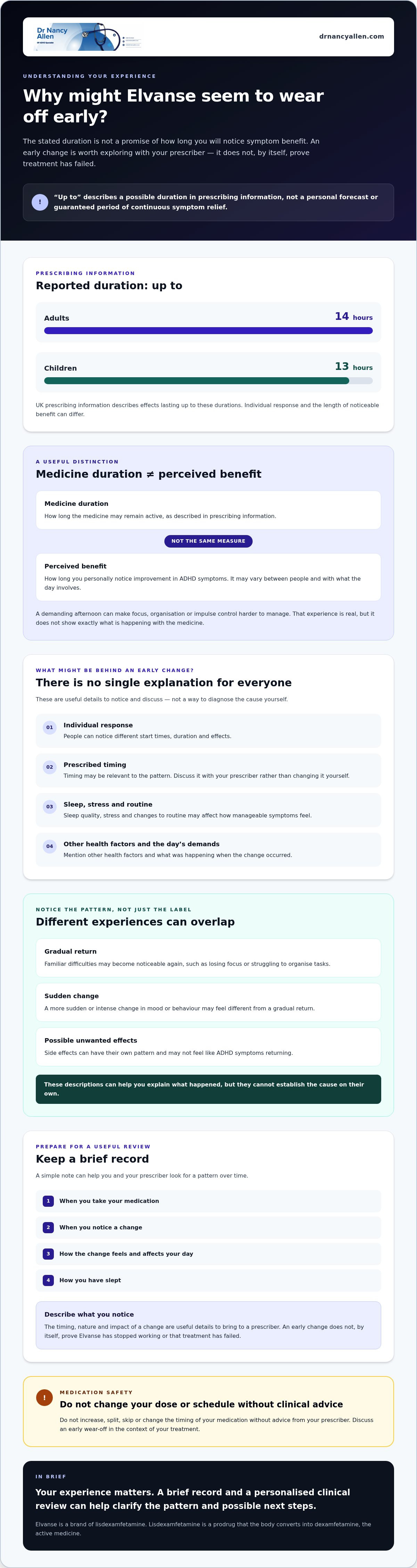
It can be unsettling when your focus fades or familiar ADHD symptoms return before the day is over. UK prescribing information describes effects lasting up to 14 hours in adults and up to 13 hours in children, but this doesn’t guarantee how long you’ll notice a benefit. Duration and perceived effectiveness vary between individuals.
This article explains how long Elvanse may last, why its effects can seem to fade early, and how a gradual return of symptoms may feel different from a sudden afternoon change. It also covers factors to note and practical ways to prepare for a conversation with your prescriber.
Record when you take your medication, when you notice a change, how it feels and how you’ve slept. This can help you and your prescriber look for a pattern. Don’t change your dose or schedule without clinical advice. An early wear-off is worth discussing in the context of your treatment.
Table of Contents
How long does Elvanse last, and what does “wearing off” mean?
Elvanse’s reported duration doesn’t mean everyone will notice the same benefit for the same number of hours. UK prescribing information describes effects lasting up to 14 hours in adults and up to 13 hours in children. “Up to” is not a promise of continuous symptom relief throughout that period. If you’re asking, “Why Does Elvanse Wear Off So Early? Duration”, it helps to separate the medicine’s stated duration from your own experience.
Elvanse is a brand of lisdexamfetamine prescribed for ADHD. Lisdexamfetamine is a prodrug: the body converts it into dexamfetamine, the active medicine. This conversion is part of how it works, but it doesn’t mean that every person will notice the same start time or duration. You can read a general overview of lisdexamfetamine for more on the medicine and its action.
The video below discusses medication crashes and people’s experiences. It’s educational content, not individual medical advice, and shouldn’t be taken as a reason to change a prescribed dose.
What does “duration” mean in practice?
Medication duration describes how long the medicine may remain active, while perceived benefit describes how long you personally notice an improvement in ADHD symptoms. These timeframes can differ. The duration in prescribing information is not a personal forecast, and the benefit you notice may depend on your response and what your day involves.
For example, focus may feel less steady during a demanding afternoon, even if the medicine’s effects haven’t simply stopped at that moment. Concentration, organisation or impulse control may become harder to manage when tasks grow more difficult, or when your usual strategies and support are less available. The experience is real, but it doesn’t show exactly what is happening with the medicine.
Does an early change mean treatment has failed?
No. A change earlier than expected deserves attention, especially if it repeatedly affects daily life, but it doesn’t by itself prove that Elvanse has stopped working or that treatment has failed. The timing, nature and impact of the change are useful details to discuss with your prescriber. Start with what you notice, rather than treating a duration figure as a personal forecast.
Why might Elvanse seem to wear off earlier than expected?
There isn’t one explanation that applies to everyone. The question “Why Does Elvanse Wear Off So Early? Duration” is best explored by looking at your experience over time, rather than treating an early change as proof of a particular cause. People respond differently, and the symptoms they notice may depend on what they’re doing and the demands of that day.
Prescribed timing may be relevant to the pattern, but don’t change when or how you take Elvanse without advice from your prescriber. Sleep quality, stress, changes to routine and other health factors may also affect how manageable symptoms feel. These are useful topics to mention, not explanations you can use to diagnose the cause yourself.
A difficult afternoon might reflect familiar ADHD symptoms becoming more noticeable, a sudden change as the medicine’s effects lessen, or an unwanted effect of treatment. These experiences can overlap, so describe what happened rather than settling on a label. The Elvanse Patient Information Leaflet provides medicine-specific information, including possible side effects.
Could it be symptom return, rebound or a side effect?
A gradual return of familiar difficulties, such as losing focus or struggling to organise tasks, may feel different from a sudden, more intense change in mood or behaviour. Unwanted effects can also have their own pattern and may not feel like ADHD symptoms returning. These descriptions can guide a conversation, but they can’t establish the cause by themselves.
Rather than deciding that it is “rebound” or a side effect, note what changed and when. Record when it began, how long it lasted, how intense it felt and what was happening around that time. For example, note whether the change came on gradually during a routine task or felt abrupt during a stressful day.
What other patterns are worth mentioning to a prescriber?
A short, consistent record can help you and your prescriber look for patterns without relying on memory alone. You could note:
When you take your medication and when you notice a change in symptoms or unwanted effects.
How you slept, what your routine was like that day, and whether stress or other health concerns differed from usual.
Whether the experience happens repeatedly or only on particular days, and how it affects work, study or home life.
Sleep and ADHD can influence one another, so it may also help to read about ADHD and sleep. If concerns about ADHD symptoms or their impact persist, a clinician-led discussion can help you decide what to raise next. Dr Nancy Allen’s practice offers private ADHD assessments and personalised care. This doesn’t guarantee a particular medication outcome.
How can you tell whether Elvanse is wearing off or not working well enough?
Look at how the change unfolds during your day. If Elvanse seems to help at first, then familiar ADHD symptoms return later, that may feel different from having limited benefit from the outset. However, timing alone can’t show what is causing the change or whether treatment is working as intended. The question “Why Does Elvanse Wear Off So Early? Duration” is best explored through clear observations, not a conclusion drawn from one difficult afternoon.
The examples below can help you describe what you notice. They aren’t diagnostic categories, and experiences may overlap.
A pattern may include more than one of these experiences. Use the table to organise your observations, not to diagnose rebound, side effects or treatment response.
What details should you track before your review?
Keep brief notes without changing how you take your medicine. Record when you take it as prescribed, when you think you notice a benefit and when you notice a change. Describe specific symptoms rather than writing only “it wore off”. For example, note whether you struggled to start tasks, follow a conversation or complete work, and how this affected study, relationships or everyday responsibilities.
Include sleep quality, routine, unwanted effects and whether the same sequence happens on different days. You don’t need a perfect diary. A few clear observations can be more useful than trying to remember everything later.
When should you seek clinical advice?
Contact your prescriber if early changes are persistent, distressing or affecting your ability to manage daily life. Seek prompt medical help for symptoms that feel severe or worrying. Don’t adjust your dose or timing while you wait for advice.
A repeated pattern across different days is usually more informative than one difficult day, because it gives your prescriber more context to review. Bring your notes to the discussion, including days when the experience was different. This can help distinguish an early change from consistently limited benefit and support a considered review, without assuming what the outcome should be.
What should you do if Elvanse wears off early?
If Elvanse seems to wear off before you need it to, take a practical approach: record what happens, look for a pattern and contact your prescriber. An early change can be frustrating, but it’s a reason to discuss your experience, not to adjust treatment on your own.
Don’t increase, split or skip a dose, or change when you take Elvanse, unless your prescriber advises you to. If you’re searching “Why Does Elvanse Wear Off So Early? Duration”, the safest next step is to explain what you notice and how it affects your day. Medication decisions should be made with a clinician who can consider your individual circumstances.
How can you prepare for a prescriber conversation?
Bring concise notes rather than trying to remember every detail during the appointment. Include when you take Elvanse as prescribed, when you first notice a benefit, when symptoms or unwanted effects change, and what that means for your daily functioning. Describe what a more helpful day looks like, then explain when difficulties return, such as when completing work, studying or managing tasks at home.
Useful questions might include: “Does this pattern need a review?”, “Could these changes be symptoms or unwanted effects?” and “What follow-up would be appropriate?” If you’re considering different treatment options, ask your prescriber what may be relevant to you. They can discuss possible next steps, but don’t assume a particular medication change or result.
Keep the record simple. Note whether the pattern repeats and any context that may help make sense of it, such as a change in sleep or routine. This gives your prescriber a clearer picture than a single statement that Elvanse “stopped working”.
What symptoms need urgent medical attention?
A routine review isn’t a substitute for urgent care. If symptoms are severe or you’re worried that you or someone else may be in immediate danger, call 999 or go to A&E. If you need urgent medical advice but it isn’t a life-threatening emergency, contact NHS 111. Don’t wait for a routine appointment or rely on an article to assess an urgent situation.
For ongoing concerns about ADHD symptoms and their impact, a clinician-led discussion can help you consider questions and follow-up. Dr Nancy Allen’s practice offers private ADHD assessments and personalised care, with secure online consultations available across the UK. You can explore private ADHD assessment and personalised care as a potential next step. A consultation can consider your concerns, but it can’t promise a particular medication outcome.
How can specialist ADHD care help when Elvanse duration is a concern?
If questions about how long Elvanse helps are affecting your confidence in treatment, an ADHD-focused clinical review can give you space to explain what’s happening and consider it in context. Duration doesn’t have one answer for everyone. A clinician can review your symptoms, treatment history and the effect on daily life, rather than relying on a duration figure alone.
What can an ADHD-focused review help clarify?
A clinician may explore how your ADHD symptoms show up across the day, what changes you notice after taking medication, and how those changes affect work, study, relationships or tasks at home. They may also consider relevant medical history and any unwanted effects you’ve experienced. Notes about your own pattern can help make the conversation specific to you.
The purpose is to understand your concerns and discuss appropriate next steps. Those steps depend on your individual circumstances and clinical assessment. An assessment doesn’t automatically lead to an ADHD diagnosis or a prescription, and a review can’t guarantee a particular medication outcome. If you’re seeking background on the assessment process, an adult ADHD assessment guide may also be useful.
What support is available through Dr Nancy Allen’s practice?
Dr Nancy Allen is a private GP with more than 25 years of clinical experience and a specialist focus on ADHD assessments and personalised care. Her practice offers adult and child ADHD assessments, alongside personalised treatment plans. Secure online consultations are available to patients across the UK.
If you’re still wondering “Why Does Elvanse Wear Off So Early? Duration”, a clinician-led conversation may help you organise your questions and understand what a considered review could involve. It’s an opportunity to discuss your experience, not a promise of a specific treatment decision.
If exploring this support feels right for you, Explore ADHD care with Dr Nancy Allen.
Take the next step with clarity
Elvanse’s stated duration is a guide, not a guarantee of how long you’ll notice symptom benefit. If it seems to wear off early, that experience matters, but it doesn’t by itself mean treatment has failed. A clear record of when changes happen, how they feel and how they affect your day can help you discuss the pattern with your prescriber.
Keep medication decisions clinician-led. Don’t change your dose or timing without professional advice, even if the pattern feels consistent. A review can consider your symptoms, treatment history and daily impact, then discuss what follow-up may be appropriate for you.
Dr Nancy Allen brings more than 25 years of clinical experience and a specialist focus on ADHD assessments and personalised care. Secure online consultations are available across the UK. If you’d value a clinician-led conversation, explore ADHD care with Dr Nancy Allen.
You don’t need to work out the cause alone. Keep careful notes and discuss the pattern with your prescriber. To explore ADHD assessment and personalised care, contact Dr Nancy Allen’s practice.
Frequently Asked Questions
How long does Elvanse usually last?
Elvanse’s duration varies, and the time you notice symptom benefit may differ from the period described in product information. The UK patient leaflet describes it as a long-acting medicine that works gradually over a 13-hour period, but this isn’t a guarantee of the same benefit for everyone. If its effects consistently seem shorter, record the pattern and discuss it with your prescriber. Don’t change your dose yourself.
Why does my Elvanse wear off after a few hours?
There isn’t one explanation that applies to everyone. Individual response, sleep, stress, daily routine, symptom patterns and unwanted effects may all be relevant to a clinical review. One difficult day can’t establish the cause. Note when the change happens, what you experience and whether it repeats. If you’re asking “Why Does Elvanse Wear Off So Early? Duration”, these observations can help your prescriber understand your experience.
Can food affect how long Elvanse lasts?
Don’t assume that a particular food explains early wear-off or change your eating routine to alter the medicine’s effect. Follow the current patient information and advice from your prescriber or pharmacist. If you notice a consistent relationship with meals or your routine, make a note of it alongside symptom timing. Ask a clinician whether that pattern may be relevant to your circumstances before making changes.
What is the difference between Elvanse wearing off and rebound?
“Wearing off” can describe a gradual return of familiar symptoms as the benefit you notice reduces. “Rebound” is often used for a more noticeable return or worsening of symptoms, though people may use the term differently. These experiences can overlap, and neither label confirms the cause. Note what changes, when it begins and how it affects you, then discuss the pattern with your prescriber.
Should I take another Elvanse dose if it wears off early?
No. Don’t take an extra dose or change your prescribed timing unless your prescriber specifically tells you to. Altering how you take medication can affect safety and unwanted effects. Contact the clinician responsible for your treatment, explain when you notice a change and describe any symptoms. If you experience severe or worrying symptoms, seek urgent medical help rather than waiting for a routine review.
Does Elvanse wearing off early mean my dose is too low?
Not necessarily. An early change in perceived benefit alone can’t show whether your dose is appropriate or identify another cause. A clinician may consider your symptom pattern, daily functioning, unwanted effects and treatment history before discussing next steps. Keep taking Elvanse as prescribed and raise repeated concerns with your prescriber. Don’t increase or otherwise adjust your dose without their advice.
When should I speak to my prescriber about Elvanse wearing off?
Contact your prescriber if the pattern keeps recurring, causes distress, affects daily functioning or occurs alongside troublesome unwanted effects. A brief record of when you take your medicine as prescribed, symptom changes, sleep and daily impact can make the conversation clearer. Seek urgent help for severe or worrying symptoms, and don’t wait for a scheduled review if you believe the situation needs urgent attention.


Comments