


Elvanse vs Concerta: What to Expect When You Switch

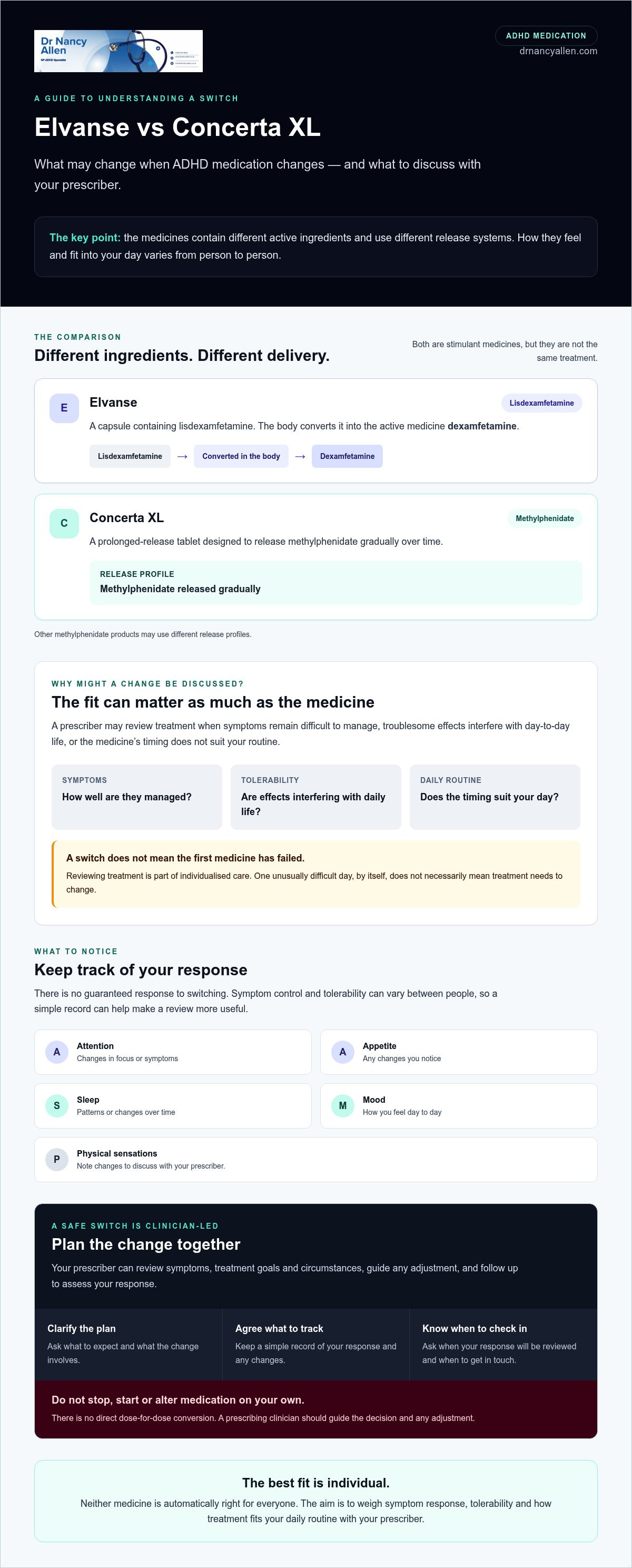
Could the same ADHD treatment feel quite different simply because its release profile has changed? Elvanse vs Concerta: What Changes When You Switch ADHD Medication? The answer depends on the individual, because these medicines contain different active ingredients and work differently across the day. Elvanse is converted in the body to dexamfetamine, whilst Concerta XL releases methylphenidate gradually.
If you’re considering a switch, it’s understandable to wonder what might happen to focus, symptoms, appetite, sleep or mood. A change doesn’t guarantee improvement or a difficult adjustment, and neither medicine is the right choice for everyone. What matters is how well the treatment’s effects and potential side effects fit your needs.
This article explains the key differences, what a prescriber may consider when planning a switch, and which changes to keep track of. There’s no direct dose-for-dose conversion, so don’t stop, start or alter medication on your own. Your prescribing clinician can guide the process, review your response and advise when to get in touch if something concerns you.
Table of Contents
Elvanse vs Concerta: why might an ADHD medication switch be considered?
A proposed change to ADHD medication can raise understandable questions: might symptoms or side effects change, and could the medicine’s timing fit better around work, study or family routines? These are useful points to discuss with the prescriber, not signs that you’re doing anything wrong.
Elvanse contains lisdexamfetamine, whilst Concerta XL is a modified-release methylphenidate product. In Elvanse, lisdexamfetamine is converted in the body into active dexamfetamine. The term lisdexamfetamine refers to the medicine’s active ingredient before this conversion.
This video offers a general comparison of Concerta and Vyvanse. It isn’t a guide to your personal treatment or UK prescribing decisions.
A clinician-led ADHD medication switch is a planned change from one prescribed medicine to another. The prescriber reviews your symptoms, treatment goals and circumstances, then guides the change and follows up to assess your response. The aim is to find an approach that better fits your needs, but no particular outcome can be assumed in advance.
What might lead a prescriber to discuss changing medication?
A review may be considered if symptoms remain difficult to manage, troublesome effects interfere with day-to-day life, or the medicine’s timing doesn’t suit your routine. A prescriber considers the whole clinical picture, including patterns over time and your priorities. One unusually difficult day, by itself, doesn’t necessarily show that treatment needs to change.
Does switching mean the first medicine has failed?
No. Reviewing treatment is part of individualised care, and a change isn’t a judgement about your effort, diagnosis or character. People can respond differently to medicines, and what suits someone may need reconsideration as their circumstances or needs change. If you’d like broader context on how ADHD is assessed, read this adult ADHD assessment guide.
So, Elvanse vs Concerta: What Changes When You Switch ADHD Medication? The answer depends on the individual. Neither medicine is automatically better for everyone; the prescriber can help weigh symptom response, tolerability and daily routine before agreeing any change.
How Elvanse and Concerta differ: active ingredients, release and daily experience
The comparison involves more than brand names. Elvanse and Concerta XL contain different active ingredients, and their formulations deliver medicine differently. This may affect how treatment fits an individual’s day, but it can’t predict which will work better for a particular person.
Elvanse contains lisdexamfetamine; Concerta XL contains methylphenidate in a prolonged-release formulation. Lisdexamfetamine is a prodrug, which means the body converts it into the active medicine dexamfetamine. Concerta XL is designed to release methylphenidate over time. Other methylphenidate products may use different release profiles.
What changes when the active ingredient changes?
These medicines belong to different stimulant groups. Their effects can vary between people, so changing ingredient doesn’t guarantee stronger focus, calmer behaviour or fewer unwanted effects. The lisdexamfetamine and methylphenidate comparison offers broader context on the two medicine groups. For another patient-focused overview, see the Cleveland Clinic comparison.
Why release profiles matter in everyday treatment
Modified or prolonged release means a formulation is designed to deliver medicine over a period of time rather than all at once. The timing and perceived duration of benefit differ between individuals; there’s no guaranteed number of effective hours. Nor should you assume that all methylphenidate products release medicine in the same way. This methylphenidate release-profile guide explains why the specific formulation matters.
For this comparison, the practical question is how the medicine’s ingredient and delivery pattern match your treatment goals and daily routine. Discuss those factors with your prescriber rather than drawing conclusions from someone else’s experience. If you’re looking for broader ADHD support, explore Dr Nancy Allen’s ADHD care.
What may feel different after switching from Elvanse to Concerta, or vice versa?
A switch may change how attention, task initiation or impulsivity feels, and whether symptom control seems to cover the parts of the day that matter to you. You might notice a difference in appetite, sleep, mood or physical sensations too. These are possibilities to observe, not outcomes that can be predicted from the medicine alone.
Individual response cannot be reliably predicted from the medicine name alone. Early experiences are worth noting, but they don’t by themselves establish whether a treatment will suit you over time. Follow the plan agreed with your prescriber, and raise concerns rather than changing how you take medication independently.
Which symptoms and side effects should you track?
Brief daily notes can make a review more useful than relying on memory. Record how symptoms feel, when effects seem to begin or change, and any differences in appetite, sleep or mood. Add relevant physical measures, such as blood pressure or pulse, if your prescriber asks you to monitor them, and follow their instructions about when and how to do so.
Keep the notes simple. For example, you might record that concentrating felt easier in the morning but harder later, or that sleep was disrupted on a particular night. A pattern over several days can give your prescriber clearer context than one isolated observation.
How can you tell whether an adjustment needs review?
Contact your prescriber if symptoms continue to interfere with daily life or unwanted effects are difficult to manage. Severe or rapidly worsening symptoms need prompt professional advice; don’t assume you have to wait for a routine review or that distressing effects are inevitable. If you’re unsure how urgently to seek help, contact an appropriate healthcare professional for guidance.
Your own experience, recorded alongside the agreed treatment plan, is useful information for a review. Sharing clear observations helps your prescriber assess whether the response is meeting your goals and what, if anything, should be reviewed.
How to safely switch between Elvanse and Concerta
A switch should be planned with the prescribing clinician, who can take account of your health, treatment history and priorities. There’s no universal dose-equivalence calculation for you to use independently. Don’t stop, start, overlap medicines or alter a dose unless your prescriber has given you clear instructions to do so.
Before the review, note any other medicines you take, relevant health conditions, previous responses to ADHD treatment and practical changes to your routine. NICE guideline NG87 provides UK guidance on ADHD care; for medicine-specific details, consult the latest UK product information for Elvanse and Concerta XL with your prescriber or pharmacist.
Questions to take to a medication review
It can help to write down questions in advance. Ask what treatment goals will define a helpful response for you, how and when to take the prescribed medicine, and what to do if any instruction is unclear. Confirm who to contact with concerns, when follow-up is planned and what monitoring your clinician recommends.
Use this preparation checklist:
1. Confirm the plan: Make sure you know which medicine is involved and the exact instructions from your prescriber.
2. Clarify uncertainties: Check the timing and what to do if a dose is missed or you’re unsure what to take. Don’t guess.
3. Record a baseline: Note current symptoms, unwanted effects and relevant routine or health changes to help compare your experience.
4. Agree follow-up: Know when your response will be reviewed, who to contact and which monitoring measures to follow.
What to record during the first review period
Keep brief notes on focus, task completion, appetite, sleep, mood and any unwanted effects. Add context that could help explain a change, such as an altered routine or a missed dose. Record what happened, but don’t use the log to adjust your treatment yourself. Follow your clinician’s instructions for any relevant physical measures.
Keep the agreed review appointment and share your notes, including concerns that arise before then. Contact the prescriber if you’re uncertain about the plan rather than making changes independently. Whether Elvanse or Concerta is suitable depends on your individual response, so a clear plan and review are central to making an informed decision.
If you’d value an informed discussion about ADHD treatment needs, explore Dr Nancy Allen’s ADHD care.
Choosing the next step: personalised review for Elvanse vs Concerta
A medication review is a chance to consider whether your current treatment still fits your needs, not a promise that a particular medicine will be recommended. Your prescriber can weigh your goals, symptom response, tolerability, formulation and monitoring requirements alongside your health and personal circumstances. The right choice is individual, and may involve discussing options rather than making an immediate change.
The question of what changes when switching between Elvanse and Concerta is best answered by looking at your own experience and priorities with a clinician. If symptoms remain difficult to manage or treatment effects interfere with daily life, arrange a discussion with your prescriber. For concerning changes, seek advice promptly rather than adjusting medication yourself. If symptoms are severe or urgent, contact appropriate urgent medical services.
How to make the appointment more useful
A little preparation can help you explain what is and isn’t working. Bring a current list of medicines, questions you want answered and a concise record of symptoms and unwanted effects. Describe what matters in your daily life, such as getting started at work or study, managing relationships, completing routine tasks or sleeping well. These details help put the medication’s effects into context.
You might also ask how the prescriber will judge whether treatment is meeting your goals, what monitoring is relevant to you and when your response should be reviewed. If you’re unclear about any medication instructions, check with the prescriber or pharmacist rather than guessing. Treatment decisions, including whether to continue or change a medicine, should remain under the prescriber’s guidance.
When diagnostic context is still relevant
If you have questions about how ADHD was assessed or want broader context alongside a medication conversation, this adult ADHD assessment and support guide may help. An assessment discussion and a review of existing medication are related but distinct; the appropriate next step depends on your circumstances.
A thoughtful review can clarify the options and what should be monitored, without guaranteeing that a specific medicine or outcome will be offered. Where further ADHD assessment or care is relevant, you can explore ADHD assessment and care with Dr Nancy Allen, whose practice supports adults and children across the UK.
Take your next step with confidence
Elvanse and Concerta contain different active ingredients and have distinct release profiles, so a switch may affect symptom control, daily coverage and tolerability in individual ways. There’s no single answer to what changes when you switch ADHD medication. Your own response, treatment goals and routine matter.
If a change is being considered, discuss the reasons and plan with your prescriber. Keep track of what you notice, ask how and when your response will be reviewed, and don’t alter your medication without clear clinical instructions. A thoughtful review can help clarify the options without assuming one medicine will suit you better.
For personalised ADHD assessment and care, Dr Nancy Allen offers secure online consultations to patients across the United Kingdom. Explore personalised ADHD care and assessment to learn more.
You deserve support that takes your experience seriously. With a clear plan and the right clinical guidance, you can approach the next conversation feeling more prepared.
Frequently Asked Questions
Can you switch from Elvanse to Concerta straight away?
Only follow a switch plan given by your prescriber; don’t stop one medicine or start the other based on general advice. There’s no universal dose-equivalence calculation to use independently, and the timing of a change depends on your clinical circumstances. Ask your prescriber to explain exactly when to take each medicine and what to do if an instruction is unclear. Don’t adjust doses or overlap medicines unless specifically instructed.
Is Elvanse stronger than Concerta?
There isn’t a straightforward way to say that Elvanse is stronger than Concerta for everyone. They contain different active ingredients and have different formulations, and individuals can respond differently to each. A medicine’s suitability is judged by its effect on your symptoms, unwanted effects and daily functioning, not by a simple strength ranking. Don’t compare or convert doses yourself; ask your prescriber how your treatment response will be assessed.
What side effects might change when switching ADHD medication?
Changes may include appetite, sleep, mood or physical sensations, as well as how symptoms feel through the day. Some people may notice unwanted effects; others may not experience the same changes. Keep a brief record of what you notice and when, then discuss it with your prescriber. Contact them if effects are troubling, and seek prompt professional advice for severe or rapidly worsening symptoms rather than assuming you should wait them out.
How long does it take to know whether Concerta or Elvanse is working?
There’s no single timeframe that applies to everyone. You may notice effects early, but judging whether treatment is consistently helping involves considering symptom control, daily functioning and tolerability over the period agreed with your prescriber. Ask when your response should be reviewed and what changes to record. Your response is individual, so don’t change your medicine or dose to speed up an assessment.
Can Elvanse and Concerta be taken together?
Don’t take Elvanse and Concerta together unless your prescriber has explicitly instructed you to do so. Both are stimulant medicines, and combining them without a clear clinical plan could create avoidable risks. If you’re switching, ask which medicine to take and when, including what to do if you’re uncertain about the instructions. Never use leftover medication to fill a gap or decide independently to take both.
What should I track after switching ADHD medication?
Make brief daily notes on focus, starting and completing tasks, appetite, sleep, mood and any unwanted effects. Record when you take the medicine as instructed and when you notice changes, plus relevant context such as a change to your routine or a missed dose. Follow your prescriber’s guidance for monitoring physical measures. Bring your notes to the agreed review and share concerns sooner if symptoms or side effects are troubling.


Comments