


Is ADHD a Handicap? Understanding Disability and Neurodiversity in the UK

Have you ever wondered if the constant struggle to stay focused is a personal failing or something far more profound? Many adults spend years feeling "lazy" or "unorganised", unaware that their brain simply processes the world differently. If you are asking yourself, "is adhd a handicap?", you aren't just looking for a label; you're seeking a way to understand your experiences within a society that often feels built for someone else. In the UK, this question carries significant weight, moving beyond simple terminology into the realm of legal protection and workplace rights.
It's exhausting to constantly mask your symptoms while fearing that disclosure might lead to discrimination. We understand that the transition from viewing yourself through a lens of deficit to one of neurodiversity is a journey that requires both clinical insight and emotional support. This article provides clarity on your rights under the Equality Act 2010, explains the medical versus legal definitions of disability, and outlines the clear steps you can take to secure a formal assessment. You will gain the knowledge needed to manage your career and personal life with a new sense of validation and confidence.
Table of Contents
Defining ADHD: Is it a Handicap, Disability, or Difference?
Attention deficit hyperactivity disorder (ADHD) is a complex neurodevelopmental condition that fundamentally alters how the brain regulates dopamine and manages executive functions. It isn't a result of a lack of willpower or a personal failing. Instead, it represents a distinct difference in brain wiring. When you find yourself asking, "is adhd a handicap?", you're likely trying to reconcile your internal experience with the labels society uses to define support and struggle. It's a valid question that touches on your identity and your legal rights.
The term "handicap" is largely considered outdated in modern clinical and social circles in the UK. We now prefer the terms "disability" or "neurodivergence" because they more accurately reflect the interaction between an individual and a world that isn't always designed for them. Understanding this shift is key to moving past the shame of feeling "unorganised" and toward a place of clinical insight. It allows you to see that your challenges are rooted in biology, not character.
To better understand this concept, watch this helpful video:
The Shift from "Handicap" to Neurodiversity
The medical model of disability historically focused on what was "wrong" with a person. It viewed ADHD as a deficit to be cured. Today, the social model of disability and the concept of neurodiversity offer a more supportive perspective. This framework suggests that neurological differences like ADHD are natural variations of the human genome. Identifying as neurodivergent can be incredibly empowering. It reframes your experience as a different way of processing information whilst acknowledging that you still face real barriers in a neurotypical society.
When ADHD Becomes a Disability
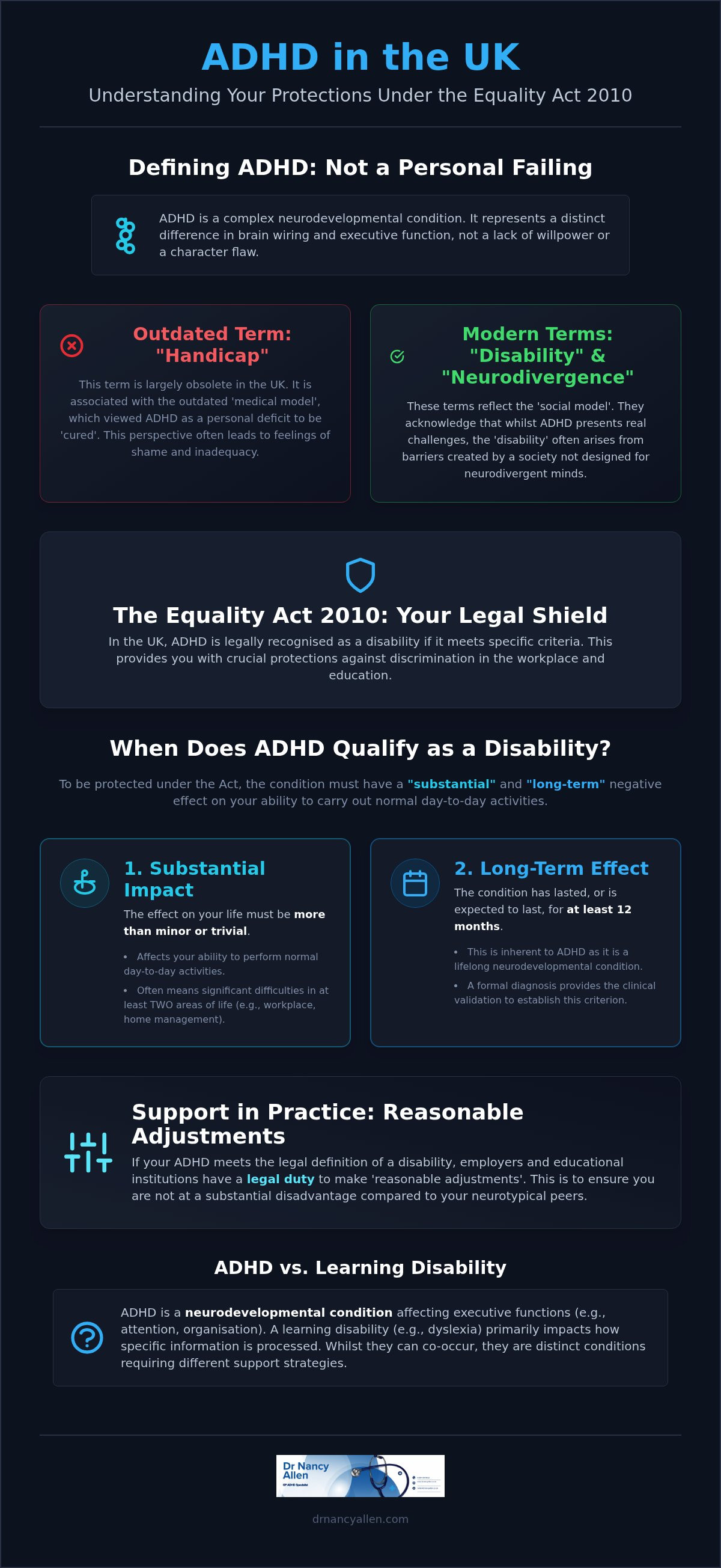
Under UK law, ADHD is recognised as a disability when it has a "substantial" and "long-term" negative effect on your ability to carry out normal day-to-day activities. "Substantial" means the impact is more than minor or trivial. "Long-term" means the condition has lasted, or is likely to last, for at least 12 months. This often manifests as significant difficulties in at least two areas of life, such as the workplace and home management.
For many women, these symptoms are masked for years. You might have spent a lifetime overcompensating, only to find that major life changes, such as the hormonal shifts during menopause, make your coping strategies crumble. This is a common experience that often goes unaddressed in standard medical literature. Securing a formal adult adhd assessment provides the clinical validation needed to access legal protections and personalised care. It is the bridge between wondering "is adhd a handicap" and knowing exactly how to navigate your world with confidence.
ADHD and the Equality Act 2010: Your Legal Rights in the UK
Whilst the term "handicap" has largely faded from the clinical lexicon, its legal successor in the UK is the term "disability". Under the Equality Act 2010, ADHD is recognised as a disability if it meets specific criteria. This legal framework provides a safety net for individuals who find that their neurodivergent traits create significant barriers in their professional or educational lives. If you have been asking yourself "is adhd a handicap", understanding these legal protections is the first step toward reclaiming your confidence and ensuring you are treated fairly.
For ADHD to be classified as a disability under the Act, it must have a "substantial" and "long-term" negative effect on your ability to perform normal day-to-day activities. In legal terms, "substantial" is defined as anything that is more than minor or trivial. "Long-term" means the condition has lasted, or is expected to last, for at least 12 months. When these conditions are met, you are legally protected against discrimination, harassment, and victimisation. This includes the legal requirement for employers to make reasonable adjustments to ensure you aren't at a disadvantage compared to your neurotypical colleagues.
The Legal Definition of Disability in the UK
Tribunals typically use a four-stage test to determine if a person is disabled under the Act. They look at whether the person has a physical or mental impairment, whether that impairment has an adverse effect, if that effect is substantial, and if it is long-term. This is why a formal diagnosis is often described as the "golden thread" of legal protection. Clinical evidence from a specialist provides the objective proof required to trigger these rights. Without a formal assessment, it can be significantly harder to hold an organisation accountable for failing to support your needs.
Access to Work: Government Support for ADHD
The UK government offers a practical resource called the Access to Work scheme. This is a publicly funded employment support programme that aims to help disabled people start or stay in work. For those with ADHD, this can be a transformative resource. As of the 2025/2026 financial year, the maximum grant available through this scheme is £69,260 per person. This funding can be used for various types of support, such as:
Professional ADHD coaching to improve executive function and time management.
Specialist software or noise-cancelling headphones to reduce workplace distractions.
Assistive technology to help with organisation and memory.
Many people don't realise that you can often apply for this support even whilst you are waiting for a formal diagnosis to be finalised. However, having a clear clinical profile allows for more tailored and effective support. If you are ready to move from uncertainty to clarity, a private ADHD assessment can provide the rapid validation you need to access these vital government resources and workplace protections.
ADHD vs. Learning Disabilities: Clarifying the Confusion
ADHD is frequently misunderstood as a learning disability, but it is actually a neurodevelopmental disorder. Whilst a learning disability typically involves a reduced intellectual ability, ADHD affects how a person processes information and manages their actions. If you've spent years wondering "is adhd a handicap", it's helpful to view it as a condition that impacts the execution of tasks rather than the capacity to learn. Many individuals with ADHD have high intelligence but struggle significantly with the mechanics of output. This distinction is vital for ensuring you receive the correct support and clinical validation.
It's common for ADHD to coexist with specific learning difficulties, which can make the initial diagnosis feel like a puzzle. Research suggests that a significant percentage of people with ADHD also have dyslexia, dyspraxia (Developmental Coordination Disorder), or dyscalculia. Untangling these overlapping conditions requires a holistic assessment. Without this clarity, you might find yourself using strategies that don't address the root cause of your struggles. A comprehensive clinical view ensures that every aspect of your neurodivergent profile is recognised and supported.
Executive Function and the Learning Process
Executive function acts as the "management system" of the brain. It involves working memory, which allows you to hold information in your mind; inhibition, which helps you resist distractions; and cognitive flexibility, which lets you switch between tasks. When these functions are impaired, even a very bright adult might struggle to produce written reports or meet deadlines. You might know exactly what needs to be done but find yourself unable to initiate the first step. This "intention-to-action" gap is a hallmark of the condition. It often leads to the mistaken belief that the individual is simply unmotivated or unorganised.
The Importance of Differential Diagnosis
Securing an accurate diagnosis is essential for accessing the legal definition of a disability and the protections it affords. Mislabelling ADHD as a general learning difficulty can lead to inappropriate support that fails to address executive dysfunction. Private assessments offer a level of nuance that standard screenings often miss, particularly when identifying how symptoms present across different life stages. They provide the evidence needed to prove that your challenges are clinical rather than a lack of effort.
For women, this picture is often further complicated by menopause symptoms. Brain fog, memory lapses, and increased irritability during perimenopause can mimic or exacerbate undiagnosed ADHD. A specialist who understands this intersection can provide the clarity needed to distinguish between hormonal changes and neurodevelopmental traits. This tailored insight ensures you receive a management plan that restores your confidence and helps you navigate both your career and personal life with a new sense of ease.
Navigating the Workplace and Education with ADHD
Once you've moved past the initial question of "is adhd a handicap" and secured a clinical diagnosis, the focus shifts to practical advocacy. In the UK, transitioning from a state of confusion to one of empowerment involves understanding how to request specific support. Communicating your needs to an employer or an HR department doesn't have to be a source of anxiety. Instead, frame the conversation around performance and neuro-inclusion. When a workplace is neuro-inclusive, it doesn't just benefit the individual; it enhances overall corporate wellbeing by fostering a culture of clarity and flexibility that helps every employee thrive.
Self-advocacy is a skill that grows with clinical validation. It's about asking for what you need without fear of being seen as "difficult" or "unproductive". You aren't asking for an unfair advantage. You're asking for the tools required to level the playing field. Many adults find that once they explain the biological basis of their executive dysfunction, colleagues are far more supportive than they anticipated. This shift in perspective is often the most significant step in restoring your professional confidence.
Reasonable Adjustments in the UK Office
Effective adjustments are often simple and low-cost. Employers have a duty to consider these changes to ensure you aren't at a disadvantage. Consider requesting the following tools to manage your daily workflow:
Body doubling: Working alongside a colleague, even virtually, to maintain focus on a specific task.
Pomodoro timers: Breaking work into short, timed intervals followed by brief breaks to prevent burnout.
Written instructions: Requesting that verbal briefs are followed up with a concise email to support working memory.
Sensory breaks: Scheduled time away from a busy office environment to reset your nervous system.
A supportive employer understands that these small changes can lead to a significant increase in productivity and job satisfaction.
Support in Higher Education
For university students, the transition from school can be a particularly challenging time as the level of independent study increases. If you're a student asking "is adhd a handicap" in an academic context, you should explore the Disabled Students’ Allowance (DSA). This government grant can fund specialist equipment and one-to-one mentoring. Additionally, universities can provide accommodations for exams, such as extra time, rest breaks, or the option to sit papers in a separate, quiet room. Seeking a formal diagnosis during this transition is essential for ensuring these supports are in place before academic pressure peaks.
If you're ready to gain the clinical evidence needed to access these vital workplace and educational rights, you can book a rapid Adult ADHD Assessment with our specialist team and receive your results within 72 hours.
Seeking Clarity: The Role of Private Assessment and Personalised Care
The journey toward a diagnosis often begins with a quiet, persistent question: is adhd a handicap that will always hold me back? This inquiry usually stems from years of internalised shame and the exhaustion of trying to fit into a neurotypical world. Seeking a private assessment is an act of self-compassion. It marks the transition from viewing your struggles as personal failings to seeing them as clinical insights. This clarity is the foundation upon which you can rebuild your self-esteem and restore your confidence.
Dr Nancy Allen’s approach prioritises the human element of medicine. By offering secure online consultations, we ensure that expert care is accessible regardless of your location in the UK. We understand that once you decide to seek help, every day of waiting can feel like an eternity. That's why we provide a comprehensive diagnosis and a tailored treatment plan within 72 hours. This rapid turnaround is designed to reduce the anxiety of the unknown and provide a clear path forward whilst the motivation for change is at its highest.
Why Speed and Expertise Matter
The state of neurodiversity support in the UK presents significant challenges for those seeking help. With some NHS waiting lists for ADHD assessments stretching between two and seven years, many adults find themselves in a state of professional or academic limbo. A delay of this magnitude can lead to severe workplace burnout or the collapse of personal relationships. Choosing a private pathway isn't merely about convenience; it's a strategic move to protect your mental health and career.
Expertise is equally vital. Dr Nancy Allen brings 25 years of clinical experience to every consultation, with a specialist focus on how ADHD intersects with hormonal health. For women, the onset of perimenopause can often unmask or worsen ADHD symptoms. Having a GP who understands this complex relationship ensures that your assessment is thorough and your management plan is truly holistic. This level of dedication ensures that you aren't just given a label, but a comprehensive understanding of your unique brain.
Your Next Steps Toward a Path to Clarity
If you're ready to move beyond the question of is adhd a handicap and start living with greater ease, the next step is to book a consultation. We'll discuss your specific challenges and explore how your brain processes the world. Remember that an ADHD diagnosis isn't a life sentence of struggle. It's the beginning of a journey toward understanding and effective management. You aren't "broken" or "lazy". You simply have a brain that works differently, and with the right personalised care, you can unlock your full potential and move forward with clarity.
Reclaiming Your Confidence Through Clinical Clarity
Understanding your rights under the Equality Act 2010 is a transformative step. It shifts the narrative from internalised struggle to professional support. You've seen that ADHD is legally recognised as a disability in the UK, ensuring you have access to reasonable adjustments in both the workplace and education. This knowledge helps you navigate daily life with a sense of security rather than fear. If you initially asked "is adhd a handicap", you now know that whilst terminology has evolved, your right to clinical validation and professional accommodation remains steadfast.
To move forward with absolute certainty, book your private ADHD assessment with Dr Nancy Allen for clarity in as little as 72 hours. With 25 years of clinical experience and a deep understanding of the intersection between neurodiversity and hormonal health, Dr Allen provides secure national online consultations that deliver diagnosis and treatment plans rapidly. You aren't defined by your challenges. With the right clinical insight, you can finally align your environment with your unique brain and begin to thrive.
Frequently Asked Questions
Is ADHD considered a disability in the UK under the Equality Act?
ADHD is recognised as a disability under the Equality Act 2010 if your symptoms have a substantial and long-term negative impact on your daily activities. "Substantial" means the effect is more than minor, whilst "long-term" refers to a condition lasting 12 months or more. This legal standing is vital for those asking is adhd a handicap, as it provides the framework for accessing necessary support and protection from discrimination.
Can I get PIP (Personal Independence Payment) for ADHD?
Yes, you can claim Personal Independence Payment (PIP) for ADHD if the condition significantly affects your ability to carry out daily living tasks or move around. Eligibility is based on the impact of your symptoms rather than the diagnosis itself. By April 2026, 100,207 people in the UK were receiving PIP with ADHD recorded as their primary disabling condition. A formal clinical assessment is usually required to support your application.
Do I have to tell my employer about my ADHD diagnosis?
You are under no legal obligation to disclose an ADHD diagnosis to your employer. However, if you require reasonable adjustments to perform your role effectively, you'll need to inform them of your condition to trigger your rights under the Equality Act. Many professionals choose to disclose during a private meeting with HR or their line manager once they have clinical evidence. This allows for a collaborative approach to workplace wellbeing.
What are "reasonable adjustments" for ADHD in the workplace?
Reasonable adjustments are practical changes made to your working environment or duties to remove barriers. Common examples include providing noise-cancelling headphones, allowing for flexible start times, or ensuring all instructions are provided in writing. Some employees also benefit from "body doubling" or using specialist task-management software. These adjustments are designed to level the playing field, ensuring neurodivergent staff can perform to the same standard as their neurotypical colleagues.
Is ADHD a learning disability or a mental health condition?
ADHD is classified as a neurodevelopmental disorder rather than a learning disability. Whilst a learning disability typically involves a reduced intellectual ability, ADHD affects the brain's executive functions, such as working memory and impulse control. It's often categorised alongside mental health conditions because it can impact emotional regulation, but its roots are in how the brain is wired. Understanding this distinction is essential for securing the correct clinical and educational support.
Can I get support for ADHD at university in the UK?
Students at UK universities can access significant support through the Disabled Students’ Allowance (DSA). This grant can cover the cost of specialist equipment, such as recording devices or mind-mapping software, and one-to-one mentoring. Universities also offer internal accommodations, including extra time for examinations or the use of a separate, quiet room for assessments. A formal diagnosis is necessary to access these resources, making the timing of your assessment crucial.
How does a private ADHD assessment help with legal protection?
A private assessment provides the objective clinical evidence required to prove that your ADHD meets the legal criteria for disability. Because private pathways often deliver results much faster than the NHS, you can secure your legal protections sooner. This evidence is the "golden thread" used by tribunals and employers to verify that your symptoms are substantial and long-term. It ensures your request for adjustments is backed by a professional medical stance.
Does ADHD count as a handicap for Blue Badge applications?
ADHD can qualify you for a Blue Badge under the "hidden disabilities" criteria. You may be eligible if your condition causes you to experience very high levels of psychological distress or puts you at risk of harm when walking. Local councils assess these applications on an individual basis. Providing a thorough clinical report that explains the specific impact of your ADHD on your safety and mobility during journeys is often essential for a successful application.


Comments