


Break the Cycle: Understanding People Pleasing and ADHD
- Dr Nancy Allen

- Aug 2
- 12 min read
What if your relentless drive to keep everyone happy isn't actually a personality trait, but a sophisticated survival strategy hardwired into your nervous system? You likely know the heavy toll of chronic exhaustion that comes from over-committing your time and the deep-seated fear of conflict that makes saying "no" feel almost physically impossible. This pattern of people pleasing often leaves you feeling as though your own identity has been swallowed by the relentless needs of those around you.
It's a common experience for many, yet it is rarely discussed as a clinical symptom. You might feel that you're simply "too nice" or perhaps lacking in willpower, but the reality is often far more complex. We promise to help you discover why these behaviours are frequently rooted in neurodiversity, specifically ADHD, and how hormonal changes can significantly intensify the urge to accommodate others at your own expense.
This guide explores the clinical connection between ADHD and rejection sensitivity, providing clarity on why your brain prioritises external harmony over internal peace. We will also outline how to establish firm boundaries without the crushing weight of guilt and help you determine if a specialist assessment is the necessary path towards reclaiming your life, your energy, and your sense of self.
Table of Contents
What is People Pleasing? Recognising the Signs and Silent Costs
The ADHD Connection: Why Neurodiversity Often Leads to Pleasing
Menopause and the 'Pleaser' Mask: Why Midlife Changes Everything
How to Stop People Pleasing: Practical Boundaries for a Balanced Life
Moving Beyond Compliance: Seeking Specialist Clinical Support
What is People Pleasing? Recognising the Signs and Silent Costs
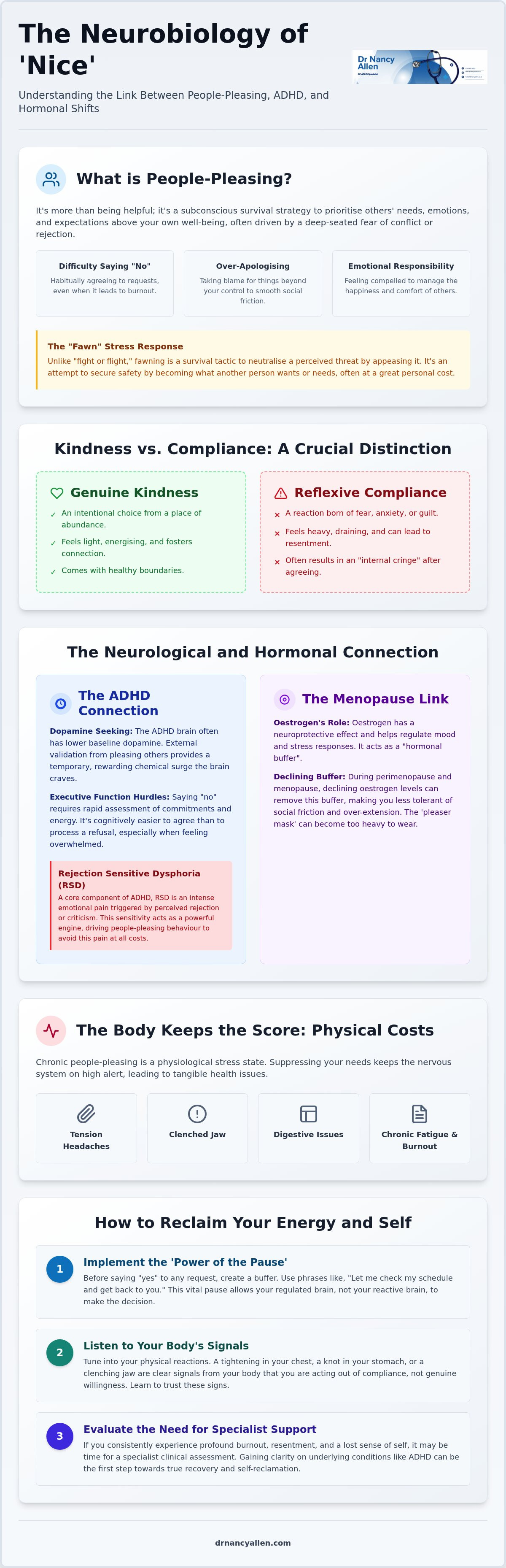
At its core, people pleasing is far more than a desire for social harmony. It is a chronic, often subconscious urge to prioritise the needs, emotions, and expectations of others above one's own well-being and values. Whilst it might appear as helpfulness on the surface, it functions as a relentless internal pressure that makes setting boundaries feel like an act of betrayal. This behaviour manifests through specific patterns: a habitual difficulty saying "no", a tendency to over-apologise for things beyond your control, and an exhausting sense of responsibility for the emotional states of those around you. You aren't just being "nice"; you're operating under a mandate of constant accommodation.
In clinical terms, this is often recognised as the "fawn" response. Unlike the well-known "fight or flight" mechanisms, fawning is a stress response designed to neutralise a perceived threat through immediate appeasement. By becoming exactly what another person wants or needs, the individual attempts to bypass conflict and secure safety. This isn't just a social habit; it is a survival strategy that often mirrors the psychological technique of ingratiation, where an individual seeks to influence others by becoming more likable. However, the cost of this constant compliance is steep, leading to profound burnout, simmering resentment, and a gradual erosion of personal identity.
The Difference Between Kindness and Compliance
Distinguishing between genuine kindness and reflexive compliance is essential for emotional recovery. Kindness is an intentional choice made from a place of abundance; it feels light and brings a sense of connection. Compliance, however, is a reaction born of fear. You can often identify it by the "internal cringe" that occurs the moment you agree to a request you actually want to decline. Because you are constantly adjusting your personality to suit others, you may find yourself feeling entirely invisible despite being the most "helpful" person in the room. Your identity becomes a collection of what others expect, leaving your true self unheard.
The Physical Impact of Suppressed Needs
The body keeps a meticulous record of the needs you ignore. Chronic people-pleasing keeps the nervous system in a state of high alert, which elevates cortisol levels and leads to persistent physical fatigue. This emotional suppression frequently manifests as tension-based ailments, such as recurring tension headaches, a clenched jaw, or digestive issues that doctors often struggle to explain. Your physical health is inextricably linked to your ability to say "no" and protect your energy. People pleasing is a physiological stress state that prioritises external safety over internal biological regulation, rather than a mere personality trait.
The ADHD Connection: Why Neurodiversity Often Leads to Pleasing
For those with ADHD, people pleasing isn't just a social preference; it's often a neurological necessity. The ADHD brain frequently operates with lower baseline levels of dopamine, the neurotransmitter responsible for reward, motivation, and focus. When you receive a "hit" of external validation or a "thank you" for over-extending yourself, it provides a temporary chemical surge that your brain craves. This creates a cycle where you become reliant on the approval of others to feel regulated, leading to a pattern of behaviour that prioritises social harmony over personal boundaries.
Executive function challenges also play a significant role in this dynamic. Saying "no" requires high-level cognitive organisation. You must quickly assess your current commitments, predict future energy levels, and formulate a polite refusal in real-time. For a neurodivergent brain, this rapid-fire processing can feel impossible. It's often far easier to simply agree than to navigate the mental gymnastics required to decline, especially when you're already feeling overwhelmed by the demands of daily life.
RSD: The Engine of ADHD People Pleasing
One of the most potent drivers of this behaviour is Rejection Sensitive Dysphoria (RSD). This is an intense, often overwhelming emotional pain triggered by the perception of being rejected, criticised, or failing to meet expectations. For someone with ADHD, a minor disagreement or a perceived slight can feel like a catastrophic emotional event. To avoid this excruciating pain, you might find yourself saying "yes" to every request before you've even had time to consider your own needs. Seeking an adult adhd assessment can be a transformative step in understanding why these emotional reactions feel so visceral and how to manage them effectively.
The Exhaustion of the 'Mask'
Many adults with ADHD engage in "masking," which involves suppressing neurodivergent traits to appear neurotypical and fit into social structures. In this context, people pleasing becomes a tool to hide struggles with forgetfulness, time blindness, or impulsivity. You might over-commit to prove you're "reliable," even whilst you're drowning in tasks behind the scenes. This performance is incredibly draining. Understanding the negative consequences of people pleasing is vital, as this constant performance often leads to a profound "social crash." A formal diagnosis often provides the clinical validation needed to finally set the mask aside and live more authentically.
Menopause and the 'Pleaser' Mask: Why Midlife Changes Everything
For many women, the transition into midlife acts as a profound biological disruptor to long-standing patterns of people pleasing. Throughout your reproductive years, oestrogen plays a significant role in social behaviour, often acting as a "pro-social" hormone that enhances your ability to tolerate friction and "smooth over" difficult interactions. This hormonal buffer effectively greases the wheels of social compliance, making it easier to prioritise the needs of others whilst suppressing your own. When oestrogen levels begin to fluctuate and decline during perimenopause, this internal social lubricant vanishes. You may suddenly find that the "nurturing" urge, which once felt like a natural part of your character, has been replaced by a stark, uncompromising clarity regarding your own limits.
This shift is particularly intense for those navigating the intersection of neurodiversity and midlife. The cognitive load required to maintain a "pleaser" mask is immense. When you add the brain fog, memory lapses, and executive dysfunction common in menopause to an existing ADHD profile, the mental energy required to perform for others simply evaporates. The intersection of neurodiversity and midlife often reveals how deeply entrenched these patterns have become, a topic frequently explored in discussions regarding ADHD and People-Pleasing. You aren't becoming "difficult"; you are simply running out of the biological resources required to be "compliant."
Hormonal Health and Emotional Boundaries
Perimenopause often triggers a necessary re-evaluation phase. Chronic sleep deprivation and night sweats leave you with very little patience for the minor dramas or unreasonable demands of others. This period of life demands a shift in focus. If you find that your emotional volatility is making it impossible to maintain your usual social roles, seeking an online menopause specialist can provide the clinical support needed to navigate this transition. Understanding the physiological basis of your changing boundaries is the first step in moving away from reflexive pleasing and towards authentic self-advocacy.
Reclaiming Your Identity in Midlife
The transition from "What do they need?" to "What do I need?" is not an act of selfishness; it is a biological necessity for survival in midlife. As your hormones shift, your brain is effectively forcing you to reclaim the energy you have spent decades over-extending to others. For many, HRT and specialist care provide the emotional stability required to navigate these changes without falling back into old, self-sacrificing habits. There is a profound liberation in the "no" that comes with hormonal clarity. It allows you to shed the exhausting mask of the pleaser and finally build a life that respects your own capacity and desires.
How to Stop People Pleasing: Practical Boundaries for a Balanced Life
Transitioning from understanding the "why" to implementing the "how" requires a shift in perspective. Breaking the cycle of people pleasing isn't about becoming unkind; it's about developing the clinical discipline to protect your limited energy. One of the most effective tools is "The Power of the Pause". This involves creating a mandatory buffer zone between a request and your response. Instead of a reflexive "yes", practice using a standard phrase such as: "I’ll need to check my diary and get back to you." This small window of time allows your executive function to catch up with your social impulses, preventing the over-commitment that leads to burnout.
Before you agree to any demand, pause and notice your internal state whilst considering your actual capacity. Do you feel a sense of expansion and genuine willingness, or do you feel a familiar tightness in your chest or a "sink" in your stomach? These are your body's "yes" and "no" signals. Prioritising these signals is a clinical requirement for your long-term health, not a luxury you can afford to skip. When declining, keep your scripts polite but firm. In a British social context, you don't need to provide an exhaustive list of excuses. Simple phrases such as, "I’m afraid I don't have the capacity to take that on right now," or "Thank you for thinking of me, but I can't commit to this," are perfectly acceptable and highly effective.
Building a Boundary Framework
To manage your energy effectively, categorise every request into one of three buckets:
The "Hell Yes": Requests that align perfectly with your values and capacity.
The "Maybe": Requests that require further thought and a review of your schedule.
The "Definite No": Requests that would compromise your well-being or existing commitments.
Defaulting to a "no" when you aren't certain is a powerful protective measure. You must also prepare for the "guilt hangover", which is the temporary wave of anxiety that often follows a new boundary. It is not a sign that you've done something wrong; it is simply your nervous system adjusting to a new, healthier pattern of behaviour as you move away from people pleasing. Consistency is key here. Boundaries only provide safety when they are maintained over time.
Specialised Strategies for the Neurodivergent Brain
For those with ADHD, visual reminders and timers are essential. Place a sticky note on your laptop or phone that says "Wait" or "Check Capacity" to interrupt impulsive pleasing. Externalising your schedule by using a physical planner or a colour-coded digital calendar allows you to see the tangible cost of your commitments. For the neurodivergent individual, a boundary is not a wall, but a vital piece of cognitive scaffolding.
Seeking professional intervention can be transformative if you find that these strategies are difficult to implement due to overwhelming RSD or hormonal fluctuations. You can book a specialist consultation to discuss how a tailored treatment plan can help you reclaim your autonomy and restore your confidence.
Moving Beyond Compliance: Seeking Specialist Clinical Support
Sometimes, despite your best efforts to implement boundaries, the compulsion to accommodate others remains overwhelming. This is often because people pleasing isn't just a social habit you can simply "unlearn" through willpower alone. It can be a significant clinical indicator of underlying neurodiversity, hormonal shifts, or chronic burnout. When your nervous system is stuck in a state of fawning or intense rejection sensitivity, you need more than just self-help strategies. You need a comprehensive, evidence-based understanding of your unique biological profile. A private GP provides a holistic view that traditional talk therapy often misses, bridging the gap between your mental health and your physical well-being.
A specialist assessment is the essential first step toward reclaiming the time and energy you've spent on everyone but yourself. Moving forward isn't about trying harder; it's about trying differently. By combining a clinical diagnosis with a compassionate, personalised treatment plan, you can finally address the root causes of your behaviour. This approach provides the stability needed to turn the strategies we've discussed into lasting lifestyle changes, ensuring you no longer feel like a passenger in your own life.
The Value of a Formal ADHD Assessment
Understanding your brain chemistry changes your entire relationship with people pleasing. For many adults, a formal assessment reveals that their lifelong struggle with compliance was actually a sophisticated coping mechanism for undiagnosed ADHD. Dr Nancy Allen's practice prioritises rapid clarity, providing diagnoses within 72 hours for both adult and child assessments. This speed is vital for those who are already at breaking point and need immediate answers. Once you have a clinical explanation for your experiences, the transition from self-criticism to self-understanding begins. You stop blaming your character and start managing your chemistry.
Holistic Menopause Management
For women in midlife, addressing the biological roots of irritability and emotional overwhelm is transformative. Specialist care can restore the "emotional bandwidth" required to manage life’s demands without defaulting to self-sacrifice. It’s about more than just symptom relief; it's about restoring your confidence and reclaiming your identity. Holistic management ensures your hormones no longer dictate your ability to say "no". Book a consultation with Dr Nancy Allen to begin your journey toward clarity and reclaim the energy you've spent decades over-extending to others.
Reclaiming Your Voice and Your Vitality
Recognising that people pleasing is often a physiological survival strategy rather than a personality trait is the first step toward genuine change. Whether your patterns are driven by the intense emotional pain of Rejection Sensitive Dysphoria or the significant hormonal shifts of menopause, you don't have to navigate this exhaustion alone. By identifying these root causes, you can move away from the performative "mask" of compliance and toward a life built on authentic boundaries and restored confidence.
Clinical clarity provides the foundation for this transformation. Dr Nancy Allen, a specialist GP with over 25 years of experience, offers a compassionate and evidence-based path forward through secure UK-wide online consultations. You can receive a formal diagnosis and a personalised treatment plan within 72 hours, allowing you to stop guessing and start healing with professional guidance. This rapid access to care ensures you can begin your recovery without the long delays often associated with specialist medical support.
Book your private ADHD or menopause consultation with Dr Nancy Allen today to begin prioritising your own well-being. It is time to reclaim the energy you have spent on others and rediscover the clarity that comes from expert assessment. You deserve to be heard.
Frequently Asked Questions
Is people pleasing a mental health disorder?
No, people pleasing is not a formal mental health disorder, but rather a learned behaviour or coping mechanism. It often manifests as a response to underlying conditions such as anxiety, ADHD, or past trauma. Whilst it isn't a diagnosis itself, the chronic stress it causes can lead to clinical burnout and depression, making it a significant focus in professional healthcare consultations.
Can ADHD cause people pleasing?
ADHD can certainly drive people pleasing through a phenomenon known as Rejection Sensitive Dysphoria (RSD). This creates an intense, almost physical pain in response to perceived criticism or rejection. To avoid this excruciating feeling, individuals with ADHD often default to a "yes" to keep others happy. Additionally, the brain's search for a dopamine "hit" through external validation can reinforce these self-sacrificing patterns.
Why has my people pleasing got worse during menopause?
Your behaviour may feel more volatile during menopause because declining oestrogen levels remove your natural "pro-social" buffer. Oestrogen helps women manage social friction and tolerate the needs of others; as it drops, your patience for over-extending yourself often evaporates. This hormonal shift can make old pleasing habits feel suddenly unbearable, leading to a period of intense resentment or a total pleaser burnout.
How do I stop feeling guilty when I say no?
You can reduce the "guilt hangover" by reframing boundaries as a clinical necessity for your physical and mental health. Guilt is simply a sign that you are breaking an old, unhealthy pattern; it doesn't mean you've done something wrong. By using the Power of the Pause and giving yourself time to respond, you allow your logical brain to override the emotional impulse to appease others.
What is the 'fawn' response in trauma?
The "fawn" response is a stress mechanism where an individual attempts to appease or mirror a perceived threat to avoid conflict. It is the fourth trauma response alongside fight, flight, and freeze. In a social context, fawning looks like excessive compliance and the suppression of one's own needs to ensure the safety of a relationship, often at a high personal cost to one's identity.
Can medication help with people-pleasing tendencies?
Whilst there is no specific pill for people pleasing, medication for underlying conditions like ADHD can be transformative. Stimulants or non-stimulants help regulate the nervous system and dampen the intensity of Rejection Sensitive Dysphoria. When your emotions feel more stable and your executive function improves, you gain the cognitive breathing space required to evaluate requests and hold firm to your chosen boundaries.
How do I know if I need an ADHD assessment or just therapy?
If you find that talk therapy provides temporary relief but doesn't change your core executive function struggles, a specialist assessment may be necessary. Therapy often addresses the "why" of your feelings, whereas an ADHD assessment looks at the "how" of your brain's biological wiring. Understanding your neurodiversity through a clinical diagnosis can provide the clarity needed to stop pathologising your inability to keep everyone happy.
What are the first steps to setting boundaries with family?
The first steps involve externalising your capacity and starting with small, low-stakes refusals. You might tell a family member you need to check your diary before committing to a Sunday lunch, rather than giving an immediate "yes". Using clear, polite scripts allows you to communicate your limits without needing to provide a long list of justifications, which often invites further negotiation or pressure.


Comments