


Beat Task Paralysis: Micro Start and Habit Strategies

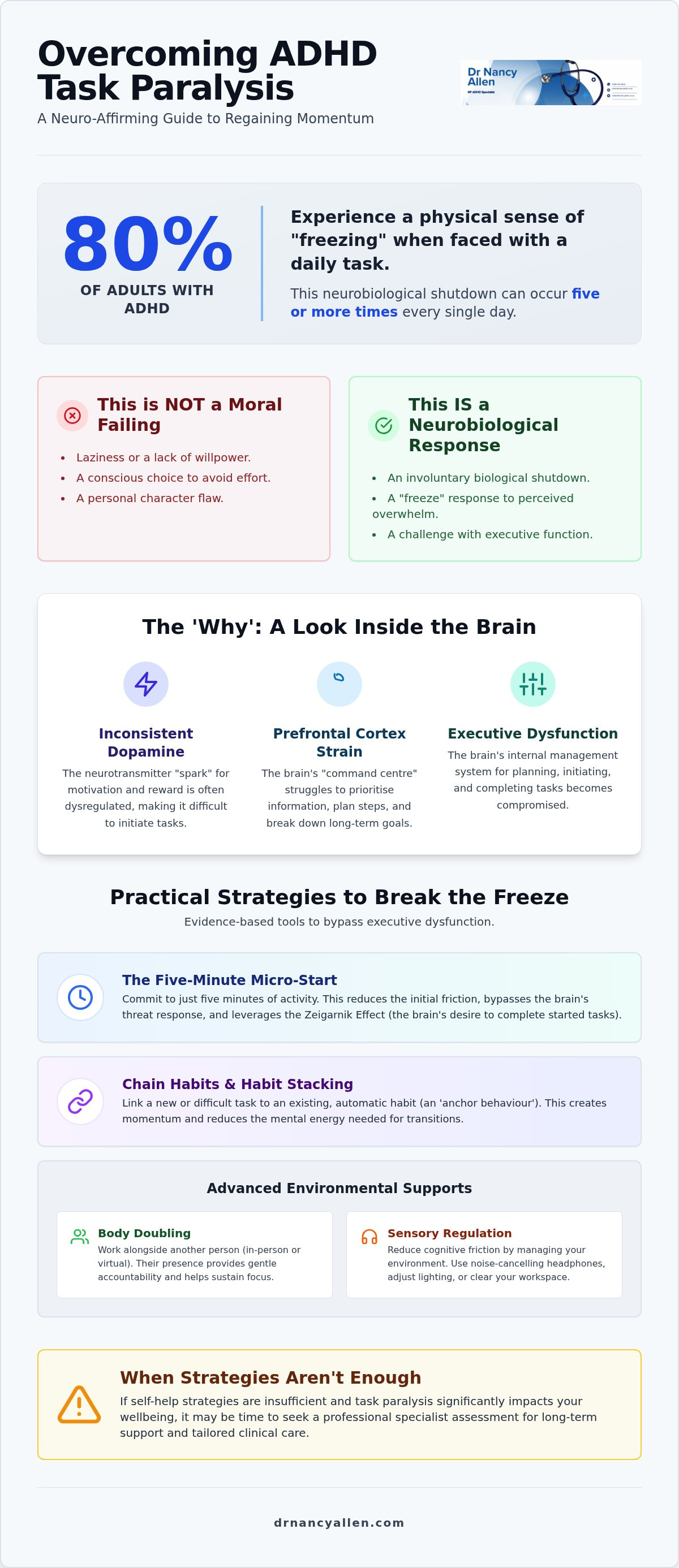
Did you know that 80% of adults with ADHD experience a physical sense of "freezing" when faced with a daily task, often occurring five or more times every single day? It's a heavy burden to carry, especially when you mistake this biological shutdown for a lack of willpower or a personal failing. You've likely felt that familiar spike of anxiety as the to-do list grows, whilst your ability to take the first step feels entirely out of reach. You aren't lazy; your brain is simply navigating a high-friction environment that requires a different set of keys to unlock.
We will explore overcoming task paralysis strategies like the five minute micro start or chain habits to help you regain your momentum. This guide provides a neuro-affirming look at why your brain pauses and offers evidence-based tools to bypass executive dysfunction. We'll move from understanding the dopamine-driven "why" behind the freeze to practical, clinical methods for restoration, including when it might be time to seek a professional specialist assessment. By the end, you'll have a clear, compassionate path toward productivity that respects your unique neurology and restores your confidence.
Table of Contents
Understanding Task Paralysis: Why Your Brain Feels 'Stuck'
Task paralysis isn't a character flaw; it's a neurological shutdown. When your brain perceives a task as too complex or emotionally taxing, it triggers a freeze response similar to how it might react to a physical threat. This involuntary state is often mistaken for laziness, yet the emotional experience is vastly different. Whilst laziness involves a choice to avoid effort, task paralysis is characterised by a desperate desire to act, coupled with a complete inability to do so. This often results in Analysis paralysis, where overthinking every possible outcome leaves you unable to take even the smallest step forward.
To better understand this concept, watch this helpful video:
Chronic paralysis creates a cycle of mounting anxiety and diminished self-esteem. As tasks pile up, the pressure increases, which only serves to reinforce the brain's threat response. This cycle can deeply impact your mental wellbeing, making even simple household chores feel like insurmountable mountains. Understanding that this is a biological event is the first step toward reclaiming control.
The Neurobiology of Executive Dysfunction
At the centre of this struggle is dopamine, the neurotransmitter responsible for motivation and reward. In neurodivergent brains, dopamine regulation is often inconsistent, meaning the "spark" required to initiate a task is missing. The prefrontal cortex, which acts as the brain's command centre, struggles to prioritise information or break down long-term goals into immediate actions. Executive dysfunction is essentially a failure in the brain's internal management system, where the ability to plan, initiate, and complete tasks becomes compromised. This is why overcoming task paralysis strategies like the five minute micro start or chain habits are so effective; they bypass these high-level processing requirements by simplifying the initial demand.
ADHD and Menopause: The Perfect Storm
For many women, these challenges become significantly more pronounced during midlife. Oestrogen plays a crucial role in dopamine production and receptor sensitivity. As levels decline during perimenopause, existing ADHD symptoms often intensify, or ADHD-like traits appear for the first time. This "brain fog" makes task initiation feel nearly impossible, as the cognitive energy required to focus is simply unavailable. If you find your usual coping mechanisms are no longer working, it may be time for a specialist menopause symptoms review to see how hormonal shifts are impacting your executive function.
The Five-Minute Micro Start: Lowering the Barrier to Entry
The core of overcoming task paralysis strategies like the five minute micro start or chain habits lies in reducing the initial friction of engagement. By committing to just 300 seconds of activity, you break what clinicians often call the 'initiation seal'. This approach leverages the Zeigarnik Effect, a psychological principle suggesting that our brains are more likely to remember and desire to complete a task once it has actually begun. When you haven't started, the task feels like a monolithic weight; once you're five minutes in, the brain's internal narrative shifts from 'I can't do this' to 'I'm already doing this'.
Bypassing the Amygdala's Fear Response
Large, undefined tasks often trigger the amygdala, the part of the brain that scans for threats. To a neurodivergent brain, an overflowing inbox isn't just work; it's a source of overwhelming sensory and cognitive pressure. A five-minute boundary signals safety. It tells your nervous system that the threat is contained and temporary. By using a physical timer, you externalise the commitment, moving the responsibility from your struggling internal clock to a reliable external device. This shift helps you move from avoidance to active engagement within the first 60 seconds, as the perceived size of the task shrinks to fit the five-minute window.
Practical Implementation for Daily Life
Success with this method comes from choosing a specific, small entry point. Rather than 'cleaning the kitchen', commit to washing just three plates or clearing a single drawer. If you're at work, aim to write just one email or organise five files. Set a timer for exactly five minutes for your most avoided task today. This simple act of temporal bounding makes the task feel manageable and less threatening to your executive system.
The most vital part of this strategy is the permission to stop. If the timer rings and you feel unable to continue, you must allow yourself to walk away. This removes the performance anxiety that often causes the paralysis in the first place. For many, however, the momentum gained in those few minutes is enough to carry them forward. If you find that even these micro-starts feel impossible, it might indicate that your executive function needs more than just tactical support. Exploring a professional ADHD assessment can provide the clinical clarity needed to understand why these barriers feel so high. Researching how to overcome task paralysis shows that whilst these tools are powerful, they work best when aligned with a clear understanding of your specific neurobiology.
Chain Habits and Habit Stacking: Building Momentum
Building momentum is often harder than maintaining it. Whilst the micro-start helps break the initial seal, habit stacking provides the structural framework to keep moving. This technique involves "chaining" a new, desired behaviour to an existing, automatic one, such as brushing your teeth or boiling the kettle. For those with neurodivergent brains, these "anchor" habits are essential because they bypass the need for active decision-making. By using The Science Behind Procrastination to understand our brain's resistance, we can see that automation is a powerful antidote to the "freeze" response. Using overcoming task paralysis strategies like the five minute micro start or chain habits allows you to create a reliable sequence that your brain follows with minimal resistance.
Designing Your First Habit Chain
To build a successful chain, you must be intentional about the links. Following a structured "If-Then" plan reduces the cognitive load of deciding what to do next. Consider this simple progression:
Identify an anchor: Choose a task you already do without thinking, like pouring your morning coffee.
Attach a micro-task: Immediately follow the anchor with a tiny task, such as clearing the post from the mat.
Celebrate the completion: Give yourself a small internal "win" or a physical stretch to trigger a dopamine spike.
Gradually increase: Once the first link is solid, add another micro-task to the sequence to strengthen the neural pathway.
This method works because it relies on "implementation intentions." Instead of vaguely planning to "be productive," you create a specific trigger. If I boil the kettle, then I will wipe the kitchen counter. This removes the "choice" element that often leads to a shutdown.
Reducing Decision Fatigue
Decision fatigue is a primary driver of executive dysfunction. Every choice we make consumes a portion of our limited cognitive energy. Automated sequences preserve this energy for more complex, high-stakes tasks later in the day. Sensory cues, such as the smell of coffee or the sound of the kettle, act as powerful triggers for these chains. It's also vital to have "low-energy" chains for difficult days amongst periods of high stress. On days when your capacity is low, your chain might simply be: if I stand up, then I will drink a glass of water. This maintains the habit pathway without overtaxing your system, ensuring you don't fall back into total paralysis.
Advanced Strategies for Chronic Task Paralysis
Whilst overcoming task paralysis strategies like the five minute micro start or chain habits provide a vital foundation, chronic executive dysfunction often requires additional environmental scaffolding. When the internal "spark" for action remains elusive, we must look toward external systems that reduce the cognitive load of initiation. These advanced techniques focus on social facilitation and sensory regulation to lower the threshold for engagement. By altering your physical and social surroundings, you can bypass the internal resistance that leads to a shutdown.
The Power of Body Doubling
Body doubling is the practice of working alongside another person, either in person or via a virtual platform. This strategy is remarkably effective; in fact, a 2026 survey found that 87% of respondents rated body doubling as either helpful or life-changing for their productivity. The presence of a "witness" provides a gentle form of social accountability that helps ground you in the present moment. It reduces the shame cycle often associated with paralysis because the focus shifts from your internal struggle to the shared environment of work.
You don't need the other person to help you with your specific task. Their role is simply to be present, creating a quiet "work zone" that signals to your brain that it's time to focus. If you feel like a burden when asking for support, remember that many people find the arrangement mutually beneficial. You might suggest a "co-working hour" where both parties work on their own separate projects in silence. This simple social anchor can be enough to prevent the "freeze" response from taking hold.
Sensory Environment Optimisation
Often, task paralysis is exacerbated by sensory irritants that we aren't consciously aware of. A flickering light, a distant humming sound, or even the texture of your clothing can consume the cognitive energy needed for task initiation. Identifying these irritants is a crucial step in "unsticking" yourself. Using brown noise, which is deeper and more grounding than white noise, can help mask distracting sounds and provide a steady auditory backdrop for focus. Similarly, using fidget tools or incorporating movement, such as a quick stretch, can help release the physical tension that often accompanies a mental block.
To further reduce friction, consider task bracketing and the creation of a "dopamine menu." Task bracketing involves defining the exact start and end points of a task visually, perhaps by using a physical tray for a specific project. A dopamine menu is a pre-selected list of stimulating rewards that you can enjoy immediately after completing a difficult task. These tools provide the external structure and motivation that executive dysfunction often lacks. If you find that despite these interventions you remain stuck, it may be time to seek professional clarity through a private ADHD assessment to explore more personalised clinical support.
When Strategies Aren't Enough: Seeking Clinical Support
Whilst overcoming task paralysis strategies like the five minute micro start or chain habits provide essential scaffolding, there comes a point where tactical shifts aren't enough. If you find that even the smallest micro-starts feel insurmountable, it's likely that the barrier isn't a lack of effort, but a clinical need for deeper intervention. Recognising this threshold is a vital step in your journey. General productivity advice often assumes a baseline level of executive function that neurodivergent individuals may not consistently possess without professional support.
Clinical intervention differs from self-help because it addresses the underlying neurobiology. Specialist coaching and medication can help regulate dopamine levels, providing the "spark" that executive dysfunction often extinguishes. When your brain's internal management system is struggling, a formal adult adhd assessment can provide the long-term clarity needed to move forward with confidence and targeted tools.
The Path to Clarity with Dr Nancy Allen
Dr Nancy Allen provides a specialised bridge between clinical expertise and patient-centric care. Her practice offers fast-track assessments, ensuring you receive a diagnosis and a personalised treatment plan in as little as 72 hours. This efficiency is particularly valuable for those stuck in a cycle of paralysis, where waiting months for an appointment only serves to increase anxiety and the feeling of being overwhelmed.
A unique aspect of this practice is the integrated approach to ADHD and menopause management. For many women, declining oestrogen levels during midlife significantly worsen ADHD symptoms, making task initiation nearly impossible. By addressing these hormonal shifts alongside neurodiversity, you receive a holistic plan that restores both focus and wellbeing. Secure online consultations ensure that this specialist care is accessible across the UK, allowing you to seek help from the comfort of your own home.
Moving from Shame to Support
Shifting your perspective from "moral failure" to "clinical condition" is often the most transformative part of the process. Validating your experience through a medical lens removes the heavy burden of shame that often accompanies chronic task avoidance. This shift allows you to view your brain with compassion rather than frustration. The long-term impact of a personalised treatment plan on your quality of life cannot be overstated; it restores your ability to engage with your work, your family, and your personal goals.
Taking the first step toward a private medical consultation is a powerful act of self-advocacy. It marks the transition from merely managing symptoms to actively treating the root cause of your struggle. Professional support provides the steady hand needed to navigate the complexities of neurodiversity, ensuring you have the clinical resources to thrive in every area of your life.
Step Forward with Confidence and Clinical Clarity
Task paralysis is a complex neurological event, but it doesn't have to define your daily experience. By reframing the "freeze" response as a biological signal rather than a personal failing, you open the door to effective intervention. We've explored how practical tools can lower the threshold for action, yet the most sustainable results often come from aligning these techniques with your specific neurobiology.
Implementing overcoming task paralysis strategies like the five minute micro start or chain habits provides the immediate relief needed to break the cycle of avoidance. However, if these barriers persist, professional insight is the most compassionate next step. Dr Nancy Allen brings over 25 years of clinical experience to help you navigate the intersection of ADHD and hormonal health with precision.
With specialist diagnosis and treatment plans available in as little as 72 hours via secure online consultations across the UK, you don't have to navigate this journey alone. Book a private ADHD or menopause consultation with Dr Nancy Allen today to reclaim your focus and restore your quality of life. You deserve a path forward that feels both manageable and supportive.
Frequently Asked Questions
What is the primary difference between task paralysis and procrastination?
The primary difference lies in the element of choice. Procrastination is often a conscious decision to delay a task in favour of something more rewarding or pleasant. In contrast, task paralysis is an involuntary "freeze" response triggered by the brain's threat system. You desperately want to start, yet your executive function shuts down. It's a biological friction that feels like being physically unable to move rather than a simple avoidance of effort.
Can menopause cause task paralysis in women who never had ADHD symptoms before?
Yes, declining oestrogen levels during menopause can trigger task paralysis even if you haven't previously identified with ADHD symptoms. Oestrogen plays a critical role in regulating dopamine, the neurotransmitter responsible for motivation and task initiation. When these levels drop, cognitive "brain fog" and executive dysfunction can appear. For many women, this midlife shift makes overcoming task paralysis strategies like the five minute micro start or chain habits essential for maintaining their daily quality of life.
How does the five-minute micro start actually change my brain chemistry?
The five-minute micro start works by signalling "safety" to the amygdala, the brain's fear centre. By setting a very short temporal boundary, you reduce the perceived threat of a large or complex task. This small action triggers a release of dopamine once the "initiation seal" is broken. This neurotransmitter boost provides the momentum needed to continue, shifting the brain from a state of anxious avoidance to one of active, reward-seeking engagement.
Is habit chaining effective for people with severe executive dysfunction?
Habit chaining is highly effective because it relies on automaticity rather than active decision-making. For those with severe executive dysfunction, the hardest part of any task is the "start" command. By anchoring a new behaviour to an existing, automatic one, you bypass the need for the prefrontal cortex to prioritise and plan. These automated sequences preserve your limited cognitive energy for more complex decisions, making it a sustainable tool for managing chronic "stuck" feelings.
What should I do if I feel 'frozen' even after trying these strategies?
If you remain frozen after trying these tools, it's important to step away and regulate your nervous system first. Forcing the issue often increases the threat response and heightens anxiety. Try sensory interventions like brown noise or a quick change of environment to reset your focus. If this becomes a frequent occurrence, it may indicate that your executive function requires clinical support. Seeking a specialist assessment can provide the personalised medical framework needed to move forward.
How do I know if my task paralysis is a sign of undiagnosed ADHD?
Task paralysis is a significant indicator of ADHD when it's part of a lifelong pattern of executive dysfunction. If you find that you're consistently overwhelmed by simple choices, struggle with "time blindness," or feel a physical sense of dread toward mundane tasks, these are common signs. Understanding these patterns is key to overcoming task paralysis strategies like the five minute micro start or chain habits, but a formal clinical diagnosis is necessary to confirm the underlying neurobiology.
Are these strategies suitable for children struggling with schoolwork?
These strategies are exceptionally suitable for children, especially those struggling with the transition to homework. Using a physical timer for a five-minute "sprint" makes the work feel less daunting and more like a game. Habit chaining can also help them build a reliable after-school routine without constant reminders. By teaching children these neuro-affirming tools early on, you help them build confidence and reduce the shame often associated with school-related executive function challenges.
Can I get a private ADHD diagnosis quickly in the UK?
You can receive a private ADHD diagnosis very quickly in the UK through specialist medical practices. Dr Nancy Allen offers a streamlined service that provides a formal assessment and a personalised treatment plan in as little as 72 hours. This rapid turnaround is designed to provide immediate clarity for those struggling with chronic task paralysis. These secure online consultations are available nationally, ensuring that expert clinical care is accessible regardless of your specific location.


Comments