


ADHD Diagnosis in Your 30s: 10 Things You Need to Know
- Dr Nancy Allen

- 1 hour ago
- 12 min read
What if the chronic exhaustion you’ve attributed to a demanding career or the relentless pace of your 30s isn’t a personal failing, but a neurological blueprint you’ve been fighting against for decades? For many, the realisation that their struggles have a biological basis comes after years of masking symptoms whilst trying to fit into a world that wasn't designed for their brain. There are 10 things nobody tells you about getting diagnosed with ADHD in your 30s, particularly how the "ADHD tax" and the mental load of staying organised can lead to profound burnout. It’s exhausting to feel like an imposter in your own career or family life, especially when you’re working twice as hard just to stay level with your peers.
We understand that a mid-life diagnosis is a profound turning point that requires more than just a medical checklist. This guide moves past generic advice to address the emotional and practical shifts you’ll actually face during this transition. You’ll discover why this diagnosis is less about fixing a defect and more about reclaiming your narrative with clinical compassion. We will provide a roadmap for specialist support and the tools you need to finally silence the inner critic and begin a journey toward genuine clarity.
Table of Contents
The Emotional Paradox: Why Relief Often Feels Like Grief
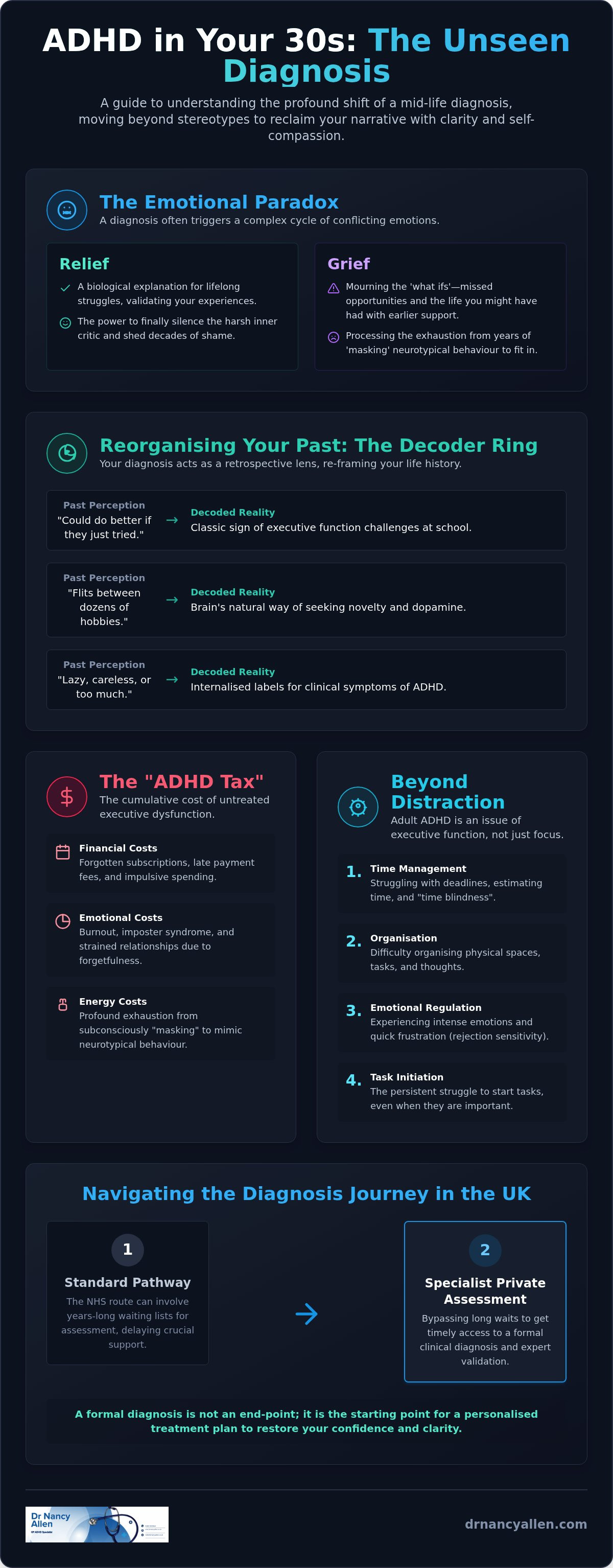
Receiving a diagnosis in your fourth decade is rarely the simple "eureka" moment many expect. Instead, it often marks the start of a turbulent emotional cycle. Amongst the 10 things nobody tells you about getting diagnosed with ADHD in your 30s is the reality that relief is almost always accompanied by a profound sense of grief. You finally have a biological explanation for why you've struggled to maintain focus or manage time, but this clarity often brings a sudden, heavy sadness for the version of yourself that spent thirty years feeling fundamentally broken. It is a period of re-evaluating your entire identity as you realise that what you once considered deeply ingrained personality flaws were, in fact, clinical symptoms of Adult attention deficit hyperactivity disorder.
Validating Your Past Struggles
For years, you likely internalised labels like "lazy," "careless," or "too much." These descriptors often become the foundation of a harsh inner critic that follows you into every meeting and social interaction. A formal clinical diagnosis provides the objective evidence needed to silence that voice. It shifts the narrative from a moral failing to a neurological difference. This is why seeking empathetic validation from a specialist who understands adult neurodiversity is so vital. They don't just provide a label; they offer a professional confirmation that your struggles were real and that your effort was never the problem. It allows you to begin embracing your true behaviour whilst shedding the weight of decades of shame.
The Grieving Process for the 'What Ifs'
As the initial fog clears, many adults find themselves mourning the life they might have led if they had known sooner. You may feel a sharp pang of regret over missed educational milestones or early career opportunities that felt just out of reach. This phase often involves tallying the "ADHD Tax," which we define as the cumulative financial and emotional cost of untreated executive dysfunction. This might manifest as thousands of pounds lost to forgotten subscriptions and late fees, or the emotional exhaustion of constantly repairing relationships strained by forgetfulness. Processing these "what ifs" is a necessary, albeit painful, step in reorganising your history.
Many patients experience a "honeymoon phase" immediately following their assessment. You feel empowered by new tools and the sudden rush of clarity. However, it's common for this to be followed by a dip in mood as the novelty wears off and the reality of long-term management sets in. This isn't a sign of failure. It is simply the emotional weight of processing thirty years of "masking" and the exhaustion that comes with finally letting that mask slip. Understanding this cycle is one of the 10 things nobody tells you about getting diagnosed with ADHD in your 30s, but acknowledging it is the first step toward genuine healing.
Reorganising Your Past: The Power of the Retrospective Lens
A diagnosis in your 30s functions as a decoder ring for your entire history. It explains why your school reports were filled with "could do better if they tried" or why you’ve abandoned dozens of expensive hobbies over the years. As a psychiatrist explains adult ADHD, the symptoms often hide in plain sight until the mounting responsibilities of adulthood make them impossible to ignore. Amongst the 10 things nobody tells you about getting diagnosed with ADHD in your 30s is the realisation that your "personality quirks" were actually sophisticated coping mechanisms. Those intense hyper-fixations on new interests weren't just passing phases; they were your brain’s way of seeking the dopamine it naturally lacks.
You also begin to recognise the sheer volume of energy lost to "masking." Masking is the subconscious process of mimicking neurotypical behaviour to fit in. By your 30s, the cost of this performance is often total exhaustion. You’ve likely spent decades white-knuckling through social events and office environments that felt fundamentally abrasive. Your 30s are the ideal time to stop performing and start pivoting your lifestyle to suit your brain’s unique wiring.
Identifying the ADHD-Hormone Connection
For many women, symptoms that were manageable in their 20s become debilitating in their late 30s. This often happens because of shifting hormonal centres. Oestrogen plays a critical role in dopamine production. As levels begin to fluctuate during the early stages of perimenopause, the "brain fog" often associated with ADHD can intensify. It is essential to seek a specialist who understands this dual challenge. A holistic view that considers both neurodiversity and hormonal health ensures your treatment plan is actually effective for your current stage of life.
Breaking the Cycle of Burnout
Burnout is a common catalyst for seeking a diagnosis in mid-life. Many 30-somethings find that the strategies they used to "get by" in their youth are no longer sufficient to manage a career, a mortgage, or a family. The constant pressure to maintain a neurotypical lifestyle leads to a state of chronic depletion. Securing a private adhd assessment provides more than just a label; it offers a roadmap out of this cycle. It allows you to replace self-blame with clinical strategies that respect your energy limits. If you are feeling the weight of these "what ifs," our team can help you find the clarity you deserve through a patient-centric Adult ADHD Assessment.
The Practical Shift: It Is Not Just About 'Concentrating'
The popular image of ADHD often involves a child unable to sit still or an adult constantly distracted by "shiny objects." In reality, for those in their 30s, the condition is far more nuanced. It often manifests as a breakdown in executive function, which explains the jarring contradiction of being able to lead a complex boardroom presentation whilst being utterly unable to remember to put the bins out on a Tuesday. Amongst the 10 things nobody tells you about getting diagnosed with ADHD in your 30s is how much of your daily struggle is actually rooted in sensory processing. You might find that certain office lights, the hum of a refrigerator, or even the texture of specific clothing fabrics have been draining your mental battery for years without you realising why. A comprehensive evaluation for adult ADHD helps to unpick these sensory sensitivities, providing a clinical explanation for why you feel so over-stimulated by the end of a standard workday.
Executive Dysfunction in the Real World
Adulthood in your 30s brings a relentless stream of complex, multi-step responsibilities like managing mortgages, filing tax returns, or coordinating family schedules. For a neurotypical brain, these are chores; for an ADHD brain, they can trigger "task paralysis." This is a state where the sheer volume of steps required to start a project feels so overwhelming that the brain simply shuts down. We define executive dysfunction as the brain's difficulty in planning, prioritising, and executing multi-step tasks. This is why the common advice to "just use a planner" often fails. A planner is a tool for recording a plan, but it cannot fix the underlying neurological struggle of creating that plan in the first place. Effective support involves building systems that bypass these executive gaps rather than trying to force a neurotypical method onto a neurodivergent mind.
Navigating Relationships Post-Diagnosis
A mid-life diagnosis often acts as a bridge to better communication with those closest to you. For years, your partner may have interpreted your forgetfulness or "clutter" as a lack of care or respect, leading to endless "chore-wars." Understanding that these behaviours are symptoms, not choices, allows couples to move from blame to collaborative problem-solving. You might start using "body doubling," a strategy where another person stays in the room whilst you complete a difficult task to help you stay anchored. It is also a time for setting firm boundaries around your energy. By explaining your diagnosis to colleagues and family, you can advocate for quieter workspaces or "low-stimulation" evenings, ensuring you have the capacity to show up fully in the areas of your life that matter most.
Navigating the Diagnosis Journey in the UK Whilst in Your 30s
The path to clinical clarity in the UK is currently marked by significant systemic challenges. With over 700,000 people on national waiting lists, the reality for many 30-somethings is a wait of between 2 and 7 years for an NHS assessment. Amongst the 10 things nobody tells you about getting diagnosed with ADHD in your 30s is that "Right to Choose" (RTC) is no longer the rapid alternative it once was. Whilst RTC allows patients in England to access private providers via the NHS, waiting times for this route have increased to between 2 and 18 months as of early 2026. For a professional in their 30s facing chronic burnout, waiting years for support is often not a viable option.
This is why many individuals now turn to private care, where assessments are typically completed within 1 to 4 weeks. A private medical consultation is a rigorous process that goes far beyond a simple screening tool or online questionnaire. Whilst a screening tool can indicate a likelihood of neurodivergence, a formal diagnosis requires a full clinical diagnostic interview. This involves a comprehensive review of your developmental history and an analysis of how symptoms currently impact your adult life. It is a collaborative, unhurried conversation designed to provide a definitive answer rather than a general suggestion.
The Private vs. NHS Pathway
Choosing a private pathway is a valid and often essential step for those requiring immediate workplace adjustments or personal peace of mind. A private diagnosis from a qualified psychiatrist or specialist practitioner carries the clinical weight needed to access support. The primary advantage is speed. Whilst the national system is under immense pressure, private care can move from initial suspicion to a confirmed treatment plan in a fraction of the time. In many cases, we can provide diagnoses and tailored support strategies within 72 hours, allowing you to begin your journey toward restoration without the weight of an indefinite wait.
Workplace Adjustments and 'Access to Work'
A formal diagnosis is a powerful tool for professional advocacy. In the UK, it allows you to apply for government support through the "Access to Work" programme. This can provide funding for practical aids such as noise-cancelling headphones to manage sensory over-stimulation or specialist coaching to help with executive function. You are also entitled to request reasonable adjustments from your employer, such as flexible working hours or a dedicated quiet space. Transitioning to a neuro-inclusive career path isn't just about "getting by"; it's about reorganising your environment so your unique strengths can actually shine. If you are ready to bypass the waiting lists and secure the clarity you need to move forward, you can begin the process with an expert Adult ADHD Assessment.
Moving Forward with Clarity: Expert Support for Your ADHD Journey
Securing a diagnosis is a significant milestone, but it is important to view it as the beginning of a new chapter rather than the final destination. One of the 10 things nobody tells you about getting diagnosed with ADHD in your 30s is that the clinical label is simply the foundation upon which you build a more sustainable life. It provides the "why" behind your past struggles, but the "how" of your future depends on a structured, supportive path forward. Dr Nancy Allen brings 25 years of clinical experience to this process, ensuring that every patient receives a level of care that balances rigorous medical authority with deep-seated empathy.
For busy professionals and parents in their 30s, the logistical challenge of seeking help can often feel like another hurdle. This is why secure online consultations have become a vital resource. They allow you to access specialist expertise from the comfort of your home, bypassing the stress of travel whilst fitting seamlessly around your career and family obligations. This modern approach to private healthcare ensures that distance is never a barrier to receiving the clarity and validation you deserve.
Beyond the Label: Personalised Management
Effective ADHD support in adulthood requires a strategy that looks at the whole person. Whilst medication can be a transformative tool for many, it is often most successful when integrated into a cohesive plan that includes lifestyle adjustments and targeted therapy. We focus on fine-tuning these support systems as your life evolves, acknowledging that your needs during a career promotion or a transition into parenthood may change. A diagnosis within 72 hours can provide the immediate clarity needed to begin your transformation, allowing you to replace decades of self-doubt with evidence-based strategies for restoration and holistic well-being.
Taking the First Step Toward Clarity
Preparing for your first consultation is an empowering act of self-care. To get the most out of your assessment, it can be helpful to gather examples of how your symptoms manifest in different areas of your life, from the boardroom to your personal relationships. This preparation allows for a more nuanced and thorough clinical interview. There is an immense sense of peace that comes from finally being heard by a seasoned professional who understands the specific complexities of adult neurodiversity. If you are ready to stop the cycle of burnout and begin reorganising your life with expert guidance, you can Book your private adult ADHD assessment with Dr Nancy Allen today. Taking this step is the first move toward reclaiming your confidence and navigating the world with a brain you finally understand.
Reclaiming Your Narrative with Clinical Clarity
A mid-life diagnosis is far more than a medical label; it is the key to unpicking decades of unexplained exhaustion and self-criticism. By understanding the 10 things nobody tells you about getting diagnosed with ADHD in your 30s, you can finally move away from the heavy weight of "masking" and begin reorganising your life around your brain's unique strengths. Whether it is navigating the complex interplay between hormones and neurodiversity or addressing the sensory sensitivities you've long ignored, the path forward is one of restoration rather than repair.
You don't have to navigate this transition alone or wait years on a national list to be heard. With over 25 years of clinical experience, Dr Nancy Allen provides a compassionate, patient-centric environment where your experiences are validated and understood. Through secure national online consultations, you can access specialist assessments and receive a comprehensive treatment plan often within 72 hours.
Secure your path to clarity with a private ADHD assessment from Dr Nancy Allen
It's never too late to start a new chapter with the support you deserve. Your journey toward genuine clarity and confidence begins here.
Frequently Asked Questions
Is it worth getting an ADHD diagnosis in my 30s if I've managed this long?
Yes, it is absolutely worth it. Whilst you may have "managed" for decades, this often comes at the high cost of chronic burnout and internalised shame. A formal diagnosis provides the biological evidence needed to replace self-blame with effective strategies. Amongst the 10 things nobody tells you about getting diagnosed with ADHD in your 30s is that the clarity you gain can completely transform your self-image and professional trajectory.
Can a private ADHD diagnosis be used for workplace adjustments in the UK?
Yes, a private diagnosis from a qualified specialist is a valid medical document for requesting reasonable adjustments under the Equality Act 2010. It also allows you to apply for the UK government's Access to Work scheme. This programme can provide funding for practical aids, such as noise-cancelling headphones or specialist coaching, to help you navigate your career with greater ease and confidence.
How long does a private ADHD assessment typically take with Dr Nancy Allen?
We prioritise rapid clarity for our patients. Whilst national waiting lists can span several years, our private assessments and subsequent treatment plans are often completed within 72 hours. This methodical yet efficient process ensures you can move from uncertainty to professional support without any unnecessary delay or anxiety, allowing you to begin your journey toward restoration almost immediately.
Will I have to take medication if I am diagnosed with ADHD as an adult?
Medication is entirely optional and is never a requirement for receiving support. Whilst pharmacological options are effective for many, your personalised management plan can focus on psychological therapy, lifestyle adjustments, and executive function coaching. The objective is to find the specific combination of tools that best suits your lifestyle and neurological needs, ensuring you feel empowered rather than pressured.
What is the difference between a private GP and an NHS ADHD assessment?
The primary differences are waiting times and the level of specialist continuity. NHS assessments currently face delays of up to seven years in some UK regions, which can be devastating for those in crisis. A private assessment provides immediate access to a seasoned practitioner and ensures your consultation is unhurried, thorough, and tailored to your specific life history and current challenges.
Can ADHD symptoms be confused with perimenopause in my late 30s?
Yes, there is a significant clinical overlap between these two experiences. Fluctuating oestrogen levels during your late 30s can exacerbate existing ADHD symptoms or create a similar "brain fog" that feels overwhelming. We specialise in the intersection of neurodiversity and hormonal health to ensure your symptoms are correctly identified and treated holistically, providing clarity where there was once confusion.
Will an ADHD diagnosis affect my driving licence or insurance in the UK?
In most cases, an ADHD diagnosis does not affect your driving licence or insurance premiums. You are only required to notify the DVLA if your condition or the medication you are prescribed impairs your ability to drive safely. Most individuals find that their insurance costs remain unchanged after receiving a formal diagnosis, as it is viewed as a managed health condition.
What happens if I was diagnosed as a child but lost my paperwork?
If your childhood records are missing, a fresh clinical assessment is typically necessary. Diagnostic criteria and treatment requirements change significantly as you transition into adulthood. A new evaluation ensures that your current support plan is evidence-based and reflects your life today. One of the 10 things nobody tells you about getting diagnosed with ADHD in your 30s is that a retrospective look at your childhood remains a vital part of this adult assessment.


Comments