


ADHD and Gambling: Understanding Risks and Finding Support
- Dr Nancy Allen

- 12 hours ago
- 12 min read
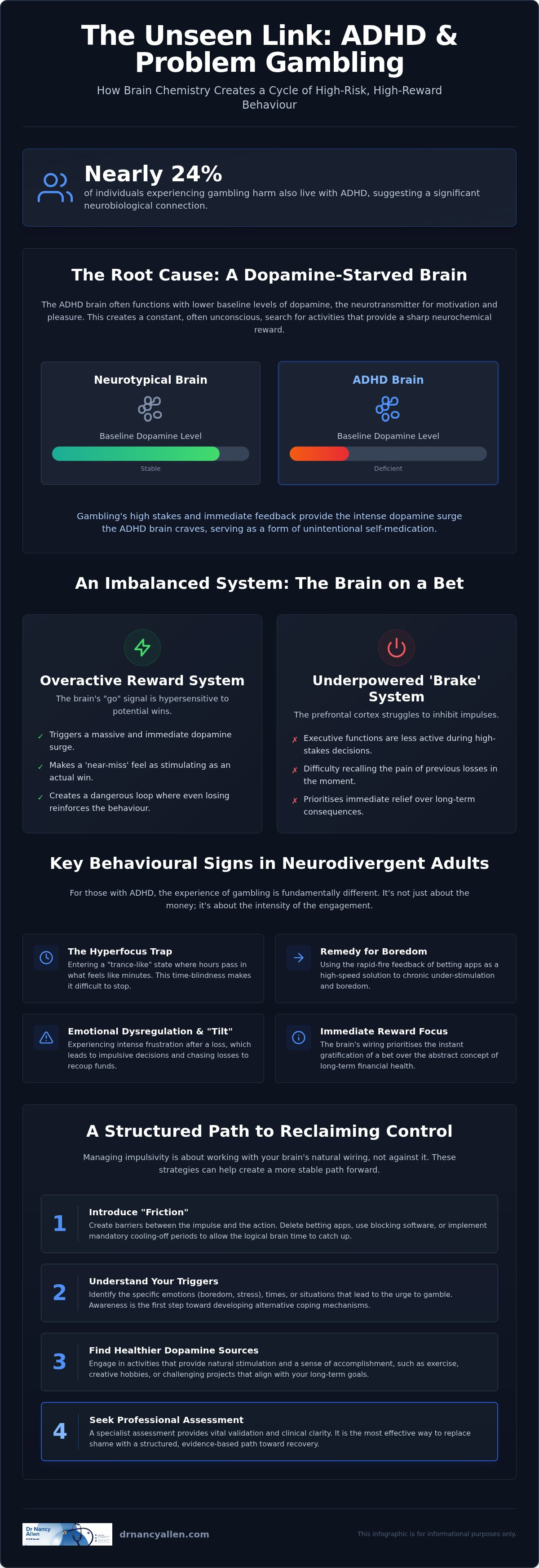
What if your struggle with impulsive betting isn't a lack of character or willpower, but a biological search for the dopamine your brain is naturally missing? For many, the link between adhd and gambling creates a punishing cycle of secretive behaviour and financial instability that standard advice simply fails to address. It's incredibly isolating to feel that your brain is working against you, yet research shows that nearly 24% of those experiencing gambling harm also live with ADHD.
You deserve to understand why this is happening. In this article, you'll discover why the ADHD brain is uniquely vulnerable to the high-stakes "rush" and how this behaviour is often a search for neurological balance rather than a personal failing. We will examine the dopamine connection in detail and explain how a professional assessment can provide the clarity and validation needed to finally break the cycle and move toward a structured management plan.
Table of Contents
The Neurobiological Link: Why ADHD and Gambling Often Co-exist
To understand why individuals with Attention deficit hyperactivity disorder are more susceptible to gambling, we must look beyond the behaviour itself and examine the architecture of the brain. For many, the impulse to place a bet isn't about greed; it's a fundamental search for stimulation. The ADHD brain is often described as "dopamine-starved," meaning it functions with lower baseline levels of dopamine, the neurotransmitter responsible for motivation and pleasure. This state, sometimes called reward deficiency syndrome, leaves the individual in a constant, often unconscious, search for activities that can provide a sharp "hit" of neurochemical reward. Because of this biological reality, the intersection of adhd and gambling is frequently a matter of unintentional self-medication. The high-stakes environment of a casino or a fast-paced betting app provides the intense focus that the ADHD brain lacks naturally, temporarily silencing the internal noise and restlessness that characterises the condition.
Dopamine: The Brain’s Reward Currency
Within the nucleus accumbens, the brain's primary reward centre, the thrill of a potential win triggers a massive surge of dopamine. Interestingly, research suggests that for those with ADHD, a "near-miss" is often just as stimulating as an actual win. This creates a dangerous loop where even losing feels like a reason to keep playing because the brain has already received its chemical reward. Dopamine dysregulation is the core driver of ADHD-related impulsivity, pushing the individual toward high-risk, high-reward scenarios without the usual pause for reflection. This chemical imbalance makes the immediate feedback of a slot machine or sports bet far more alluring than the quiet, steady rewards of daily life.
Executive Function and the "Brake" Mechanism
Whilst the reward system is overactive, the brain's "brake" system is often underpowered. The prefrontal cortex, which governs executive functions, is responsible for weighing consequences and inhibiting impulses. In neurodivergent individuals, this area is frequently less active during decision-making. Impaired working memory makes it difficult to hold the pain of previous losses in mind whilst in the heat of a new bet. There is also a significant struggle with "future-self" thinking; the brain prioritises the relief of the present moment over the financial health of the person three months from now. Willpower isn't a fixed trait but a finite cognitive resource that quickly depletes during high-stimulation activities, leaving the person vulnerable to the cycle of adhd and gambling harm. Understanding this biological reality is the first step toward reclaiming control and moving away from the "shame-cycle" of secretive betting.
Recognising the Signs of Impulsive Gambling in Neurodivergent Adults
Whilst many people can treat a bet as a form of social entertainment, for those living with ADHD, the experience is often fundamentally different. It isn't merely about the money or the game; it is about the intensity of the engagement. Recognising the signs of problem gambling in a neurodivergent context requires looking past the financial loss and examining the behavioural patterns that drive it. For an individual with ADHD, gambling often serves as a high-speed remedy for chronic boredom. When the brain feels under-stimulated, the rapid-fire feedback of a betting app provides an irresistible level of engagement that "social gambling" simply cannot match. This isn't a lack of discipline. It is a biological response to a brain that is constantly seeking a higher floor of stimulation to feel functional.
The ADHD Hyperfocus Trap
One of the most distinct signs of adhd and gambling harm is the transition from play into a "trance-like" state of hyperfocus. In this state, time-blindness takes over. An individual might pick up their phone for a single bet and find that three hours have passed in what felt like twenty minutes. This loss of time perception is a hallmark of executive function challenges. Online gambling platforms are specifically designed to exploit this, offering a seamless, friction-free environment that keeps the ADHD brain locked in. You might notice that a hobby has become a compulsion when the "off-switch" feels physically impossible to find, or when the digital world becomes more vivid and manageable than your physical surroundings.
Emotional Dysregulation and "Tilt"
In the gambling world, "tilt" describes a state of emotional frustration that leads to poor decision-making. For neurodivergent adults, emotional dysregulation makes this state far more frequent and intense. When a loss occurs, the resulting spike in frustration or shame can be overwhelming. Rather than walking away, the impulsive urge to "fix" the feeling leads to chasing losses. This isn't driven by logic, but by a desperate need to regulate a painful emotional state through a "big win." This cycle often stems from a lifetime of low self-esteem related to ADHD symptoms, where a win represents a rare moment of personal validation. The subsequent "crash" after a session can leave the individual feeling depleted, often causing a temporary worsening of core ADHD symptoms like brain fog and irritability.
Because these patterns are so deeply rooted in brain chemistry, traditional willpower-based advice often falls short. Gaining clarity on your specific neurodivergent profile is often the first step toward breaking these cycles. A professional ADHD assessment can provide the clinical insight needed to understand these "blind spots" in your executive function and help you build a management plan that actually works with your brain.
Financial blind spots are also common amongst those with executive dysfunction. This might manifest as:
Difficulty tracking cumulative losses over a week or month.
Ignoring bank statements because the administrative "cost" of checking them feels too high.
Using multiple accounts to bypass self-imposed limits during a hyperfocus episode.
Prioritising the immediate "hit" of a bet over essential long-term costs like rent or utilities.
The Dopamine Trap: How ADHD Brains Process Risk and Reward
Many find it surprising that a high-intensity environment like a live casino or a fast-paced betting app can feel strangely "calming" to someone with ADHD. When your internal world feels like a constant storm of competing thoughts and sensory input, the singular, high-stakes focus of a bet provides a temporary anchor. This is the dopamine trap in action. The brain prioritises the immediate, tangible reward of the current moment over the abstract, delayed reward of long-term financial health. This isn't a failure of logic. It's a fundamental struggle of executive function: the biological inability to bridge the gap between "now" and "not now."
The relationship between medication and these urges is equally nuanced. For many, stabilising dopamine levels through a structured treatment plan reduces the "hunger" for external hits, providing the cognitive space to use the "braking" mechanisms discussed earlier. However, medication is not a universal "fix." If an individual is already caught in a hyperfocus loop when their medication peaks, they might find themselves more intensely focused on the gambling activity itself. This highlights why clinical management must be holistic, combining expert assessment with practical, ADHD-specific strategies to manage the intersection of adhd and gambling.
Risk Sensitivity vs. Reward Sensitivity
A common misconception is that neurodivergent people are simply "risk-takers." In reality, the ADHD brain is often reward-sensitive rather than risk-blind. The neural pathways that register the "joy" of a potential win are hyper-responsive, whilst the pathways meant to register the "pain" or consequence of a loss are often under-active. This imbalance means the lesson of a lost bet doesn't "stick" in the same way it might for others. Instead of feeling a warning signal after a loss, the brain remains hyper-focused on the next potential win, leading to a repetitive cycle of high-risk behaviour that feels impossible to break through willpower alone.
The Role of Novelty and Variety
Modern betting platforms are masterclasses in exploiting executive function weaknesses. They use a constant stream of "novelty"—new games, shifting markets, and varied soundscapes—to ensure the ADHD brain never habituates or becomes bored. By removing the physical friction of handling cash and replacing it with "gamified" digital tokens, these apps bypass the brain's natural warning signals. Modern app design specifically targets executive function weaknesses by creating a seamless, high-frequency reward environment that the ADHD brain is biologically wired to crave. Unlike social gamblers who move on after a session, the ADHD individual often experiences a severe "rebound" effect, where the dopamine crash following a session leads to a significant, temporary worsening of core ADHD symptoms like brain fog and irritability.
Strategies for Managing Impulsivity and Breaking the Cycle
Managing the intersection of adhd and gambling requires a fundamental shift in perspective. Standard advice often focuses on willpower or "setting a budget," but for someone with executive function challenges, these methods can feel like trying to build a house on sand. Budgeting itself is an executive function task; it requires planning, working memory, and impulse control, which are the very areas where the ADHD brain often struggles. To break the cycle, you must stop fighting your neurobiology and start building an external "braking system" that works on your behalf. This approach relies on the concept of "friction," which involves creating physical and digital barriers that slow down the transition from an impulsive thought to a placed bet.
Creating Environmental Friction
Environmental friction is about making the path of least resistance lead away from gambling. Because the ADHD brain thrives on immediate gratification, adding even a few seconds of delay can be enough to allow the prefrontal cortex to "catch up" and intervene. Effective strategies include:
Digital Barriers: Install blocking software such as Gamban or BetBlocker on all devices. These tools act as a permanent external "brake" when your internal one is fatigued.
Financial Friction: Most UK banks now offer transaction blocks specifically for gambling. Activating these adds a layer of security that cannot be undone in a moment of hyperfocus.
The 24-Hour Rule: Implement a mandatory waiting period for any financial transfer over a specific threshold. This provides the necessary space for the "reward-seeking" surge to subside.
Remove One-Click Access: Delete saved card details and biometric login options from betting apps. The administrative effort of typing in details creates a vital moment of reflection.
Replacing the Dopamine Hit
Whilst removing triggers is essential, the ADHD brain still needs stimulation. If you remove the source of dopamine without providing a healthier alternative, the restlessness will likely lead you back to old patterns. Identifying high-stimulation activities that don't carry financial risk, such as high-intensity exercise, immersive video games, or complex creative projects, can help satisfy the brain's hunger for engagement. Many also find success with "body doubling," where a trusted friend or partner sits with you whilst you manage your finances. This presence reduces the "shame-cycle" and makes secretive behaviour much harder to maintain. Addressing the link between adhd and gambling is not about restriction alone; it's about restoration.
Ultimately, these strategies are most effective when built upon a foundation of clinical understanding. Seeking an Adult ADHD Assessment is often the most significant step you can take. It allows you to address the underlying neurobiology rather than just the symptoms of gambling. If you are ready to gain the clarity needed to break this cycle, you can book a specialist ADHD assessment to begin your journey toward a more stable and focused life.
The Role of Professional Assessment in Reclaiming Control
For many, the journey to breaking the cycle of adhd and gambling begins with a single, profound moment of clinical clarity. It is the realisation that your struggle isn't a moral failing or a lack of character, but a direct consequence of a brain that processes reward and impulse differently. A formal diagnosis serves as the essential key that unlocks a path toward effective management. It provides the validation that you are "wired differently," which is often the only thing powerful enough to halt the destructive shame-cycle. By viewing your challenges through a clinical lens, you can replace self-criticism with a structured, evidence-based plan for recovery.
Dr Nancy Allen provides a safe, empathetic space where these complex behaviours are understood without judgement. With 25 years of clinical experience, she specialises in the nuances of neurodiversity, ensuring that every patient feels heard and supported. This professional insight is vital because it moves the conversation beyond "stopping the gambling" and toward "treating the ADHD," which is the root cause of the impulsivity.
Why Speed Matters in Crisis
When impulsive betting leads to immediate financial strain or relationship breakdown, time is a critical factor. Long waiting lists for traditional assessments can leave individuals in a state of high anxiety, which often triggers further impulsive bets as a coping mechanism. Dr Nancy Allen offers secure online consultations nationwide, with the possibility of a diagnosis and treatment plan in as little as 72 hours. This rapid turnaround is essential for those needing urgent intervention to stabilise their lives. Unlike a generic GP visit, a specialist consultation focuses deeply on the neurobiological drivers of your behaviour, ensuring that the specific link between adhd and gambling is addressed with clinical precision from the very first meeting.
Personalised Treatment Beyond the Diagnosis
A diagnosis is the foundation, but the subsequent management plan is what facilitates long-term change. Personalised treatment is designed to "level the playing field" by stabilising dopamine signalling, which reduces the constant "hunger" for high-stakes stimulation. When the core symptoms of ADHD are managed effectively, the environmental friction and behavioural strategies discussed earlier finally have the cognitive space to work. This holistic approach doesn't just target the gambling; it focuses on the restoration of your confidence and the overall quality of your life. The path to clarity is about more than just breaking a cycle. It is about gaining the insight and professional support needed to move forward with a steady hand and a renewed sense of control.
Moving Toward Clarity and Lasting Change
Breaking the cycle of impulsive behaviour begins with a shift from self-blame to clinical understanding. The relationship between adhd and gambling is rooted in a biological search for stimulation rather than a personal failing. By recognising the "dopamine trap" and implementing external friction, you can begin to regain control over your financial and emotional well-being. These strategies are most effective when supported by a professional diagnosis that validates your experience and provides a tailored management plan.
You don't have to navigate this journey alone. Dr Nancy Allen offers a secure and empathetic environment to help you find the answers you need. With secure online consultations available nationwide, you can receive a comprehensive diagnosis and treatment plan within 72 hours. This rapid support is designed to reduce anxiety and provide immediate clarity for those who feel they have reached a breaking point.
Book your private ADHD assessment with Dr Nancy Allen today and take the first step toward a more stable, focused future. Reclaiming your life is possible when you have the right expert guidance by your side.
Frequently Asked Questions
Is gambling a common symptom of ADHD in adults?
Whilst it isn't a formal diagnostic symptom, gambling is a frequent co-occurring condition driven by core ADHD traits like impulsivity and reward-seeking. A systematic review in June 2026 found that 24% of individuals experiencing gambling harm also have ADHD, compared to just 2.58% of the general population. This suggests that the biological search for dopamine often leads neurodivergent adults toward high-stakes, high-stimulation environments.
Can ADHD medication help stop gambling urges?
Medication can be a powerful tool in reducing the biological drive to seek external stimulation. By stabilising dopamine signalling, it helps "level the playing field" and provides the cognitive space needed to utilise self-regulation strategies effectively. It's important to remember that medication works most successfully when combined with a personalised management plan that addresses your specific behavioural triggers and environmental friction.
How do I know if my gambling is an addiction or ADHD impulsivity?
Distinguishing between the two often requires a specialist clinical assessment to look at the underlying drivers of the behaviour. Whilst addiction is a learned compulsive habit, ADHD impulsivity is a biological challenge with the brain's "braking" mechanisms. If you find yourself gambling in a "trance-like" state or experiencing severe time-blindness whilst betting, it's likely that executive dysfunction is the primary driver.
Why do I feel the need to gamble when I am bored or stressed?
Your brain likely uses gambling as a "chemical fix" to manage the discomfort of an under-stimulated nervous system. When you're bored or stressed, your dopamine levels drop even further; this makes the "rush" of a bet feel like a neurological necessity for focus. This is why standard willpower often fails. Your brain is simply trying to regulate its own chemistry in the most immediate way it knows how.
Is it possible to get a private ADHD diagnosis quickly in the UK?
Yes, you can obtain a specialist private diagnosis rapidly through dedicated providers like Dr Nancy Allen. Whilst NHS waiting lists can span several years, our private assessments are conducted via secure online consultations nationwide. This streamlined process allows for a full clinical diagnosis and the creation of a comprehensive treatment plan in as little as 72 hours, providing immediate clarity during a crisis.
What should I do if a family member with ADHD is gambling secretly?
The most effective approach is to lead with clinical validation rather than moral judgement. Secretive behaviour is often driven by a deep "shame-cycle" that is common amongst neurodivergent adults. By discussing the link between adhd and gambling as a neurological challenge, you can encourage them to seek a professional assessment. This helps them understand that their behaviour has a biological basis, which reduces the barriers to seeking help.
Can ADHD-related gambling lead to other impulsive behaviours?
Yes, impulsive gambling is often part of a broader pattern of dopamine-seeking behaviours that affect various areas of life. If the underlying ADHD remains unmanaged, the brain will continue to seek high-intensity rewards through other outlets, such as impulsive spending or binge eating. Managing the core neurobiology through a specialist plan is the most effective way to stabilise these various impulsive tendencies simultaneously.
Does menopause make ADHD-related gambling worse?
Hormonal shifts during perimenopause and menopause can significantly exacerbate ADHD symptoms and impulsive urges. As oestrogen levels decline, dopamine production also drops; this often leads to a marked increase in restlessness and a greater vulnerability to the "rush" of gambling. Dr Nancy Allen’s dual expertise in neurodiversity and hormonal health is particularly valuable for women navigating this complex and often misunderstood intersection of health.


Comments