


ADHD and Wild Partying: Understanding the Connection

What if your tendency to stay until the lights come up isn't a lack of discipline, but a physiological search for the dopamine your brain naturally craves? You likely recognise the exhausting cycle: the initial rush of a crowded room, followed by an "ADHD hangover" of crushing shame and anxiety the next morning. It's often distressing to feel out of control in social settings whilst everyone else seems to know exactly when to call it a night. The link between adhd and wild partying is frequently misunderstood as simple hedonism, yet for many, it's a subconscious attempt to "level up" a brain that feels chronically under-stimulated.
We understand how heavy the weight of social regret can feel, and we're here to offer a more compassionate perspective rooted in neurobiology. This article explores why high-intensity environments are so magnetic for the ADHD brain and provides practical strategies to enjoy socialising without the inevitable mental health crash. We'll also help you determine if these patterns indicate a need for a professional assessment, offering a path towards greater clarity and the restoration of your confidence.
Table of Contents
The Neurobiology of the Night: Why ADHD Brains Crave High-Stimulus Environments
Dopamine, Alcohol, and Impulsivity: The Science of the 'Wild' Party
Beyond the Hangover: Recognising the Risks of Sensory Overload and Shame
Strategies for Safer Socialising: Navigating Nightlife with an ADHD Brain
Seeking Professional Clarity: How an ADHD Assessment Can Change Your Relationship with Partying
The Neurobiology of the Night: Why ADHD Brains Crave High-Stimulus Environments
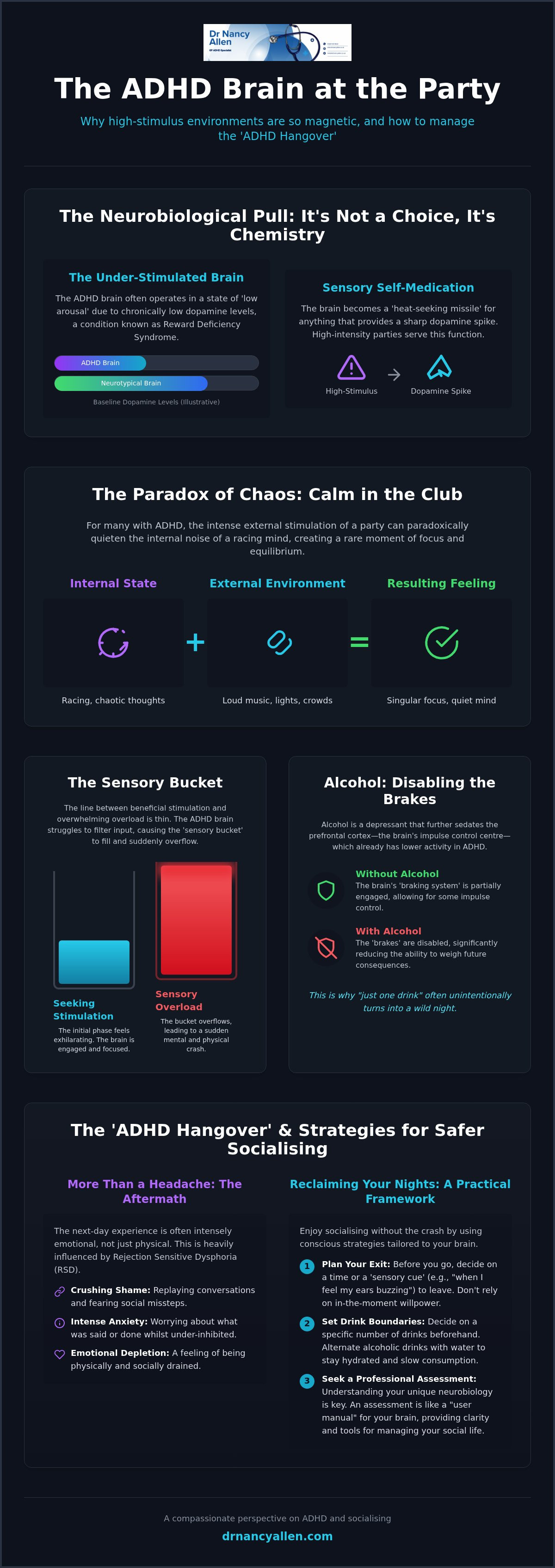
The ADHD brain operates on a baseline of "low arousal," meaning the internal environment is often under-stimulated compared to neurotypical peers. This isn't a choice; it's a biological reality tied to Reward Deficiency Syndrome. When dopamine levels are chronically low, the brain becomes a heat-seeking missile for anything that provides a sharp chemical spike. This drive is deeply connected to The Science of Impulsivity, which explains why the immediate allure of a high-energy event often outweighs long-term considerations of rest or health. For a dopamine-starved brain, partying often serves as a form of sensory self-medication, providing the intense neurochemical feedback that daily life lacks.
Many people find the connection between adhd and wild partying confusing, especially the idea that a chaotic nightclub can feel peaceful. However, for many neurodivergent individuals, the thumping bass and rhythmic strobe lights act as a sensory "blanket." These intense external inputs can paradoxically quieten the internal noise of a racing mind, allowing a rare moment of singular focus. The external chaos matches the internal speed, creating a strange sense of equilibrium that is hard to find in a quiet office or a calm living room.
Sensory Seeking vs. Sensory Overload
The line between seeking stimulation and hitting a wall of exhaustion is incredibly thin. While the initial phase of a night out feels like "filling the tank," the ADHD brain's inability to filter background noise effectively can lead to a sudden, jarring crash. In a crowded room, your brain tries to process every conversation, the clink of every glass, and every change in light simultaneously. You might find yourself "stimming" through dance or constant movement to regulate this input. This physical expression helps manage the sensory load until the "bucket" is full and the environment shifts from being exhilarating to being overwhelming.
The Social Magnetism of the 'Wild' Party
The ADHD nervous system is primarily interest-based rather than importance-based. High-energy social centres provide a constant stream of novelty and "high stakes" interaction that keeps the brain engaged. In these settings, being "too much," talking fast, or jumping between topics is often the social norm rather than an eccentricity to be masked. It's common for neurodivergent individuals to gravitate towards each other in these spaces, drawn by a shared rhythm and a mutual relief at being in an environment where their natural energy levels finally match the room. Understanding adhd and wild partying means recognising that these spaces often offer a rare, albeit temporary, sense of belonging where the need for constant stimulation is finally validated.
Dopamine, Alcohol, and Impulsivity: The Science of the 'Wild' Party
Alcohol is a central nervous system depressant, but its effect on the neurodivergent brain is complex. For most, the prefrontal cortex acts as the brain's "braking system," governing impulse control and executive function. In individuals with ADHD, this area often operates with lower baseline activity. When alcohol is introduced, it further sedates these already quiet "brakes." This biological interaction explains why the intention to have "just one drink" frequently dissolves into a night of adhd and wild partying. Without a fully engaged prefrontal cortex, the ability to weigh future consequences against immediate pleasure is significantly diminished.
The brain's search for dopamine doesn't stop once the music starts. In fact, under the influence of alcohol, the "reward hit" from risk-taking behaviour becomes even more seductive. Whether it's staying out hours later than planned or engaging in high-stakes social interactions, each impulsive choice provides a temporary chemical surge. This cycle is often exacerbated by ADHD and Sensory Overload, as individuals may use substances to numb the discomfort of a chaotic environment while simultaneously chasing the high that the environment provides. It's a taxing biological paradox that often leads to a deep sense of physical and emotional depletion the following day.
Alcohol as a Tool for Social Masking
For many, particularly those diagnosed later in life, alcohol serves as a blunt tool for "masking." It's used to quiet the relentless internal monologue and the persistent hum of social anxiety. By lowering inhibitions, substances can make it feel easier to fit into neurotypical social structures where loud, fast-paced interaction is expected. This is notably prevalent amongst women, who may have spent years over-compensating for their symptoms in professional or domestic settings. The cost of this masking is high, often resulting in a "social hangover" that lasts far longer than the physical effects of the alcohol itself.
Hormones, Menopause, and Impulsive Partying
The intersection of ADHD and hormonal health is a critical, yet often overlooked, factor in social behaviour. Oestrogen plays a vital role in dopamine production and regulation. When oestrogen levels begin to fluctuate and drop during perimenopause, ADHD symptoms frequently intensify. Women in midlife may suddenly find themselves struggling with a renewed sense of impulsivity or a desperate craving for high-intensity social outlets to counter feelings of brain fog and low mood. Understanding these shifts is essential for long-term wellbeing. If you're noticing these changes, exploring Menopause Symptoms: A Comprehensive Guide to Specialist Clinical Care can provide much-needed clarity. Recognising that your social urges are linked to your biology is the first step toward regaining balance, and a private ADHD assessment can offer the tailored support needed to navigate this transition with confidence.
Beyond the Hangover: Recognising the Risks of Sensory Overload and Shame
For many, the physical consequences of adhd and wild partying are the least of their worries. Whilst others might simply nurse a headache, the individual with ADHD often faces a profound state of neurochemical depletion that affects their ability to regulate even the simplest emotions. This "ADHD hangover" is a unique combination of physical fatigue and intense emotional dysregulation. It occurs because the brain has exhausted its limited dopamine reserves during the high-intensity social event, leaving the individual feeling raw, irritable, and deeply vulnerable the following morning.
This vulnerability is frequently weaponised by Rejection Sensitive Dysphoria (RSD), a common but excruciating aspect of ADHD. RSD can turn a minor social gaffe into a perceived catastrophe. You might spend hours ruminating on a single sentence you said or a joke that didn't land, convinced that your friends are secretly judging or excluding you. This morning-after anxiety is often more debilitating than the physical symptoms of a late night, creating a heavy cloud of shame that can last for days. Recognising when socialising has crossed the line from a fun outlet to a detrimental cycle is vital for protecting your long-term mental health.
The Emotional Fallout of Impulsivity
The ADHD brain tends to ruminate more intensely on social interactions because it struggles to filter out the perceived "noise" of social feedback. This often leads to a destructive cycle of shame. You might use partying as a way to escape the stress of everyday executive dysfunction, only to find that the partying itself creates a new, more intense layer of stress and self-criticism. If you find that your social life is becoming a primary tool for avoidance, it's a clear sign that your coping mechanisms may be causing more harm than good.
Physical Safety and Executive Function
Executive dysfunction doesn't just affect your work; it has serious implications for your physical safety in high-pressure social settings. Research into ADHD and substance use risk suggests that neurodivergent traits can lead to higher levels of risk-taking, often mediated by the social groups we choose to join. Poor working memory makes it significantly more likely that you'll lose keys, phones, or even lose track of your friends in a crowded venue. When your judgment is further impaired by substances, the risk of making unsafe choices regarding personal safety or sexual health increases. Learning to identify your "limit" before your executive function fails entirely is a practical skill that can prevent many of the most serious risks associated with adhd and wild partying.
Strategies for Safer Socialising: Navigating Nightlife with an ADHD Brain
Navigating nightlife shouldn't mean sacrificing your mental health or feeling a sense of dread the following morning. For those with ADHD, traditional advice like "know your limit" is often ineffective because executive dysfunction makes it difficult to monitor your own behaviour in the heat of the moment. Instead, a framework of "conscious partying" focuses on setting external boundaries that protect you when your internal ones fail. This approach acknowledges the reality of adhd and wild partying without judgment, prioritising safety and wellbeing over rigid rules.
One of the most effective tools is the "Exit Strategy." You must learn to recognise when your sensory bucket is full before you reach a state of total overwhelm. Once you hit that point, your ability to make safe choices diminishes rapidly. Pair this with a "Buddy System." Choose a friend who understands your ADHD triggers and can provide a gentle, pre-arranged nudge when they notice you're becoming over-stimulated or impulsive. Additionally, be mindful of medication timings. Stimulants and alcohol can mask each other's effects, leading to a dangerous "see-saw" effect. Always discuss your lifestyle habits with a specialist to understand how your specific prescription interacts with socialising.
Pre-Party Preparation and Pacing
Physical preparation is your first line of defence against sensory overload. The "Full Stomach, Full Battery" rule is essential; eating a protein-rich meal and ensuring you're well-rested can significantly improve your baseline resilience. Since the ADHD brain often loses track of time, use external triggers like phone alarms to remind you to drink water or check in with yourself. When choosing where to go, prioritise venues that offer outdoor areas or "quiet zones." These spaces allow you to take a five-minute sensory break, resetting your nervous system without having to end the night early.
Managing the 'Morning After'
The day following a high-intensity event should be viewed as a "Dopamine Recovery Day." Your brain has been through a period of intense stimulation and needs a low-pressure environment to recalibrate. Practice radical self-compassion to handle the inevitable spikes of RSD and social anxiety. Remind yourself that the shame you feel is often a chemical byproduct of a dopamine crash rather than a true reflection of your character. If you find that the post-party "crash" is becoming unmanageable or that you're consistently losing control, it may be time to seek professional clarity. A private Adult ADHD Assessment can help you understand your unique neurobiology and provide the strategies needed to reclaim control over your social life.
Seeking Professional Clarity: How an ADHD Assessment Can Change Your Relationship with Partying
Understanding the link between adhd and wild partying is an essential first step, but a formal diagnosis provides the definitive "user manual" for your social behaviour. Many adults spend years wondering why they feel a desperate need for the highest level of stimulation whilst their peers seem content with a quiet evening. A professional assessment moves the conversation away from character flaws and places it firmly in the context of neurobiology. It offers a structured way to look back at your history of impulsivity with compassion rather than regret, providing the clarity needed to make different choices in the future.
Effective treatment, which often includes a combination of medication and tailored therapy, can significantly reduce the "need" for extreme external stimulation. When your brain's dopamine levels are managed through evidence-based care, the magnetic pull of chaotic environments often loses its intensity. You might find that you can enjoy a social event without feeling driven to stay until the very end or over-indulge in substances to feel "normal." Dr Nancy Allen brings over 25 years of clinical experience to this process, offering a compassionate and non-judgmental environment where your experiences are validated and explained.
The Path to an Adult ADHD Diagnosis
Choosing the private route for an assessment allows you to bypass the anxiety of long waiting lists. Dr Nancy Allen provides a thorough evaluation with a fast 72-hour turnaround for diagnoses and treatment plans. During your consultation, you'll explore how your symptoms manifest in social settings and how your unique brain type influences your decision-making. This deeper insight is often the key to reducing the heavy burden of social shame that many neurodivergent people carry. To understand the full process, you can read our Adult ADHD Assessment: A Comprehensive Guide to Seeking Clarity and Support.
Personalised Treatment and Ongoing Support
A diagnosis isn't just a label; it's the foundation for a lifestyle that actually works for your neurodiversity. Beyond medication, specialist care helps you manage the complex overlap between ADHD, lifestyle choices, and even hormonal health. For women, this is particularly vital, as fluctuating oestrogen levels during perimenopause can make impulsive behaviours feel more difficult to manage. By working with a professional who understands these nuances, you can develop a personalised plan that restores your confidence and allows you to reclaim control over your social life. If you're ready to move towards a more balanced future, book your private ADHD assessment with Dr Nancy Allen today.
Reclaiming Balance and Social Confidence
Recognising that your experiences with adhd and wild partying are rooted in neurobiology is often the first step towards radical self-compassion. We've explored how the search for dopamine and the challenges of executive function can lead to exhausting cycles of over-stimulation and emotional fatigue. By implementing conscious strategies, such as recognising your sensory limits and planning for recovery, you can begin to enjoy socialising without the crushing weight of morning-after shame.
True clarity comes from understanding your unique brain type. Dr Nancy Allen, a specialist GP with over 25 years of experience, provides personalised treatment plans that address the complex intersection of neurodivergence and hormonal health. Through secure online consultations available across the UK, you can move from feeling out of control to having a clear, evidence-based path forward. Book a private ADHD assessment with Dr Nancy Allen for clarity in as little as 72 hours and start the journey of restoring your confidence. You deserve a social life that feels supportive whilst allowing you to be your authentic self.
Frequently Asked Questions
Is wild partying a symptom of ADHD?
Wild partying isn't a clinical symptom itself, but it's a common manifestation of core ADHD traits like impulsivity and the constant search for high-intensity stimulation. Because the neurodivergent brain often operates at a lower baseline of arousal, you might subconsciously seek out loud music and crowded spaces to "level up" your dopamine. This behaviour is frequently a coping mechanism for a brain that feels chronically under-stimulated by everyday life.
Why do I feel more 'sober' than my friends after drinking alcohol with ADHD?
This phenomenon is often linked to the paradoxical way stimulants and depressants interact with the ADHD brain. While alcohol is a depressant, it can initially spike dopamine, which temporarily improves focus or makes you feel "calmer" and more "sober" than your neurotypical peers. However, this is a dangerous illusion. Your motor skills and judgment are still significantly impaired, and this feeling often leads to over-consumption because your internal "off switch" isn't triggered.
Can I take my ADHD medication if I plan on drinking alcohol at a party?
Mixing ADHD medication with alcohol is generally discouraged by clinical professionals. Stimulants can mask the sedating effects of alcohol, making you feel less intoxicated than you actually are. This increases the risk of alcohol poisoning or engaging in dangerous behaviours because you can't accurately gauge your level of impairment. Always consult with a specialist like Dr Nancy Allen to understand how your specific prescription interacts with socialising and lifestyle choices safely.
What is an 'ADHD hangover' and why is it so much worse than a normal one?
An ADHD hangover involves more than just physical symptoms like headaches or nausea. It's a profound state of neurochemical depletion combined with intense emotional dysregulation. After a night of high stimulation, your dopamine reserves are exhausted, which can trigger severe "rebound" symptoms. This often includes crushing anxiety, irritability, and Rejection Sensitive Dysphoria (RSD), where you ruminate excessively on social interactions and feel an overwhelming, lingering sense of shame.
How can I stop being so impulsive when I'm out with friends?
Managing impulsivity during adhd and wild partying requires setting external boundaries before you leave the house. Since your internal "braking system" is less reliable in high-stimulus environments, try using phone alarms to check in with your hydration levels or set a firm departure time. Employing a "buddy system" with a trusted friend who knows your triggers can also provide a gentle external nudge when your executive function begins to decline under pressure.
Is there a link between ADHD and substance misuse in the UK?
Research indicates a significant correlation between ADHD and an increased risk of substance use. In the UK, many individuals with undiagnosed ADHD may use substances as a form of "self-medication" to quieten a racing mind or manage social anxiety. Without professional support, the search for dopamine can lead to a reliance on alcohol to cope with daily executive dysfunction. Seeking a formal assessment is a vital step in breaking this cycle.
Can undiagnosed ADHD lead to a 'party lifestyle' as a form of coping?
For many, a "party lifestyle" serves as a subconscious way to mask the challenges of undiagnosed ADHD. High-energy environments provide the constant novelty and stimulation that an interest-based nervous system craves, making you feel "normal" or even "successful" in a space where high energy is the norm. However, using adhd and wild partying as a primary coping mechanism often leads to long-term burnout and prevents you from accessing targeted clinical support.
How do I know if my partying is a problem or just my ADHD personality?
Partying becomes a concern when it consistently leads to negative outcomes, such as severe emotional crashes, financial strain, or damaged relationships. If you find yourself unable to say "no" or if your social life is followed by deep cycles of shame and anxiety, it may indicate a struggle with executive function rather than just a vibrant personality. A private Adult ADHD Assessment can provide the clarity needed to distinguish between your natural traits and harmful patterns.


Comments