


Chronic Pain and ADHD: Managing Co-occurring Symptoms
- Dr Nancy Allen

- 3 days ago
- 12 min read
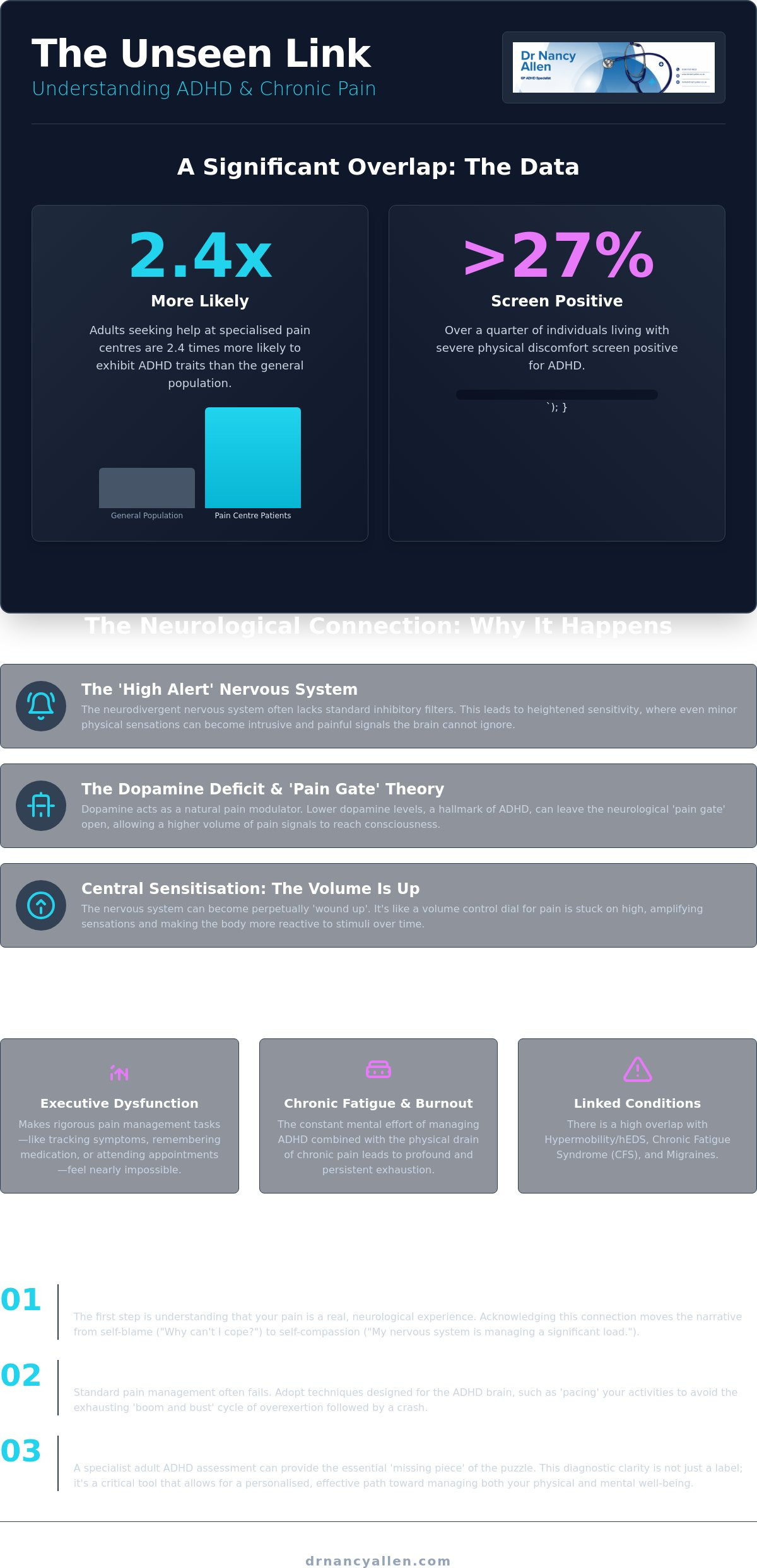
Did you know that adults seeking help at specialised pain centres are 2.4 times more likely to exhibit ADHD traits than the general population? Recent research from 2026 indicates that amongst those living with severe physical discomfort, over 27% screen positive for ADHD. If you've spent years feeling dismissed by practitioners who suggest your symptoms are merely psychological, these figures offer the clinical validation you deserve. The link between chronic pain and ADHD is a neurological reality, not a lack of willpower.
It's exhausting to manage the double burden of executive dysfunction and chronic fatigue, especially when sensory overwhelm seems to amplify every ache. We understand that your experience is both real and deeply taxing. This article explores the scientific connection between your neurodivergent brain and your body's pain responses, promising a neuro-affirming approach to care that can transform your quality of life. We'll examine the "why" behind this connection and provide actionable, holistic steps to help you regain a sense of comfort and clarity.
Table of Contents
The Overlooked Connection Between Chronic Pain and ADHD
For many, the experience of living with Chronic pain is deeply intertwined with the cognitive challenges of neurodivergence. Whilst medical professionals often treat these as separate issues, the reality is a complex, bidirectional relationship where one condition consistently fuels the other. Chronic pain and ADHD don't simply exist side-by-side; they interact at a neurological level. When your brain is already working overtime to filter sensory input and maintain focus, the constant signal of physical pain acts as an additional, exhausting distraction. Conversely, the executive dysfunction associated with ADHD can make the rigorous demands of pain management, such as tracking symptoms or attending appointments, feel nearly impossible.
This intersection creates what we might call 'neurodivergent pain'. This isn't pain that is "made up" or purely psychological. Instead, it's a physical reality processed by a nervous system that is naturally more sensitive to stimuli. Standard pain management protocols often fail this population because they don't account for the sensory processing differences or the dopamine dysregulation inherent in the ADHD brain. Without addressing the underlying neurobiology, traditional treatments can feel like trying to solve a puzzle with missing pieces.
Common Comorbidities: When Pain and ADHD Collide
We frequently see a significant overlap between ADHD and physical conditions that cause widespread discomfort. For instance, there is a high prevalence of hypermobility and Ehlers-Danlos Syndrome (hEDS) amongst the neurodivergent community; these connective tissue disorders often lead to joint instability and persistent aches. Similarly, Chronic Fatigue Syndrome (CFS) can often mask or mimic the profound burnout experienced by undiagnosed adults. Even migraines are linked to this profile, as dopamine dysregulation affects both your attention span and your brain's ability to inhibit pain signals.
Why Validation is the First Step to Healing
Many of our patients come to us after years of medical gaslighting. They've been told their discomfort is a result of anxiety or that they simply need to "stress less." Moving away from these purely psychological explanations is vital for recovery. Understanding that your brain is wired to process pain more intensely provides a framework for self-compassion rather than self-blame. It changes the narrative from "why can't I cope?" to "my nervous system is managing a significant load."
Seeking a formal adult ADHD assessment is often the first time a patient feels truly heard. It provides the missing context for why their body feels the way it does. This diagnosis isn't just a label; it's a tool that allows for a more tailored, neuro-affirming approach to physical health. When we validate the neurological reality of your experience, we can finally begin to build management strategies that actually work for your specific brain.
Why ADHD Makes the Body More Sensitive to Pain
For many neurodivergent adults, physical sensations that others might describe as minor inconveniences are felt with startling intensity. This isn't a matter of "low pain tolerance" in the traditional sense. Instead, it's a reflection of how the neuroatypical brain processes sensory data. The 'Low Threshold' theory suggests that the ADHD nervous system lacks the standard inhibitory filters that usually dampen non-essential stimuli. Consequently, a slight muscle ache or the rub of a clothing seam can become an intrusive, painful signal that the brain cannot ignore. This heightened sensitivity often makes the management of Chronic pain and ADHD feel like an uphill battle against one's own biology.
Dopamine and the Pain Gate Theory
Dopamine is widely recognised for its role in focus and motivation, but it also serves as a critical component of the body's internal pharmacy. In the "pain gate" theory, dopamine acts as a modulator that can help close the gate on physical discomfort. When dopamine levels are lower, which is a hallmark of the ADHD brain, that gate remains open. This allows a higher volume of pain signals to reach the consciousness. Recent research into the link between ADHD-related traits and pain severity confirms that those with more pronounced ADHD symptoms often report higher levels of physical suffering. It's also why some patients find that stimulant medications, which increase dopamine availability, can counterintuitively reduce their chronic physical aches.
Central Sensitisation and the 'Volume Control'
Think of central sensitisation as a nervous system that has its volume control stuck on the highest setting. The prefrontal cortex is responsible for executive functions, but it also helps filter out sensory "noise." When this area is underactive, the brain stays in a state of high alert, unable to distinguish between a genuine injury and a harmless stimulus. This persistent state of arousal is exhausting. Whilst navigating a world designed for neurotypical people, the constant stress of "masking" and over-compensation can lead to systemic inflammation. This inflammation further sensitises the nerves, creating a self-perpetuating cycle of discomfort and fatigue.
Executive dysfunction also plays a practical role in this sensitivity. Managing a complex pain condition requires consistent self-care, such as regular movement, hydration, and medication adherence. For someone with ADHD, these routine tasks are often the first to fall away during a busy week. Missing a dose of medication or forgetting to rest during a hyperfocus session can lead to a significant flare-up. If you find yourself trapped in this cycle of sensory overwhelm, seeking a specialist ADHD assessment can be the first step in understanding the neurological drivers behind your physical experience.
The Role of Sensory Processing and Emotional Regulation
Living with a neuroatypical brain means your internal filters function differently than those of the neurotypical population. For many, this manifests as an "Attention Loop," where the brain's inability to deprioritise non-essential stimuli makes it nearly impossible to ignore persistent physical discomfort. Whilst a neurotypical person might successfully "tune out" a mild backache to focus on a task, the ADHD brain often treats that pain as a high-priority alert. This constant focus on the sensation doesn't just make the pain feel more intrusive; it actually strengthens the neural pathways associated with that discomfort. A comprehensive review on The Overlooked Connection Between Chronic Pain and ADHD suggests that these sensory and emotional processing differences are fundamental to understanding why pain management is so complex for this group.
We must also distinguish between "pain catastrophising" and valid sensory overwhelm. Traditional clinical models often label a patient's intense emotional response to pain as a cognitive distortion. However, for those with ADHD, these "big feelings" are often a logical result of a flooded nervous system. When your brain is already overwhelmed by noise, light, and executive demands, a flare-up of physical pain can be the final straw that triggers emotional dysregulation. This isn't a lack of resilience; it's a physiological response to an overloaded system.
Sensory Overload as Physical Pain
For individuals with Sensory Processing Disorder (SPD), which frequently co-occurs with ADHD, the line between an "annoying" stimulus and physical pain is incredibly thin. Tactile defensiveness—a heightened sensitivity to touch—can make the texture of a work uniform or the seam of a sock feel like a constant, abrasive irritation. Over time, the effort required to "mask" this discomfort in social or professional settings leads to profound exhaustion. This chronic state of sensory-driven stress contributes significantly to the overall burden of Chronic pain and ADHD, as the body remains in a perpetual state of tension.
Hormonal Shifts: The Perimenopause Intersection
For women and people assigned female at birth, the intersection of neurodivergence and hormonal health is a critical, yet often ignored, factor. As oestrogen levels begin to fluctuate and drop during perimenopause, both ADHD symptoms and joint pain typically intensify. Oestrogen plays a vital role in dopamine production and joint lubrication; when it declines, the "perfect storm" of increased distractibility and systemic inflammation often follows. This is why a specialist who understands the unique overlap of ADHD and menopause is essential. Managing these symptoms requires a nuanced approach that considers how your hormones, your neurobiology, and your physical body interact during midlife.
Practical Strategies for Managing Pain with ADHD
Managing Chronic pain and ADHD requires a departure from traditional, one-size-fits-all medical advice. Because your nervous system is wired differently, standard strategies often fail to account for the executive function hurdles and sensory sensitivities you face daily. A multimodal approach is essential. This means combining clinical intervention with neuro-affirming lifestyle adjustments that work with your brain, rather than against it. It's about creating a toolkit that respects your energy levels and your cognitive style.
One of the most significant challenges for neurodivergent individuals is the "boom and bust" cycle. During periods of hyperfocus or high energy, you might ignore your body's early warning signs, overexerting yourself until a major pain flare-up forces you into days of bed rest. Breaking this cycle requires radical pacing. Instead of waiting for pain to stop you, use external cues like phone timers to enforce regular movement breaks or rest periods. This proactive management prevents your nervous system from reaching a state of total sensory exhaustion. It's not about doing less; it's about distributing your effort in a way that doesn't trigger a physiological crash.
Neuro-Affirming Lifestyle Adjustments
Your environment plays a massive role in your pain levels. Reducing the baseline of sensory "noise" can significantly lower your perceived discomfort. Consider these adjustments:
Sensory Regulation: Use noise-cancelling headphones or dim, warm lighting to prevent sensory overload from reaching a painful threshold. A calmer environment leads to a calmer nervous system.
Low-Friction Exercise: If the executive demand of a gym visit is too high, focus on gentle, accessible movement at home. This is particularly vital for those with hypermobility, where consistent, low-impact strengthening is more beneficial than sporadic, high-intensity workouts.
Sleep Hygiene: An ADHD brain that won't switch off worsens physical pain. Use weighted blankets or white noise to provide the calming sensory input your system needs to transition into restorative rest.
Clinical Pathways and Medication
Specialist support is the cornerstone of a sustainable plan. Whilst traditional painkillers have their place, many patients find that ADHD medications provide unexpected relief by modulating dopamine and improving the brain's ability to filter out intrusive pain signals. However, medication is only one piece of the puzzle. A truly effective strategy involves a multi-disciplinary team, including a GP and a therapist to help manage the emotional load of chronic illness. Under medical supervision, anti-inflammatory diets and targeted supplements can also help manage the systemic inflammation that often accompanies neurodivergent stress.
If you're struggling to find a management plan that sticks, it may be because your neurodivergence hasn't been factored into your care. You can explore a private ADHD assessment to begin building a strategy that finally recognises your neurological reality.
Seeking Clarity: The Role of a Specialist ADHD Assessment
For those who have navigated the frustrating overlap of Chronic pain and ADHD, the journey toward relief often feels like a series of dead ends. Traditional medical models frequently overlook how neurodivergent sensory processing affects physical health, leaving patients feeling misunderstood and unsupported. A specialist assessment provides the clinical framework needed to bridge this gap. It's often the missing piece of the puzzle, offering a neurological explanation for why your body feels the way it does and why standard treatments haven't provided the relief you expected.
Choosing a private consultation offers a level of depth and speed that is rarely available through traditional pathways. Rather than waiting years for an appointment, you can access expert care that prioritises your immediate need for validation and clarity. Dr Nancy Allen’s approach is specifically designed to be neuro-affirming, recognising that your experience of pain is a physical reality processed by a unique brain. By integrating expertise in both neurodiversity and hormonal health, we ensure that every factor, from dopamine levels to oestrogen fluctuations, is considered in your care plan.
The Path to a Diagnosis within 72 Hours
We've streamlined our process to be as empathetic and efficient as possible. With over 25 years of clinical experience, Dr Nancy Allen understands that living with chronic discomfort and executive dysfunction is exhausting. That's why we provide a diagnosis and a personalised treatment plan within 72 hours of your assessment. This rapid turnaround allows you to move forward with confidence, armed with a strategy that respects your brain's unique wiring. Our secure online consultations mean you can access this specialist support from the comfort of your own home, avoiding the sensory stress and physical strain of travelling to a clinic.
A Holistic Future: Beyond the Diagnosis
The peace of mind that comes from being heard by an expert who truly "gets it" cannot be understated. A formal adult ADHD assessment is more than a clinical requirement; it's an act of self-compassion. It allows you to stop fighting your biology and start supporting it. Moving from surviving the daily burden of Chronic pain and ADHD to thriving with a supported nervous system is a realistic goal when you have the right diagnostic clarity. You don't have to continue this journey without a map. Book your initial consultation with Dr Nancy Allen today to begin your path toward restoration and a better quality of life.
Reclaiming Your Quality of Life
Understanding that your physical discomfort is rooted in your neurological wiring is a transformative shift. We've explored how dopamine dysregulation and sensory processing differences create a unique experience of pain that requires more than just traditional management. By adopting neuro-affirming strategies like radical pacing and sensory regulation, you can begin to break the cycle of overwhelm and physical exhaustion. Managing Chronic pain and ADHD is not about trying harder; it's about finally having the right tools for your specific brain.
You don't have to navigate this journey alone or feel dismissed by a system that doesn't see the full picture. Dr Nancy Allen offers specialist expertise in both ADHD and menopause, providing the nuanced care that many adults, particularly women, have long been missing. Through our secure online consultations, you can receive a clinical diagnosis and a personalised treatment plan within 72 hours. This rapid turnaround ensures you aren't left waiting for the validation and support you need to move forward.
Taking this first step toward clarity is an act of restoration. Book your private ADHD assessment with Dr Nancy Allen today to move beyond surviving and start thriving with the expert support you deserve. Your path to a more comfortable, focused life is within reach.
Frequently Asked Questions
Can ADHD cause physical pain throughout the body?
ADHD doesn't directly cause physical injury, but it fundamentally changes how your brain perceives and processes sensory input. This often leads to a state of central sensitisation, where your nervous system remains on high alert. Consequently, minor physical tensions or environmental stressors can manifest as widespread aches or persistent discomfort. Understanding the link between Chronic pain and ADHD is vital for recognising that these physical sensations are a neurological reality rather than something "all in your head."
Is there a link between ADHD and Fibromyalgia?
Research indicates a significant overlap between these two conditions, with many individuals diagnosed with Fibromyalgia also meeting the clinical criteria for ADHD. Both conditions involve a disruption in how the brain regulates pain signals and manages sensory data. When these conditions co-occur, treating the underlying ADHD traits can often lead to a meaningful reduction in the frequency and severity of Fibromyalgia flare-ups.
Why do I feel pain more intensely than others?
You likely feel pain more intensely because your neurodivergent brain has a lower threshold for filtering out sensory "noise." In a neurotypical brain, dopamine helps dampen non-essential signals, but lower dopamine levels in the ADHD brain keep the "pain gate" open. This means your nervous system doesn't just notice pain; it amplifies it. Physical sensations that others might ignore become intrusive and distressing signals that your brain cannot easily deprioritise.
Does ADHD medication help with chronic pain management?
Many patients find that stimulant medications used to treat ADHD can provide a degree of relief from physical pain. By increasing dopamine availability, these medications help your brain's internal "volume control" function more effectively. This allows the prefrontal cortex to better filter out persistent pain signals. Whilst not a primary painkiller, medication can be a powerful tool in a multimodal management plan, though it must be discussed with a specialist.
How do I know if my pain is related to ADHD or something else?
Distinguishing between injury-based pain and neurodivergent sensory processing requires a thorough clinical assessment. If your discomfort is widespread, fluctuates with your stress levels, or is accompanied by sensory overwhelm, your ADHD is likely a significant contributing factor. A specialist can help you identify whether your symptoms stem from a primary physical condition, your neurological wiring, or a complex interaction of both factors.
Can menopause make my ADHD and pain symptoms worse?
Oestrogen levels drop significantly during perimenopause and menopause, which directly impacts both dopamine production and joint health. This hormonal shift often creates a "perfect storm" where ADHD symptoms and physical aches intensify simultaneously. Because Dr Nancy Allen specialises in both neurodiversity and menopause, she provides the expert insight needed to manage these overlapping shifts through a personalised and holistic approach to care.
What is the best way to explain neurodivergent pain to my GP?
When speaking with your GP, focus on using clinical terms like "sensory processing differences" and "central sensitisation." Explain that your brain struggles to filter out physical stimuli, which amplifies your perception of discomfort. Providing a summary from a specialist Chronic pain and ADHD assessment can offer the evidence-based framework your GP needs to move beyond purely psychological explanations and provide more effective support.
Is hypermobility more common in people with ADHD?
Clinical studies have confirmed that joint hypermobility and conditions like Ehlers-Danlos Syndrome (hEDS) are significantly more common amongst the neurodivergent population. This physical trait often leads to chronic joint instability and persistent muscle tension. For hypermobile individuals with ADHD, it is essential to use management strategies that respect both your joint health and your sensory sensitivities to avoid the "boom and bust" cycle of activity.


Comments