


Methylphenidate vs Atomoxetine: ADHD Treatment Comparison

The faster-acting option isn’t automatically the better fit. If you’re searching for “methyl phenidate vs atomoxetene”, you may be weighing the difference between a stimulant and a non-stimulant, and wondering how each could affect your routine, symptoms and wellbeing.
Methylphenidate often begins working more quickly, while atomoxetine can take several weeks to show its full effect. Both may help with ADHD, but benefits and side effects vary from person to person. There isn’t one medicine that is right for everyone.
This comparison explains how the treatments differ, what factors may shape a clinician’s recommendation and what to discuss before starting or changing medication. It covers how they work, their potential day-to-day effects and why health history, treatment preferences and individual response matter. Use it to prepare for a conversation with an ADHD clinician, not to choose a medicine on your own. A specialist assessment can put treatment options in the context of your needs.
Table of Contents
Methylphenidate vs atomoxetine: what is the difference?
Comparing ADHD medicines can feel confusing, particularly when one is described as a stimulant and the other as a non-stimulant. The aim is not to declare a universal winner, but to explain the distinction in practical terms. Methylphenidate and atomoxetine are both used in ADHD treatment, yet they act differently and may suit different people.
The phrase “methyl phenidate vs atomoxetene” may make you look for a straightforward answer. There isn’t one that applies to everyone. Suitability depends on individual circumstances and clinical assessment. This comparison can help you prepare questions, but it can’t determine whether a particular medicine or prescription is right for you.
What does stimulant versus non-stimulant mean?
Methylphenidate is a stimulant medicine. Atomoxetine is classed as a non-stimulant. These labels describe medicine categories and their differing effects in the body; they don’t mean that one is automatically stronger, safer or better. Both relate to brain signalling involving chemicals such as dopamine and noradrenaline, but their actions are not the same. The next section explains how those differences relate to time course and treatment review.
For general background on methylphenidate, you can consult the Methylphenidate Wikipedia overview. It provides broad context, but it isn’t a substitute for UK prescribing information or advice from a clinician who understands your health history.
Who is this comparison relevant to?
This comparison may be useful for adults considering ADHD treatment and parents who want to understand options before discussing a child’s care. The questions may differ. An adult might be considering how treatment could fit around work, sleep or existing health needs; a parent may want to understand how a child’s age and circumstances inform clinical decisions.
Evidence and prescribing considerations can vary by age, and a medicine’s effects and tolerability are individual. One family’s experience, or an account shared online, can’t predict what another person will experience. If ADHD has not yet been assessed, understanding the assessment process can help put medication questions in context. An adult ADHD assessment guide can outline what an adult assessment involves, while a clinician can discuss how your history, needs and treatment goals relate to possible next steps.
This article is educational, not a diagnosis, prescription or personalised treatment plan. If you’re already taking either medicine and have questions about its effects or a possible change, raise them with the clinician responsible for your care rather than stopping or adjusting treatment based on a general comparison. A considered discussion can turn broad information into questions relevant to you or your child.
How methylphenidate and atomoxetine work and differ over time
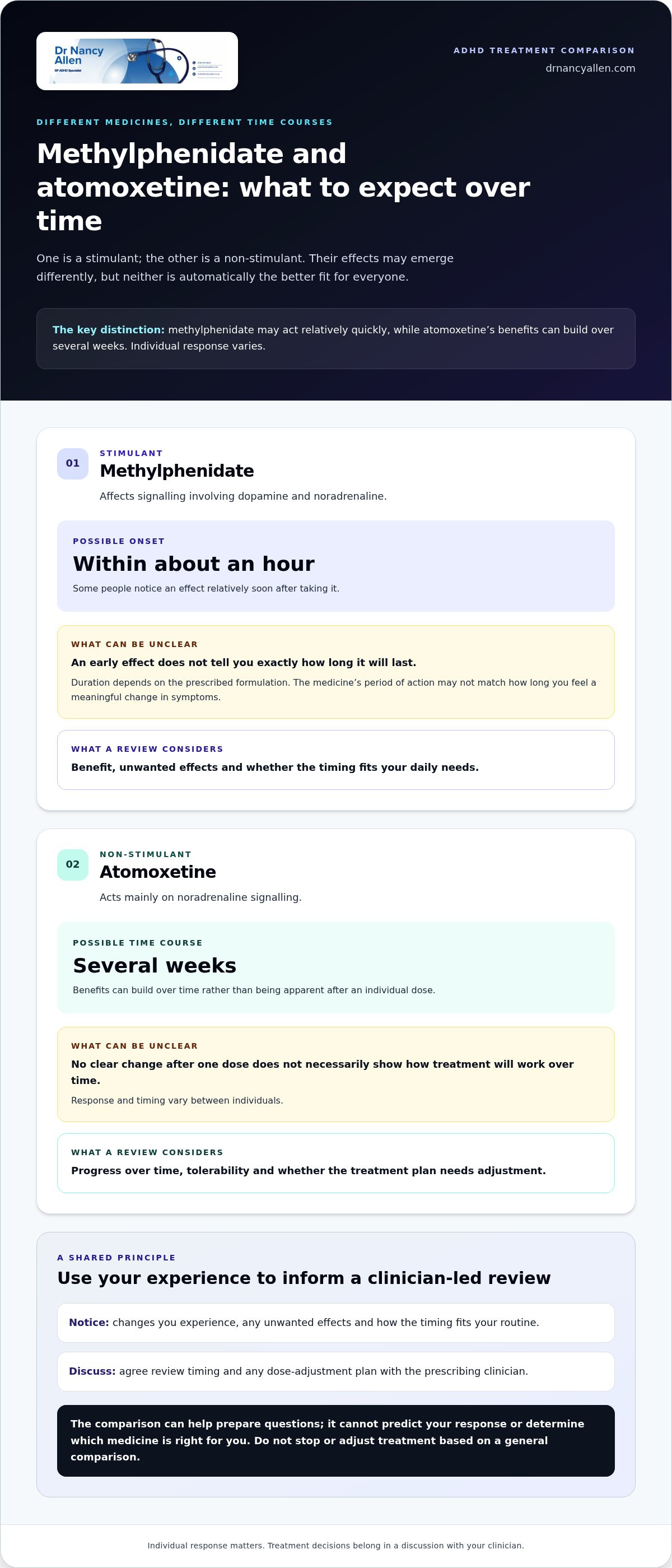
The main practical difference is not only how these medicines act, but also how their effects may emerge. Methylphenidate is a stimulant that affects signalling involving dopamine and noradrenaline. Atomoxetine is a non-stimulant that acts mainly on noradrenaline signalling. These broad mechanisms help explain why their time courses differ, but can’t predict exactly how a person will respond.
Comparison
Methylphenidate: Stimulant; affects dopamine and noradrenaline signalling. Some people notice an effect relatively soon after taking it, while duration depends on the prescribed formulation. Review considers benefit, unwanted effects and how well the timing fits daily needs.
Atomoxetine: Non-stimulant; acts mainly on noradrenaline signalling. Benefit may build over several weeks rather than being apparent after an individual dose. Review considers progress over time, tolerability and whether the treatment plan needs adjustment.
How do the two medicines act differently?
Methylphenidate influences the availability of dopamine and noradrenaline, chemical messengers involved in brain activity. Atomoxetine also affects brain signalling, but it is not a stimulant and acts selectively on noradrenaline. In plain terms, they influence overlapping aspects of brain function through different routes. A mechanism describes how a medicine works; it doesn’t establish which option will be more helpful for a particular person.
That distinction matters in a methyl phenidate vs atomoxetene comparison, but it is only one part of the clinical picture. Two people taking the same medicine may experience different benefits or difficulties. Formulation, dose and individual circumstances also matter, so general descriptions shouldn’t be treated as a prediction or a basis for changing treatment.
When might someone notice an effect?
Methylphenidate may have a relatively rapid onset, and some people notice an effect within about an hour. This isn’t a fixed promise: the formulation can affect how long its action lasts, and perceived symptom benefit may not match a medicine’s pharmacological time course exactly. A dose’s period of action is not necessarily the same as the length of time someone feels a meaningful change in focus, organisation or other ADHD-related difficulties.
Atomoxetine generally takes longer. Benefits can develop over several weeks, so not noticing a clear change after one dose doesn’t necessarily tell you how treatment will work over time. Response and timing vary between individuals, and neither medicine guarantees a particular pattern of benefit.
Agree review timing and any dose adjustment plan with the prescribing clinician. They can consider the changes you notice, whether unwanted effects arise and whether the medicine’s timing suits your routine. Brief notes on sleep, appetite, concentration and everyday functioning can make those discussions more specific. If you’re exploring these questions as part of an assessment, a personalised ADHD assessment can provide clinical context for discussing treatment options without presuming which medicine is appropriate.
Effectiveness, side effects, and concerns: how to compare fairly
It’s natural to want to know which medicine is more effective or easier to tolerate. Research can describe how treatments perform across groups, but it can’t tell you exactly what will happen for one person. A fair comparison considers potential benefits alongside side effects, health history, other medicines and the outcomes that matter in everyday life.
What should readers know about possible side effects?
Both medicines can cause unwanted effects, and experiences differ. Methylphenidate may reduce appetite and affect sleep; some people also experience anxiety. Atomoxetine may affect appetite, and nausea or mood changes can occur, particularly when treatment is starting. These are possible effects, not a checklist everyone will experience, and their impact can vary.
Side-effect information should be interpreted in context. Appetite changes, for example, may matter differently depending on a person’s age, health and usual eating patterns. Existing conditions and other medicines may also affect what a clinician considers. Check the current patient information leaflet for your prescribed medicine and raise concerns with the prescribing clinician. Seek prompt professional advice about severe or unexpected symptoms, or significant changes in mood. Don’t change or stop treatment based on a general comparison.
Does one medicine work better for everyone?
No. Research findings describe groups, not guaranteed outcomes for individuals. A review comparing methylphenidate and atomoxetine in children and adolescents aged 6-18 addresses that age group. It shouldn’t be treated as a direct answer for every adult or as a prediction for any particular child. Differences in study design and the outcomes measured can also shape how results are interpreted.
Evidence about average treatment effects cannot predict an individual’s response with certainty. Even if two medicines show similar outcomes across a study population, a particular person may benefit more from one, experience troublesome effects with another, or find that neither meets their needs. The practical question isn’t simply which medicine ranks higher. It’s how potential benefits and risks fit the person’s circumstances and treatment goals.
For a broader overview of non-stimulant options, a non-stimulant ADHD medication guide can provide context. In a clinical discussion, describe what you hope treatment will improve, any previous experiences with ADHD medicine, relevant health conditions and all medicines you currently take. For a child, parents can share observations from home and school, while the clinician considers the child’s age and individual needs.
The phrase “methyl phenidate vs atomoxetene” can sound like a contest with one clear winner. A more useful approach is to weigh evidence carefully, discuss concerns openly and review treatment in light of the person’s own experience. Online accounts may offer perspective, but they can’t replace a personalised clinical conversation.
How clinicians decide between methylphenidate and atomoxetine
Choosing between ADHD medicines is a clinical discussion, not a self-selection exercise. A clinician considers the assessment alongside a person’s health, daily needs and priorities, then reviews how any agreed treatment is working. In the UK, prescribing decisions should be guided by current NICE recommendations and relevant prescribing information, which may be updated over time.
A useful framework is to establish the assessment and treatment goals, review relevant health history and medicines, discuss suitable options and their possible benefits and drawbacks, then agree how progress will be reviewed. This gives the comparison a personal context without treating any single factor as an automatic reason to choose or rule out a medicine.
Which personal factors may shape the discussion?
The clinician may ask which difficulties have the greatest effect on everyday life, such as staying focused at work or managing routines at home. They’ll also consider relevant health conditions, other medicines, previous ADHD treatment and any effects or concerns from those experiences. Age and individual clinical circumstances can influence assessment and prescribing considerations, so the discussion may differ for an adult and a child.
Preferences matter too. You may want to understand how a medicine’s expected time course fits your routine, or have questions about appetite, sleep or other possible effects. These details inform a balanced discussion; none alone determines the right option. If formulations are part of the conversation, ask how methylphenidate release profiles differ and what that could mean for the treatment plan.
What questions can you take to an appointment?
Preparing a few questions can make it easier to leave with a clear understanding of the plan. Consider asking:
What changes might treatment aim to support, and how will we assess whether they’re happening?
When should we review progress, and what should I note between appointments?
Which possible side effects should I look out for, and when should I seek advice?
How might my health history, other medicines or previous treatment experience affect this discussion?
What should I do if my circumstances or health change during treatment?
Bring an up-to-date list of medicines and share relevant health changes, as well as anything you’ve noticed with previous treatment. Parents can bring observations about a child’s day-to-day functioning to help describe the impact of ADHD across settings. Clear examples are often more useful than deciding in advance which medicine seems preferable.
Online searches for “methyl phenidate vs atomoxetene” can help you identify questions, but they can’t replace individual clinical advice. Don’t start, stop, switch or alter ADHD medication without guidance from the prescriber responsible for your care. A personalised assessment can put treatment options in context; you can explore an ADHD assessment as a starting point for discussing your needs.
Next steps: discuss ADHD medication with a specialist
There’s no universal winner in the methylphenidate and atomoxetine comparison. Online accounts and general information can help you identify questions, but they can’t show which option is appropriate for you or your child. A discussion with a clinician can connect the evidence to your assessment, health history, treatment priorities and day-to-day needs.
What information is useful to bring?
You don’t need to prepare a perfect record before seeking advice. A few concise notes can help focus an appointment. Consider noting:
The ADHD-related difficulties that have the greatest effect on daily life, with a brief example where useful.
Your treatment priorities, including which areas of functioning you hope to address.
Relevant health history, current medicines and any recent changes in your health.
Previous treatment experiences, including benefits, concerns or unwanted effects.
Questions about expected benefits, possible side effects and when follow-up may take place.
For a child, parents or carers can share observations from everyday settings and describe what they most hope treatment discussions will address. If you’re already receiving care, bring what you know about your current plan. Don’t delay seeking appropriate clinical advice because you haven’t gathered every detail.
If you’d like support making sense of your needs and possible next steps, you can explore a private ADHD assessment with Dr Nancy Allen. Assessment and personalised treatment planning can put medication questions in the context of your circumstances, without assuming a particular prescription is suitable.
How can a specialist assessment help?
A specialist assessment offers an opportunity to understand the difficulties you’re experiencing and discuss care in a considered, individual way. It can help organise the information relevant to a treatment conversation, including your history, current priorities and previous experiences. Dr Allen is a private GP specialising in ADHD assessments and care, with over 25 years of clinical experience. Her practice provides ADHD assessments and personalised treatment planning, with secure online consultations available across the UK.
If you’re comparing options such as methylphenidate and atomoxetine, the aim is to have a useful conversation, not to select a medicine from an online article. You may also find it helpful to read a lisdexamphetamine and methylphenidate comparison if you’re considering broader questions about ADHD medicines; each treatment still needs to be discussed in your own clinical context.
The search phrase “methyl phenidate vs atomoxetene” can be a starting point for learning, but your own needs deserve individual attention. If an assessment feels like the right next step, explore a private ADHD assessment and discuss what support may be appropriate for you or your child.
Take your next step with confidence
Searching “methyl phenidate vs atomoxetene” can help you put useful questions into words, but you don’t have to reach a decision alone. A conversation grounded in your needs can help you understand what matters for your care and what to explore next. Start by noting one or two changes you hope treatment could support, alongside any concern you’d like your clinician to understand.
Dr Nancy Allen’s ADHD assessments offer space to discuss individual circumstances and personalised treatment planning. With over 25 years of clinical experience, she provides secure online consultations across the UK. An assessment can support a considered conversation about care; it doesn’t mean a particular medicine or prescription is guaranteed.
If you’re ready to explore your options, explore a personalised ADHD assessment with Dr Nancy Allen. You can begin with the questions that feel most important to you.
Frequently Asked Questions
Is methylphenidate better than atomoxetine for ADHD?
No, neither medicine is better for everyone. The search “methyl phenidate vs atomoxetene” can make the choice sound like a simple ranking, but treatment response varies. A clinician will consider which symptoms affect daily life, relevant health factors and previous treatment experiences. Priorities around sleep, appetite or the timing of support may shape the discussion, but don’t determine the outcome on their own.
How long does atomoxetine take to work compared with methylphenidate?
Methylphenidate may have an effect relatively soon after a dose, whereas atomoxetine’s benefits can take several weeks to develop. These are broad patterns, not a timetable for every person. If you’re tracking changes, note practical areas such as completing tasks, managing routines or getting through lessons. Share those observations with the prescriber, who can consider them alongside the agreed treatment plan.
Can adults take both methylphenidate and atomoxetine?
An adult should take both only if a prescriber has specifically recommended that plan. Combining ADHD medicines isn’t a decision to make independently, even if one medicine seems to help only part of the day. The prescriber can consider the reason for treatment, other medicines and possible risks before advising. If both names appear on your medication list, clarify the instructions with the prescriber or pharmacist before making changes.
What are the main side effects of methylphenidate and atomoxetine?
Methylphenidate can affect appetite and sleep, and some people experience anxiety. Atomoxetine may cause appetite reduction, nausea or mood changes, particularly when treatment begins. This isn’t a complete list, and an effect that is manageable for one person may be disruptive for another. Check the patient information leaflet supplied with your medicine, and seek professional advice about severe, unexpected or concerning symptoms.
Is atomoxetine a stimulant?
No. Atomoxetine is classed as a non-stimulant medicine used in ADHD treatment. This describes its medicine category; it doesn’t guarantee that it will feel mild or be free from side effects. If you’re asking because of a concern about a current or proposed treatment, explain what worries you, such as sleep, appetite or another medicine you take. A clinician can discuss that concern in your individual context.
Can I switch from methylphenidate to atomoxetine without speaking to my prescriber?
No. Don’t switch, stop or change ADHD medication without advice from the prescriber responsible for your care. The medicines differ in how their effects develop, so changing between them needs an individual plan. If you’re experiencing unwanted effects or feel your current treatment isn’t meeting your needs, contact your prescriber to discuss what’s happening. If symptoms are severe or feel urgent, seek prompt medical help.
How do clinicians choose between methylphenidate and atomoxetine in the UK?
UK clinicians consider the assessment, the person’s age and circumstances, relevant health history, other medicines, treatment priorities and previous experiences. They also consult current NICE recommendations and prescribing information when making decisions. Bringing a concise list of medicines and a real example of a difficulty, such as losing track of tasks at work or school, can make the discussion more specific. The decision and any follow-up remain clinician-led.



Comments