


HRT Too Low or the Wrong Fit? Expert Advice

Could ongoing symptoms on HRT mean your dose is too low, or that the treatment isn’t the right fit? The answer isn’t always either. If you’re asking, “Too Low or the Wrong Fit?”, it’s understandable to want relief while feeling cautious about changing a treatment that may bring unwanted effects.
Symptoms that continue deserve attention, but they don’t automatically mean you need a higher dose. A clinician can consider your symptom pattern, current treatment, how you’re using it, any side effects and other possible explanations. There’s no need to guess or alter your HRT on your own. If symptoms persist or concern you, a personalised review can help clarify what may be going on and when to seek advice.
This article explains what a clinician may explore, what details to bring to a review and how to discuss possible next steps safely. Dr Nancy Allen provides evidence-based menopause care in a supportive setting, with decisions tailored to your circumstances. You’ll leave with a clearer understanding of what to ask, rather than a one-size-fits-all answer about your dose.
Table of Contents
HRT Dose Too Low or the Wrong Fit? Start With What Has Changed
Continuing to experience symptoms after starting HRT can leave you wondering whether the treatment is helping as much as it could. That uncertainty doesn’t, by itself, mean treatment has failed or your dose is wrong. Start by noticing what has changed: which symptoms remain, whether they feel different, and whether anything about your treatment or preferences has shifted.
“Too low” is a possibility to discuss with a clinician, not a conclusion to draw from one symptom. Symptoms can have more than one explanation, and their meaning depends on your circumstances and treatment. A clinical review can consider the whole picture instead of treating a single symptom as proof that your dose needs to change.
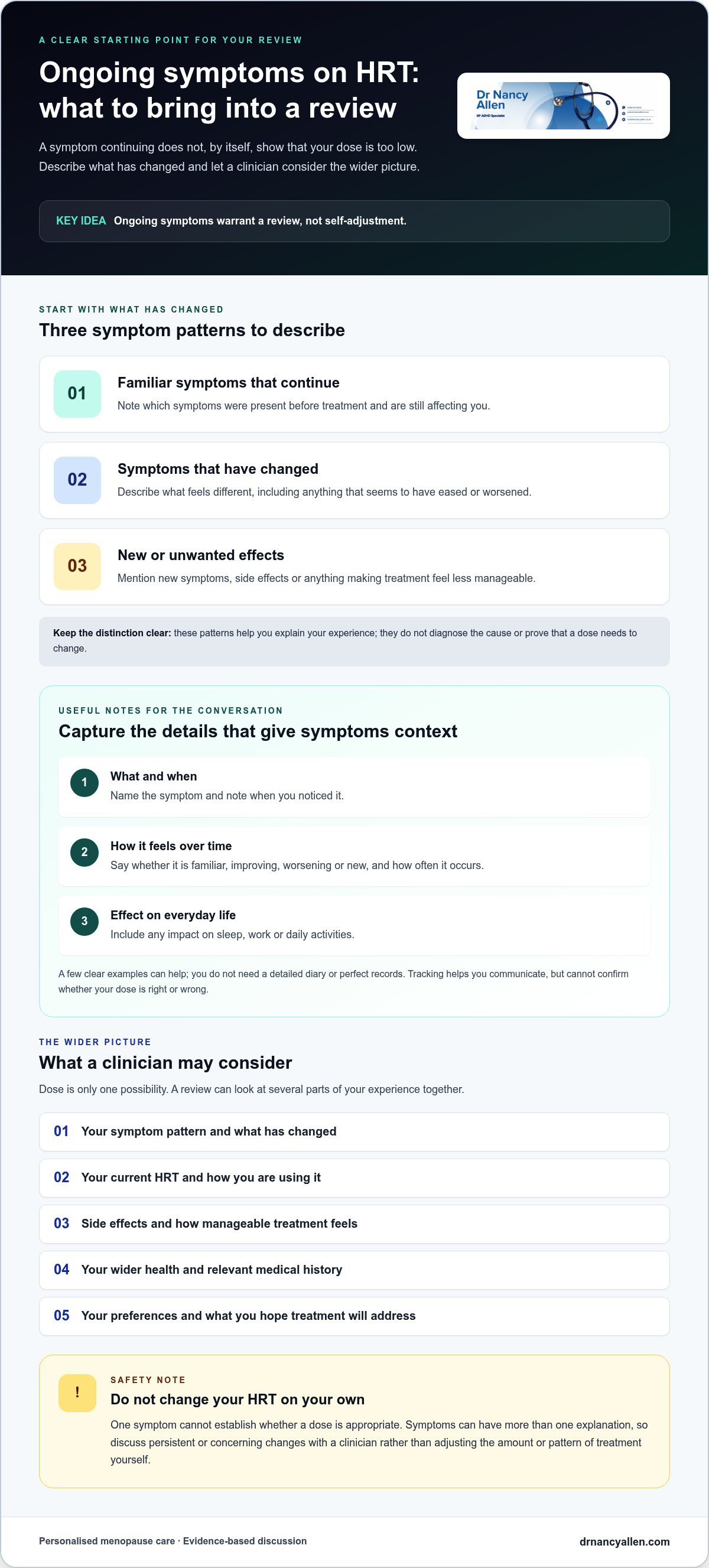
Ongoing symptoms warrant a review, not self-adjustment.
What does ‘HRT dose too low’ mean?
Dose adequacy is considered in the context of your symptoms and the HRT you’re using. Hormone replacement therapy (HRT) can involve different hormones and treatment forms, so the name or amount alone doesn’t tell the full story. A clinician may need to understand how the treatment fits your needs and how you’re experiencing it. One symptom, on its own, can’t establish whether a dose is appropriate. Don’t change the amount or pattern of treatment without clinical advice.
When might HRT feel like the wrong fit?
“Wrong fit” is a broader question than whether the dose is sufficient. You may want to discuss side effects, how manageable the treatment feels, your preferences about its form, or what you hope it will address. These concerns matter even if some symptoms have improved. They’re useful information for an individual conversation with a clinician, not a reason to blame yourself or assume there is only one suitable approach.
It can help to separate the questions you’re asking. Are familiar symptoms still affecting you, or are you mainly concerned about an unwanted effect or the treatment approach itself? Both can be relevant, and sometimes they overlap. You don’t need to decide which explanation is correct before seeking advice. Describing what you’ve noticed gives a clinician a clearer starting point.
Dr Nancy Allen’s evidence-based peri-menopause and menopause care provides an opportunity to discuss ongoing symptoms and treatment concerns as part of personalised planning. A consultation takes your experience and priorities into account. It won’t assume in advance that a higher dose or a different approach is the answer. Any treatment decisions are made clinically.
Why Symptoms Can Continue on HRT: Dose Is Only One Possibility
If you’re still experiencing symptoms, it’s natural to look for one clear explanation. But an isolated difficult day or a single symptom can’t show whether HRT is the cause, whether treatment needs reviewing or whether another factor matters. Patterns over time can give a clinician a more useful starting point than assumptions about dose alone.
Distinguish between symptoms that were present before treatment and continue, symptoms that have changed, and new or unwanted effects that appeared during treatment. These categories don’t diagnose the cause. They help you describe what you’re experiencing clearly, so a clinician can consider the details in context.
How symptom patterns can help a treatment review
Make a brief note of which symptoms persist, which seem to have eased and what feels different. Record when they occur, how often, and whether they affect sleep, work or everyday activities. You don’t need a detailed diary or perfect records; a few clear examples can be more useful than trying to remember everything during an appointment.
Note the symptom and when you noticed it.
Describe whether it is familiar, improving, worsening or new.
Record how it affects your day, without trying to interpret the cause.
Tracking helps you communicate; it can’t confirm whether your dose is right or wrong. Symptoms may vary, and the significance of a pattern depends on your individual circumstances. There isn’t a one-size-fits-all timeline to apply from a diary alone, so don’t treat a particular number of days or episodes as proof that treatment needs to change.
What else may influence how treatment feels?
Your preferences and how manageable you find the treatment are relevant, too. You may have concerns about its form, how it fits into your routine, or effects you’ve noticed. These are valid topics to raise, even if you’re unsure whether they’re connected to HRT. A review can consider both your experience and what you want treatment to address.
Menopause symptoms can overlap with other health concerns, so it’s unwise to assume that every change is hormonal. Equally, a new symptom doesn’t automatically mean HRT is responsible. A clinician may consider your wider health and medical history alongside your symptom pattern and current treatment. Looking at restorative and functional health concepts—such as those discussed at 5280restorativemed.com—can also provide helpful context on how stress, fatigue and lifestyle intersect with hormone wellbeing. Avoid diagnosing yourself or making changes based on an online comparison with someone else’s experience.
Claims about how quickly HRT should work, or how much improvement to expect, need to be considered against current clinical guidance and your circumstances. Rather than using someone else’s timeline as a benchmark, bring your own observations and questions to a review. That keeps the discussion focused on what has changed for you, not on a presumed response.
If you’d value a structured conversation about symptoms, treatment and personal priorities, Dr Nancy Allen’s menopause care offers evidence-based, personalised planning. The aim is to explore your concerns with a clinician, not to assume what is causing them or what adjustment, if any, is appropriate.
Dose Too Low or Treatment Mismatch? Compare the Questions to Discuss
Persistent symptoms and concerns about how HRT feels can raise different questions, even though they may overlap. If you’re asking, “Too Low or the Wrong Fit?”, separating your concerns can make a treatment review more focused. The comparison below helps organise what you want to discuss; it is not a test that identifies the right treatment or dose.
Dose adequacy and treatment suitability are related, but separate, questions.
Clues that make dose adequacy worth discussing
If symptoms you already recognise are continuing or affecting everyday life, describe that to your clinician without assuming it proves the dose is low. Include what has changed since you started treatment or last reviewed it. Your account helps frame the discussion; only an appropriately qualified clinician can assess whether the dose or plan should change.
Concern
Information to note
Question for your clinician
Familiar symptoms continue
Which symptoms remain, and how they affect daily life
Could we review how my current treatment relates to these symptoms?
Symptoms have changed
What feels different and when you noticed the change
What should we consider about this change?
Treatment feels difficult to manage
Any unwanted effects or practical concerns you’ve noticed
Could we discuss how well this plan suits me?
Your priorities have shifted
What you most want treatment to address now
Does my current approach still reflect my priorities?
Clues that make treatment fit worth discussing
A treatment review isn’t only about symptoms that haven’t eased. If you have unwanted effects, concerns about the approach or preferences that aren’t reflected in your plan, mention them too. You might ask whether your current treatment aligns with what matters to you, and what options could be considered in light of your circumstances.
Keep the discussion open rather than arriving with a particular product, route or regimen in mind. Your clinician can consider your preferences alongside your symptoms, treatment and relevant medical history. The aim is to understand what needs attention, not to treat the table as a checklist that produces a prescription.
You may have concerns in both columns. For example, familiar symptoms might persist while the treatment also feels difficult to manage. You don’t have to choose between raising one issue or the other. Explain both, and ask how they can be considered together. Beyond clinical reviews, addressing emotional wellbeing is often an essential part of finding the right fit with any hormone therapy; for gender-diverse and transgender individuals navigating their care, genderidentitycenter.com offers specialised individual, family, and group therapy.
Use the comparison to prepare for a conversation, not to make a treatment decision alone. Bring your observations and questions to a clinician, who can assess the whole picture and discuss next steps with you.
How to Prepare for an HRT Review Without Changing Treatment Yourself
A little preparation can help you make the most of an HRT review, especially if it’s difficult to describe symptoms or treatment concerns on the spot. You don’t need to arrive with a solution or prove that something is wrong. Give the clinician a clear account of your experience and leave space to discuss options together.
Use this simple sequence:
Record your concerns. Note what you want help understanding, including symptoms that continue, changes you’ve noticed or effects that concern you.
Write down your treatment details. Bring a current medication list, including your HRT and any other medicines, and note relevant changes since your last consultation.
Prepare your questions. Choose the points you most want to cover, so they’re easier to raise during the appointment.
Arrange a review. If symptoms or concerns are affecting you, book a menopause consultation rather than changing your treatment yourself.
What to record before the appointment
Keep notes simple and practical. Include what you’ve experienced, when it tends to happen and how it affects everyday activities, such as sleep, work or your usual routine. If you already track sleep, mood, periods or hot flushes, bring those notes if they feel useful. There’s no need to start an elaborate diary or draw conclusions from the information.
Take a medication list and relevant medical history to the consultation. Note any changes to medicines or your treatment since your previous review, including what changed and when. Dr Nancy Allen’s menopause consultations also use questionnaires as part of preparation. These details help the clinician understand your circumstances; they don’t determine by themselves whether your HRT needs to change.
Questions to take into your HRT review
Questions can help you take an active part in the conversation without arriving with a predetermined dose change in mind. You might ask:
What could help explain the symptoms I’m experiencing?
What information or aspects of my health are you considering in your assessment?
Does my current treatment plan still reflect my symptoms, circumstances and priorities?
What next steps might be appropriate, and when should we review how things are going?
If you’re unsure whether your concern is “Too Low or the Wrong Fit?”, say so plainly. Explain what you hope treatment will address, as well as any effects or practical concerns that matter to you. The clinician can discuss what the information suggests and whether any options are appropriate for your individual situation. Prescribing decisions are made at clinical discretion.
Dr Nancy Allen provides evidence-based menopause care and personalised treatment planning, with online consultations available UK-wide. If a structured discussion would help you consider your concerns, explore specialist menopause care.
Find a Personalised HRT Review That Fits Your Needs
Uncertainty about ongoing symptoms or treatment can be difficult to carry on your own. A menopause consultation gives you space to describe what you’re experiencing, explain what matters to you and discuss your questions with a clinician. You don’t need to arrive knowing whether the issue is dose, treatment fit or something else. The purpose is to consider your circumstances, not assume an answer in advance.
What to expect from a specialist menopause consultation
A review can explore your symptoms, relevant medical history, current treatment and any concerns or priorities you’d like to raise. Sharing what has changed, what you find difficult and what you hope treatment will address helps shape a fuller discussion. If you’re still asking, “Too Low or the Wrong Fit?”, that uncertainty itself is a reasonable concern to bring.
Dr Nancy Allen provides evidence-based peri-menopause and menopause specialist care, with personalised treatment planning. Any plan is based on clinical assessment and your circumstances; a particular change or outcome can’t be assumed before that discussion. If a prescription is considered appropriate, it’s issued at clinical discretion and supplied by an external pharmacy.
Online consultations are available UK-wide. Bring a medication list, relevant medical history and any notes you’ve made about symptoms or treatment concerns. These details can support a focused conversation while leaving room for questions you may not have thought of beforehand.
When to seek urgent help instead
These are planned private consultations, not emergency care. If you need urgent medical help, call 999 or contact NHS 111. A private menopause appointment isn’t a substitute for urgent assessment, so seek appropriate urgent help rather than waiting for a planned review.
For non-urgent concerns, it’s reasonable to seek a review if symptoms continue, treatment feels difficult to manage or you’re unsure what to discuss next. Explain what you’ve noticed and ask how your symptoms, health history and treatment priorities are being considered. The clinician can discuss possible next steps without presuming that a dose increase or a particular alternative is right.
A thoughtful review won’t reduce your experience to a single symptom or a yes-or-no answer. It can help you understand what information is relevant, clarify what you want from treatment and consider options in the context of your health. That discussion may offer greater clarity, even when decisions need to be made carefully and individually.
If you’re ready to discuss your concerns in a planned consultation, book a menopause consultation with Dr Nancy Allen.
Make Your Next HRT Conversation Count
You don’t need to arrive with a firm answer to “Too Low or the Wrong Fit?” Your next step can simply be deciding what you want your clinician to understand: the changes you’ve noticed, what concerns you most and what you hope to discuss. You’re entitled to ask questions and take part in decisions about your care, without choosing a treatment change in advance.
Dr Nancy Allen brings over 25 years of experience as a dedicated GP to evidence-based menopause care and personalised treatment planning. Online consultations are available UK-wide, providing a planned setting to discuss your concerns and consider your needs with a clinician. Treatment decisions are individual and based on clinical assessment; no particular outcome can be guaranteed.
If you’re ready to talk through your situation, book a menopause consultation. Take things one question at a time and move towards a more informed, confident discussion.
Frequently Asked Questions
How do I know if my HRT dose is too low?
You can’t confirm that from one symptom alone; a clinician needs to assess your symptoms alongside your treatment and health circumstances. If you’re wondering “Too Low or the Wrong Fit?”, note what remains difficult and how it affects you, then discuss it at a review. Avoid using another person’s dose or experience as a guide. The right assessment is individual, and any treatment decision should be made with a clinician.
Can I increase my HRT dose if my symptoms have not improved?
Don’t increase your dose without advice from the clinician responsible for your care. Continuing symptoms are a good reason to ask for a review, but they don’t establish that a higher dose is appropriate. The clinician can consider your current treatment, health history and concerns before discussing next steps. If you’ve already changed your dose, let them know what you changed and when, so they have accurate information.
How long should I wait before asking for an HRT review?
There isn’t one waiting period that suits everyone. You can seek advice if symptoms are troubling you, changing, or affecting your daily life, rather than waiting for a particular milestone. If you’re unsure whether a concern can wait, contact a healthcare professional for guidance. Seek urgent help for urgent medical concerns, rather than relying on a planned menopause appointment.
What should I track before discussing my HRT?
Alongside symptom notes, write down the exact treatment name and form shown on the packaging, when you started it, and any changes since then. Note when symptoms occur and how they affect your routine. If relevant, record whether you’ve had difficulty following the prescribed instructions. Bring a current list of other medicines and supplements, too, so the clinician can review your treatment in context.
Could my HRT be the wrong fit even if the dose is not too low?
Yes. Treatment may warrant discussion even if the question isn’t dose adequacy. You might be concerned about unwanted effects, find the routine difficult to manage, or feel that the approach doesn’t match your preferences or priorities. Explain what feels difficult and what you’d like treatment to address. A clinician can consider these points with your medical history and discuss whether any options are appropriate for you.
Should I stop taking HRT if I am worried about side effects?
Speak to the clinician who manages your HRT before stopping or changing it, unless you’ve already been given different instructions. Describe the effect, when it began and how it’s affecting you; this can help guide advice about what to do next. If you feel you need urgent medical help, call 999 or contact NHS 111. A planned menopause consultation isn’t a replacement for urgent care.
Can an online menopause consultation help review my HRT?
Yes. An online consultation can provide an opportunity to discuss your symptoms, treatment concerns, medical history and priorities with a clinician. Have your medication details and questions ready, and explain what you’d like help deciding. Dr Nancy Allen offers online consultations across the UK as part of her menopause specialist care. Any treatment plan is based on clinical assessment, and prescriptions are issued at clinical discretion.



Comments