


The True Cost of Not Treating Childhood ADHD

Updated: 23 hours ago
What might a child miss out on when ADHD needs go unrecognised or unsupported? The cost of not treating childhood ADHD isn’t simply about schoolwork. Ongoing difficulties with attention, organisation or impulsivity can affect a child’s confidence, friendships and family life, particularly when their behaviour is misunderstood. Challenges may build over time, but they don’t determine a child’s future.
If you’re worried about your child’s progress, you may be unsure whether ADHD is the reason or whether seeking help could lead to an unwanted label. Those concerns are understandable. A thoughtful assessment doesn’t assume a diagnosis or that every child needs the same support. It can help clarify what may be happening and inform practical next steps suited to your child’s needs.
This article explores how unsupported ADHD may affect wellbeing and development, signs your child could benefit from further support, and why outcomes are not predetermined. It also explains how a child ADHD assessment with Dr Nancy Allen, a private GP with more than 25 years of clinical experience, can help families understand their child’s needs and consider personalised care.
Table of Contents
The cost of not treating childhood ADHD: what may go unnoticed
How unsupported childhood ADHD can affect learning, wellbeing, and relationships
Does untreated childhood ADHD inevitably lead to lasting problems?
What parents and carers can do when a child may need ADHD support
How a child ADHD assessment can turn concern into informed next steps
The cost of not treating childhood ADHD: what may go unnoticed
The cost of not treating childhood ADHD isn’t a single financial figure. It describes the possible effects of unmet needs on a child’s wellbeing and daily life, from repeated frustration to feeling misunderstood. These effects can accumulate, but they don’t happen to every child and they aren’t a forecast of any individual child’s future.
ADHD is a neurodevelopmental condition, not laziness, poor parenting or deliberate misbehaviour. Attention deficit hyperactivity disorder (ADHD) is a neurodevelopmental disorder characterized by symptoms of inattention, hyperactivity, impulsivity, and emotional dysregulation. Its effects vary according to a child’s needs, strengths, environment, any co-occurring difficulties and the support around them.
This video discusses possible consequences of unsupported ADHD in children:
What does the cost of untreated childhood ADHD mean?
An unrecognised condition is different from diagnosed ADHD where support is absent, inconsistent or no longer meeting a child’s needs. In either case, difficulties may be overlooked or mistaken for a lack of effort. For instance, a child who regularly struggles to begin a task may be told to try harder, rather than adults exploring what is making it difficult.
Repeated setbacks or criticism may contribute to frustration, conflict or reduced confidence. These are possibilities, not inevitable consequences, and no single measure captures the “cost” for every child.
In brief: “The cost of unsupported childhood ADHD means the possible effects of unmet needs on a child’s wellbeing and daily life, not a prediction of what will happen to any individual child.”
Why recognising the child’s needs matters
When a child finds everyday demands harder than expected, misunderstandings can build. If adults focus only on missed instructions, unfinished work or impulsive moments, a child may come to see themselves as careless or “bad”. Looking for patterns can shift the response from blame to curiosity: what feels difficult, and what might help?
This approach also makes room for the whole child. Interests, strengths and supportive relationships shape how ADHD is experienced, alongside challenges at home, school or elsewhere. Recognising a possible need doesn’t mean assuming a diagnosis or expecting a particular outcome. It’s a considered first step towards understanding the difficulty and exploring appropriate support.
How unsupported childhood ADHD can affect learning, wellbeing, and relationships
ADHD-related needs can show up differently across settings. A child might concentrate on a favourite activity yet struggle to follow several classroom instructions, begin independent work or remember what they need for the day. This contrast can be confusing for families and teachers, especially when the effort behind a task isn’t obvious.
School, learning, and confidence
At school, difficulties with attention, organisation or executive function may make it harder to start work, keep track of belongings, move between activities or finish tasks in the expected time. A child might understand a subject but leave questions incomplete because planning and sustaining effort are challenging. Repeated reminders or criticism, without recognition of the underlying difficulty, may add to the pressure.
Repeated struggles may affect self-belief. A child who is often told they’re careless or not trying could begin to doubt their abilities, even when they’re making an effort. This isn’t inevitable. Supportive relationships and adjustments that respond to a child’s needs can help make school more manageable. Our guidance on supporting children with ADHD at school offers further ideas for constructive conversations about classroom support.
Emotional wellbeing, friendships, and family life
Impulsive comments, difficulty waiting or missing social cues may sometimes lead to misunderstandings with peers. At home, transitions, forgotten requests or unfinished routines can become sources of tension. What looks like defiance or not listening may sometimes reflect difficulty shifting attention, managing frustration or coping with a demand. Not every disagreement or emotional concern is caused by ADHD, and a child’s wellbeing can be affected by many factors.
Stress can build when behaviour is seen as deliberate and a child’s needs remain unclear. Responding with curiosity while keeping expectations calm and clear may help adults understand what is happening. Family guidance on demand avoidance or meltdowns may also be useful where those experiences are relevant.
Across home and school, ADHD-related challenges with attention, planning, impulse control or emotional regulation may affect how a child manages tasks, responds to expectations and connects with others, although the pattern and impact differ from child to child. Observations from more than one setting can help build a fuller picture of the child’s needs.
If you’re seeking clarity about difficulties affecting your child, a child ADHD assessment can help explore their history and current needs, and inform personalised next steps.
Does untreated childhood ADHD inevitably lead to lasting problems?
No. A child’s future can’t be predicted from an ADHD diagnosis or from the fact that their needs haven’t yet been recognised. Some children may continue to experience difficulties when support doesn’t fit their needs, but this doesn’t prove ADHD caused every challenge or mean another child will have the same experience.
Recognising a possible risk is not the same as predicting a child’s future. The cost of not treating childhood ADHD may include difficulties when needs go unmet, but it isn’t a fixed outcome or a measure of a child’s potential. Understanding what is happening can help families and professionals consider useful support without assuming the worst.
Why outcomes differ from child to child
ADHD can present differently, and its effects may change as a child develops and faces new demands. Strengths, supportive relationships, family circumstances and the school environment all shape their experience. One child may find busy classrooms difficult but manage better with clear instructions; another may need a different kind of support.
ADHD may also overlap with other needs or circumstances. Sleep difficulties, anxiety, learning differences or stress, for example, can affect concentration and behaviour. An ADHD diagnosis alone may not explain every difficulty, and noticing a possible connection isn’t the same as establishing its cause.
Research can identify associations across groups, but that doesn’t prove what caused a particular child’s experiences. Possible effects on learning, relationships or family life are risks to consider, not guarantees. A child’s circumstances matter, and no statistic or label can determine what their future will look like.
Does support have to mean medication?
Treatment decisions need individual clinical consideration and discussion with the family. A child ADHD assessment can explore a child’s history, strengths and current difficulties, then inform personalised next steps without assuming a diagnosis or intervention in advance. Support can also be reviewed as needs change.
What parents and carers can do when a child may need ADHD support
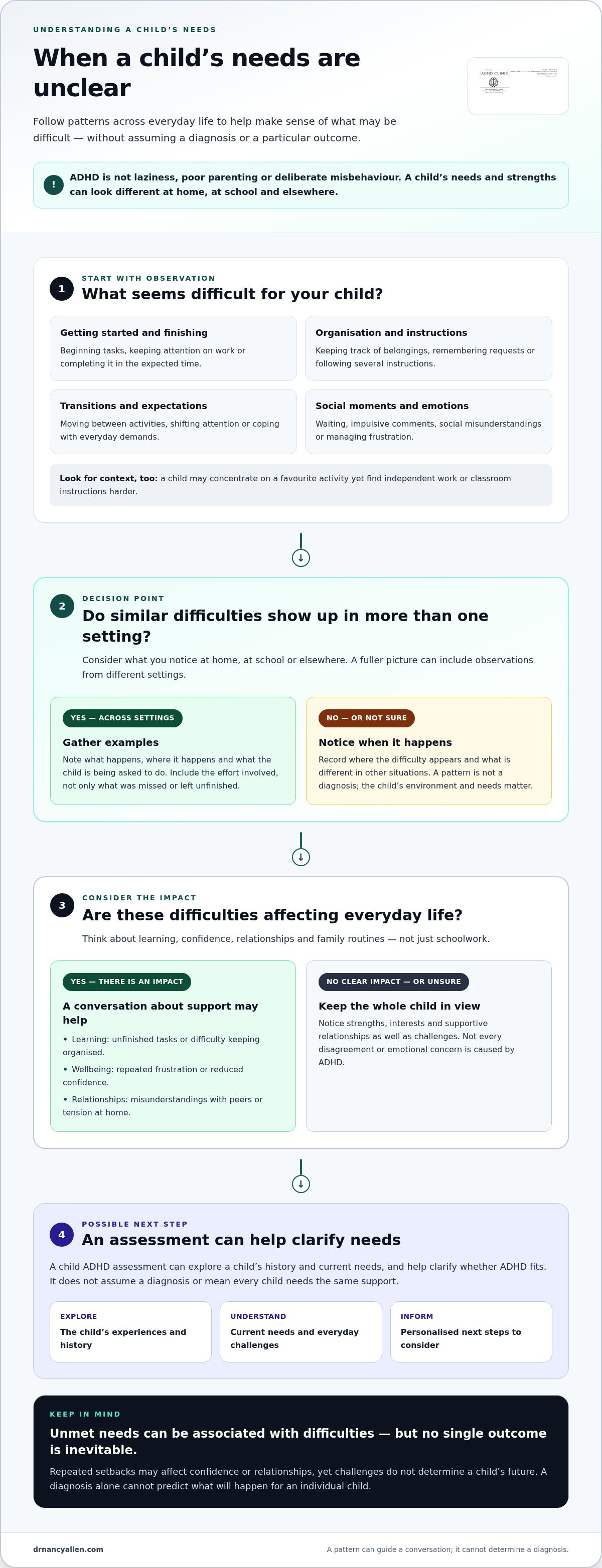
If you’re concerned, you don’t need to reach a conclusion straight away. Start by noticing what happens, where it happens and what seems to help. The aim is to build a clear picture of your child’s needs, not to prove a particular diagnosis.
Notice patterns and share clear examples
Brief notes can make a discussion with a teacher or clinician more specific. Record the situation, what happened beforehand, how your child responded and what helped afterwards. For example, note whether getting ready is harder after a change in routine, or whether a short, clear instruction helps them begin a task.
Record what’s going well, too. Include your child’s interests, strengths and the situations where they find a task easier. Observations from home and school may show whether a difficulty occurs in more than one setting or is linked to particular demands. Share information respectfully: keep notes private, avoid labelling language and involve your child in an age-appropriate way. The article on supporting children with ADHD at school may help you make school observations constructive.
Support the child while seeking clarity
Small adjustments can make everyday expectations easier to manage, although they won’t resolve every difficulty. Depending on what suits your child, you could try:
Keeping a predictable routine, with advance notice of changes where possible.
Giving one clear instruction at a time and asking your child what they understood.
Breaking a larger task into manageable steps, with a pause between them.
Offering calm reassurance when your child is distressed, then discussing what happened once they feel ready.
These strategies are supportive tools, not proof that your child has ADHD and not a substitute for an assessment. If a child is struggling, responding with curiosity rather than shame or punishment can help you explore what made the situation difficult. Keep reviewing what helps and what doesn’t; needs may vary by activity, setting or day.
When you seek a discussion, share the examples you’ve gathered and stay open to explanations other than ADHD. A child ADHD assessment can help clarify whether ADHD fits your child’s history and current needs, then inform personalised next steps. Understanding those needs can help families consider the cost of not treating childhood ADHD without assuming a diagnosis or a particular outcome in advance.
If you’d like to explore whether an assessment could help clarify your child’s needs, find out about child ADHD assessments.
How a child ADHD assessment can turn concern into informed next steps
When difficulties persist or affect everyday life, an assessment can help replace uncertainty with a clearer understanding of your child’s needs. It explores whether ADHD fits their history and current experiences, while recognising that other factors may also contribute. The purpose isn’t to judge your child or your parenting, and an assessment doesn’t guarantee a particular diagnosis or outcome.
What families can gain from a considered assessment
Greater clarity can help you make sense of patterns you’ve noticed and consider what might help at home, at school or in both settings. If ADHD is identified, the findings can inform personalised next steps. If it isn’t, the discussion may still help clarify other needs to consider. Either way, the focus is on understanding the individual child, rather than expecting every family to follow the same plan.
This perspective can also make it easier to discuss practical support with people involved in your child’s care and education. An assessment won’t instantly resolve every challenge, but it can offer a more informed starting point than trying to interpret difficulties alone. For families worried about the cost of not treating childhood ADHD, it can help explore what is happening without assuming every concern is caused by ADHD or that every child needs the same intervention.
Choose a next step that feels manageable
You might consider seeking professional guidance if concerns are persistent, appear across situations or affect your child’s learning, confidence or relationships. You don’t need to be certain ADHD is the explanation before asking for help. Bringing your observations and questions to a clinical discussion can be a manageable way to explore what may be behind them.
Seeking an assessment can feel like a significant step, particularly if you’re concerned about labels or what a diagnosis might mean. A considered assessment is an opportunity to understand your child more fully, not a prediction of their future. Dr Nancy Allen is a private GP with more than 25 years of clinical experience, offering child ADHD assessments and secure online consultations for families across the UK.
If you feel ready to explore whether an assessment could help clarify your child’s needs, find out about Dr Nancy Allen’s child ADHD assessment.
Take a thoughtful next step towards clarity
The cost of not treating childhood ADHD can include the effects of unmet needs on a child’s wellbeing, learning and relationships, but it doesn’t predict their future. Difficulties may have more than one explanation, and outcomes vary. Noticing patterns, recording what helps and seeking a considered assessment can give you a clearer basis for deciding what support may suit your child.
An assessment isn’t a judgement of your child or your parenting. It can help clarify whether ADHD fits their history and current needs, and inform personalised next steps. You don’t have to be certain of the answer before exploring your concerns.
Dr Nancy Allen offers child ADHD assessments with compassionate, personalised care. With more than 25 years of clinical experience and secure online consultations available across the UK, she can help families seeking a clearer understanding of their child’s needs.
Explore child ADHD assessment and find a clearer way forward. With the right information, you can take the next step at a pace that feels manageable and support your child with greater understanding.
Frequently Asked Questions
What happens if childhood ADHD is left untreated?
There’s no single outcome: some children may continue to find attention, organisation, emotional regulation or relationships difficult if their needs aren’t understood or supported. The cost of not treating childhood ADHD can involve effects on wellbeing and everyday life, but it doesn’t predict what will happen to an individual child. Noticing persistent difficulties can help families explore useful support without assuming ADHD is the only possible explanation.
Can untreated ADHD affect a child’s school performance?
Yes, ADHD-related difficulties may affect schoolwork, though they don’t determine a child’s ability or potential. A pupil might understand a lesson but struggle to start an assignment, follow several instructions, stay focused or remember equipment. These challenges can affect task completion and confidence, particularly if they’re mistaken for a lack of effort. Sharing clear observations with school staff may help identify practical support, while further assessment can clarify what may be contributing.
Does untreated childhood ADHD cause problems in adulthood?
Some people with ADHD continue to experience difficulties as adults, and unmet needs during childhood may be associated with challenges over time. That doesn’t prove ADHD caused a particular adult’s difficulties or mean every child will have problems later. Experiences vary, and a child’s future can’t be predicted from a diagnosis alone. Recognising needs may help families and professionals consider support suited to the child, but outcomes are not fixed.
Is every child with ADHD affected in the same way?
No. ADHD can affect children differently, and the same child may find some settings or tasks easier than others. Their strengths, development, environment, relationships and any other needs all contribute to their experience. One child may struggle most with organisation, whilst another may need help managing restlessness or impulsive responses. A careful assessment considers the individual child rather than assuming one description or support plan fits everyone.
Can a child with ADHD do well without medication?
Yes, a child may do well without medication, though what helps depends on their needs and circumstances. Support might include predictable routines, clear instructions, manageable steps, school adjustments or guidance for parents and carers. Medication is one possible part of care, not an automatic requirement for every child. Treatment decisions should be discussed with a clinician and family, taking account of the child’s difficulties, strengths and preferences where appropriate.
How can I support my child while waiting for an ADHD assessment?
Try a predictable routine, give one clear instruction at a time and break larger tasks into smaller steps. Notice when difficulties occur and what seems to help, including your child’s strengths and interests. Share relevant observations with school staff in a respectful, practical way, whilst protecting your child’s privacy. If they become distressed, offer reassurance and explore what felt difficult once they’re calm. These adjustments may help, but don’t confirm or rule out ADHD.
Does an ADHD assessment guarantee a diagnosis?
No. An assessment explores whether ADHD fits a child’s history and current needs; it can’t guarantee a particular diagnosis or outcome. The findings may indicate that ADHD is a suitable explanation or that other factors should be considered. Either way, discussing the results can help families understand their child’s needs and consider personalised next steps. An assessment is a route to greater clarity, not a judgement of the child or family.



Comments