


ADHD and Oppositional Defiance: Understanding the Link

Updated: 24 minutes ago
Defiance isn’t always deliberate. Oppositional defiant disorder (ODD) involves a persistent pattern of emotional and behavioural symptoms lasting at least six months, which can disrupt family life, school or social activities. Oppositional defiance and ADHD can occur together; impulsivity linked with ADHD may intensify conflict, although it doesn’t explain every oppositional behaviour.
If arguments, anger or refusal seem constant, it’s understandable to wonder whether a child is choosing to behave this way. Looking at the pattern in context can offer a clearer picture without labelling every difficult moment as a disorder.
This article explains what ODD is, how it can overlap with ADHD and other conditions, and what ADHD medication may change about oppositional symptoms. It also explains why assessment considers more than behaviour alone, including how long symptoms have lasted, where they occur and whether another condition may help explain them.
Table of Contents
What Is Oppositional Defiant Disorder?
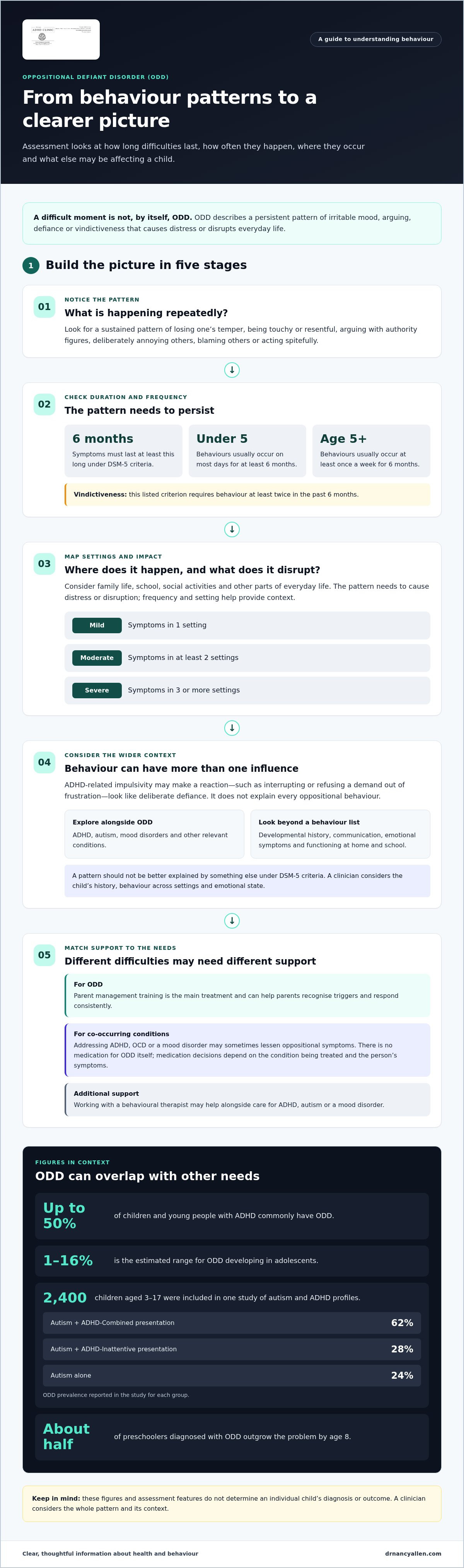
Oppositional defiant disorder (ODD) describes a persistent pattern of irritable mood, arguing, defiance or vindictiveness. DSM-5 criteria require symptoms lasting at least six months, with distress or disruption to everyday life.
For a clear overview of how ADHD and ODD can interact in children, watch this video:
Symptoms in adolescents with ADHD
In adolescents with ADHD, ODD means a sustained pattern of angry, argumentative or vindictive behaviour alongside attention difficulties or hyperactivity. The overlap matters because impulsive reactions, such as interrupting or refusing a demand out of frustration, can look like deliberate defiance. The pattern, duration and impact help distinguish them. ODD symptoms generally start in preschool years and almost always develop before the early teen years.
Adult symptoms and long-term outcomes
ODD is usually identified in childhood, but oppositional patterns can persist into adult life as frequent conflict, irritability, blame or resistance to rules. The condition can last from a few months to a lifetime, so childhood symptoms do not predict one fixed outcome. About half of preschoolers diagnosed with ODD outgrow the problem by age eight, while persistent difficulties deserve careful attention.
Behavioural and psychological symptoms
ODD symptoms include losing one’s temper, being touchy or resentful, arguing with authority figures, deliberately annoying others, blaming others and acting spitefully. Vindictive behaviour must have occurred at least twice in the past six months to meet that listed criterion. These behaviours can affect family life, school, social activities and work, particularly when anger and frustration are frequent.
Frequency and setting matter. For children younger than five, behaviours usually need to occur on most days for at least six months; from age five, they usually need to occur at least once a week for six months. Mild ODD describes symptoms in one setting, moderate ODD in at least two, and severe ODD in three or more. The pattern should not be better explained by something else under DSM-5 criteria.
ODD is estimated to develop in 1-16% of adolescents, and it is often found in children under 12. A clinician considers whether symptoms are persistent and impairing, rather than treating one difficult argument as evidence of a disorder. For example, repeated conflict at home and school carries different assessment context from occasional refusal during a stressful change.
Misdiagnosis can happen when overlapping symptoms are considered in isolation. ADHD-related hyperactivity and impulsivity, or symptoms associated with a mood disorder, may affect how a young person reacts to demands. A child’s history, behaviour across settings and emotional state help clarify whether ODD, ADHD, another condition or several factors best explain the difficulties.
ADHD and other co-occurring conditions
ODD and ADHD can occur together because difficulties with attention, impulse control and frustration may overlap. No single factor explains every child’s experience. Understanding each condition helps distinguish related symptoms from separate needs.
ODD alongside ADHD and autism
ODD may co-occur with ADHD, autism or both, creating a more complex picture of a child’s behaviour. One study examined 2,400 children aged 3-17 and found ODD in 62% of children with autism and ADHD-Combined presentation. The prevalence was 28% for autism with ADHD-Inattentive presentation, and 24% for autism alone. These differences show why an assessment considers the combination of needs, not one behaviour in isolation.
Why ODD and ADHD occur together
There isn’t one simple explanation for why ODD and ADHD occur together. Challenges with impulse control, attention, frustration and managing emotions can interact: a child may react before considering a request, then become angry when corrected. ODD is commonly seen in up to 50% of children and young people with ADHD. This overlap makes it useful to look at when behaviour happens, what precedes it and how it affects daily life.
Medication for co-occurring conditions
There is no medication for ODD itself, but treating a co-occurring condition can sometimes lessen oppositional symptoms. For example, addressing ADHD, OCD or a mood disorder may reduce difficulties that contribute to conflict. Medication decisions depend on the condition being treated and the person’s symptoms; medication is not usually the first treatment for ODD. Separating treatment goals helps families understand what medicine may change and what still needs other support.
Treating co-occurring conditions
Care can address both the child’s mental health needs and patterns affecting family or school life. Parent management training is the main treatment for ODD and can help parents recognise triggers and respond consistently. Working with a behavioural therapist may also help alongside care for ADHD, autism or a mood disorder. A child ADHD assessment can clarify whether attention difficulties, hyperactivity or impulsivity are part of the picture.
Screening should consider more than a checklist of behaviours. A clinician can explore the child’s developmental history, communication differences, emotional symptoms and functioning at home and school. For instance, refusal during an overwhelming change may call for a different response from repeated arguments across several settings. These distinctions help shape support around the child’s needs, rather than treating every conflict as the same problem.
Does ADHD medication help with ODD symptoms?
In the UK, parents can access group-based parenting programmes to learn behaviour-management strategies. Parent training can also help parents and teachers understand oppositional behaviour and its triggers, supporting a more consistent approach at home and school.
Managing a child’s ADHD first may reduce oppositional behaviour. ADHD medication targets ADHD symptoms, such as difficulties with attention, impulsivity or hyperactivity; it does not treat ODD itself. That distinction matters when a child’s arguing or refusal continues, because the remaining behaviour may need support beyond medication.
There is no medication for ODD, and medication is not usually its first treatment. Treating co-occurring conditions such as ADHD, OCD or mood disorders can lessen ODD symptoms. If a child also shows signs of depression, a clinician can consider those emotional symptoms as part of the wider picture, rather than assuming every difficulty comes from ODD.
For ODD, parent management training is a central treatment approach. In these programmes, parents practise strategies between weekly sessions and discuss their progress. They can try short, focused commands, then praise the child for completing the requested steps. Consistency between parents matters too: agreeing how to respond to repeated refusal can reduce mixed messages.
Practical school support can build on the same principles. Parents and teachers can share observations about when arguments occur, what triggers them and which responses help the child complete a task. For example, a short instruction followed by praise for the first completed step gives adults a clear response to use consistently. This can also help distinguish attention or impulsivity difficulties from deliberate refusal. In pre-school and nursery settings, working with specialists such as Awake Early Years Consultancy can help early years educators establish effective behavioural strategies and supportive routines.
Individual or family sessions with a behavioural therapist may complement treatment for ADHD or another co-occurring condition. As highlighted by Benessere Marriage and Family Therapy, Inc, integrating psychoeducation into therapy can help families understand recurring patterns and develop practical strategies for managing them. A child can explore emotional triggers, while family conversations can focus on recurring conflict and agreed responses. The aim is to understand the pattern and practise more constructive interactions, not to blame a parent or child.
Medication decisions should reflect the symptoms being treated. If ADHD symptoms improve but conflict remains, that is useful information for reviewing the support plan. Changes in mood, sleep or behaviour can also help clinicians understand whether depression or another condition needs attention. Tracking specific examples at home and school gives families a clearer account to discuss during treatment reviews.
ODD prevalence by diagnostic group
ODD rates differ across diagnostic groups, so a percentage describes a study group, not an individual child. Assessment also considers symptoms, their impact and possible explanations.
In the UK, co-occurring ODD and ADHD are assessed by examining each condition’s symptoms and history separately, alongside their effects at home and school. DSM-5 criteria state that ODD symptoms must not be better explained by something else.
A child can be assessed by a clinician experienced in ADHD and children’s mental health. Parents or carers and school staff can provide useful observations about behaviour in different settings.
In one study, 53% of children with ADHD-Combined presentation met criteria for ODD. The figure was 14% among children with ADHD-Inattentive presentation only. That difference shows why ADHD presentation matters when interpreting group findings. It does not determine whether a particular child has ODD, or explain the causes of their behaviour.
These percentages are best understood as comparisons between diagnostic groups. They suggest that oppositional symptoms may be more common in some groups than others, but they cannot replace an individual assessment. For example, a child with an inattentive presentation may still have persistent ODD symptoms, while another child with combined symptoms may not meet ODD criteria.
DSM-5 criteria help structure an ODD assessment. They consider patterns such as irritability, arguing, defiance and vindictiveness, alongside duration and impact. The criteria also require that symptoms are not better explained by another condition. This matters when attention difficulties, hyperactivity or emotional distress could contribute to behaviour that looks oppositional.
Assessment looks beyond a single argument or school incident. A clinician can consider the child’s developmental history, family observations and examples from school, then compare the pattern with diagnostic criteria. For instance, repeated conflict across home and school provides different information from a brief change in behaviour during a stressful period.
Screening for co-occurring needs can clarify what support may help. If a child has attention difficulties alongside repeated defiance, assessment considers whether both ADHD and ODD criteria are met. School reports about difficulty following instructions can be weighed alongside what parents observe at home. This broader view helps distinguish overlapping symptoms without assuming one diagnosis explains everything.
Group rates can guide understanding, but diagnosis depends on the child’s own pattern. The difference between 53% and 14% highlights why presentation is relevant; it does not make a diagnosis automatic. A careful assessment connects the criteria with specific examples, the settings where difficulties occur and their effect on everyday functioning.
ADHD-related impulsivity and oppositional behaviour
ADHD-related impulsivity can make a child react before they have time to pause, especially when faced with demands or frustration. For example, a child might interrupt or immediately refuse a task, then regret the response once calmer. That moment alone does not establish oppositional defiant disorder (ODD). The distinction is whether a persistent pattern of ODD symptoms also affects relationships and daily life.
Impulsivity may intensify disagreements without being the same as deliberate defiance. A young person who blurts out “no” when asked to stop a game may be struggling to shift attention; repeated arguing, blaming others or vindictive behaviour suggests a different pattern to explore. Understanding the link between oppositional defiance and ADHD can help families describe these reactions without treating every impulsive response as intentional opposition.
Context matters. A child may respond calmly to a familiar instruction but become distressed when a noisy classroom, difficult task or unexpected change adds pressure. Anxiety can also affect behaviour: avoiding a feared activity may look like refusal, while frustration about a task can lead to an argument. These examples do not prove a diagnosis, but they help clarify what may be driving the response.
Look for patterns across relationships and settings rather than judging one difficult exchange. Parents might note whether conflict arises around transitions, homework or screen time; school observations can show whether similar difficulties occur with teachers or peers. If behaviour is mainly linked to attention demands, impulsivity may be prominent. If persistent hostility or vindictiveness appears across situations, ODD symptoms may need separate consideration.
This distinction can help prevent a child from being labelled simply “bad” or “defiant”. ADHD can affect waiting, stopping an activity and remembering instructions; repeated criticism or punishment may deepen conflict without addressing those difficulties. A consistent adult response, such as a brief instruction followed by praise for the first completed step, gives the child a clearer expectation and helps parents observe what changes.
Conduct problems, anxiety and mood difficulties can overlap with ADHD and ODD, so assessment considers more than visible behaviour. A clinician may ask about the child’s emotional state, triggers, developmental history and functioning at home and school. For example, withdrawing from friends alongside refusing school raises different questions from impulsive interruptions during lessons. Understanding oppositional defiance and ADHD together means exploring how attention, emotion and behaviour interact, rather than assuming one cause explains every conflict.
For adults, a history of impulsive reactions or recurring conflict can also be relevant when exploring longstanding attention difficulties. An ADHD assessment can help examine whether ADHD-related symptoms form part of that history and how they affect everyday relationships.
Dr Nancy Allen: Adult ADHD Assessment
Dr Nancy Allen’s Adult ADHD Assessment can help adults explore whether attention difficulties, impulsivity or longstanding patterns of conflict may relate to ADHD. A clear assessment can provide a better understanding of symptoms and inform personalised treatment planning.
This may be a useful next step if difficulties with focus, organisation or relationships have persisted into adult life and affect everyday routines. Dr Nancy Allen offers secure online consultations to patients across the United Kingdom, with diagnoses and personalised treatment plans provided within as little as 72 hours.
An assessment can clarify ADHD-related needs, though it does not replace specialist support for a child’s ODD or provide emergency care. To explore an Adult ADHD Assessment, visit drnancyallen.com or book an appointment with Dr Nancy Allen.
Choose a clearer next step
Understanding the relationship between oppositional defiance and ADHD can help families move from repeated conflict towards a more informed conversation about support. A useful next step is to note which difficulties affect daily life, where they arise and what seems to trigger them. These observations can help focus an assessment and give families a clearer starting point.
Dr Nancy Allen offers Adult ADHD Assessment and Child ADHD Assessment for people exploring whether ADHD may be contributing to difficulties. She also offers Peri-menopause & Menopause Specialist Care. The right support depends on the question you want to address, whether it concerns a child’s behaviour, your own attention and organisation, or another health need.
If you’re ready to discuss ADHD assessment, you can contact Dr Nancy Allen. Taking a considered next step can help you approach the challenges with greater clarity and confidence.
Frequently Asked Questions
How does ODD affect adults with Attention-Deficit/ Hyperactivity Disorder?
For adults with ADHD, longstanding oppositional difficulties can contribute to friction at home, work or in close relationships. For example, impulsive replies may escalate a disagreement, while persistent resentment or blame can make it harder to resolve. To explore the pattern, note recurring situations, their effect on relationships and whether attention or emotional regulation difficulties are also present. An adult assessment can help clarify ADHD-related needs.
How is ODD diagnosed?
ODD is diagnosed through a clinical assessment of behaviour, emotional symptoms, duration and impact. A professional considers examples from everyday life, such as repeated arguments with caregivers or persistent conflict at school, rather than relying on one incident. DSM-5 criteria also require that symptoms aren’t better explained by another condition. Information from parents, carers and teachers can help build a fuller account of how the pattern appears in different settings.
How is ODD different from ADHD?
ADHD primarily involves persistent difficulties with attention, hyperactivity or impulsivity; ODD centres on a pattern of irritable, argumentative or defiant behaviour. The distinction can be subtle: interrupting because a child acts impulsively differs from repeatedly arguing or blaming others. Both conditions can occur together, so noting what happens before and after a disagreement can help describe the behaviour accurately during an assessment.
What does ODD look like?
ODD may involve frequent temper loss, arguing with adults, refusing reasonable requests, deliberately irritating others or blaming someone else after a conflict. A child might repeatedly argue about getting ready for school, then insist someone else caused the disagreement. Look at the pattern and its effect rather than interpreting a single refusal as a diagnosis. Adults may also notice recurring resentment or conflict in relationships.
What is ODD?
Oppositional defiant disorder is a mental health condition involving a persistent pattern of irritable mood, defiance, arguments or vindictive behaviour. It is more than occasional frustration: the pattern causes difficulties in daily life, such as repeated disruption to family routines or problems with friendships. A professional considers the child’s age, circumstances and behaviour over time before deciding whether the diagnostic criteria fit.
When should my child see their healthcare provider?
Arrange an assessment when behaviour persists, causes distress or repeatedly disrupts home, school or friendships. Bring concrete examples, such as what happened before an argument, how often similar incidents occur and how your child responds afterwards. Include observations from school, since behaviour can differ between settings. For immediate danger or a medical emergency, seek urgent help rather than waiting for a routine appointment.
What is oppositional defiant disorder (ODD), and how is it different from ADHD?
ODD describes a persistent pattern of oppositional, argumentative or irritable behaviour, whereas ADHD involves attention difficulties, hyperactivity or impulsivity. The conditions are not interchangeable, though a child may meet criteria for both. For instance, missing an instruction because attention wandered differs from repeatedly refusing it and starting an argument. Assessment considers the reasons, duration and impact of behaviour, not simply whether a child says “no”.
How common is ODD in children with ADHD?
ODD is commonly seen in up to 50% of children and young people with ADHD, though prevalence differs across groups and studies. One study found ODD in 53% of children with ADHD-Combined presentation and 14% with ADHD-Inattentive presentation only. These figures describe groups, not an individual child. They can provide context, but diagnosis depends on the child’s own symptoms and how they affect everyday life.



Comments