


The Cost of Not Treating Adult ADHD: Hidden Impacts

Updated: 23 hours ago
What if the cost of not treating adult adhd isn’t one clear expense, but the strain that builds when everyday difficulties keep repeating? Missed deadlines, forgotten tasks and plans that are hard to follow through can affect work, relationships and confidence. If you’ve blamed yourself for not trying hard enough, persistent difficulties may be worth exploring rather than simply pushing through.
There’s no single pattern or outcome. Not every adult with ADHD experiences the same challenges, and support can’t remove every obstacle. This article looks at possible personal and practical costs of going without recognition or support, from the effort of staying organised to effects on wellbeing. It also explains how to notice patterns that may be worth discussing with a clinician and how an adult ADHD assessment can help make sense of your experiences and consider personalised next steps. Seeking clarity isn’t an admission of failure, and it’s not too late to explore what may help.
Table of Contents
What is the cost of not treating adult ADHD, and what does “untreated” mean?
How can adult ADHD affect wellbeing, work and relationships?
What are the financial and opportunity costs of unsupported ADHD?
How can you recognise the impact and prepare for a helpful conversation?
How can an adult ADHD assessment help you consider next steps?
What is the cost of not treating adult ADHD, and what does “untreated” mean?
The cost of not treating adult adhd isn’t a single bill or a predictable outcome. “Cost” can mean the effort and consequences associated with persistent difficulties: strain on wellbeing and routines, friction in relationships, or challenges at work and with opportunities. These effects aren’t inevitable, and they vary widely. A difficulty that seriously disrupts one person’s life may be manageable for someone else, depending on their circumstances and the support around them.
“Untreated” also means more than not taking medication. An adult may be undiagnosed, may know they have ADHD but have little practical or clinical support, or may have a management plan that doesn’t suit their needs. The Adult attention deficit hyperactivity disorder overview describes a range of symptoms and impacts, but a general account can’t predict how ADHD will affect any individual.
For a broader look at how ADHD may carry economic effects, you can watch this report:
Why “untreated” does not mean the same thing for everyone
Diagnosis and support are related, but they aren’t the same. Someone may have a diagnosis and useful adjustments or strategies; someone else may recognise recurring difficulties without knowing what could be contributing to them. Practical support might include routines, changes to how tasks are organised, or understanding from people around them. Medication may be discussed as part of care, but it isn’t necessary or suitable for everyone.
People also differ in the strategies they’ve developed and the demands they face. A system that works well in one role or stage of life may become harder to maintain when responsibilities change. This doesn’t mean a person has failed. It may be a sign that their current approach needs reconsidering.
How ADHD-related difficulties can become cumulative
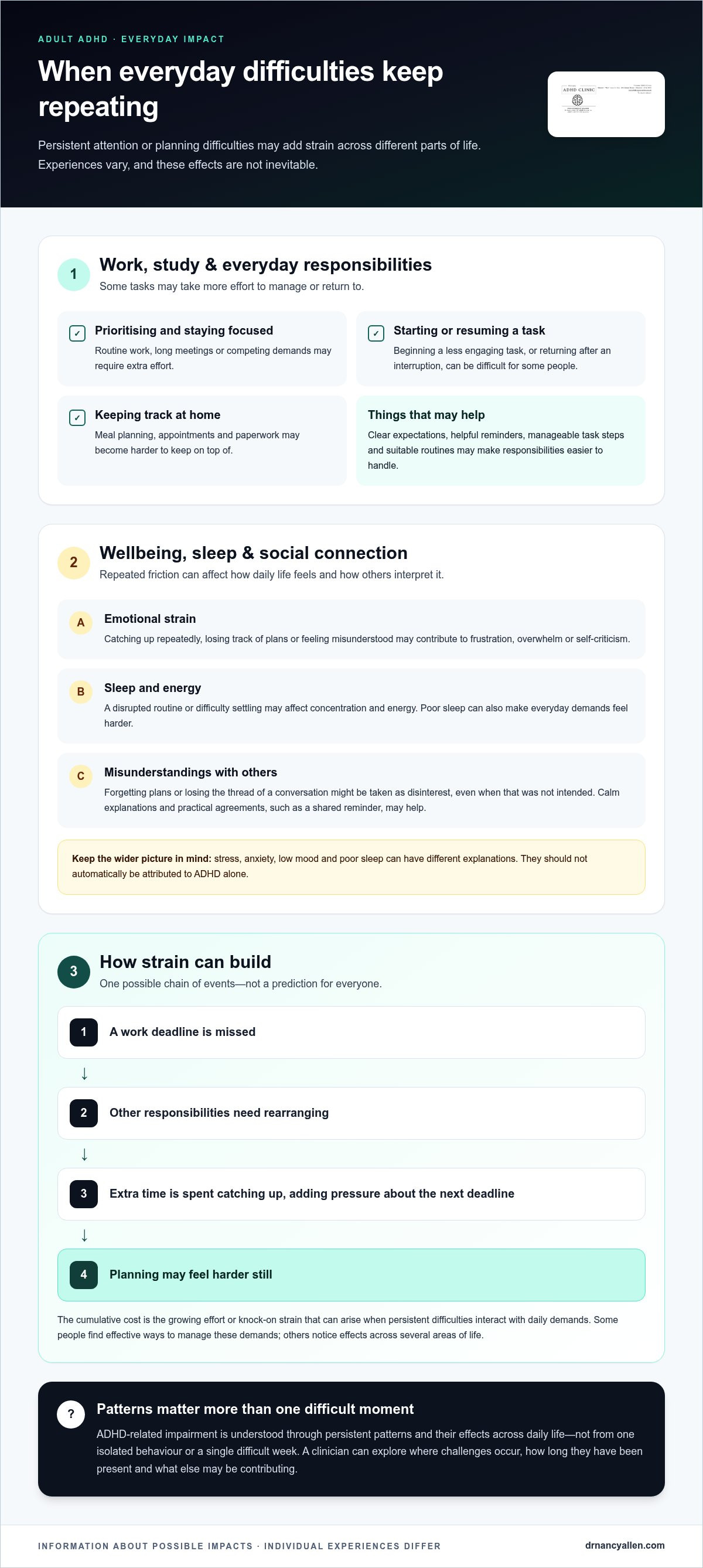
A recurring difficulty with attention or planning may affect more than one task. For example, missing a work deadline could mean rearranging other responsibilities, spending extra time catching up and feeling more pressure about the next deadline. That pressure might make planning feel harder still. This is one possible chain of events, not proof that ADHD inevitably causes a particular outcome.
The cumulative cost is the growing effort or knock-on strain that can arise when persistent difficulties interact with daily demands, not a prediction that every adult with ADHD will be harmed. Some people find effective ways to manage these demands; others notice effects across several areas of life. Identifying a pattern can help you work out what is affecting you, without reducing your experience to a label or assuming a single cause.
How can adult ADHD affect wellbeing, work and relationships?
ADHD-related difficulties can look different from one setting to another. Trouble shifting attention might make it harder to follow a long meeting, keep track of household paperwork or stay present in a conversation. These are possible experiences, not a checklist, and they don’t mean every adult with ADHD will face problems in each area.
The cost of not treating adult adhd can include the effort of managing repeated friction, as well as its effects on confidence, responsibilities and connection with others. However, anxiety, low mood and poor sleep can have different explanations and shouldn’t automatically be attributed to ADHD alone.
Work, study and everyday responsibilities
At work or during study, prioritising tasks, maintaining attention on routine activities and switching between competing demands may take extra effort. Someone might complete complex work well but struggle to begin a less engaging task, or find it difficult to return to a task after an interruption. At home, similar challenges could affect meal planning, appointments or keeping up with paperwork.
Context matters. Clear expectations, helpful reminders, manageable task steps and routines that suit the individual may make responsibilities easier to handle. A change in role or workload can alter how well existing strategies work. An adult ADHD assessment guide explains how an assessment can consider a person’s history and the impact of difficulties across settings.
Emotional wellbeing, sleep and social connection
Repeatedly having to catch up, losing track of plans or feeling misunderstood can contribute to frustration, overwhelm or self-criticism for some people. These feelings deserve attention, but they don’t establish that someone has ADHD. Stress, anxiety and low mood can overlap with attention difficulties. A clinician can consider the broader picture instead of assuming one cause.
Sleep can also be part of that picture. A disrupted routine or difficulty settling may affect concentration and energy, while poor sleep can itself make daily demands feel harder. It’s useful context, not proof of ADHD. Socially, forgetting a plan or losing the thread of a conversation might be interpreted as disinterest, even when that wasn’t intended. A calm explanation and practical agreements, such as using a shared reminder, may help reduce misunderstandings.
ADHD-related impairment is understood through persistent patterns and their effects across daily life, not from one isolated behaviour or a single difficult week. A clinical discussion can explore where challenges occur, how long they have been present and what else may be contributing. For some people, this brings useful clarity. It doesn’t guarantee a diagnosis or mean every challenge will disappear.
If these patterns feel familiar and consequential, learn about adult ADHD assessment and personalised care as a possible next step.
What are the financial and opportunity costs of unsupported ADHD?
The cost of not treating adult adhd isn’t limited to money leaving your bank account. Some effects may be visible, such as replacing a misplaced item or paying a late fee. Others are harder to count: time spent catching up, an opportunity you didn’t feel able to pursue, or emotional energy used to manage recurring friction. These examples can help you reflect, but they aren’t inevitable outcomes or evidence that someone has ADHD.
The table separates possible impacts into four categories. One experience could fit more than one, and none is inevitable.
Visible expenses and less visible opportunity costs
Small expenses can be easier to notice than the time and effort involved in managing a task. Replacing a lost everyday item has a direct cost; searching for it may also take time and disrupt the rest of the day. A missed appointment or payment might bring a fee, but the reason could vary, from a change in circumstances to an administrative error. These examples aren’t specific to ADHD, and financial difficulty alone can’t establish a diagnosis.
Opportunity costs can be personal rather than financial. Someone might turn down an extra responsibility because they’re already using considerable energy to keep up with existing demands. Another person may thrive in the same situation with suitable routines or a supportive environment. The useful question is what is happening for you, not what an experience is assumed to mean.
How to interpret research on ADHD-related costs
Economic studies estimate patterns across groups, but results depend on whom researchers studied, which outcomes they counted, the healthcare system involved, the methods used and when the research took place. Findings from another country or an older study may not translate directly to present-day life in the UK. An association between ADHD and an outcome also doesn’t, by itself, prove that ADHD caused it. Other personal and social factors may contribute.
Population-level economic estimates cannot predict one individual’s personal costs. Instead of applying a broad figure to yourself, consider which effects, if any, recur and matter in your circumstances. This keeps the discussion grounded and avoids turning a research estimate into a personal forecast.
How can you recognise the impact and prepare for a helpful conversation?
If you’re wondering whether ongoing difficulties deserve attention, you don’t need to arrive with a diagnosis or a perfect explanation. A short record of what happens in everyday life can make it easier to describe your concerns and consider what support may be useful. The aim is to notice patterns and their effects, not to judge yourself.
Try this four-step reflection:
Notice patterns. Which difficulties keep returning, such as starting tasks, keeping track of plans or shifting attention?
Record examples. Note what was happening, what felt difficult and the practical or emotional effect.
Consider settings. Think about where the pattern occurs, such as at work, at home or socially, if relevant. Has it changed with different routines or demands?
Identify priorities. Which difficulty would you most like to understand or address? Include strategies that help, strengths you draw on and circumstances that make things easier or harder.
A practical way to record day-to-day effects
A brief diary can be enough. For each example, note the situation, the difficulty, its impact and anything that helped. For instance, you might write that an appointment was missed after a change to your routine, that this caused disruption, and that a calendar reminder made the next appointment easier to manage. Include only the areas of life that matter to your experience.
Look for recurring patterns over time rather than treating one difficult day as proof of anything. Record helpful adjustments too: they can show what already works and which conditions support you. You don’t need exhaustive notes or a particular format. Clear, ordinary examples are often more useful than trying to match your experience to a symptom checklist.
When another explanation may also need consideration
Stress, sleep problems, mood concerns and other health factors can affect concentration and organisation. They may overlap with ADHD-related experiences, occur alongside them or have another explanation. For those looking to investigate wider physical wellbeing or rule out other physiological factors, clinical and diagnostic providers such as ukmedicarescreening.com offer accessible health screening options across the UK. An overlap doesn’t prove or rule out ADHD. Note changes in your health or circumstances as part of the picture, rather than trying to decide the cause alone.
A clinical assessment considers the wider context, including developmental history, symptoms and how difficulties affect daily functioning. Your notes can help guide that discussion, but they aren’t a test you have to pass. An assessment may help clarify whether ADHD fits your experiences and support a conversation about personalised next steps, without guaranteeing a particular conclusion.
Reflecting on the cost of not treating adult adhd is most useful when it helps you identify persistent, meaningful effects without blame. The adult ADHD assessment and support guide explains how an assessment can offer a route to greater clarity. You can also explore adult ADHD assessment as a considered next step.
How can an adult ADHD assessment help you consider next steps?
An adult ADHD assessment can help make sense of persistent difficulties by considering how they fit with your history, symptoms and everyday experiences. It isn’t simply a checklist or a judgement about how well you cope. A clinician considers the wider context and whether ADHD may explain the patterns, while recognising that other factors can affect concentration, organisation and wellbeing.
The purpose is greater clarity, not a guaranteed diagnosis or a promise that every challenge will disappear. If ADHD is identified, the discussion can turn to support that may suit your individual circumstances. If it isn’t, understanding what else may be contributing can still inform a constructive conversation about what to do next.
What clarity from an assessment can and cannot provide
A clinical assessment looks beyond one difficult period or an isolated experience. It considers symptoms and their impact across a person’s life, alongside developmental history and relevant circumstances. This broader view helps distinguish recurring patterns from challenges that may be better understood in another way. Preparing examples can support the conversation, but you don’t need to work out the explanation yourself beforehand.
An assessment can guide discussion about possible next steps, but it can’t guarantee changes in work, finances, relationships or other life circumstances. Support may help you understand your needs and consider suitable options; it isn’t a guaranteed financial solution. Workplace rights and support are a separate practical consideration. For background on that context, explore ADHD rights and support in the UK.
A supportive route towards personalised care
Dr Nancy Allen is a private GP specialising in adult ADHD assessment and personalised care, with more than 25 years of clinical experience. Secure online consultations are available to patients across the UK. An individual assessment offers space to explore your concerns, consider the clinical picture and discuss what might be helpful, without assuming in advance what the conclusion or plan should be.
You can help make the conversation useful by sharing what you most want to understand, how difficulties affect your day-to-day life and what already helps. It’s also reasonable to talk about uncertainty. You may be exploring whether ADHD fits, rather than arriving convinced of a particular answer. Care is a collaborative process shaped around the person and the information gathered, rather than a one-size-fits-all promise.
Considering the cost of not treating adult adhd can prompt you to seek clarity, not give you a reason to feel pressured or blame yourself. If you’re ready to explore whether an assessment may be a helpful next step, explore adult ADHD assessment with Dr Nancy Allen.
Take a thoughtful next step towards clarity
You don’t have to wait until difficulties become overwhelming to ask questions about them. A useful next step can be deciding what you’d most like to understand, then bringing a few examples of how it affects your daily life. The cost of not treating adult adhd isn’t a fixed prediction, and seeking an assessment doesn’t commit you to a particular explanation or course of care. It creates an opportunity to explore what may be behind persistent challenges and consider options that fit your circumstances.
Dr Nancy Allen offers adult ADHD assessment and personalised care through secure online consultations for patients across the UK. Learn about the approach and decide whether it feels like a helpful next step.
Explore adult ADHD assessment with Dr Nancy Allen. Seeking clarity is a constructive step, and you can take it at your own pace.
Frequently Asked Questions
Can adults with ADHD live well without medication?
Yes, adults with ADHD can live well without medication, although what helps is personal. Some people use practical approaches such as breaking larger tasks into smaller steps, setting external reminders, keeping regular routines or using workplace adjustments. Others may discuss medication as one option with a clinician. A useful plan fits the person’s needs, preferences and circumstances rather than assuming everyone needs the same treatment.
Does untreated ADHD affect life expectancy?
ADHD itself doesn’t mean that an individual will have a shorter life. Research has reported associations between ADHD and some health and safety risks, but group-level findings can’t predict one person’s lifespan or establish what caused an outcome. Other health conditions and personal circumstances matter. If you’re concerned about your health or safety, discuss those specific concerns with a clinician rather than treating a broad statistic as a personal forecast.
Can untreated ADHD lead to burnout?
Ongoing effort to manage competing demands may contribute to exhaustion for some adults, but burnout isn’t an inevitable consequence of ADHD. For example, repeatedly using evenings to catch up on work could leave less time for rest. Heavy workloads, stress and other health factors can also play a part. If tiredness or overwhelm persists, consider discussing both the pressures you face and their effect on your wellbeing with a clinician.
Does ADHD get worse as you get older?
ADHD doesn’t necessarily worsen with age, though its effects may feel different as circumstances change. Someone who managed well with a predictable routine might struggle more after taking on caring responsibilities or a role with less structure. Coping strategies may also become less effective under new demands. A change in difficulty is worth exploring, but it doesn’t by itself show that ADHD has progressed or is the only explanation.
Is it too late to seek an ADHD assessment as an adult?
No, adulthood isn’t in itself a reason to rule out assessment. A clinician can explore your current concerns alongside relevant experiences from earlier life, including information you may be able to gather from school reports or someone who knew you as a child. Such material can be helpful, but the discussion should consider your individual history. Seeking an assessment later in life can still offer a clearer understanding of persistent difficulties.
Can ADHD be mistaken for anxiety or depression?
Yes, some experiences, such as difficulty concentrating or completing tasks, can occur with ADHD, anxiety or depression. These conditions can also co-exist, so noticing one doesn’t automatically explain the others. For instance, worry may disrupt focus, while repeated difficulties may add to stress. A clinician considers how symptoms began, how they vary over time and the wider health picture, rather than relying on one overlapping experience to decide.
How can I tell whether my difficulties might be related to ADHD?
You can’t confirm ADHD from a self-check alone, but you can note whether difficulties with attention, organisation or impulse control recur and affect more than one part of life. Consider whether similar patterns were present earlier in life, and whether changes in sleep, stress or health might also be relevant. Brief, dated examples can help a clinician understand the pattern and decide whether a full assessment may be appropriate.



Comments