


Managing Demand Avoidance: Effective Tips and Strategies

Updated: 9 hours ago
What if the "defiance" you encounter every day isn't a choice or a lack of discipline, but a neurological SOS for safety and autonomy? If you're living with someone who seems to recoil from the simplest requests, you likely know the chronic exhaustion that comes from constant negotiation. You might even feel like you're failing, or worry that their behaviour is simply laziness. We recognise that this is a valid neurodivergent profile, not a character flaw. This article shares the TOP TIPS TO MANAGE DEMAND AVOIDANCE, moving away from traditional control and towards a partnership that respects individual needs.
You deserve a household or workplace that feels peaceful rather than like a battlefield. By shifting your perspective from compliance to collaboration, you can significantly reduce the anxiety that drives these intense reactions. We'll explore professional strategies that provide practical tools for daily life, ensuring you feel validated and equipped to handle challenges with confidence. From subtle language shifts to environmental adjustments, you'll discover how to create a supportive space where everyone can thrive without the weight of constant conflict.
Table of Contents
Understanding Demand Avoidance: Why "No" is a Neurological Response
Many parents and adults find themselves trapped in a cycle of escalating conflict, where a simple request triggers an explosive or shut-down reaction. It's easy to label this as defiance or a lack of discipline, but for those with a demand avoidant profile, "no" isn't a choice; it's a reflex. This behaviour stems from a deep-seated neurological drive to maintain autonomy and safety. Unlike typical reluctance, which might be overcome with a reward or a firm boundary, this response is rooted in the brain's threat detection system. When we look for the TOP TIPS TO MANAGE DEMAND AVOIDANCE, we must first understand that we aren't dealing with a "naughty" child or an uncooperative colleague, but an individual whose nervous system is in a state of high alert.
Everyday reluctance happens when someone simply doesn't want to do something. Pathological Demand Avoidance (PDA), however, involves an inability to comply with even basic self-imposed demands, such as eating or dressing, because the perceived loss of control triggers a fight-flight-freeze response. Living with this level of constant resistance is exhausting. You might feel like you're walking on eggshells, constantly scanning the environment for potential triggers. It's common to feel like a failure when traditional techniques fall flat. Your exhaustion is valid, and the fear that you're "letting them get away with it" is a natural response to a very complex situation.
The Pervasive Drive for Autonomy (PDA) Profile
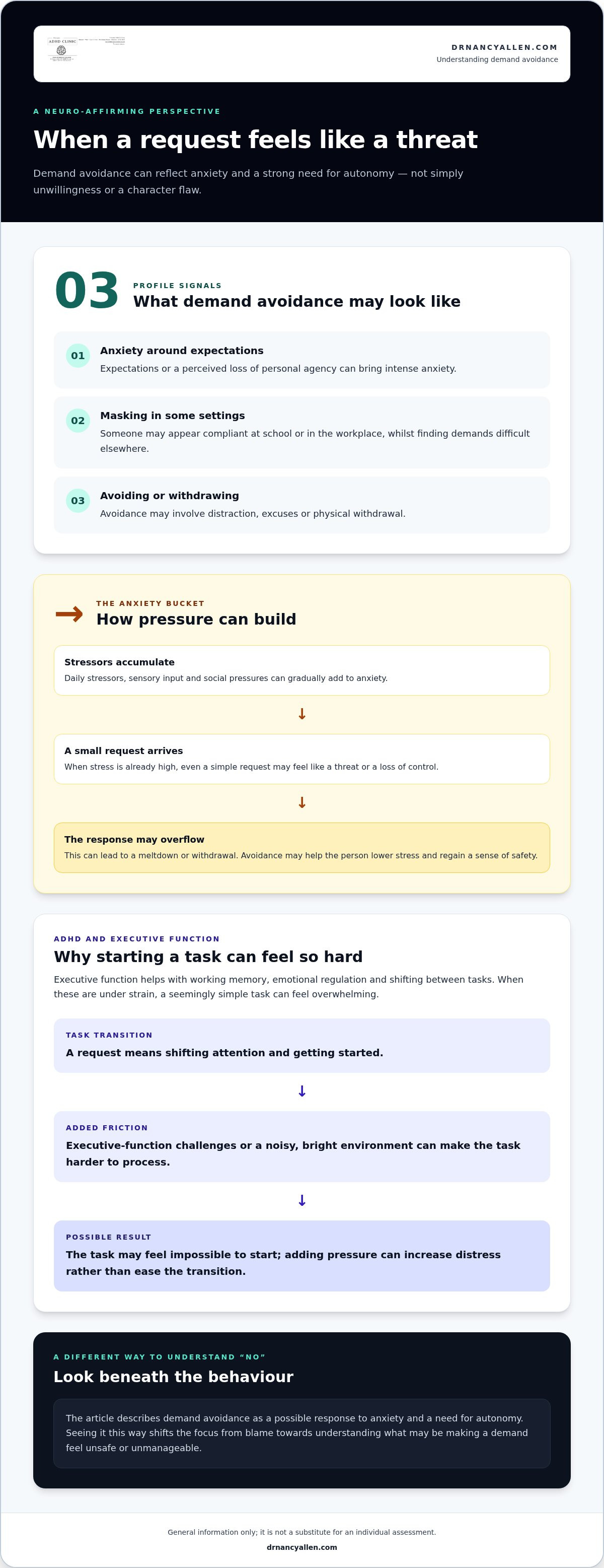
Clinicians and advocates are increasingly moving away from the term "Pathological" in favour of "Pervasive Drive for Autonomy." This shift reflects a more neuro-affirming view of the profile. Core characteristics often include:
Extreme anxiety when faced with expectations or loss of personal agency.
Using social mimicry or "masking" to appear compliant in specific settings, like school or the office.
Resisting demands through distraction, excuses, or physical withdrawal.
PDA is a neuro-affirming profile that prioritises personal agency rather than a deficit-based disorder that requires fixing.
The Role of Anxiety in Avoidant Behaviour
Imagine your brain perceives a request like "put your shoes on" as a physical threat. For a person with this profile, a direct demand feels like being backed into a corner. We often use the "anxiety bucket" analogy; daily stressors, sensory input, and social pressures slowly fill the bucket. When it's nearly full, a tiny request causes it to overflow, leading to a meltdown or total withdrawal. Avoidance serves as a vital coping mechanism to lower that internalised stress and regain a sense of safety. Recognising this helps us provide TOP TIPS TO MANAGE DEMAND AVOIDANCE that actually work by lowering the baseline anxiety rather than increasing the pressure.
The Neurobiology of Avoidance: ADHD, Hormones, and Executive Function
Understanding the internal mechanics of resistance requires a look at the brain's wiring. While demand avoidance is often discussed alongside autism, the overlap with ADHD is profound and frequently overlooked. Both conditions involve significant challenges with executive dysfunction. In an ADHD brain, dopamine regulation is often inconsistent. This neurotransmitter is crucial for motivation and the ability to shift gears between tasks. When a request is made, the brain needs a sufficient chemical signal to transition. Without it, the task feels physically impossible to start. This is why many TOP TIPS TO MANAGE DEMAND AVOIDANCE focus on reducing the friction of transitions rather than enforcing compliance.
Traditional "reward and punishment" systems often fail because they rely on a neurotypical response to consequences. For a neurodivergent individual, the threat of a punishment or the promise of a sticker doesn't bridge the executive function gap. Instead, it adds more pressure, filling the "anxiety bucket" and triggering the survival response. Recognising the diagnostic features of PDA helps us see that these standard methods often backfire. They treat a neurological incapacity as a moral failing, which only deepens the individual's distress and resistance.
Executive Function and Task Initiation
Executive function acts like the brain's air traffic controller. When working memory is strained or emotional regulation is low, even a "simple" task feels like climbing a mountain. The cognitive load becomes too heavy to process. Sensory processing issues also play a part. If the environment is too loud or bright, the brain is already working overtime to stay calm. Any additional demand feels like a threat to that fragile equilibrium, making avoidance a necessary protective measure rather than a choice of defiance.
The Menopause Connection: Why Symptoms Worsen in Midlife
Dr Nancy Allen offers unique clinical insight into how hormonal shifts impact these neurodivergent traits. During perimenopause and menopause, declining oestrogen levels directly affect dopamine production and executive function. Women who have successfully "masked" their ADHD or demand avoidance for decades often find their coping mechanisms crumbling. The increase in menopause symptoms can make previously manageable demands feel insurmountable. This midlife "perfect storm" often leads women to seek a specialist Adult ADHD Assessment to finally understand their experience and regain a sense of control over their lives.
Direct Demands vs. Collaborative Language: A Strategic Framework
Shifting the way we communicate is one of the most effective TOP TIPS TO MANAGE DEMAND AVOIDANCE. For a neurodivergent individual, a direct imperative like "put your coat on" functions as a verbal shove. It bypasses the logical brain and hits the amygdala, triggering that survival response we explored earlier. Collaborative language, by contrast, invites the person into the process. It transforms a power struggle into a shared task. By adopting a "low-demand living" framework, you aren't removing all expectations; you are simply adjusting the delivery to ensure the individual feels safe enough to participate.
Shared control is the cornerstone of this approach. When a person feels they have a say in how, when, or why a task is completed, their anxiety levels naturally drop. You might use indirect requests to bypass the "demand" trigger entirely. This could involve using humour or referring to a third-party object. For instance, instead of saying "tidy your room," you might remark that "the Lego bricks on the floor look like a bit of a trip hazard." This allows the individual to "discover" the need for action themselves, preserving their sense of autonomy.
Declarative Language: The Power of "I Wonder"
Declarative language involves stating observations rather than giving orders. An imperative sentence like "take the bin out" is a direct demand. A declarative alternative would be, "I notice the bin is full." This simple shift removes the pressure of an immediate command. Using phrases like "I wonder if we could find a way to make this easier" or "I'm curious about your thoughts on this" fosters a partnership. It signals that you value their input, which is vital for anyone with a pervasive drive for autonomy.
Creating a Low-Arousal Environment
A low-arousal environment is about more than just peace and quiet. It involves actively reducing sensory triggers that might be filling up the "anxiety bucket." Whilst many people use "counting to three" as a tool for compliance, this often increases the threat response in neurodivergent brains. Giving more time is far more effective. Sometimes, the most professional strategy is to "drop the demand" entirely if anxiety levels are too high. Prioritising emotional safety over immediate completion of a task prevents meltdowns and builds long-term trust. This flexibility is key to maintaining a peaceful household or workplace whilst implementing TOP TIPS TO MANAGE DEMAND AVOIDANCE effectively.
Top Tips to Manage Demand Avoidance in Daily Life
Success in managing demand avoidance is rarely about achieving immediate compliance. Instead, it's about building a foundation of trust and emotional safety that allows the individual to feel capable of meeting expectations. One of the TOP TIPS TO MANAGE DEMAND AVOIDANCE is to prioritise the relationship over the task. When a person feels heard and understood, their baseline anxiety drops, making them more likely to engage. Flexibility is your most valuable tool. Picking your battles means letting go of minor demands to preserve energy for the essential ones, such as safety or health.
Strategies for Children at Home and School
For children, the pressure of direct interaction can often be the primary trigger. Using "parallel play" or "parallel work" allows you to be in the same space without the demand for eye contact or immediate response. Another effective technique is speaking in the "third person". Rather than saying "Feed the dog," you might observe that "The dog's bowl is looking quite empty." This allows the child to process the need for action without feeling the weight of a direct order. Educators can find more specific classroom strategies in our guide for teachers.
Managing Adult Demand Avoidance and "Self-Demand"
Adults often struggle with "internal demands," where the brain avoids activities the person actually wants to do. This can lead to deep frustration and shame. In the workplace, autonomy is crucial. Adjustments such as flexible deadlines and the freedom to choose how a task is executed can significantly reduce the sense of being controlled. Unmasking and practicing self-compassion are vital steps for neurodivergent adults. If you find your professional or personal life is constantly hindered by these responses, a private Adult ADHD Assessment can offer the clarity and specialist support needed to move forward.
The "Collaborative Pro-Active Solutions" (CPS) Approach
Ross Greene’s CPS framework is an excellent model for solving problems together. It moves away from "doing to" the individual and towards "doing with" them. The process involves three clear steps:
Empathy: Gather information to understand the individual's concern or perspective.
Define the Problem: State your concern clearly and neutrally.
Invitation: Brainstorm solutions together that address both sets of concerns.
This approach builds long-term problem-solving skills and reduces the frequency of conflict by addressing the root cause of the resistance. It is amongst the most effective TOP TIPS TO MANAGE DEMAND AVOIDANCE for creating lasting change.
When to Seek Support: Path to Specialist Assessment
Whilst the TOP TIPS TO MANAGE DEMAND AVOIDANCE shared throughout this article offer a vital foundation for change, there often comes a point where strategies alone feel insufficient. For many, the missing piece of the puzzle is a formal diagnosis. This isn't merely a label; it serves as a "user manual" for the brain. It provides a framework that explains why certain requests trigger such intense survival reactions. Seeking a specialist assessment allows you to move from guesswork to a structured path of support, ensuring that the strategies you implement are tailored to your specific neurological profile.
A private assessment offers several advantages, particularly regarding the speed of service and access to specialist expertise. For families or individuals in crisis, waiting months or years for answers isn't a viable option. Gaining professional clarity allows you to advocate for yourself or your child with confidence, whether that's in the classroom or the boardroom. It transforms the narrative from one of "defiance" to one of "support needs," which is essential for long-term well-being and the restoration of a peaceful environment.
The Value of Clarity and Validation
One of the most profound benefits of a diagnosis is the reduction of shame. Adults and parents often carry a heavy burden of perceived failure, but understanding the biological roots of demand avoidance allows for a shift toward self-compassion. A formal assessment is also a key that opens doors to appropriate support. In the UK, a diagnosis can be the catalyst for securing workplace adjustments or educational support plans. For those seeking immediate answers, Dr Nancy Allen provides a streamlined process, offering diagnosis and treatment plans for adult ADHD assessments within 72 hours of consultation.
Personalised Care with Dr Nancy Allen
Dr Nancy Allen brings 25 years of clinical experience to her practice, offering secure online consultations nationwide across the UK. Her approach is rooted in empathetic validation, ensuring that every individual feels heard and respected. A unique strength of Dr Allen's work is her ability to combine ADHD expertise with a deep understanding of hormonal health. This is particularly vital for women in midlife, where the overlap between neurodivergence and menopause can make implementing TOP TIPS TO MANAGE DEMAND AVOIDANCE feel especially challenging. By taking a holistic view of your health, Dr Allen creates a personalised treatment plan that addresses the human element of medicine alongside clinical facts. We invite you to take the first step toward reclaiming your quality of life through expert, compassionate support.
Reclaiming Peace through Understanding and Action
Shifting from control to collaboration and recognising the neurological roots of resistance are essential steps for any household or workplace. We've explored how declarative language and sensory adjustments can lower anxiety, providing a clearer path toward a more harmonious environment. Implementing these TOP TIPS TO MANAGE DEMAND AVOIDANCE helps transform daily interactions from battles of will into shared journeys based on trust.
If you're seeking deeper clarity, professional validation is within reach. Dr Nancy Allen offers specialist expertise in the complex overlap between ADHD and hormonal health, providing secure online consultations across the UK. You can receive a comprehensive diagnosis and treatment plan within 72 hours, allowing you to move forward with a personalised roadmap for support. Book a private consultation with Dr Nancy Allen today. You don't have to navigate this journey alone; expert guidance can turn a cycle of conflict into a future of mutual respect and understanding.
Frequently Asked Questions
Is demand avoidance the same as being "naughty" or "defiant"?
No, demand avoidance is an anxiety-driven survival response rather than a choice of defiance. Whilst "naughty" behaviour usually stems from a desire for a specific outcome, demand avoidance is a neurological reaction to a perceived loss of autonomy. The individual's nervous system enters a fight-flight-freeze state, making compliance physically and emotionally impossible. Recognising this distinction is one of the TOP TIPS TO MANAGE DEMAND AVOIDANCE, as it shifts the focus from punishment to safety.
Can demand avoidance be cured, or is it a lifelong trait?
Demand avoidance is a recognised neurodivergent profile and a lifelong trait rather than a condition that can be "cured". However, the intensity of the avoidance often fluctuates based on environment, stress levels, and support systems. By implementing tailored strategies and reducing baseline anxiety, individuals can lead fulfilling lives. The goal of management is not to eliminate the trait, but to provide the tools necessary for the individual to navigate demands without reaching a state of crisis.
How does demand avoidance differ between ADHD and Autism?
Whilst demand avoidance is traditionally associated with the Pathological Demand Avoidance (PDA) profile of autism, it frequently co-occurs with ADHD. In autism, the avoidance often stems from a need for predictability and control. In ADHD, it's frequently linked to executive dysfunction and dopamine regulation. If the brain cannot find the motivation or "mental energy" to initiate a task, it may instinctively recoil. Understanding these nuances is essential for choosing the right TOP TIPS TO MANAGE DEMAND AVOIDANCE.
What are the best ways to handle a meltdown caused by a demand?
The priority during a meltdown is emotional and physical safety. You should immediately drop the demand and reduce sensory input by dimming lights or lowering your voice. Avoid trying to reason with the individual whilst they are in a state of high arousal; their logical brain is temporarily offline. Once the individual is calm, focus on restoring the relationship through validation and empathy rather than discussing the initial request or the behaviour that followed.
Does medication help with demand avoidance and PDA?
There is no specific medication designed to treat demand avoidance itself. However, if the avoidance is exacerbated by co-occurring conditions like ADHD or anxiety, treating those underlying issues can be highly beneficial. For example, ADHD medication can improve executive function and task initiation, making daily requests feel less overwhelming. Any pharmacological approach should be part of a holistic plan that includes environmental adjustments and collaborative strategies, developed alongside a specialist professional.
How can I explain my child’s demand avoidance to their school?
Frame the explanation around anxiety and the need for a low-arousal approach. Explain that your child's resistance is a survival response, not a lack of respect for authority. Suggest that staff use declarative language and provide "indirect" requests to bypass the threat response. Sharing professional resources, such as a specialist clinical assessment, can help the school understand that your child requires a different set of tools to succeed in an academic environment.
Can adults develop demand avoidance later in life, perhaps during menopause?
Adults don't "develop" demand avoidance later in life, but existing traits often become much more prominent during periods of significant change. For women, the drop in oestrogen during perimenopause and menopause directly impacts dopamine and executive function. This shift can make previously manageable demands feel insurmountable, causing a "mask" of compliance to slip. Specialist hormonal care and ADHD assessments are often the key to understanding why these avoidant behaviours have suddenly intensified in midlife.
What is the "low-demand" lifestyle, and is it sustainable?
A low-demand lifestyle involves prioritising emotional safety and autonomy over traditional expectations. It isn't about having no boundaries, but rather about "picking your battles" and removing unnecessary pressure to lower the individual's baseline anxiety. This approach is sustainable because it prevents burnout and preserves the relationship. By focusing on essential needs like health and safety, you create a stable foundation that eventually allows for more complex demands to be met with less resistance.



Comments