


Feeling Left Behind in Life: Could It Be Adult ADHD?

Updated: 23 hours ago
What if being on a different timeline isn’t proof that you’re broken? If you’ve found yourself thinking, “MY SISTERS ARE MARRIED WITH KIDS ....AM I BROKEN ? COULD IT BE ADHD ?”, the comparison can feel painful, especially when relationships, family life or everyday responsibilities seem easier for others. But milestones don’t measure your worth, and they can’t tell you whether you have ADHD.
If you’ve struggled with organisation, follow-through or relationships for years, it makes sense to look for an explanation. ADHD may help explain some lifelong patterns, but one difficulty or a different life path isn’t enough to identify it. A thoughtful assessment considers your experiences over time and across different parts of life, rather than starting with a label.
This article explores why you may feel left behind, which patterns could make an adult ADHD assessment worth considering, and how to seek clarity without diagnosing yourself. You’ll also find practical ways to prepare for a conversation with a clinician. Your life doesn’t have to follow your sisters’ path to be meaningful, and an assessment is a way to explore what’s happening, not a test of your worth.
Table of Contents
My sisters are married with children: why a different life path does not mean you are broken
Could ADHD explain feeling behind? Look for lifelong patterns beyond relationship milestones
ADHD, life circumstances or something else? How to think about the difference
How an ADHD assessment can offer clarity without defining who you are
My sisters are married with children: why a different life path does not mean you are broken
“MY SISTERS ARE MARRIED WITH KIDS ....AM I BROKEN ? COULD IT BE ADHD ?” If this question has crossed your mind, you may be carrying several feelings: envy, grief, loneliness, uncertainty, or none of these. Seeing your sisters reach milestones you haven’t reached can sharpen the sense that you’re falling short. But marriage, children, being single and the timing of any of these are not measures of your worth or mental health.
There’s no single timetable you’re supposed to follow. You might want a relationship or children, feel unsure, or want neither. Each is a valid experience. Comparing your life with your sisters’ can make private difficulties feel like evidence of failure, but a difference in circumstances doesn’t tell you what caused those difficulties.
If you’d like to hear one person’s experience of receiving an adult ADHD diagnosis, this video may offer a useful perspective:
Why sibling comparisons can feel so painful
Siblings often share a childhood, family stories and expectations, so differences in adult life can feel especially visible. Perhaps family conversations focus on weddings and children, or you notice your sisters’ choices being celebrated while your own life feels harder to explain. These pressures affect people differently; they don’t necessarily mean your family intends to hurt you.
Before turning the comparison into a verdict about yourself, try to identify what it brings up. Is it a wish for companionship, a sense of loss, pressure to meet others’ expectations, or concern about a longstanding difficulty? Naming the feeling can help you understand what you need without treating it as proof that you’ve failed. Exploring these emotional strains with tailored counselling resources, such as Female Focused Therapy, can also offer helpful guidance on finding compassionate therapeutic support to work through societal pressures.
Your relationship status cannot diagnose ADHD
ADHD can affect some people’s everyday functioning, including how they manage tasks or communicate, but being single, married or a parent doesn’t establish whether someone has it. Relationship experiences have many possible influences, and the same status can mean very different things to different people. An overview of adult attention deficit hyperactivity disorder can provide general background, but it can’t determine your individual circumstances.
A different timeline is not an ADHD symptom, and it is not proof that you’re broken. If you’re wondering about ADHD, focus on whether there are persistent patterns in your life that you’d like to understand, beyond comparing milestones. Your relationship status does not define your value, and no particular path is the one everyone should pursue.
Could ADHD explain feeling behind? Look for lifelong patterns beyond relationship milestones
Feeling out of step with your sisters may prompt the question, “MY SISTERS ARE MARRIED WITH KIDS ....AM I BROKEN ? COULD IT BE ADHD ?” ADHD is a neurodevelopmental condition, not a synonym for being distracted, disorganised or occasionally forgetful. Most people experience these challenges sometimes. With ADHD, difficulties are more persistent and can affect day-to-day functioning.
Clinicians look beyond one milestone or recent struggle. They consider the pattern over time, its impact in different areas of life and whether relevant signs were present earlier in development. Could ADHD explain feeling behind? The National Institute of Mental Health outlines common ADHD features, but an online description or symptom list can’t establish a diagnosis.
What adult ADHD can look like in everyday life
ADHD may involve difficulties with attention, or with hyperactivity and impulsivity, and people can experience these features differently. Everyday examples might include repeatedly losing track of commitments, struggling to organise tasks, finding it hard to sustain attention or misjudging how long things will take. Some adults experience restlessness or act quickly before they’ve had time to consider the consequences.
These examples aren’t a checklist. The key question is whether difficulties recur, are hard to manage and have a meaningful impact, rather than happening occasionally during a busy or stressful period. Some adults’ challenges are less obvious to others, particularly if they’ve developed ways to compensate. A proper assessment considers the whole picture in line with current UK clinical guidance, rather than inviting you to diagnose yourself from a list.
Why childhood history matters even when concerns emerge later
You can start wondering about ADHD in adulthood even if nobody raised it when you were younger. An assessment explores whether relevant patterns were present earlier in life, as well as how they affect you now. You might remember difficulty keeping track of schoolwork, belongings or instructions, but not everyone has clear memories.
Old school reports, recollections from relatives or your own account may each offer useful context. No single source has to tell the whole story; assessment involves considering information together. For further context on how ADHD can be recognised in women, including masking, read this guide to ADHD in women, masking and the hormonal connection.
If lifelong patterns feel familiar and affect your daily life, a specialist adult ADHD assessment with Dr Nancy Allen can offer a structured way to explore them. It’s a clinical conversation, not a test of your worth, and it doesn’t begin with a predetermined answer.
ADHD, life circumstances or something else? How to think about the difference
“MY SISTERS ARE MARRIED WITH KIDS ....AM I BROKEN ? COULD IT BE ADHD ?” is an understandable question, but feeling behind or having relationship difficulties doesn’t, by itself, point to ADHD. Similar challenges can have different causes, and more than one factor may be contributing. Rather than drawing a conclusion from one life milestone, consider how long the difficulties have been present, where they show up and how they affect daily life.
Clues that may make an ADHD conversation worth having
As a reflection exercise, consider whether difficulties with attention, organisation, time or follow-through have recurred across different settings and stages of life. Do they affect work, home responsibilities, friendships or everyday tasks? The aim isn’t to match a stereotype or count experiences. These prompts can help you describe what’s happening, but they aren’t a score, diagnostic checklist or way to rule ADHD in or out.
A broad contrast may help you organise your thoughts. It cannot confirm or exclude ADHD, or identify another explanation.
Use this table to guide reflection, not as a diagnostic test.
Other pressures can affect how life feels
Stress, low mood, anxiety, disrupted sleep and significant life transitions can all affect concentration, energy and coping. For instance, someone facing a major change may find it harder to keep track of commitments than usual. That doesn’t establish the cause, and it doesn’t rule out ADHD: longstanding patterns and current pressures can coexist. A clinician can explore the wider context rather than assuming one explanation fits everything.
If it helps, jot down when a difficulty happens, what else is going on and its practical effect. Keep the notes descriptive, not diagnostic. For more detail on what a clinical conversation may involve, read this adult ADHD assessment guide.
If recurring difficulties are affecting your life, a specialist adult ADHD assessment with Dr Nancy Allen can provide a considered way to explore them. Assessment isn’t a predetermined answer; it’s an opportunity to understand your experiences and consider appropriate next steps.
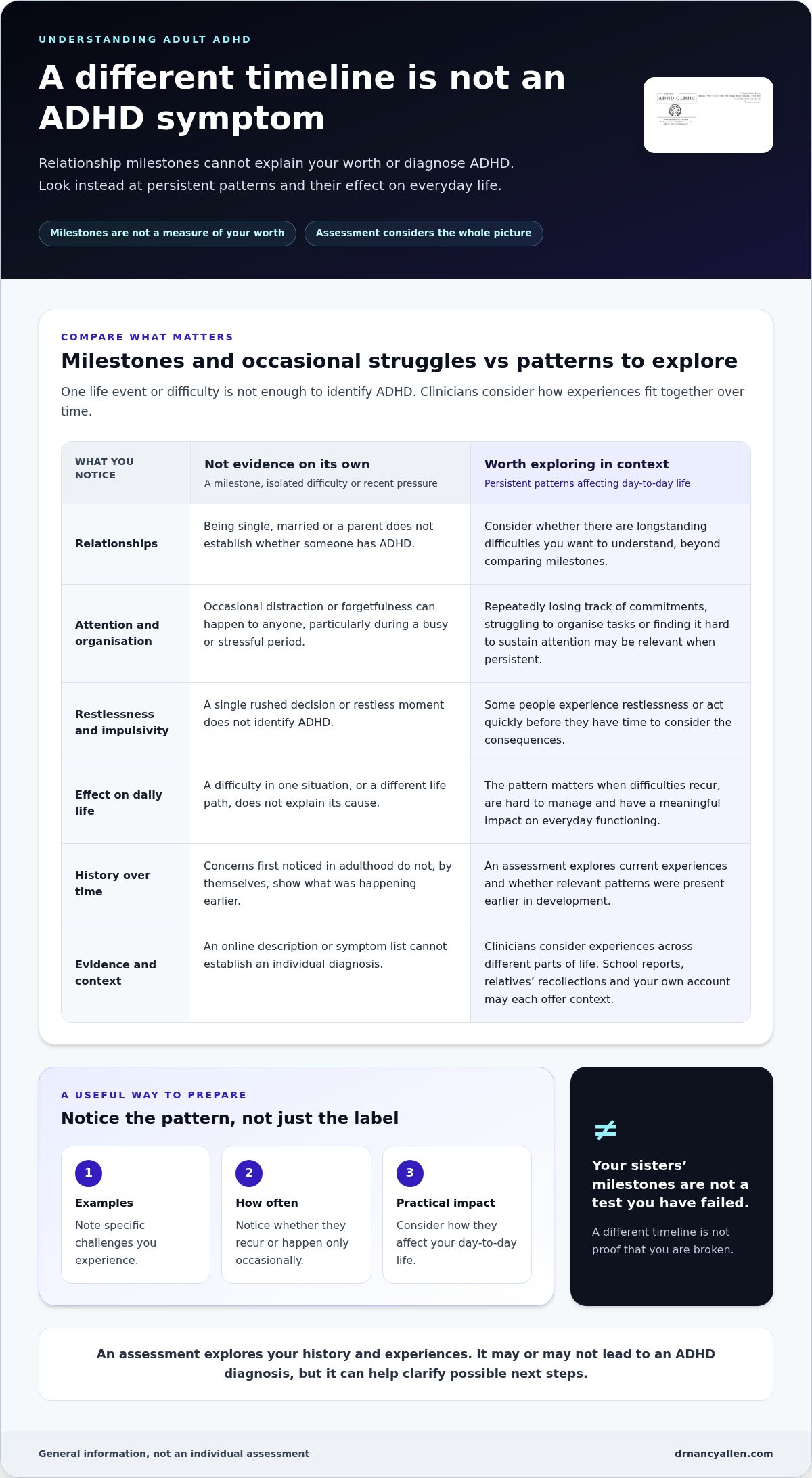
What to do if you recognise possible ADHD patterns
Recognising possible patterns doesn’t mean you need to decide for yourself whether you have ADHD. A manageable first step is to notice what’s happening, collect a few examples, consider their effect on your life, then decide whether you’d like to discuss them with a clinician. You don’t need certainty or perfect records before asking for advice.
Prepare examples for a conversation with a clinician
Brief notes can make it easier to explain your concerns, especially if it’s hard to recall examples in the moment. You might record:
The situation: what was happening at work, at home, in a relationship or during an everyday responsibility?
How often it happens: was it a one-off, or does a similar difficulty recur?
The impact: did it affect a task, commitment, conversation or your wellbeing?
Your timeline: when did you first notice this, and how does it affect you now?
If available, old school reports or observations from someone who knew you earlier in life may add context. They’re optional, and no single memory or document has to provide the whole story. You could also write down questions: What will the assessment explore? What other factors might help explain these experiences? What could the next steps be?
These notes are prompts for a conversation, not a diagnostic test. A clinician can consider them alongside your wider history and circumstances.
Protect your wellbeing while you seek clarity
Try describing difficulties neutrally rather than criticising yourself. Instead of “I’m useless”, you might note, “I missed an appointment after losing track of the date; reminders may help.” This keeps attention on what happened and what support might be useful, rather than judging your character.
If it feels helpful, share your concerns with someone you trust, while choosing for yourself what to disclose. You can take this at your own pace. If distress feels unmanageable, contact your GP or a local urgent mental health service. If you or someone else is in immediate danger, call 999 or go to A&E. In the UK, Samaritans can also be called free on 116 123 for emotional support.
If you’re ready to explore longstanding concerns with clinical support, you can book an adult ADHD assessment with Dr Nancy Allen. It’s a considered way to seek clarity, not a test you need to pass.
How an ADHD assessment can offer clarity without defining who you are
If the question “MY SISTERS ARE MARRIED WITH KIDS ....AM I BROKEN ? COULD IT BE ADHD ?” still troubles you, an assessment can help explore the ADHD part of that uncertainty without judging your life choices. It isn’t a test of your value, and it doesn’t begin with a predetermined diagnosis. The purpose is to understand your experiences and consider what may help you move forward.
What a thoughtful clinical assessment is intended to clarify
A clinician will explore the difficulties you’re experiencing now, how they affect daily life and whether similar patterns were present earlier in your development. They’ll consider your history and the wider clinical picture, including other factors that could contribute to, or occur alongside, ADHD-related difficulties.
No single symptom or questionnaire can tell the whole story. An assessment brings information together to build a considered understanding of your circumstances. It may result in an ADHD diagnosis, or it may not. Either outcome can help inform appropriate next steps, including whether further support or a different explanation should be explored.
A diagnosis is information, not a measure of your worth
For some people, a diagnosis offers a framework for making sense of longstanding experiences and discussing suitable support. For others, an assessment points towards another way of understanding their difficulties. Neither outcome changes a person’s worth, and you don’t need a diagnosis to validate loneliness, grief or the strain of feeling out of step with those around you.
Dr Nancy Allen is a private GP with over 25 years of clinical experience. Her adult ADHD assessments offer a personalised clinical approach to exploring your history and concerns. Secure online consultations provide a route to a clinical conversation for patients across the UK.
You can take time to decide whether assessment feels right for you. To explore your concerns with a clinician, find out more about Dr Nancy Allen’s online ADHD assessment service. The aim is clarity and considered support, not a particular outcome or a label that defines you.
Take a compassionate next step towards clarity
Your sisters’ milestones don’t define your worth, and feeling left behind isn’t, by itself, evidence of ADHD. If you’re wondering, “MY SISTERS ARE MARRIED WITH KIDS ....AM I BROKEN ? COULD IT BE ADHD ?”, focus on the wider picture: whether difficulties have been present over time, how they affect everyday life, and what else might be contributing.
You don’t need to diagnose yourself or have every answer before seeking advice. A thoughtful assessment explores your experiences without assuming the outcome and can help you understand possible next steps. Dr Nancy Allen offers specialist adult ADHD assessments and personalised clinical support, drawing on over 25 years of clinical experience. Secure online consultations are available to patients across the UK.
If you feel ready to explore your concerns, find out about Dr Nancy Allen’s online ADHD assessment service. Take the next step at your own pace. Your life doesn’t have to follow anyone else’s timeline to be meaningful.
Frequently Asked Questions
Does being single mean I have ADHD?
No. Being single is not a sign or diagnosis of ADHD, and relationship status says nothing about your worth or mental health. If you’re thinking, “MY SISTERS ARE MARRIED WITH KIDS ....AM I BROKEN ? COULD IT BE ADHD ?”, look beyond relationship milestones. An assessment explores whether persistent patterns have affected different parts of your life over time, not whether you’re married, dating or single.
Can ADHD make it harder to maintain relationships?
It can contribute to some relationship challenges for some people, but it affects everyone differently and doesn’t explain every difficulty between partners. For example, forgetfulness, trouble organising shared tasks or acting impulsively may create misunderstandings. These experiences need to be understood in context, alongside each person’s circumstances and communication. Relationship difficulties alone can’t confirm ADHD, and having ADHD doesn’t mean someone can’t build or maintain a fulfilling relationship.
What are the signs of ADHD in adult women?
Adult women with ADHD may experience persistent difficulties with attention, organisation, time management or follow-through. Some may also experience restlessness or impulsivity, though these features vary between individuals. Signs can be less visible if someone has developed ways to mask or compensate for difficulties. These examples aren’t a diagnostic checklist: similar challenges can have other explanations, so a clinician considers the person’s history and how the patterns affect daily life.
Can ADHD symptoms be missed in childhood and recognised as an adult?
Yes. ADHD-related patterns may not have been recognised in childhood, particularly if they were less disruptive to others or a person found ways to compensate. Concerns can become clearer later, for example when responsibilities change. An adult assessment explores whether relevant difficulties were present earlier in life as well as how they affect you now. Memories, school reports or family observations may offer helpful context, but one source doesn’t determine the outcome.
How do I know if I should seek an ADHD assessment?
Consider seeking clinical advice if difficulties with attention, organisation, time or follow-through are persistent, affect your everyday functioning and seem to have a longer history. Note a few examples, when they happen and their practical impact. You don’t need to be certain you have ADHD or bring perfect records. An assessment can explore your concerns, developmental history and other relevant factors, and help clarify appropriate next steps.
Can stress or anxiety feel like ADHD?
Yes. Stress and anxiety can affect concentration, memory, sleep and the ability to manage everyday tasks, which may resemble some ADHD-related difficulties. Other factors, including low mood, sleep disruption or life changes, can also affect how you’re functioning. Similar experiences don’t establish the cause, and more than one factor may be present at once. A clinician can consider the timing, history and impact of your concerns as part of a wider assessment.
Does an ADHD diagnosis mean I will have to change my life plans?
No. An ADHD diagnosis doesn’t require you to marry, have children, change careers or follow anyone else’s timeline. For some people, a diagnosis helps make sense of experiences and opens discussion about suitable support or strategies. An assessment may or may not result in a diagnosis, but either outcome can inform possible next steps. Your choices remain yours, and you don’t need a diagnosis to validate how you feel.



Comments