


Conquering ADHD Time Blindness: Practical Tools

Updated: 3 hours ago
You glance at the clock at 14:00, certain you have plenty of time to finish a task, only to blink and find it's suddenly 14:45 and you're late again. This isn't a character flaw or a lack of effort; it's the neurological reality of the ADHD brain, where time feels like an abstract fog rather than a steady stream. We recognise the professional friction and the painful "shame spiral" that follows every missed appointment or rushed deadline. That's why Dr Nancy Allen focuses on practical tools for improving time perception and conquering ADHD time blindness. These include strategies like virtual timers, setting alarm buffers, and even reverse to-do lists, all designed to help you regain a sense of agency over your day.
It's exhausting to feel constantly blindsided by the transition from "now" to "not now." You deserve a reliable system that allows you to actually see time passing, moving beyond the anxiety of unstructured hours. In this guide, we'll explore expert-led strategies and sensory tools designed specifically for the neurodivergent brain. By combining clinical validation with practical, externalised structures, you can bridge the gap between intention and action, replacing the frantic rush with a calm, methodical flow that respects your unique way of thinking.
Key Takeaways
Understand the neurobiological roots of time blindness and why shifting from internal intuition to externalised systems is essential for managing executive dysfunction.
Discover how conquering time blindness-practical tools for time perception such as virtual timers setting alarm buffers or reverse to to-do list can help you bridge the gap between "now" and "not now" with confidence.
Learn how to use "backwards planning" to break down complex projects into manageable steps that respect your natural cognitive rhythm and energy levels.
Replace vague language like "soon" with specific time-estimation techniques to reduce the anxiety of deadlines and improve your daily productivity.
Recognise that whilst sensory tools are invaluable, a formal clinical assessment provides the necessary foundation for a truly personalised and effective management plan.
Table of Contents
Understanding the Neurobiology of Time Blindness
Time blindness isn't a character flaw or a symptom of poor motivation. It's a fundamental deficit in non-verbal working memory and time perception. For those living with ADHD, which is a complex neurodevelopmental disorder, the brain's internal clock doesn't tick at a consistent pace. This neurological difference makes it incredibly difficult to gauge how much time has passed or how much is left before a deadline. Whilst neurotypical individuals often have an intuitive "feel" for the minutes, the ADHD brain relies on a much more binary system.
This system is often described as the "Now" versus "Not Now" brain. If a task or event isn't happening in the immediate present, it effectively ceases to exist in the individual's conscious awareness. The prefrontal cortex, which is responsible for sequencing events and prioritising future goals, struggles to bridge the gap between a distant deadline and the current moment. This is why standard wall clocks often become invisible; they provide a snapshot of the current time but fail to illustrate the volume or passage of time in a way the neurodivergent brain can process.
The Emotional Impact of Time Blindness
Living with time blindness often means carrying the heavy weight of being labelled "lazy" or "disorganised" by others. These labels are deeply inaccurate. Chronic lateness and the constant "shame spiral" of missed appointments contribute significantly to ADHD burnout and persistent anxiety. It's a painful experience to desperately want to be on time whilst your brain physically fails to track the minutes required to get there. Validating this struggle is the first step toward restoration. We must move away from moral judgements and toward clinical understanding to reduce the friction this causes in professional and personal lives.
Reframing Time as a Sensory Experience
To manage this challenge, we have to stop trying to "know" what time it is and start "seeing" it. Externalising executive functions is essential for anyone focused on conquering time blindness-practical tools for time perception such as virtual timers setting alarm buffers or reverse to to-do list allow the brain to bypass its internal clock. By turning time into a physical or visual representation, you provide the prefrontal cortex with the data it needs to sequence tasks effectively. Time blindness is a neurological inability to track the passage of time without external anchors. By using sensory tools, you create those anchors, transforming an abstract concept into a visible, manageable reality that reduces anxiety and improves your quality of life.
Externalising the Clock: Sensory Tools and Virtual Timers
Evidence-based research on time perception in adult ADHD confirms that individuals often perceive time as a series of disconnected moments rather than a continuous flow. Because the internal clock is unreliable, the most effective strategy is to make time visible and tangible. When you're focused on conquering time blindness-practical tools for time perception such as virtual timers setting alarm buffers or reverse to to-do list, the goal is to reduce the cognitive load of "guessing" how much time has passed. By externalising the clock, you transform an abstract concept into a sensory experience that your brain can actually process.
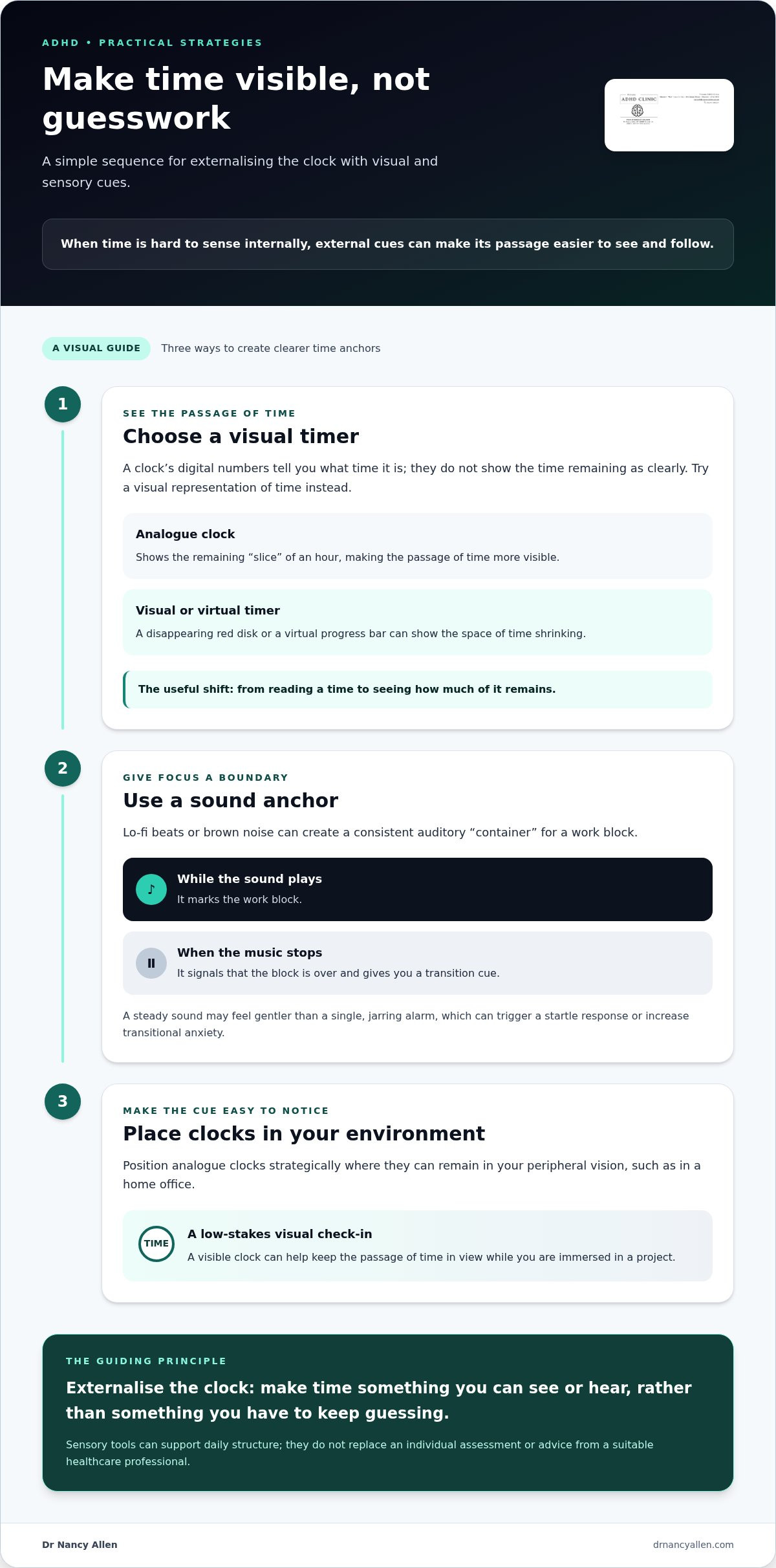
Visual timers are particularly powerful because they represent time as a physical volume. Whether it's a physical device with a disappearing red disk or a virtual progress bar, seeing the "space" of an hour shrink provides immediate, non-verbal feedback. This visual cue bypasses the struggle of mental sequencing, allowing you to feel the urgency of a deadline without the accompanying panic. For many, identifying these specific sensory needs begins with a professional Adult ADHD Assessment to understand their unique executive profile.
Sound anchors can also define the boundaries of a work block. Using lo-fi beats or brown noise creates a consistent auditory "container" for your focus. When the music stops, the time block is over. This provides a gentle transition signal that is often more effective than a jarring, singular alarm, which can trigger a "startle response" and increase transitional anxiety.
Choosing the Right Virtual Timer
Digital numbers like "14:30" are far too abstract for the neurodivergent brain. They tell you what the time is, but they don't show you where you are in the day. Analogue clocks, however, show the "slice" of the hour that remains. Placing these clocks strategically throughout your environment creates a "time-rich" space. Try setting up a sensory centre in your home office where a large analogue clock is always in your peripheral vision. This constant, low-stakes visual check-in helps your brain maintain a tether to the passage of time whilst you're deeply immersed in a project.
Structural Strategies: Alarm Buffers and Reverse To-Do Lists
Whilst visual cues help you see the minutes, conquering time blindness-practical tools for time perception such as virtual timers setting alarm buffers or reverse to to-do list create a structural safety net for your executive function. One of the most common hurdles for the neurodivergent brain is "time optimism," a cognitive bias where we underestimate how long a task actually takes. To counter this, we recommend the "Plus 50%" rule. If your intuition says a task will take thirty minutes, schedule forty-five. This buffer provides the necessary "transition zones" in your digital calendar, allowing your brain to switch gears without the frantic cortisol spike that usually accompanies a deadline.
Creating Your Alarm Buffer Sequence
A single alarm is rarely enough for the ADHD brain; it's either ignored or it triggers an immediate sense of panic. A sequence of three distinct alerts creates a gentler, more methodical transition. This layered approach helps reduce alarm fatigue and respects the time your brain needs to disengage from a current focus. Consider this sequence for every major transition:
The Awareness Alarm: Set this for 30 minutes before you need to move. It serves as a soft nudge to begin wrapping up your current activity.
The Action Alarm: Set for 10 minutes before departure. This is the signal to physically put things away, grab your bag, or close your laptop.
The Final Call: This is the absolute moment you must be out of the door or on the call. It's the "hard stop" that requires immediate movement.
Mastering the Reverse To-Do List
Traditional planning starts at the beginning of the day and looks forward, which is often too abstract for a brain that struggles with sequencing. The "Reverse To-Do List," or backwards planning, is a far more effective alternative. By identifying the absolute moment you must be at your destination, you can begin the methodical process of working backwards through every necessary micro-behaviour. This clarity reduces the anxiety of unstructured time and provides a realistic "Real Start Time" that accounts for the hidden minutes we often overlook.
To implement this, start with your arrival time. Subtract travel time, then subtract the ten minutes it takes to find your keys and shoes. Subtract the time needed to get dressed or finish a meal. Often, you'll find your real start time is an hour earlier than you initially thought. This level of clinical precision is what makes conquering time blindness-practical tools for time perception such as virtual timers setting alarm buffers or reverse to to-do list so transformative. It replaces guesswork with a reliable, evidence-based system that restores your confidence and professional reputation.
Cognitive Reframing: Moving from "Soon" to "Specific"
Vague language is often the primary enemy of neurodivergent time perception. When we tell ourselves we'll start a task "soon", we're essentially handing a blank cheque to a brain that cannot define what "soon" looks like. This linguistic ambiguity creates a vacuum where procrastination and anxiety thrive. By conquering time blindness-practical tools for time perception such as virtual timers setting alarm buffers or reverse to to-do list, we begin to replace these abstract concepts with concrete data points. This shift isn't about being more rigid; it's about providing the clarity your prefrontal cortex needs to function without the constant weight of indecision. Specificity is your greatest ally.
Linguistic Shifts for Better Timing
One of the most effective cognitive shifts is replacing "later" with a specific timestamp. For example, "I will do it at 14:15" provides a definitive anchor. It's also vital to distinguish between active time and passive time. Active time is the five minutes it takes to unload the dishwasher. Passive time is the ten minutes spent looking for your phone or choosing a podcast before you start. Recognising these hidden blocks reduces the cognitive load of decision-making, as you're no longer negotiating with yourself about when to begin. You've already made the decision for your future self.
The Time Estimation Exercise
Many neurodivergent adults find that their internal sense of time is consistently out of sync with reality. The "Time Estimation Game" is a clinical exercise where you guess how long a routine task will take, such as showering or writing an email, and then time yourself. It's common to find that a "five-minute" task actually takes fifteen. Track the reality. Using a "Time Log" for one week allows you to identify your personal time-wasters without judgment or shame. This data is vital; it allows you to organise your favourite routines based on what actually happens rather than what you hope will happen.
Body doubling, or working in the presence of another person, can also serve as a powerful anchor in the present moment. It helps cultivate "Time Wisdom," which is the ability to recognise your own cognitive rhythms and energy levels throughout the day. Whilst these reframing techniques are powerful, they are most effective when built upon a firm clinical foundation. If you're struggling to implement these changes, a professional Adult ADHD Assessment can provide the clarity and personalised strategy you need to move forward with confidence.
A Personalised Approach to Executive Function
Whilst the strategies we've discussed are transformative, it's important to recognise that they often function best when integrated into a wider clinical framework. Conquering time blindness-practical tools for time perception such as virtual timers setting alarm buffers or reverse to to-do list is a significant step, but for many, these systems only truly "click" once the underlying neurological profile is fully understood. A personalised treatment plan ensures that you aren't just fighting symptoms; you're building a lifestyle that respects your specific brain chemistry. Integrating professional neurofeedback from Neurobics can be a valuable addition to this framework, helping individuals regulate their brain activity for improved focus.
There is a powerful synergy between practical tools and clinical support. For instance, ADHD medication can often lower the "activation energy" required to actually respond to an alarm buffer or begin a reverse to-do list. Without this clinical foundation, even the best tools can feel like an uphill struggle. A diagnosis provides the "user manual" for your brain, allowing you to stop guessing and start implementing strategies that are scientifically proven to work for your specific executive profile.
An adult ADHD assessment is more than a diagnostic hurdle; it's an opportunity to rewrite your self-narrative. Instead of viewing yourself as someone who "fails" at time management, you begin to see yourself as a neurodivergent individual who simply needs a different set of anchors. Our 72-hour diagnosis pathway is designed to provide rapid validation and clarity, allowing you to move from frustration to action without unnecessary delay. For a deeper look at this process, you can explore our Adult ADHD Assessment pillar.
Beyond the Diagnosis: Ongoing Support
Developing a holistic strategy involves more than just setting a timer on your desk. It requires a compassionate blend of clinical insight, lifestyle adjustments, and consistent support. This journey is not about achieving "perfection" but about restoring your confidence and reducing the anxiety that unstructured time can cause. Dr Nancy Allen helps patients move from confusion to clarity with expert-led assessments. By combining 25+ years of clinical experience with a deep-seated empathy for the neurodivergent experience, we ensure that your path toward better time management is both professional and deeply human. You don't have to navigate this transition alone; expert guidance is available to help you build a reliable system that lasts.
Reclaiming the Hours Ahead
Time blindness doesn't have to dictate the rhythm of your life or the quality of your professional reputation. By shifting from an unreliable internal sense of time to externalised systems, you can move away from the "shame spiral" of chronic lateness and the persistent anxiety of unstructured hours. The journey toward conquering time blindness-practical tools for time perception such as virtual timers setting alarm buffers or reverse to to-do list is about more than just punctuality; it's about restoring your self-trust and mental clarity.
Whilst these tools provide immediate relief, a formal clinical foundation remains essential for long-term success. Dr Nancy Allen brings 25+ years of specialist clinical expertise to provide compassionate, neuro-affirming private care. With diagnosis and treatment plans available in as little as 72 hours, you can quickly transition from confusion to a structured, supportive path forward. You have the capacity to build a system that respects your brain's unique wiring; you simply need the right expert guide to help you start.
Frequently Asked Questions
What is the most effective tool for ADHD time blindness?
Visual timers are widely considered the most effective tool because they translate the abstract concept of time into a physical volume. By using a disappearing disk or a progress bar, your brain can "see" the time remaining rather than trying to calculate it mentally. This is a core component of conquering time blindness-practical tools for time perception such as virtual timers setting alarm buffers or reverse to to-do list, as it provides immediate sensory feedback.
Can timers actually make ADHD anxiety worse?
For some, the ticking or sudden beeping of a timer can trigger "alarm fatigue" or a heightened stress response. If you find timers anxiety-inducing, switch to silent visual countdowns or use lo-fi music as an auditory anchor. The goal is to create a supportive structure, not a source of pressure. Adjusting the sensory input allows you to benefit from the externalised clock without the accompanying cortisol spike that disrupts focus.
How do I use a reverse to-do list for work projects?
To use a reverse to-do list, start with your project's "hard stop" or submission deadline and work backwards through each milestone. Identify the very last step, then the one before that, until you reach the current moment. This method reveals the "real start time" by accounting for hidden tasks like proofreading or file exporting. It ensures your schedule reflects the true complexity of the work rather than an optimistic, abstract guess.
Why do I ignore my alarms even when I know they are important?
Ignoring alarms often happens because the brain is either in "hyperfocus" or is overwhelmed by the transition required. A single alarm can feel like an intrusion rather than a helpful nudge. This is why a sequence of three alerts is more effective; it prepares the brain to disengage gradually. By the time the final alarm sounds, your executive function has had the necessary lead time to switch gears mentally and physically.
Is time blindness a recognised symptom of ADHD in the UK?
Whilst "time blindness" is a colloquial term, it is clinically recognised in the UK as a significant deficit in executive function and non-verbal working memory. It is a hallmark trait of the neurodivergent experience. During a private assessment, clinicians look at how these perception issues impact your daily life, validating that your struggle with lateness is a neurological reality rather than a lack of discipline or effort. It is a valid medical concern.
How can I explain time blindness to my employer or partner?
Explain that your brain lacks a reliable internal clock, making it difficult to "feel" the passage of time. Frame it as a neurological difference rather than a character flaw. You might say: "My brain struggles to track time naturally, so I use external tools like virtual timers to stay on track." Focusing on the specific strategies you are using helps others understand that you are proactive and dedicated to finding a collaborative, professional solution.
Do digital or analogue clocks work better for ADHD?
Analogue clocks are generally superior for the ADHD brain because they represent the "volume" of time. Digital numbers like "15:45" are abstract and only tell you the current moment. An analogue face shows you the physical "slice" of the hour that has passed and what remains. This visual representation is vital for conquering time blindness-practical tools for time perception such as virtual timers setting alarm buffers or reverse to to-do list in a home office.
Can medication help with time perception issues?
Medication can significantly improve time perception by regulating the neurotransmitters responsible for focus and executive function. It often reduces the "activation energy" needed to start tasks or respond to external cues like alarms. Whilst medication isn't a "cure" for time blindness, it provides a more stable foundation. This makes it much easier to implement and maintain the practical tools and routines that support your daily life and professional reputation.



Comments