


ADHD Medication & Hormones: Why Efficacy Drops

Updated: 18 hours ago
Why Does My ADHD Medication Feel Less Effective Before My Period or During Perimenopause? If your focus, motivation or emotional regulation dips at certain times, it can be unsettling to feel that a treatment you rely on is not helping as much. A recurring pattern is worth discussing. It does not mean you are imagining the change or that your medication has stopped working.
Hormonal changes may affect ADHD symptoms and how helpful medication feels. Oestrogen interacts with brain systems involved in attention and motivation, but the relationship is complex. Evidence about medication response across the menstrual cycle and during perimenopause is still developing. Hormones may be one factor among others, including sleep, stress, other symptoms and medication timing.
This article explains what may be happening, what remains uncertain and how to prepare for a useful conversation with your prescriber. You’ll find practical ways to record symptoms alongside your cycle or changing midlife symptoms, details that may help guide a review, and advice on when to seek clinical input. Don’t change your dose or schedule without speaking to your prescriber. An individual review is the safer next step.
Table of Contents
Why can ADHD medication feel less effective before a period?
A recurring dip in focus or emotional regulation before your period can disrupt work, study or home life, and it deserves to be taken seriously. On its own, it does not prove that your ADHD medication has failed or that you need a different dose.
Perceived reduced effectiveness means a change in ADHD symptoms or day-to-day functioning while taking medication. It describes an experience, not a diagnosis or a confirmed cause. Hormonal fluctuations may be one influence, but a pattern alone cannot establish that hormones are responsible for an individual change.
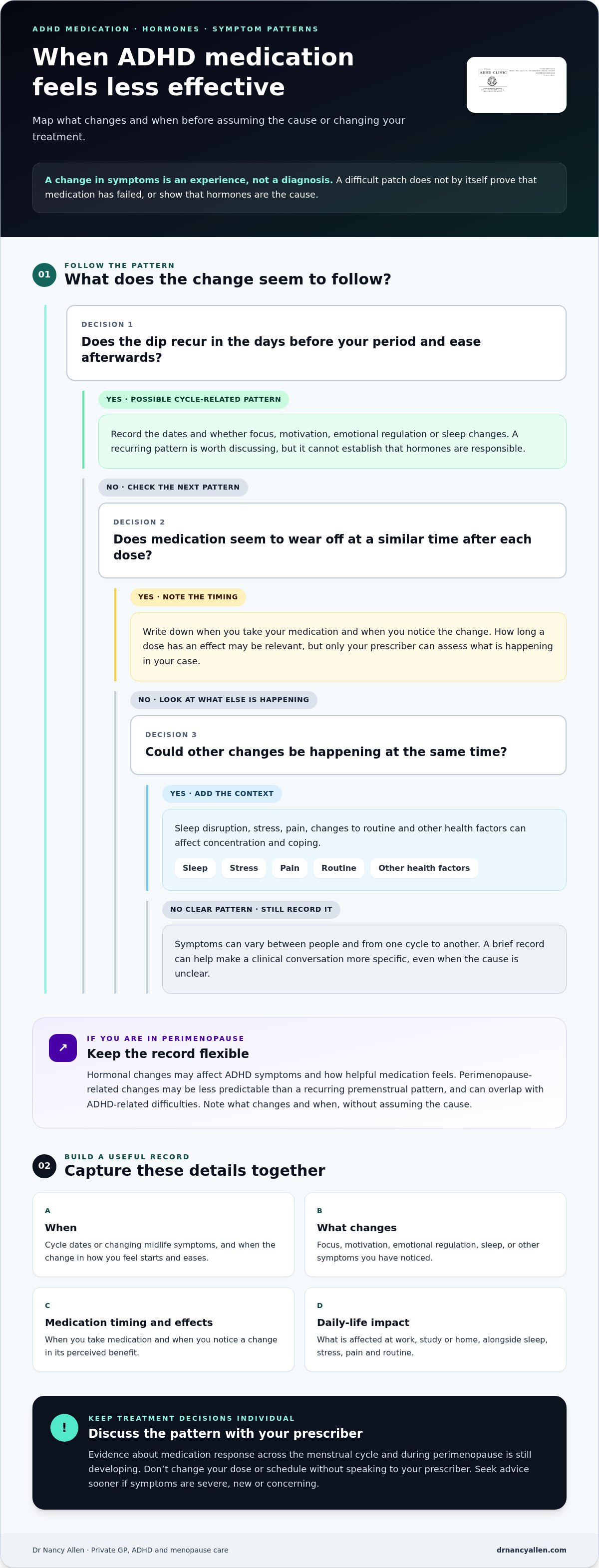
Notice whether the difficulty follows a cycle-related pattern, appearing in the days before a period and easing afterwards, or whether medication seems to wear off at a similar time after each dose. The latter may relate to how long a dose has an effect, although only a prescriber can assess what is happening in your case. Both patterns can occur together, too.
What might change in the days before a period?
Some people notice more difficulty sustaining attention, organising tasks or getting started. Motivation may feel lower, emotions harder to manage, or sleep less settled. Others notice little change or experience a different pattern. Symptoms can vary between people and from one cycle to another.
Premenstrual symptoms can include physical or emotional changes before a period. Premenstrual dysphoric disorder (PMDD) is a more severe condition involving marked mood symptoms and disruption to daily life. A difficult premenstrual week does not establish PMDD. If symptoms are intense or affecting your wellbeing, discuss them with a healthcare professional, while specialised counselling from providers such as Female Focused Therapy can also help women manage the emotional impact of hormonal shifts.
Does a difficult week mean the medication has stopped working?
No. A temporary change in symptoms does not establish treatment failure. Stress, disrupted sleep, pain, changes to routine and other health factors can affect concentration and coping, sometimes at the same time as premenstrual symptoms.
Rather than drawing conclusions from one difficult week, note whether similar changes recur across cycles and what else is happening at the time. A brief record of dates, symptoms and effects on work, study or home life gives you and your prescriber a clearer starting point. Don’t adjust your dose or timing on your own.
If you’re asking, “Why Does My ADHD Medication Feel Less Effective Before My Period or During Perimenopause?”, start by describing what changes and when, without assuming the cause. A clinician can consider the pattern alongside your medication and wider health. Seek advice sooner if symptoms are severe, new or concerning instead of waiting to see whether they recur.
How might oestrogen and the menstrual cycle affect ADHD symptoms?
Oestrogen may influence brain systems involved in attention, motivation and dopamine signalling. Dopamine helps regulate processes that can be affected in ADHD, so researchers have proposed that hormonal fluctuations could contribute to changes in symptoms or perceived medication benefit. Psychiatric Times discusses this proposed interaction between oestrogen and dopamine, but a plausible biological explanation does not prove what is causing a particular person’s symptoms.
Oestrogen’s possible influence on dopamine offers a potential explanation for cycle-related changes, but it cannot show that an individual’s ADHD medication dose needs to change. Hormone levels vary across the menstrual cycle, and people’s symptoms, medication responses and cycle experiences vary too. No single hormone level determines how well medication works for everyone.
What happens to hormones across the menstrual cycle?
Hormone levels shift through the cycle. After ovulation, the body enters the luteal phase, the time between ovulation and the start of the next period. Oestrogen and progesterone fluctuate during this phase, then change again around menstruation. Timing and patterns can differ between individuals and cycles, so a calendar estimate alone cannot confirm which hormones are affecting symptoms.
Some people report changes in focus or emotional regulation at particular points in their cycle; others do not notice a consistent pattern. A change during the luteal phase may be worth recording, but it should not be taken as evidence that oestrogen has directly reduced medication effectiveness.
What does research say about stimulant medication and cycle changes?
Research into menstrual-cycle effects on ADHD medication response remains limited. A small 2023 study is described in secondary coverage as finding a reduced response to amphetamine in the late luteal phase. However, the study details available here are not sufficient to verify its design, participants or limitations against the original publication. Its finding should not be treated as proof that the same effect applies to you.
Even an observed change in a small study cannot establish a reliable dose adjustment for other people. Emerging research may help shape future understanding, but it does not provide a standard protocol for changing stimulant doses according to cycle phase. Don’t alter your medication without discussing your symptoms and treatment with your prescriber.
If cycle-related changes affect daily life, a personalised review may help you consider the pattern alongside your ADHD and hormonal health. Dr Nancy Allen specialises in ADHD assessment and menopause care. Find out more about ADHD and menopause care.
How is perimenopause-related change different from premenstrual symptoms?
A change that appears before a period and one that develops during perimenopause can feel similar, but their timing may offer useful clues. A premenstrual pattern may recur at a similar point in successive cycles. Perimenopause is a longer transition in which cycles can become less predictable, making symptoms harder to link to one phase. Neither pattern confirms a cause on its own.
This distinction matters when asking, “Why Does My ADHD Medication Feel Less Effective Before My Period or During Perimenopause?” Cycle-related changes and perimenopause-related changes are not supported by identical evidence. Research into menstrual-cycle effects on ADHD medication response is limited; evidence specifically showing how medication response changes during perimenopause is also limited. Don’t assume findings about one situation explain the other, or that either means your prescription needs changing.
What patterns may point to a menstrual-cycle link?
Look for symptoms that recur at a similar point before menstruation over multiple cycles. Record the first day of bleeding, when changes begin and ease, and how they affect everyday tasks. Timing can help a clinician explore a possible association, but it does not prove hormones are the cause. Seek advice if symptoms are severe, new or significantly affecting daily life.
What can change during perimenopause?
Perimenopause is a transition that can bring changing or less predictable periods. Hot flushes, disrupted sleep and mood changes may also affect attention, memory and coping, making it difficult to separate overlapping experiences. For individuals looking to support their broader vitality during midlife changes, telehealth services such as Summit Health provide personalised hormone optimisation to help manage energy and well-being. Don’t attribute every new difficulty to ADHD or hormones without considering other possible explanations with a clinician.
Use this comparison as a prompt for observation, not as a diagnostic test:
Premenstrual pattern
Timing: Symptoms may recur before menstruation and ease afterwards.
Pattern to record: Bleeding dates, when symptoms start and settle, and their effect on daily activities across cycles.
Useful clinical question: Does this change repeatedly happen at a similar point in my cycle?
Perimenopause-related pattern
Timing: Changes may be less predictable as periods and other symptoms shift through the transition.
Pattern to record: Cycle changes, ADHD symptoms, sleep, hot flushes, mood and day-to-day impact.
Useful clinical question: Could sleep or other menopause symptoms be contributing to the changes I’ve noticed?
Bring your observations to a healthcare professional, particularly if several factors are changing at once. A review can consider your symptom history and treatment together, without assuming in advance that the cause is hormonal or that your medication needs to change. If you are seeking remote support tailored to hormonal transitions, you can discover Women’s Mental Health Specialist for virtual, hormone-informed care.
What should you track and ask your ADHD prescriber?
A clear record can turn “something feels different” into details your prescriber can assess. You do not need a perfect record or several cycles of notes before asking for advice, especially if symptoms are severe or concerning.
A simple symptom and medication record
Use a calendar, notebook or notes app. Each day, record your cycle dates if relevant, the medication you took as prescribed and when you took it, and any noticeable changes. A simple personal scale, such as rating focus, mood, sleep and everyday functioning from low to high, can help you compare days consistently. The scale does not need to be clinical or exact.
Add brief notes about factors that may affect how you feel, such as stress, illness, pain, disrupted sleep or a change in routine. Note practical effects too: for example, whether you struggled to start work, keep track of tasks or manage conversations. Look for patterns over time where practical, but do not delay asking for help to complete a record.
When and how to seek clinical advice
Arrange a review with your responsible prescriber if changes recur, worsen or interfere with daily life. Bring your notes and a concise summary: when the change began, how long it lasted, what else was happening and whether you noticed side effects. You could ask:
Could the timing of these symptoms relate to my cycle, medication schedule or another factor?
Could side effects, sleep disruption, stress, pain or another health change be affecting how I’m functioning?
What should I monitor, and when should I contact you again?
What review options are appropriate for me, and what are the risks and benefits?
Don’t alter, skip or add prescribed medication without advice from the responsible prescriber. That includes changing the dose or timing in response to a difficult day or a suspected cycle pattern.
If you have severe mood symptoms or feel at immediate risk, seek urgent help rather than waiting for a routine appointment. Contact urgent NHS services, such as NHS 111 where available, for advice. If there’s immediate danger, call 999 or go to A&E.
If you’d like specialist input that considers ADHD and hormonal health together, you can explore ADHD assessment and menopause care with Dr Nancy Allen. A consultation can help you discuss your individual history and concerns without assuming in advance what is causing the change.
How can personalised ADHD and menopause care help clarify the pattern?
Changes in focus or perceived medication benefit are easier to discuss when considered in context. Cycle stage, possible perimenopause symptoms, sleep, mood, treatment history and everyday demands may all be relevant. There is no single explanation or response that applies to everyone, so a review should begin with your experience rather than an assumption that hormones or medication are the cause.
What may an individual review consider?
A clinician may ask when the changes began, how they relate to bleeding or cycle changes, what you’ve noticed in your ADHD symptoms and medication, and whether sleep, mood or other health factors have shifted. Notes about day-to-day effects can make the discussion more specific. Together, you can consider appropriate next steps for your circumstances. An ADHD medication change or hormone treatment is not automatically suitable or necessary. For patients who are also investigating broader approaches to hormone replacement therapy, specialist practices such as Dr. Renato Lobo illustrate how personalised hormonal evaluation can be integrated into comprehensive patient care.
It can also help to explain what you’ve already tried, any side effects and what you hope to improve. A careful review does not guarantee a particular explanation or outcome. Its value is in weighing relevant details and making decisions with a clinician who understands the limits of current evidence.
When specialist support may be useful
Consider seeking clinical advice if changes remain difficult to interpret, recur, worsen or affect everyday functioning. If you’re unsure whether to raise the issue with your ADHD prescriber, a clinician with expertise in both ADHD and menopause care may help you discuss overlapping symptoms and identify what needs further review. Keep following your prescription unless the responsible prescriber advises otherwise.
Dr Nancy Allen is a private GP with over 25 years of clinical experience and a specialist focus spanning ADHD assessment and menopause care. Secure online consultations are available across the UK, offering an option to discuss your history and concerns in a personalised clinical conversation. This does not promise that a particular cause will be identified or that your medication will change.
If you’d like to explore this kind of support, Explore ADHD and menopause care. Whether you’re asking “Why Does My ADHD Medication Feel Less Effective Before My Period or During Perimenopause?”, your observations and treatment history can provide a useful starting point for a safe, individual discussion.
Take your next step with a clearer picture
Hormonal changes may influence ADHD symptoms or how effective medication feels, but the evidence is still developing and a recurring pattern does not confirm the cause. Recording cycle dates, sleep, symptoms and their effect on daily life can help you explain what has changed and support a more focused conversation with your prescriber.
If you’re asking, “Why Does My ADHD Medication Feel Less Effective Before My Period or During Perimenopause?”, you do not have to work it out alone. Discuss your concerns with your prescriber, and don’t change, skip or add medication without their advice. An individual review can consider your symptoms, hormonal health and treatment history together.
Dr Nancy Allen brings over 25 years of clinical experience, with specialist care spanning ADHD and menopause. Secure online consultations are available across the UK. If you’d like to explore whether this support may suit your needs, explore personalised ADHD and menopause care.
Your experience deserves to be heard. A thoughtful conversation with a clinician is a positive step towards greater clarity.
Frequently Asked Questions
Can ADHD medication work differently before my period?
Some people notice that their ADHD symptoms or perceived medication benefit change before a period, but experiences vary and research is limited. Hormonal fluctuations may influence systems involved in attention and dopamine signalling, though this does not prove what is causing an individual change. If you notice a recurring pattern, record when it happens and how it affects daily life, then discuss it with your prescriber rather than changing your dose yourself.
Why might ADHD symptoms feel worse before a period?
Hormonal changes before menstruation may be one possible influence on attention, motivation or emotional regulation, but they do not explain every difficult premenstrual week. Sleep disruption, stress, pain, changes in routine and other health factors can also affect concentration and coping. Notice whether symptoms recur at a similar point across cycles and what else changes at the same time. A pattern can inform a clinical discussion, but timing alone cannot confirm the cause.
Can perimenopause make ADHD medication feel less effective?
Perimenopause may coincide with changes in ADHD symptoms or how helpful medication feels, but evidence about medication response during this transition remains limited. Changing periods, hot flushes, disrupted sleep and mood changes can affect concentration and everyday functioning, making the cause difficult to identify. If you’re asking, “Why Does My ADHD Medication Feel Less Effective Before My Period or During Perimenopause?”, discuss the full pattern with a clinician rather than assuming a dose change is needed.
Should I increase my ADHD medication dose before my period?
No. Don’t increase, reduce, skip or add prescribed ADHD medication without advice from the prescriber responsible for your care. Research has not established a standard dose-adjustment approach based on menstrual-cycle timing, and a change that may be appropriate for one person may not suit another. If symptoms regularly worsen before your period, share your notes with your prescriber and ask what options, if any, are appropriate for you.
How can I tell whether my ADHD medication is wearing off or hormones are affecting my symptoms?
Look at the timing, while recognising that timing alone cannot identify the cause. Medication wearing off may seem to happen at a similar time after a dose on different days. A possible cycle-related pattern may recur before menstruation and ease afterwards. These patterns can overlap, and sleep, stress or other health changes may contribute. Record medication timing and symptoms, then ask your prescriber to help interpret what you’ve noticed.
What should I track before speaking to my ADHD prescriber?
Use a calendar or notes app to record period dates, symptoms, when you take medication as prescribed, sleep and effects on daily functioning. A simple, consistent rating of focus, mood and sleep can make changes easier to compare. Add brief notes about stress, illness, pain or disrupted routine. You do not need a perfect record or several cycles of notes before asking for help, especially if symptoms are severe or concerning.



Comments