


ADHD Behaviour: Why Emotional Responses Are Counterproductive

Updated: 23 hours ago
What if the stronger your reaction, the harder it becomes to get through a difficult moment? When behaviour feels disruptive or disrespectful, it’s understandable to feel frustrated, worried or drawn into an argument. Yet emotional responses to "bad" behaviour are counter productive when they intensify distress without helping a child understand what to do differently. A calm response isn’t the same as ignoring behaviour or letting boundaries slide.
If you’re caught in repeated clashes, you may be unsure whether your child is acting deliberately, reacting impulsively or struggling with an unmet need. ADHD can affect emotional regulation and impulse control, but challenging behaviour alone doesn’t prove a child has ADHD. Looking at what happens before and after a behaviour can help you respond more effectively without excusing it.
This article explains how a strong reaction can escalate tension and offers practical ways to respond calmly, consistently and safely while protecting your relationship and setting clear limits. You’ll also learn when recurring difficulties that affect daily life may be worth discussing with a health professional, and how a child ADHD assessment can be one route to greater understanding.
Table of Contents
Why emotional reactions to “bad” behaviour can make difficult moments harder
Repeated conflict can leave parents and carers worn down, especially when an ordinary request seems to turn into another argument. You may try to stay measured, then find yourself raising your voice or repeating warnings as the situation intensifies. That shift is emotional reactivity: responding more strongly or quickly than the calm, considered response you intended. It’s human, and it doesn’t mean you don’t care about your child.
The idea that emotional responses to "bad" behaviour are counter productive isn’t a call to ignore what’s happening. It’s a reminder that a strong reaction can add intensity to an already difficult moment, whether or not that is the child’s intention. Understanding what might be contributing to the behaviour can help you choose a response; it doesn’t mean accepting harm or giving up clear boundaries.
This short video offers a useful introduction to recognising and managing emotions:
What might “bad” behaviour be communicating?
Describe what you can see rather than defining your child by a difficult moment. For example, “She shouted and pushed the workbook away” is more useful than “She’s being impossible”. The action might follow frustration, impulsivity, overwhelm or difficulty stopping one activity and moving to another. These are possibilities to explore, not conclusions. The same action can have different causes at different times, so consider what happened before, during and after it.
Emotional regulation can be difficult for some people with ADHD; Emotional dysregulation describes difficulties managing emotional responses. This context may help make sense of a moment, but it doesn’t establish why a particular behaviour occurred or diagnose ADHD.
Why does a strong adult reaction sometimes escalate the moment?
Raised voices, lengthy arguments and repeated warnings can make an interaction feel more charged. A child may become more upset, struggle to take in what’s being said or respond by shouting more. Adult attention can also be one consequence of behaviour, whether positive or negative, but it isn’t a guaranteed explanation and shouldn’t be used to assume intent.
“You can describe what a child did; you can’t know their intention from the behaviour alone.” Keeping that distinction in mind can reduce blame and help you focus on what’s needed now: safety, a clear limit and a response proportionate to the action. Calmness doesn’t require you to feel unbothered. It gives you a better chance of responding deliberately rather than being pulled into an escalation.
How ADHD-related executive function and emotional regulation can affect behaviour
Some behaviour that looks deliberate from the outside may happen before a child has had time to pause and consider what to do. Executive function is the set of mental skills used to pause, plan, shift attention and manage actions. For a child with ADHD, some of these skills may be harder to use consistently, particularly during a demanding or emotionally charged moment.
Emotional regulation is also a skill that develops over time. It involves noticing feelings and finding ways to manage them, rather than simply choosing to behave well. This doesn’t mean a child has no responsibility or that every action is caused by ADHD. Children’s experiences vary, and behaviour needs to be understood in its context.
What can impulse control and cognitive flexibility look like day to day?
A child might interrupt before remembering to wait, react quickly to a disappointment or find it hard to stop a favourite activity when asked. A change of plan or an unexpected transition may add to the challenge for some children. These are examples of possibilities, not diagnostic signs or experiences shared by every child with ADHD.
CHADD’s behaviour strategies for raising children with ADHD offer further context for responding thoughtfully. Advice such as “respond, don’t react” can be a useful aim, but it doesn’t require parents to be perfectly calm or resolve every situation immediately.
How can stress and overwhelm change a child’s response?
Fatigue, frustration, sensory demands or competing pressures can make it harder for a child to manage a request or recover from a setback. For instance, being asked to stop playing while already tired may feel different from the same request after a settled day. A calm adult presence can help keep the interaction from becoming more charged, although it may not change the child’s response straight away.
“Behaviour shows what happened, not the whole story of why it happened.” Notice when difficulties occur, what tends to come before them and how they affect daily life. Persistent concerns across settings are worth considering alongside a child’s wider developmental history. Behaviour alone can’t establish ADHD; assessment involves a broader clinical picture.
If concerns are ongoing and affecting your child’s daily life, a child ADHD assessment may help build a fuller understanding of their needs.
Does staying calm mean letting “bad” behaviour continue?
No. Staying calm doesn’t mean ignoring behaviour, excusing it or allowing anyone to be hurt. It means holding a boundary without adding a lengthy argument or making a threat in the heat of the moment. The aim isn’t to make a child’s distress disappear instantly, but to respond in a way that protects safety and makes the limit clear.
Reactive punishment can shift the focus from the behaviour to a confrontation between adult and child. A clear, proportionate response is different: name what must stop, explain the immediate next step and follow through predictably. For example, if a child throws a toy, you might calmly move it out of reach and say, “I won’t let you throw that. The toy is going away for now.” Adapt the words and action to the child’s age, needs and circumstances.
Noticing and acknowledging helpful behaviour can also show a child what you want to see more of: “You were upset, and you put the toy down when I asked.” Positive attention can support learning, but it isn’t a cure-all. A child may still need help with frustration, transitions or other underlying difficulties. The point is to make room for connection and guidance alongside firm limits.
How can parents set a firm boundary without escalating?
Keep the message brief and specific. Say what needs to stop and what safe action comes next, rather than relying on repeated warnings or a lecture. Once you’ve stated the limit, follow through as calmly and consistently as you can. For instance: “I won’t let you hit. I’m moving back to keep us safe.” The right response depends on the child and what is happening, so use language they can understand.
When is ignoring behaviour not an appropriate response?
Behaviour involving danger, injury or significant distress needs prompt adult attention. Don’t ignore a child who may be in pain, overwhelmed or signalling that they need support. If someone is at risk, focus first on creating safety and getting appropriate help for the situation. Reflection and teaching can come afterwards.
Once everyone is safe and more settled, talk briefly about what happened, restate the boundary and consider how to repair any harm. A child may need support to take part in that conversation; it doesn’t have to become another confrontation. This distinction matters: emotional responses to "bad" behaviour are counter productive when they intensify a situation, but a calm response can still be direct, protective and consistent.
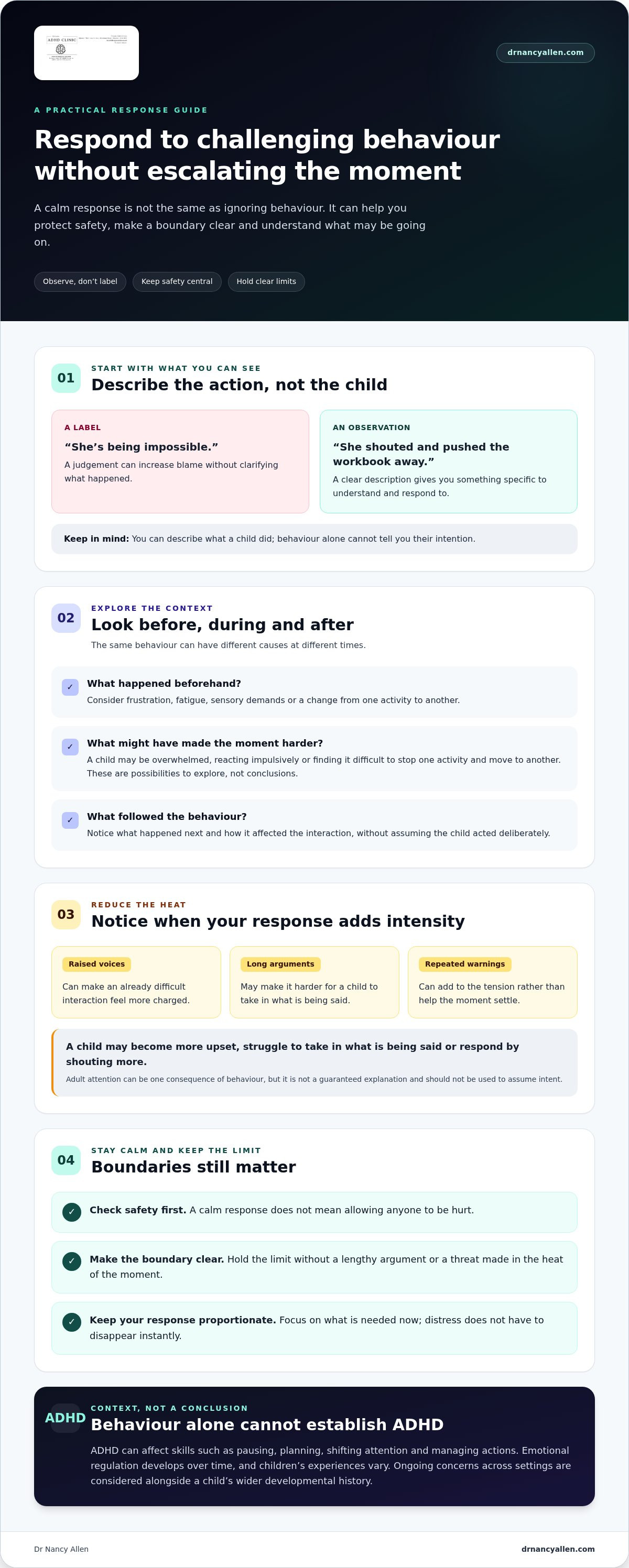
Managing your response to your child's behaviour
A simple sequence can help you act deliberately when emotions rise: pause, regulate yourself, check safety, state the boundary and reconnect. You don’t need to feel perfectly calm before responding. If it’s safe to do so, take a brief pause or slow your breathing before speaking. Even a moment to gather your thoughts can help you choose a clear next step rather than reacting on impulse.
Pause: Stop for a moment before answering.
Regulate yourself: Take a steady breath or lower your voice.
Check safety: Attend first to any risk of harm.
State the boundary: Use a short, specific instruction.
Reconnect: Return to the conversation when you’re both more settled.
Afterwards, notice what was happening around the incident. Was your child tired, frustrated or facing a sudden change? Does the same situation tend to be difficult? Looking for patterns can help you consider what support or adjustments might help next time. It’s information, not a reason to blame yourself or your child.
What can you say during a difficult moment?
During intense distress, keep your words brief and avoid shaming, sarcasm, threats or demands that your child explain their reasoning straight away. You might say, “I can see you’re upset. I won’t let you hit,” or, “You’re frustrated. The tablet is going away now.” These phrases acknowledge emotion without changing the limit. If talking is making things more heated, you can say, “We’ll talk when we’re both ready,” then return to it once your child is more settled.
How can you reconnect and reinforce a better next step?
Repair doesn’t mean pretending nothing happened. When the moment has passed, acknowledge the impact, restore connection and agree what to try next. For example: “That was hard for both of us. Let’s think about what could help next time you need to stop playing.” Keep the discussion suited to your child’s age and readiness.
Notice specific efforts, not only perfect outcomes. You might recognise that your child tried to pause, used words to ask for help or came back to repair the interaction. Small steps are worth naming. If overwhelm is a recurring part of these moments, the ADHD meltdown action plan offers further practical guidance.
These steps can take practice. The aim isn’t to remove every difficult feeling, but to make your response steadier and more predictable. The principle that emotional responses to "bad" behaviour are counter productive is not about being passive; it’s about making space for a firm boundary and a more constructive next step. If persistent behaviour concerns are affecting daily life, explore a child ADHD assessment as one possible route to greater understanding.
When repeated behaviour may call for a wider support plan
If difficulties keep arising and affect family life, learning or relationships, look beyond the difficult moments themselves. Notice whether similar concerns appear at home, at school or in other settings, and whether they persist despite support. The aim is curiosity, not blame: recurring behaviour may have several influences, and understanding the wider picture can help identify what a child needs.
Behaviour alone cannot establish ADHD. A clinical assessment considers a broader developmental and clinical history, including how concerns affect the child’s daily life. A single incident or one challenging behaviour isn’t enough to determine a diagnosis.
What patterns may be useful to discuss with a professional?
Brief notes can help you describe what you’ve observed without turning it into a diagnostic checklist. You might record how often a difficulty occurs, how long it has been a concern, where it happens and what impact it has. Include the circumstances around it, what your child is good at, and what seems to help or make things harder. These details can support a more informed conversation than focusing only on difficult incidents.
How can families build consistent support across home and school?
With your child’s needs in mind, sharing relevant observations calmly with adults involved in their care can help build a fuller understanding. Discuss what seems to prompt difficulties, which approaches help your child feel supported and how boundaries are being handled. Consistency doesn’t mean every adult must respond in exactly the same way; it means aiming for clear, respectful communication and a shared understanding of what the child may need.
If demands or transitions are a recurring source of difficulty, these practical demand avoidance support tips may offer useful ideas. For school-based approaches, see support for children with ADHD at school.
Seeking a wider understanding doesn’t mean that you’ve failed to manage your child’s behaviour. If concerns are persistent and affect daily life, a child ADHD assessment may be one option to explore. Dr Nancy Allen offers child ADHD assessments through secure online consultations across the UK, giving families an opportunity to discuss concerns and gain clinical insight. The next step can be a thoughtful conversation, guided by the patterns you’ve noticed and the support your child needs.
Choose a calmer next step
Repeated conflict can be draining, but a difficult moment doesn’t define your child or your relationship. A calm response can still be firm: check safety, state a clear boundary and return to the conversation when you’re both more settled. Understanding possible ADHD-related challenges may help you respond with greater insight, while remembering that behaviour alone cannot establish a diagnosis.
The principle that emotional responses to "bad" behaviour are counter productive isn’t about being permissive or expecting yourself to stay perfectly calm. It’s about creating room to respond consistently, notice what may be affecting your child and seek a fuller understanding when difficulties persist.
If ongoing concerns are affecting your child’s daily life, a child ADHD assessment may help you explore them in context. Dr Nancy Allen has more than 25 years of clinical experience and offers child ADHD assessments through secure online consultations across the UK. Explore child ADHD assessment and supportive clinical care.
Small, steady changes can make difficult moments easier to understand and navigate. You don’t have to work everything out at once.
Frequently Asked Questions
Why are emotional reactions to a child’s “bad” behaviour sometimes counterproductive?
Emotional responses to "bad" behaviour are counter productive when they add heat to an already difficult moment without helping a child understand what to do next. Raised voices, repeated warnings or lengthy arguments can increase distress and make it harder for a child to take in what you’re saying. A calm response isn’t permissive: you can acknowledge feelings, stop unsafe behaviour and state a clear boundary without escalating the exchange.
Does staying calm mean I should ignore my child’s behaviour?
No. Calmness means responding deliberately, not overlooking behaviour or allowing harm. If your child is shouting, for instance, you can name the limit briefly and explain what happens next. If anyone is at risk, attend to safety first. Later, once your child is more settled, you can talk about what happened, reinforce the boundary and consider what might help in a similar situation.
Can ADHD affect a child’s impulse control and emotional regulation?
Yes, ADHD can affect skills such as pausing before acting, managing attention and regulating emotions, though children’s experiences differ. A child might interrupt, react quickly to frustration or find a transition difficult, but these examples don’t prove ADHD. Similar behaviour can have different causes. A fuller understanding considers how long difficulties have been present, their impact, the settings where they occur and the child’s developmental history.
What should I do when my child is having a meltdown?
Focus first on safety and reducing pressure. Use a calm voice, brief words and a clear limit if needed, such as, “I won’t let you hit.” If it’s safe, give your child room and time rather than pressing them to explain or reason while distressed. Once they’re calmer, reconnect and discuss what happened. If someone is in immediate danger, prioritise safety and seek appropriate urgent help.
Is positive reinforcement more effective than punishment for ADHD behaviour?
There isn’t one response that resolves every difficulty, and positive reinforcement isn’t a complete solution. Noticing a specific helpful action, such as asking for a break or putting something down safely, can show your child what you want to encourage. Clear, proportionate boundaries still matter. Rather than relying on reactive punishment alone, combine limits with attention to what may be making the situation difficult and what support could help.
When should I seek professional advice about my child’s behaviour?
Consider discussing your concerns with a health professional if difficulties persist, affect daily life or arise in more than one setting, such as at home and school. Make a note of when they happen, what seems to come before them, how often they occur and what helps. Include your child’s strengths and circumstances too. These observations can support a broader conversation, without assuming that a behaviour has a single cause.
Can a child ADHD assessment help explain recurring behaviour difficulties?
A child ADHD assessment can help explore whether ADHD may be part of a wider picture, but behaviour alone cannot establish a diagnosis. Assessment considers developmental history, how difficulties affect everyday life and other relevant clinical information. For families seeking this perspective, Dr Nancy Allen offers child ADHD assessments through secure online consultations across the UK. An assessment is one possible step towards understanding a child’s needs and considering appropriate support.



Comments