


ADHD and OCD: Understanding Comorbidity and Diagnosis

Updated: 23 hours ago
What if the same missed deadline or repeated routine had very different explanations? ADHD and OCD can look similar from the outside: concentration may be difficult, tasks can be hard to start, and routines may take up a lot of time. That resemblance can leave you wondering whether one condition is obscuring another.
It’s understandable to look for a clear answer, but behaviour alone doesn’t always reveal what’s driving it. Difficulty focusing, for example, may relate to distractibility or to attention being absorbed by distressing thoughts. The context, pattern and impact over time all matter.
This article explains where ADHD and OCD may overlap, how the underlying experiences can differ, and which everyday examples may be useful to discuss during clinical assessment. It also considers how both conditions can occur together, without asking you to diagnose yourself from a checklist.
Dr Nancy Allen offers adult and child ADHD assessments through secure online consultations across the UK. An ADHD assessment can explore attention-related concerns and their impact, but it does not diagnose OCD. If you’re unsure how to interpret your experiences, you can begin by describing what happens and when.
Table of Contents
ADHD and OCD: Why Similar Behaviours Can Feel So Confusing
If you recognise a mix of distractibility, repeated checking or difficulty getting started, it’s understandable to wonder what these experiences mean. Noticing overlap between ADHD and OCD doesn’t establish either diagnosis, and you don’t need to settle the question by yourself.
From the outside, similar actions can appear to tell the same story. In practice, the thoughts, feelings or difficulties behind them may be quite different. Looking at what happens before and during a behaviour can offer more useful context than the behaviour alone.
For a brief overview of ADHD and how it may affect daily life, watch this video:
What ADHD and OCD mean in everyday language
ADHD is a neurodevelopmental condition that can affect attention, activity levels and impulse regulation. Its effects aren’t identical for everyone: one person may lose track of conversations or belongings, whilst another may find it difficult to pause before acting or organise tasks. The overview of attention-deficit hyperactivity disorder (ADHD) describes these broad features and their varied presentation.
OCD involves obsessions, compulsions or both. Obsessions are intrusive, unwanted thoughts, images or urges that can cause distress. Compulsions are repeated actions or mental rituals a person feels driven to perform, often in an attempt to ease distress or prevent something feared. These terms describe specific experiences, not simply enjoying order or preferring a routine.
Symptom overlap means that different conditions can produce similar outward difficulties without being interchangeable. The examples here are for understanding, not a checklist or diagnostic test.
Why attention, routines and task difficulties can overlap
Concentration, decision-making and starting tasks can be difficult for different reasons. Someone might put off opening an email because they’re distracted, have lost track of the steps involved or feel unsure where to begin. Another person might delay because they’re worried about making a mistake or feel compelled to check something first. The visible delay is similar, but the experience driving it may not be.
Routines can be just as difficult to interpret. A routine might help someone remember what needs doing, whilst another repeated action may feel tied to distressing thoughts or a need to reduce anxiety. Rechecking a door, for example, doesn’t by itself point to ADHD or OCD. It matters what prompts the checking, how the person feels if they try to stop, and what effect it has on everyday life.
If you’re searching for “adhd and ocd”, keep this distinction in mind: one habit alone can’t explain the wider pattern. Exploring the reasons, circumstances and impact of an experience can make a clinical conversation more informative.
How ADHD and OCD Can Co-Occur and Affect Daily Life
Experiencing attention-regulation difficulties alongside intrusive thoughts or compulsions can make ordinary tasks feel more complicated. ADHD and OCD can occur in the same person, but recognising features associated with one doesn’t establish the other. Equally, a behaviour that resembles one condition may have another explanation.
Co-occurrence means that two conditions are present in the same person; it doesn’t mean that one causes the other. The relationship between them is an area of clinical interest, but an individual’s experience needs to be understood on its own terms. The International OCD Foundation’s discussion of OCD and ADHD considers why their presentation can be difficult to distinguish, including how obsessions may affect concentration.
When both sets of difficulties may be present
Someone may find it hard to keep track of appointments, organise belongings or hold several steps in mind, whilst also experiencing distressing thoughts or feeling driven to repeat certain actions. These difficulties can happen at the same time, but they don’t necessarily arise from the same process. One person’s main challenge may be attention and organisation; another may be more affected by obsessions or compulsions, and some may experience a mix.
The level of impact also varies. A ritual might take time away from getting ready for work, whilst attention or working-memory difficulties may make it harder to remember what remains to be done. This doesn’t mean that every person with ADHD has OCD, or that OCD is present whenever routines or checking are important. Assessment considers the broader pattern, not a single feature in isolation.
How the interaction may affect routines and wellbeing
Consider a person preparing to leave home. They may lose track of the next step, become absorbed in another task, then return to check something because of a distressing doubt. The morning may take longer, but the delay alone doesn’t explain what happened. Attention shifting, difficulty keeping track of tasks, intrusive thoughts or compulsive checking are possibilities to explore, not conclusions to draw from the example.
Competing demands can feel tiring. Time spent responding to intrusive thoughts or rituals may make it harder to concentrate on a conversation or finish a task. At the same time, difficulty organising steps or remembering intentions may complicate a routine. These experiences can contribute to frustration or uncertainty, but they won’t affect everyone in the same way. For adolescents and young adults managing this complexity, youth-focused mental health services such as thriveteens.ca offer guidance on navigating emotional distress alongside attention difficulties.
It may help to separate what you observe from what you think it means: note what was happening, what occupied your attention, whether distress or an urge was present, and how the task was affected. Those details can make a clinical conversation more grounded and personal. If attention-related difficulties affect daily life, information about ADHD assessment explains one route towards clarifying those concerns. An ADHD assessment considers ADHD-related history and impact; it doesn’t, by itself, diagnose OCD.
ADHD or OCD? Compare the Possible Drivers, Not Just the Behaviour
A delayed task, repeated check or difficult decision can have more than one possible explanation. Rather than treating a behaviour as evidence of a particular condition, notice what is happening around it: what thought or feeling comes up, what makes the action hard to stop, and how the pattern affects daily life.
The table offers prompts for reflection, not answers. Possible drivers can overlap, vary between situations or have explanations beyond ADHD and OCD. Use it as a conversation aid, not a screening tool, checklist or way to diagnose yourself.
Task delay, distraction and difficulty finishing
With ADHD, a task might be delayed because its steps feel hard to organise, attention moves elsewhere or it’s difficult to sustain effort. A person may begin drafting a message, switch to another activity and later realise it’s unfinished. In another situation, someone may hesitate over the wording because they fear getting it wrong or feel unable to proceed without certainty. What happens internally matters as much as the delay itself.
Try noting what you were thinking and feeling before the task stalled, then what happened as you tried to continue. This can help you describe the experience without deciding in advance what it means.
Checking, routines and the need for certainty
A preference for structure isn’t automatically a compulsion. A routine may help someone remember what to do, whilst repeated checking may be connected to distressing thoughts or an urge to reduce anxiety. Checking or reassurance-seeking can also have different contexts and needs careful clinical interpretation. The action alone can’t show why it’s happening, and these patterns don’t form a rigid ADHD-versus-OCD divide.
If you’re trying to understand adhd and ocd, focus on the pattern over time: the situation, thoughts, feelings, repetition and impact. Sharing these observations in a clinical conversation can support a more informed discussion than relying on one example or a self-made label.
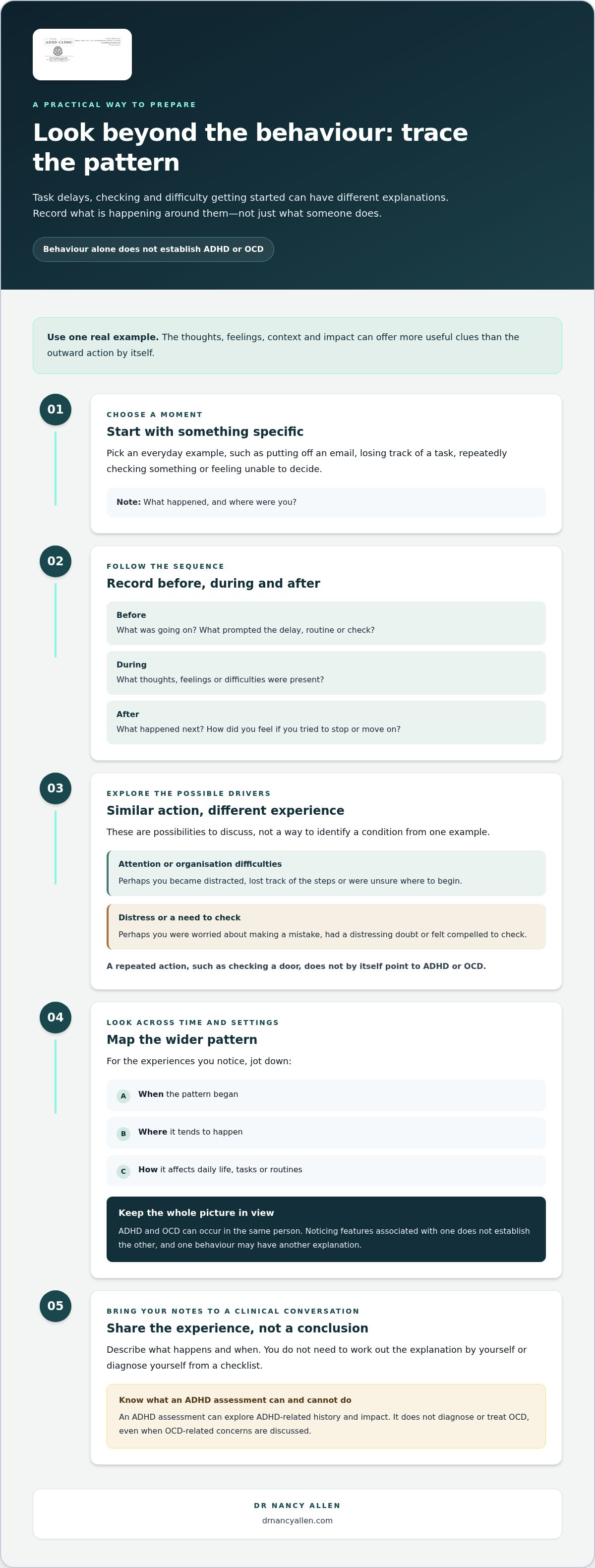
How to Prepare for a Clinical Conversation About ADHD and OCD
It can be difficult to explain overlapping experiences in the moment, especially if you’re worried that one concern may overshadow another. A few notes beforehand can help you describe what’s happening in your own words. You don’t need to arrive with a diagnosis or a complete account of your life.
For an ADHD-focused appointment, the adult ADHD assessment guide explains what an assessment may explore. Your own notes can help you focus on the details that matter to you.
Record examples without trying to diagnose yourself
Keep your notes practical and brief. Rather than deciding that an experience “must be” ADHD or OCD, describe what happened, what you noticed internally and what followed. Include examples that fit your expectations and those that don’t; both can help present a fuller picture.
Describe a specific moment. Note the situation and what you were trying to do, such as finishing a piece of work, leaving home or making a decision.
Record what came before and after. What thoughts, feelings or distractions arose? What did you do next, and how did you feel afterwards?
Notice frequency and impact. Record how often something happens and whether it affects work, study, relationships, sleep or everyday tasks. Include distress or time involved if you can.
Add the wider pattern. Where remembered, note when the difficulties began and whether they occur across settings, such as at home, school or work. A rough recollection is useful; you don’t need exact dates.
Questions that can support a clearer conversation
Bring questions that help you understand what the assessment can clarify and how your concerns will be heard. It’s reasonable to raise uncertainty directly, including a worry that attention difficulties or intrusive thoughts might be masking another part of your experience.
How will the assessment consider my developmental history alongside my current difficulties and their impact?
Can I talk through experiences that don’t seem to fit neatly into one explanation?
How will we distinguish ADHD-related concerns from other factors that may affect attention or daily functioning?
If some questions remain unanswered, what would be an appropriate next step?
You can use everyday language rather than clinical labels. “I reread the message because I was afraid I’d made a serious mistake” gives a clinician a concrete starting point. So does “I opened the task several times, but kept losing track of what I needed to do.” In a discussion about adhd and ocd, these details support exploration without turning preparation into self-diagnosis.
If you’re considering an ADHD assessment, you can explore adult ADHD assessment options as one route towards greater clarity about attention-related concerns.
How an ADHD Assessment Can Help When OCD Is Also a Concern
If you’re unsure how to interpret overlapping experiences, an ADHD assessment offers a structured opportunity to explore ADHD-related concerns. It looks beyond a few behaviours in isolation, considering their history, how they affect everyday life and the wider context you describe. It may bring clarity about ADHD, although it can’t guarantee that every question about overlapping experiences will be resolved.
What an ADHD assessment may clarify
An assessment considers reported symptoms alongside developmental history and current functioning. You may be asked how difficulties have affected areas such as work, study, relationships or daily responsibilities, and how long-standing patterns have changed over time. This broader view helps distinguish a recurring pattern from an isolated experience or a difficulty that may have another explanation.
It can be helpful to mention concerns about intrusive thoughts, repeated actions or uncertainty, particularly if they affect concentration or task completion. These details provide context for the discussion; they don’t turn an ADHD assessment into an assessment for OCD. An ADHD assessment does not diagnose or treat OCD, and raising the concern doesn’t mean either condition has been established.
That distinction matters when searching for answers about adhd and ocd. A careful ADHD assessment can explore whether ADHD-related patterns fit your history and current difficulties, while recognising that some experiences may need consideration beyond its scope. It may clarify one part of the picture without settling every question.
A measured next step with Dr Nancy Allen
Dr Nancy Allen offers adult and child ADHD assessments through secure online consultations for patients across the UK. As a private GP with over 25 years of clinical experience, she can provide a setting to discuss ADHD-related concerns, relevant history and their impact on daily life.
You can bring uncertainty as well as examples. You don’t need to arrive with the right terminology or be certain that ADHD explains everything. The conversation can focus on the concerns you want explored and what an ADHD assessment may clarify, without assuming a particular outcome or treating the appointment as an OCD assessment.
If you’d like to understand the assessment process and consider whether it may be a useful step, explore ADHD assessment with Dr Nancy Allen.
Take the Next Step at Your Own Pace
You don’t need to resolve every uncertainty before asking for support. If you’re thinking about adhd and ocd, focus on the questions that matter most to you and the experiences you’d like understood. A clear account of what affects your daily life can be a useful starting point, even if you’re still unsure how to interpret it.
An ADHD assessment can explore ADHD-related concerns, but it isn’t a diagnosis or treatment for OCD, and it may not answer every question about overlapping experiences. You can take things one step at a time, without feeling you must arrive with a label or a settled explanation. Outside of diagnostic evaluations, adults re-evaluating their personal and professional paths during times of transition may also benefit from psychotherapy for major life changes to work through the deeper psychological impact.
Dr Nancy Allen offers adult and child ADHD assessments through secure online consultations across the UK, drawing on over 25 years of clinical experience. If exploring an assessment feels like a helpful next step, explore ADHD assessment with Dr Nancy Allen.
Your experiences deserve careful attention, and seeking clarity can begin with a conversation.
Frequently Asked Questions
Is OCD a type of ADHD?
No, OCD isn’t a type of ADHD. They’re distinct conditions, although a person can experience both. ADHD involves patterns affecting attention, activity or impulse regulation, whilst OCD involves obsessions, compulsions or both. Similar difficulties, such as losing focus or repeating an action, don’t make the conditions interchangeable. If you’re unsure what may be behind a behaviour, its history, context and impact are more informative than the behaviour alone.
Can OCD cause difficulty concentrating?
Yes. Intrusive thoughts can take up attention, and a person may find it difficult to return to a conversation, lesson or work task whilst absorbed in them. Mental rituals, such as silently reviewing an event or repeating words, may also interrupt concentration. However, difficulty focusing has many possible explanations and doesn’t by itself indicate OCD. It can help to notice what was occupying your attention and whether distressing thoughts or urges were involved.
Can ADHD medication make OCD symptoms worse?
It can happen for some people, but it isn’t inevitable. Some stimulant medicines used for ADHD may worsen OCD symptoms in certain cases, so changes in intrusive thoughts, urges or rituals after starting or adjusting medication are worth documenting. Don’t change or stop prescribed medication on your own. Discuss what you’ve noticed with the clinician responsible for prescribing it, including when symptoms began and how they compare with your usual pattern.
Does having routines mean you have OCD?
No. Having routines, liking things organised or following a familiar sequence doesn’t by itself mean you have OCD. For example, preparing a bag the same way each evening might simply be convenient. A clinician would consider the wider experience, including whether intrusive thoughts or compulsions are present, how much distress they cause and whether they interfere with daily life. A routine alone can’t establish a diagnosis.
Can you have OCD without visible compulsions?
Yes. Some compulsions are mental rather than visible to other people. A person might silently repeat a phrase, count, review a memory or try to cancel out an unwanted thought. OCD can also involve obsessions without an obvious repeated action. Because these experiences may be private, describing what happens internally can be useful in a clinical conversation. Not every repeated thought is OCD, so the overall pattern needs careful assessment.
Can children have both ADHD and OCD?
Yes, a child can experience ADHD and OCD, but signs of one don’t prove the other. For instance, a child may struggle to organise school materials and also experience distressing thoughts or repeated mental or physical rituals. Adults can note what they observe at home and school, how the child describes their experience and what affects their day. A child ADHD assessment explores ADHD-related concerns; it doesn’t diagnose or treat OCD. For families navigating complex developmental or neurological questions in young people, specialised paediatric practices such as Blue Cactus Neurology illustrate the value of expert clinical evaluation when untangling overlapping childhood conditions.



Comments