


Will ADHD Stimulants Change Your Personality? What to Know

What if the traits you've always considered your core personality are actually just the symptoms of a brain struggling to regulate itself? It's the most common question I hear from patients: will stimulant medication change my personality? You might worry that your quick wit, your creative spark, or your emotional spontaneity will vanish, leaving behind a "zombie" version of yourself. This fear is entirely valid, especially when you've spent a lifetime building an identity around your unique way of thinking.
I understand that you don't want to be "fixed" if it means losing the essence of who you are. The truth is that effective ADHD treatment isn't about erasing your character; it's about removing the cognitive noise that prevents your true self from shining through. In this guide, I'll explain how to distinguish between your personality and your symptoms, whilst showing you how to spot the signs of emotional blunting. You'll discover how a personalised approach to medication can help you regain focus and confidence without sacrificing your spirit.
Table of Contents
Understanding the Fear: Will I Still Be "Me" on ADHD Medication?
It is entirely natural to feel a sense of trepidation when considering pharmacological support for a neurodivergent brain. For many, the traits associated with ADHD, such as a quick wit, high energy, and an ability to think laterally, feel inextricably linked to their identity. The question "will stimulant medication change my personality" is often rooted in a deep respect for one's own unique spirit. You might worry that by "fixing" the struggles, you will inadvertently dull the very things that make you vibrant. I want to reassure you that the goal of treatment is to support your brain's executive functions, not to re-engineer your character.
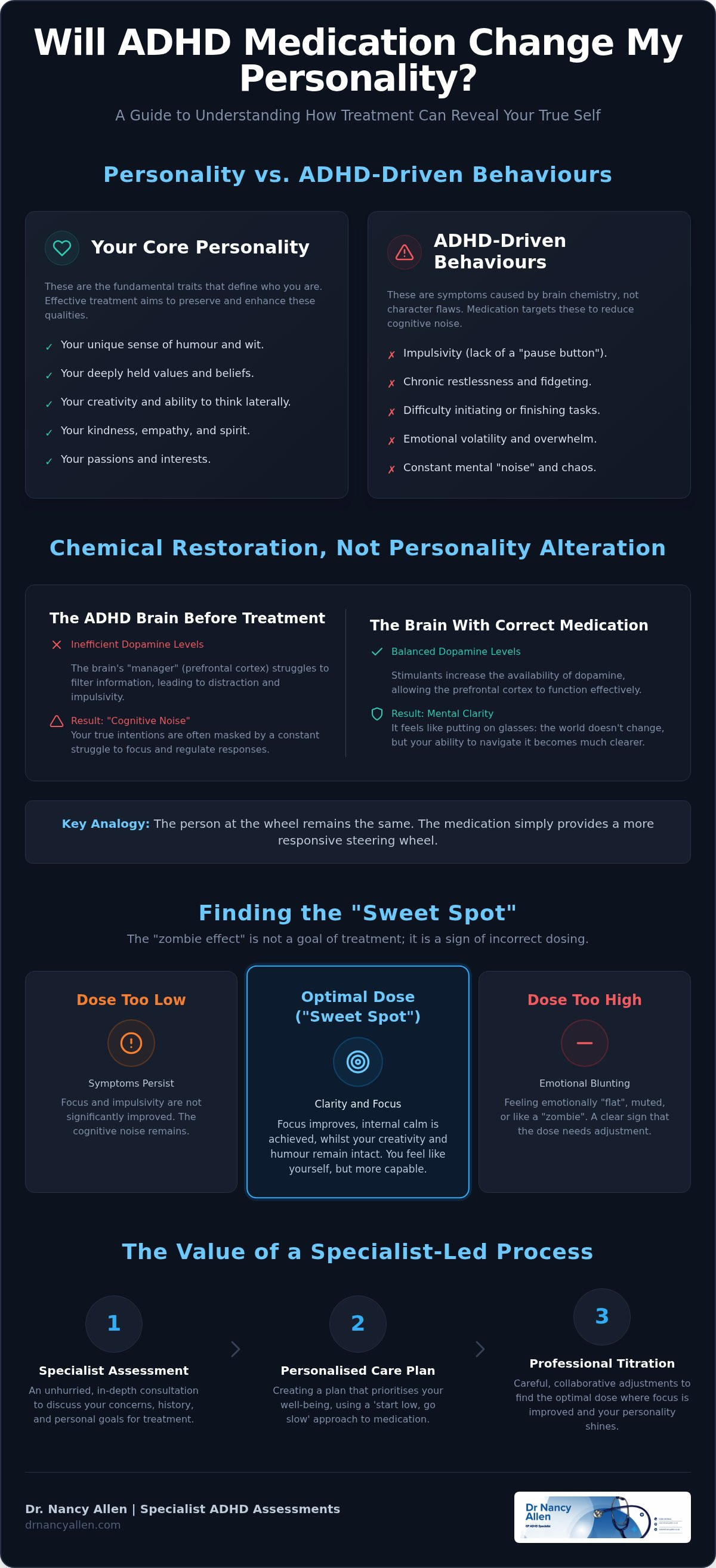
To understand why this fear exists, we must distinguish between core personality and ADHD symptoms. Your values, your sense of humour, and your fundamental kindness are your personality. Impulsivity, chronic restlessness, and the inability to finish a task are behaviours driven by neurobiology. Whilst medication is a cornerstone in the management of ADHD, its purpose is to refine your focus, not replace your essence. Effective treatment should feel like putting on a pair of glasses; the world doesn't change, but your ability to navigate it becomes much clearer.
The Myth of the "Spark" vs. the Reality of ADHD
We often romanticise the "chaotic creative" trope, mistaking the frantic energy of a dopamine-seeking brain for genuine spontaneity. There is a profound difference between being spontaneous and being impulsive. Spontaneity is a choice to embrace the moment. Impulsivity is a lack of a "pause button" that often leads to regret or overwhelm. When you are constantly drowning in mental noise, your true personality is often masked by survival strategies. By reducing this internal chaos, medication allows your real traits to surface without the constant interference of executive dysfunction.
Why British Patients Often Hesitate
In the UK, a certain cultural stigma regarding mental health medication still lingers. We are often told to "keep calm and carry on," which can make the decision to start stimulants feel like a personal failure or a surrender of one's "natural" self. This is why seeking a private adhd assessment is frequently a preferred route for those who need more than a cursory consultation. A specialist assessment provides the time and space to discuss these emotional concerns in depth. It ensures that your treatment plan is built on clinical clarity and a deep understanding of your personal goals, rather than a one-size-fits-all approach.
Behaviour vs. Personality: How Stimulants Work in the Brain
To understand if your character is at risk, we must look at the neurobiology of the ADHD brain. Stimulants work by increasing the availability of dopamine and norepinephrine in the synapses, which are the gaps between nerve cells. It is widely accepted that ADHD medications should not change a child's personality, and the same principle applies to adults. These medications don't create a "high" or a false state of euphoria when prescribed correctly. Instead, they level the playing field by allowing the prefrontal cortex to function as intended. When someone asks "will stimulant medication change my personality", they are often describing a fear of chemical interference, but the reality is one of chemical restoration.
The "person at the wheel" remains exactly the same; the medication simply provides a more responsive steering wheel. You might notice that you appear quieter to others, but this is usually a result of internal calm rather than a loss of spirit. When your brain is no longer screaming for stimulation, you don't need to fidget or talk incessantly to stay alert. This external silence is often just the sound of a mind that is finally at peace, allowing your true intentions to guide your actions.
The Role of Dopamine in Emotional Regulation
Dopamine acts as a filter, helping the brain to distinguish between important information and background noise. Without sufficient dopamine, every stimulus feels equally urgent, leading to the emotional volatility often seen in ADHD. Executive function is the "manager" of the brain’s personality, overseeing how we plan, focus, and regulate our reactions. By supporting this "manager", stimulants allow you to choose your responses rather than being at the mercy of every passing impulse. This leads to better emotional control without numbing your genuine feelings.
Hormonal Nuances in Medication Response
For women, the relationship between brain chemistry and medication is further complicated by hormonal shifts. Oestrogen plays a vital role in dopamine production; as levels drop during perimenopause, ADHD symptoms often intensify, and previous medication dosages may feel less effective. This is why a specialist menopause guide is such a critical resource for women who find their focus slipping during midlife. Adjusting treatment to account for these biological changes ensures that you remain yourself throughout every life stage. If you feel your current approach isn't quite right, seeking a private ADHD assessment can help you tailor your care to your body's specific needs.
The "Zombie Effect" and the Importance of Personalised Dosing
One of the most pervasive myths surrounding ADHD treatment is the "zombie effect". This term describes a state of emotional blunting, where the individual feels flat, humourless, or disconnected from their surroundings. If you are asking yourself, "will stimulant medication change my personality", it is likely this specific outcome that you fear. It is vital to understand that feeling like a "zombie" is not a side effect you must endure; it is a clinical sign that your dosage is too high or that the specific medication is not the right fit for your unique physiology.
The process of finding the correct dose is known as titration. This is a delicate, evidence-based journey where we start with a low dose and gradually increase it whilst monitoring your response. The goal is to reach a "sweet spot" where your executive functions are supported, but your emotional range remains fully intact. Often, what people mistake for a personality shift is actually a physical side effect, such as the "crash" that can occur as medication wears off. Irritability or a temporary dip in mood during these periods is a manageable biological response, not a permanent change to who you are.
Signs Your Dose Might Be Too High
When a dose exceeds your brain's requirements, the very focus you seek can become excessive. You might experience:
A sense of being "wired" or unable to relax.
A persistent, uncharacteristic seriousness that replaces your usual sense of humour.
A significant loss of appetite, which can lead to low energy and irritability.
A sudden lack of interest in the hobbies or social interactions you usually enjoy.
These symptoms indicate that the medication is over-stimulating your system, effectively drowning out your personality rather than supporting it. If these signs appear, it is a clear signal that your treatment plan needs adjustment.
The Titration Journey: A Collaborative Process
Titration is not a passive experience. It requires a partnership between you and your specialist. During this phase, I encourage patients to keep a simple diary to track their focus, mood, and sleep patterns. This data is invaluable. It allows us to make precise adjustments, ensuring your treatment plan is as unique as your neurodiversity. Regular follow-up appointments are non-negotiable during this time, as they provide the safety net needed to explore different options. Remember, medication is not a life sentence. Doses can be refined, and formulations can be changed until you feel like the best version of yourself, not a different person entirely.
Beyond Symptoms: How Treatment Can Reveal Your True Self
Many adults arrive at their first consultation with a quiet anxiety. They ask, "will stimulant medication change my personality", fearing that their unique spark will be replaced by a sterile, clinical version of themselves. In my experience, the opposite is usually true. ADHD often acts as a mask, hiding a person's real capabilities behind a layer of chronic overwhelm and executive dysfunction. When you aren't constantly fighting to remember appointments or struggling to start basic tasks, you finally have the mental energy to be the person you've always been underneath the noise.
This shift often leads to a profound re-discovery phase. Without the constant hum of background anxiety, your confidence begins to grow as you realise you're capable of following through on your intentions. You aren't a "new" person; you're simply a version of yourself that isn't perpetually exhausted by the effort of existing in a world not designed for your brain. This newfound clarity allows you to engage with life from a position of strength rather than one of survival. You might still wonder, "will stimulant medication change my personality" if you've seen others struggle with incorrect doses, but when the balance is right, it simply allows your true character to take the lead.
Unlocking Creativity through Structure
There is a common myth that ADHD is the sole source of creativity. Whilst the lateral thinking associated with neurodiversity is a gift, creativity without structure often results in a trail of half-finished projects and frustrated potential. Being able to actually finish a project is a significant personality win that builds a sense of achievement. Medication provides the rails for the creative train to run on. It doesn't provide the fuel or the destination; it simply ensures you arrive where you intended to go with your ideas intact.
Improving Social Connection
The impact of treatment on relationships is often the most rewarding part of the journey. By improving emotional regulation, medication can help reduce the intensity of rejection sensitive dysphoria (RSD), making social interactions less fraught with anxiety. You'll find it easier to be a better listener, as your brain is no longer darting toward every passing distraction whilst someone is speaking. Instead of just surviving the day, you can begin enjoying the moment with those you love. Being truly "present" is perhaps the greatest gift you can give to your family and friends. If you're ready to peel back the mask and discover your true potential, you can book a private ADHD assessment to begin your journey with expert guidance.
Finding Clarity: Why a Specialist ADHD Assessment is Essential
A hurried, tick-box diagnosis rarely provides the depth needed to answer complex questions about your identity. When you are grappling with the concern, "will stimulant medication change my personality", you deserve more than a cursory screening. Effective management of ADHD requires a nuanced understanding of your history, your lifestyle, and your specific neurobiological profile. A specialist assessment is the only way to ensure that your treatment plan is designed to enhance your life whilst protecting the qualities that make you unique. Precision in the initial assessment phase is what prevents the emotional blunting or "zombie effect" that so many patients fear.
Dr Nancy Allen brings 25 years of clinical experience to every consultation, ensuring that your care is rooted in both evidence and empathy. This expertise is particularly vital for women, where the intersection of ADHD and hormonal health requires a sophisticated clinical lens. By choosing a private assessment, you bypass the lengthy waiting lists and the often impersonal nature of standard care. We provide a diagnosis and a comprehensive treatment plan within 72 hours, offering immediate peace of mind and a clear path forward. This rapid turnaround doesn't sacrifice depth; instead, it provides the clarity you need to start your journey toward a more focused and confident life.
The Path to Personalised Support
During a consultation with Dr Nancy Allen, you can expect an unhurried and supportive environment. We conduct assessments through a secure online platform, allowing you to discuss your concerns from the comfort of your own home. This setting often helps patients feel more at ease, leading to a more authentic and insightful conversation about their experiences. We move beyond simply identifying symptoms to creating an actionable management plan that respects your individual goals. This personalised approach ensures that any medication prescribed is carefully titrated to support your executive functions without altering your core character.
Taking the Next Step
Deciding to seek help is a significant moment in your neurodivergent journey. It is essential to choose a clinician who understands the "whole person" rather than just the condition. Whether you are seeking an assessment for yourself or your child, our focus remains on restoration of confidence and holistic well-being. When you choose a specialist who prioritises the human element of medicine, the question "will stimulant medication change my personality" becomes a starting point for a collaborative journey, not a reason to avoid treatment. You can find the clarity you've been searching for by taking that first step today. Book your private ADHD assessment with Dr Nancy Allen to begin your transition from uncertainty to expert-led support.
Embracing Your Authentic Self with Confidence
Choosing to manage ADHD is a vital step towards reclaiming your focus and your future. Many patients start their treatment journey wondering, will stimulant medication change my personality, and the answer is that the right care should only ever enhance who you are. When managed correctly, medication doesn't erase your character; it clears the cognitive fog that has been masking your true potential for years. You deserve a treatment plan that respects your unique spirit whilst providing the stability you need to thrive.
Finding this balance requires expert guidance and a deeply personalised approach. Dr Nancy Allen offers specialist care backed by over 25 years of clinical experience, ensuring that every patient feels heard and supported. We provide comprehensive diagnoses and tailored management plans within 72 hours, helping you move from uncertainty to action without delay. You don't have to navigate this journey alone or settle for a life that feels "flat" or disconnected.
Begin your journey to clarity with a private ADHD assessment and discover how the right support can help you become the most vibrant version of yourself. Your true personality is waiting to be revealed.
Frequently Asked Questions
Will stimulant medication make me feel like a "zombie"?
Feeling like a "zombie" isn't a normal side effect of ADHD treatment; it's a clinical indicator that your dose is too high. Effective medication should make you feel more like yourself, not less. If you experience emotional blunting or a "flat" affect, it means your brain's being over-stimulated. You should contact your specialist immediately to refine your prescription, as the right dose should provide clarity without dampening your spirit or your sense of self.
Can ADHD medication affect my creativity or sense of humour?
Your creativity and humour are core personality traits that stimulant medication shouldn't erase. Many patients find that their creative output actually improves because they finally have the focus to complete their projects. Whilst you might feel less "chaotic," your unique perspective remains intact. If you find your wit feels dulled or your creative spark has vanished, this is usually a sign that your medication needs a professional adjustment to better suit your physiology.
What should I do if I feel my personality is changing on medication?
Many patients worry and ask, "will stimulant medication change my personality?" If you feel a shift in your sense of self, start by keeping a daily log of your mood. Note specific times when you feel different, as this helps identify if the issue is the dose or the "crash" as it wears off. You must discuss these observations with your clinician. They can help you determine if another medication might be more suitable to preserve your natural traits.
Is the change in my behaviour permanent if I stop taking stimulants?
No, any changes in behaviour or focus aren't permanent. Stimulant medications are short-acting and are processed by your body relatively quickly. Once the medication is out of your system, your brain will return to its baseline state. This is why many people use "medication holidays" under clinical supervision. You aren't permanently altering your brain's structure; you're simply providing temporary support for your executive functions during the hours the medication is active.
How long does it take to find the right dose of ADHD medication?
The titration process typically takes several weeks or even months to complete. We start with a low dose and gradually increase it whilst monitoring your response. This methodical approach is essential to ensure we find the "sweet spot" where you gain focus without experiencing unwanted personality shifts. Every person's metabolism is different, so patience is key. Regular follow-ups during this period ensure your management plan is personalised to your specific needs and lifestyle.
Does ADHD medication affect adults differently than children?
Whilst the core mechanism of action is the same, adults often have different treatment goals, such as managing workplace performance or complex household responsibilities. Adults also have different metabolic rates and may be taking other medications that interact with stimulants. Hormonal changes in adults also influence how the body responds to treatment. This is why a specialist assessment is so important; it ensures that your life stage and physical health are fully considered.
Can menopause change how my ADHD medication affects my mood?
Yes, the drop in oestrogen during perimenopause and menopause can significantly impact how your medication works. Oestrogen helps regulate dopamine; when it declines, your ADHD symptoms may feel more intense, or your usual medication dose might seem less effective. This can lead to increased irritability or mood swings. It's often necessary to adjust your ADHD treatment alongside menopause care to ensure you maintain emotional stability and focus during this transition.
Will I still feel "spontaneous" whilst taking stimulants?
You will certainly still be able to be spontaneous. Spontaneity is a delightful personality trait that allows you to enjoy the moment, whereas impulsivity is a symptom that often leads to regret. Stimulants help you distinguish between the two. By providing a "pause button," medication allows you to choose to be spontaneous without being driven by a frantic need for stimulation. You'll likely find you enjoy your spontaneous moments more when they aren't overshadowed by chaos.


Comments