


Signs of Undiscovered ADHD: Finding Clarity

ADHD does not always look hyperactive. The signs of undiscovered ADHD can centre on attention, organisation and memory, without obvious restlessness or impulsive behaviour. According to the NHS, ADHD symptoms usually start before the age of 12, even if they aren’t recognised until adulthood.
If everyday tasks have always seemed to take you more effort than they do for other people, it’s understandable to want a clearer explanation. This article explores how ADHD can present without obvious hyperactivity, why it may be missed in adults, and how difficulties with focus, planning and emotional regulation can affect daily life. These experiences alone don’t establish a diagnosis: a specialist assessment looks at the wider pattern and its impact. The aim is to help you recognise possible signs without reducing your experience to a checklist or assuming one explanation fits everyone.
Table of Contents
Can You Have ADHD Without Hyperactivity?
Yes. ADHD can involve persistent difficulties with attention and organisation without obvious hyperactivity or restlessness. In the UK, diagnosis considers symptoms, their history and their effects across daily life.
Inattentive symptoms and coping strategies
Inattentive ADHD can make it harder to sustain focus, plan tasks, organise belongings or remember everyday commitments. Someone might reread an email several times, then forget to reply despite intending to do so. These difficulties can be less visible than physical restlessness, especially when a person has developed ways to compensate.
Rigid routines, reminders, lists or extra time spent on tasks may help someone keep daily responsibilities on track. But relying heavily on these strategies can be tiring, and difficulties may remain hidden from others. Anxiety, depression, sleep problems and hormonal changes around menopause can also affect concentration or cause mental fog. Attention problems alone don’t establish ADHD.
Symptom duration and settings
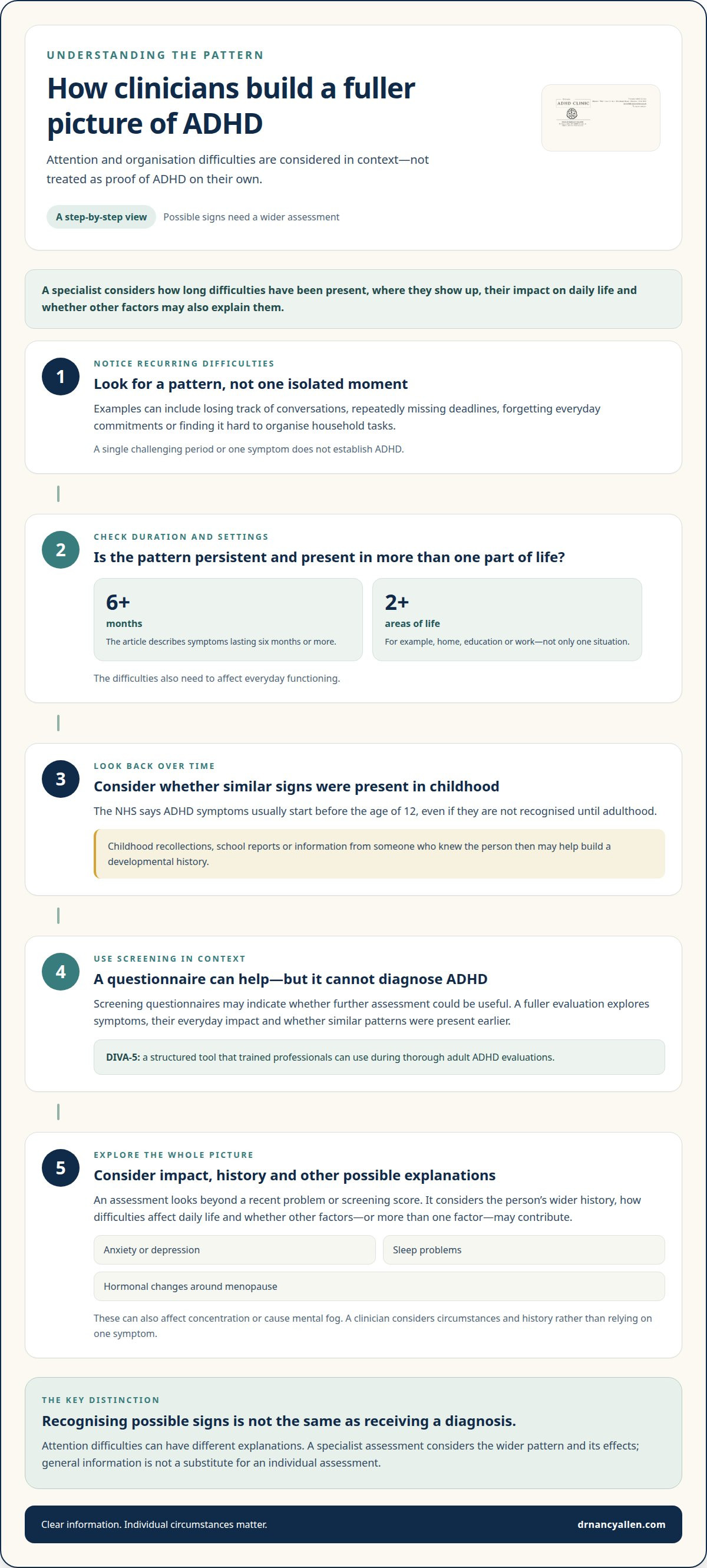
For an ADHD diagnosis, symptoms must be persistent, affect everyday functioning and appear across settings, rather than being limited to one situation. The criteria described in the research information require symptoms for six months or more and in two or more areas of life, such as home, education or work.
This matters because a difficult period at work, for example, may have several explanations. An assessment considers whether similar patterns have affected other parts of life and how long they have been present. The NHS says ADHD symptoms usually start before age 12, even when a person only recognises their impact much later.
Adult ADHD presentations
Adults can experience inattentive symptoms, hyperactive-impulsive symptoms, or a combination of both. Visible hyperactivity may become less obvious, while problems with focus, organisation or emotional regulation continue. Someone might know they need to leave in 30 minutes, then begin getting ready only five minutes beforehand. This can become harder after starting university, taking on full-time work or becoming a parent, when earlier coping strategies meet greater demands.
For adults and adolescents over 16, the research information gives a threshold of five symptoms of inattention or hyperactivity and impulsivity. Support in the UK may include practical strategies and, for adults, cognitive behavioural therapy (CBT) to help break tasks into steps and manage time. ADHD medicines must be started and monitored by an ADHD specialist.
ADHD in women and girls
Inattentive ADHD in girls may be overlooked when difficulties are less disruptive in the classroom. Women may also work harder, force themselves to focus or rely on elaborate routines to meet expectations, making their struggles less apparent to others. These coping approaches can conceal the effort involved for years.
Pregnancy or menopause may coincide with increased forgetfulness, difficulty concentrating or mental fog in women with inattentive ADHD. These changes can also have other explanations, so a clinician considers the person’s history and circumstances rather than relying on one symptom. Recognising a longstanding pattern can help clarify what support may be appropriate.
Why Is ADHD Commonly Missed in Adults?
ADHD may go unrecognised when difficulties are less disruptive or hidden by coping strategies. Adults may seek assessment after years of challenges with work, relationships or daily responsibilities. An adult assessment explores whether these difficulties fit an ADHD pattern, rather than relying on one recent problem or a screening score alone.
Why adult ADHD can be overlooked
Childhood expectations can shape what teachers, families and clinicians notice. A pupil who isn’t disruptive may attract less attention, even if they regularly lose belongings, forget instructions or struggle to finish classwork. Adults may have learned to conceal similar difficulties through overwork, rigid routines or extensive planning.
Other explanations may also seem plausible. Anxiety can make concentration difficult when worries dominate, while depression can affect motivation and focus. Some adults receive support for these mental health challenges without ADHD being considered. An assessment can explore whether ADHD, anxiety, depression or more than one factor contributes to a person’s experience.
A 2016 study by Sternat found that 34% of patients referred for treatment-resistant mood disorder met ADHD criteria. This finding concerns that particular group, not all adults with mood difficulties. It illustrates why clinicians need to consider a person’s wider history, rather than assume one diagnosis explains every challenge.
Adult screening and assessment
Screening questionnaires can help identify whether further assessment may be useful, but they don’t establish a diagnosis by themselves. A fuller evaluation considers symptoms, their effects on everyday life and whether similar patterns were present earlier. The DIVA-5 is a structured tool trained professionals can use during thorough adult ADHD evaluations.
Useful examples might include repeatedly missing deadlines, losing track of conversations or struggling to manage household tasks. Childhood reports, school records or recollections from someone who knew the person then may help build a developmental history. The assessor also considers other possible explanations and any co-existing mental health difficulties.
Before speaking to a GP, note recurring challenges and examples from work, home or relationships. This can make it easier to describe how difficulties affect daily functioning, rather than relying on a general feeling of being overwhelmed. A GP may refer someone for an NHS assessment or discuss other assessment routes.
NHS Right to Choose in England
In England, eligible patients can choose the organisation providing their NHS-funded ADHD assessment through the NHS Right to Choose pathway. This is an NHS route, not a private assessment; eligibility and referral arrangements shape how it applies in each case.
Assessment routes differ across the UK, so Right to Choose applies to England rather than being a UK-wide pathway. For an adult considering assessment, the key step is to discuss persistent difficulties and their impact with a GP. Clear examples from different settings can help inform that conversation.
Cognitive and organisational difficulties
ADHD can affect the mental processes involved in planning, remembering and completing everyday activities. These difficulties may influence work, home routines and relationships.
Planning and organisation challenges
Difficulties with planning and organisation can make it harder to manage time, keep track of belongings and finish tasks. Their impact often becomes clearer through repeated everyday examples, rather than one isolated lapse.
Someone might open an email to deal with a simple request, become distracted, then realise they’ve spent 20 minutes on something unrelated. Long or monotonous tasks can also be difficult to start, even when the person understands their importance. Putting them off may bring missed deadlines and stress.
Keeping several demands in mind can be tiring. A person may remember an appointment only after missing it, or start household jobs without completing them. These patterns can affect confidence and relationships, especially if others interpret forgetfulness as a lack of care. Frustration about unfinished work doesn’t, by itself, establish ADHD; the wider pattern and its effects matter.
Sleep is another part of the picture. Sleep problems affect up to 70% of adults with ADHD, and poor sleep can make concentration and organisation harder. This relationship can work in both directions: restless thoughts or difficulty settling may disrupt rest, while tiredness can make daytime tasks more challenging. A clinician considers sleep alongside other circumstances and symptoms.
Executive function difficulties
Executive functions are mental skills used to organise actions, manage attention and shift between tasks. Difficulties with these skills can explain why someone knows what needs doing but struggles to begin or follow through.
For example, a person may intend to prepare a meal, notice an unanswered message, then become absorbed in another job. They might lose their place when instructions have several steps or find it difficult to return to an unfinished task. Interest matters too: stimulating activities can hold attention, while tasks that feel boring or meaningless may be harder to start or continue.
ADHD-related attention challenges may occur in different situations and relate to executive functioning, rather than appearing only during a low mood. However, depression can affect motivation and concentration too. If depression improves but problems with organisation, time management or attention remain, describe those ongoing challenges to a healthcare professional. The distinction depends on the person’s history and the pattern across daily life.
Social situations can also require sustained attention. Someone may lose track during a conversation, miss part of what was said or struggle to stay present in a group. This can lead to misunderstandings or a sense of disconnection in relationships. Large gatherings may feel mentally exhausting, particularly when keeping up with several conversations takes substantial effort.
Differences between inattentive and hyperactive ADHD
ADHD can involve inattention, hyperactivity and impulsivity in different combinations. The DSM-V describes three presentations, helping explain why ADHD doesn’t look the same in everyone.
Inattention, hyperactivity and impulsivity
Inattention can mean losing track of instructions, overlooking details or finding it difficult to sustain attention on a task. Hyperactivity may appear as restlessness, frequent movement or difficulty remaining seated. Impulsivity involves acting or speaking before considering the consequences, such as interrupting before someone has finished.
The DSM-V describes predominantly inattentive, predominantly hyperactive-impulsive and combined presentations. These describe symptom patterns, not separate conditions or measures of how serious someone’s difficulties are. Someone with an inattentive presentation may show no obvious physical restlessness, while a person with combined symptoms experiences features from both groups.
Hyperfocus and inconsistent attention
Attention can vary with the activity in ADHD, so difficulty focusing on one task can coexist with intense focus on another. A person might struggle to read a routine report, then become absorbed in an engaging creative project.
This intense absorption is often called hyperfocus, although it isn’t one of the DSM-V presentations. Hours may pass unnoticed, and someone may forget an appointment or a meal while concentrating. This contrast can confuse family members or colleagues who see strong focus in one setting and difficulty sustaining it elsewhere. It doesn’t mean the person can reliably choose when to concentrate.
Switching attention
Switching attention means stopping one activity and directing focus to another demand. For someone with ADHD, moving away from a stimulating task can be difficult, even when another responsibility needs attention.
For example, someone engrossed in a game might not notice repeated requests to get ready. In another situation, a phone notification may interrupt a task, and returning to the original work can take effort. These examples show why attention isn’t simply present or absent. The demands of the task, competing distractions and the person’s pattern of difficulties all help explain what is happening.
Signs in children and teenagers
In children and teenagers, ADHD may appear as frequent distraction, unfinished schoolwork, restlessness or acting before thinking. A child might forget classroom instructions, while a teenager may interrupt conversations or struggle to wait their turn.
Inattentive difficulties can be less noticeable than disruptive behaviour, particularly when a pupil quietly loses track of lessons or belongings. Hyperactive or impulsive behaviour may be more visible at school or home, but one incident alone doesn’t establish ADHD. Adults supporting a young person can note examples from lessons, friendships and home routines, then discuss persistent concerns with an appropriate healthcare professional.
Emotional regulation and sensitivity to criticism
ADHD can involve emotional difficulties alongside challenges with attention and organisation. Strong reactions may affect family life, friendships and a person’s view of themselves.
Emotional regulation
Emotional regulation is the ability to recognise and manage feelings as they arise. With ADHD, emotions may feel intense, shift quickly or take longer to settle.
For example, a minor change of plan might trigger marked frustration, followed by difficulty returning to a conversation. This pattern is sometimes described as emotional dysregulation. It can affect daily life because reactions may influence communication, decision-making and relationships, even when the original trigger seems small to others.
Emotional dysregulation isn’t enough to identify ADHD on its own. A clinician considers it alongside the person’s broader history, attention patterns and everyday difficulties. This helps avoid treating one emotional response as proof of a disorder.
Anxiety and low self-esteem
Repeated difficulties can contribute to anxiety or low self-esteem, particularly when someone interprets them as personal failings. An adult who often misses deadlines, for instance, may conclude they’re lazy despite working hard to keep up.
Over time, criticism at work or tension at home can increase worry about making mistakes. Adults with ADHD may also experience anxiety or depression, which can affect concentration too. Considering both emotional wellbeing and longstanding attention difficulties helps clarify what may be contributing to a person’s experience.
Sensitivity to criticism can make feedback feel especially painful. A brief comment about a late task might stay on someone’s mind long after the conversation ends. The reaction deserves understanding, but it doesn’t determine a diagnosis by itself.
Emotional and behavioural indicators
Emotional and behavioural indicators are recurring responses that affect how someone feels or acts in everyday situations. Examples include becoming upset quickly, finding it hard to calm down or reacting impulsively during disagreements.
In children, these behaviours might appear as tearfulness after a classroom correction or anger when an activity changes unexpectedly. Adults may withdraw from a discussion after feeling criticised, or reply sharply and later regret it. Noticing when these reactions occur and what impact they have can help describe the pattern to a healthcare professional.
Similar responses can arise for different reasons. Anxiety, depression, stress and other circumstances can influence behaviour and feelings, so context matters. A repeated pattern across home, school or work offers more useful information than one difficult day.
Emotional overwhelm
Emotional overwhelm occurs when demands or feelings become difficult to process all at once. For example, a noisy room, several requests and an unexpected change may leave someone unable to decide what to address first.
That feeling may lead to tears, irritability, shutting down or leaving the situation. A child might struggle to rejoin a lesson after becoming upset, while an adult may need time before continuing a demanding conversation. These examples can help explain the effects of emotional difficulties without assuming ADHD is the only possible cause.
Dr Nancy Allen: Adult ADHD Assessment
Dr Nancy Allen’s Adult ADHD Assessment offers a structured opportunity to explore persistent difficulties with attention, organisation or emotional regulation. It may be a useful next step when these challenges affect everyday life and you want to understand whether ADHD could be contributing.
The assessment considers your symptoms, personal history and circumstances, building a fuller picture rather than relying on a checklist alone. You can discuss appropriate options, and, where relevant, communication with your NHS GP or other healthcare professionals may form part of your care, with your consent. An assessment doesn’t guarantee a particular diagnosis or treatment outcome.
If you’d like to explore whether an assessment suits your situation, you can contact Dr Nancy Allen.
Take the next step towards greater clarity
Recognising signs of undiscovered ADHD can raise new questions about how you experience work, relationships and everyday responsibilities. You don’t need to have every answer before starting a conversation. Describing the difficulties that matter most to you is a practical place to begin.
Dr Nancy Allen offers Adult ADHD Assessment and Child ADHD Assessment, alongside Peri-menopause & Menopause Specialist Care. An individual assessment can explore your history and circumstances, then discuss appropriate options without assuming one explanation fits everyone. General information can support understanding, but it can’t replace clinical advice about your situation.
If you’d like to discuss an assessment or ask about the next step, contact Dr Nancy Allen. A thoughtful conversation can help you consider your options with greater confidence.
Frequently Asked Questions
How can a provider know if I showed ADHD symptoms as a child?
An assessment builds a picture from your memories and any relevant information from childhood. You might recall school reports mentioning unfinished work, forgotten equipment or difficulty following instructions. A parent, sibling or someone who knew you then may also describe what they observed. Records and other people’s recollections can help, but the assessment considers your whole history rather than relying on one document or memory.
What Is Undiagnosed ADHD?
Undiagnosed ADHD means a person has ADHD-related difficulties that haven’t yet been recognised through an assessment. This may become apparent when demands change, such as starting a new role or managing a household. Signs of undiscovered ADHD can resemble difficulties linked to sleep, anxiety or depression, so symptoms alone don’t confirm the condition. An assessment considers their history, impact and possible explanations.
What is Inattentive ADHD (ADHD-PI)?
ADHD-PI is a commonly used term for the predominantly inattentive presentation of ADHD. It describes a pattern where attention-related symptoms are prominent, without the person necessarily showing obvious hyperactivity. Examples might include overlooking details in a form, forgetting an agreed appointment or struggling to follow a long conversation. The term describes a presentation, not a separate diagnosis or a judgement about someone’s ability.
Why wasn’t I diagnosed with ADHD earlier?
ADHD may be missed when difficulties are quiet, mistaken for something else or managed through considerable effort. A child who completes schoolwork by staying up late, for example, may not appear to need help. Girls with inattentive symptoms may also be less likely to attract attention through disruptive behaviour. Some adults develop coping routines that conceal difficulties until work, study or caring responsibilities become harder to manage.
What are common signs of undiagnosed ADHD in adults?
Adults may repeatedly misplace essential items, lose track of appointments, struggle to begin paperwork or find it difficult to follow through on plans. Someone might intend to pay a bill, become distracted by another task and remember only after receiving a reminder. These examples can occur for different reasons. A clinician considers whether difficulties form a persistent pattern and affect everyday functioning, rather than treating one lapse as evidence of ADHD.
What are the inattentive, hyperactive-impulsive and combined ADHD presentations?
These names describe patterns of ADHD symptoms. The inattentive presentation centres on difficulties such as sustaining attention or keeping track of tasks. The hyperactive-impulsive presentation involves symptoms such as restlessness or acting before thinking. The combined presentation includes features from both groups. A person’s presentation describes their symptoms, but doesn’t capture every aspect of their experience or determine how ADHD affects them day to day.
How can ADHD symptoms affect work, education, relationships and daily life?
ADHD-related difficulties can affect different parts of life in distinct ways. At work, someone may miss a deadline despite understanding the task; in education, they may lose track of instructions. At home, forgotten plans can create tension, while distraction during conversations may leave a partner feeling unheard. These examples show practical impact. An assessment considers how challenges affect functioning across settings, not only performance in one role.
How is ADHD assessed and diagnosed in the UK?
An ADHD assessment involves a detailed review of symptoms, personal history and their effects on everyday life. A trained professional may use a structured tool such as the DIVA-5 for adult evaluations, alongside clinical discussion. A screening questionnaire alone doesn’t establish a diagnosis. In the UK, a person can speak to their GP about referral for NHS assessment or consider a private assessment; routes and arrangements differ across the country.



Comments