


ADHD hyperactive test: Check symptoms and understand next steps

An ADHD hyperactive test can highlight patterns worth exploring, but it cannot provide a formal diagnosis. A screening result is only an indication. A clinical assessment considers symptoms over time, their effects in different areas of life and whether other factors could explain them.
If you’re looking for clarity, it’s understandable to hope a test will give you a definite answer. Screening can be a useful starting point: it may help you notice experiences such as restlessness or impulsive behaviour and decide whether to seek a fuller assessment.
This article explains what a screening can and can’t tell you, how a professional ADHD assessment explores your history and day-to-day experiences, and why attention, hyperactivity and impulsivity are considered alongside mental health. You’ll also learn what steps may follow a screening result, so you can approach the next conversation with greater understanding and confidence.
Table of Contents
Professional ADHD assessment
An online ADHD hyperactive test can highlight experiences to discuss, but it cannot establish a diagnosis. A qualified clinician reviews the person’s history, symptoms and circumstances before reaching a clinical conclusion. This wider assessment also helps distinguish ADHD from other explanations for difficulties with attention, activity or impulse control.
Childhood history matters. The American Psychiatric Association states that ADHD symptoms usually start before the age of 12. An assessment therefore explores when the difficulties began and how they appeared at school, at home or in other settings. For a child, a parent or carer may help describe early behaviour; an adult may share memories or relevant records.
A thorough assessment considers more than a checklist score. The clinician explores the pattern and impact of symptoms, including effects on education or work, relationships and everyday tasks. They also review medical and mental health history, since sleep problems, anxiety, low mood and other conditions can affect concentration or behaviour. With the person’s agreement, information from someone who knows them well can add context.
Describe the history. The clinician asks when the difficulties began and whether they have continued over time.
Explore different settings. The assessment considers whether symptoms affect more than one part of life, rather than appearing in a single situation.
Review possible alternatives. Medical and psychosocial history helps identify other factors that may contribute to the same difficulties.
There is no single assessment duration that applies to everyone. The time needed depends on the complexity of the history, the information available and whether further discussion is needed. An appointment is not a pass-or-fail test, but a structured clinical review using diagnostic criteria, including those described in the Diagnostic and Statistical Manual of Mental Disorders.
In England, NHS specialist ADHD assessment waits can be several months or years. Right to Choose is a separate route in England: it was introduced in 2014 and allows eligible patients to choose an eligible provider for NHS-funded care. A private assessment is another option, distinct from an NHS-funded appointment. The available route depends on where a person lives and how their care is arranged.
If symptoms affect your work, education, relationships or a child’s daily life, discuss them with a GP or another suitable healthcare professional. They can help you consider an appropriate assessment route. Keeping clear examples, such as unfinished tasks, frequent interruptions or restlessness in class, can make the conversation more specific.
Structured Adult ADHD Self-Test adaptation
A structured self-test turns experiences into answers that can be reviewed consistently. The Structured Adult ADHD Self-Test, or SAAST, is one source of an adapted screening questionnaire. The adult ADHD self-screening questionnaire was developed by the World Health Organization and the Workgroup on Adult ADHD. It can indicate whether further clinical discussion may be useful, but it does not confirm attention deficit hyperactivity disorder.
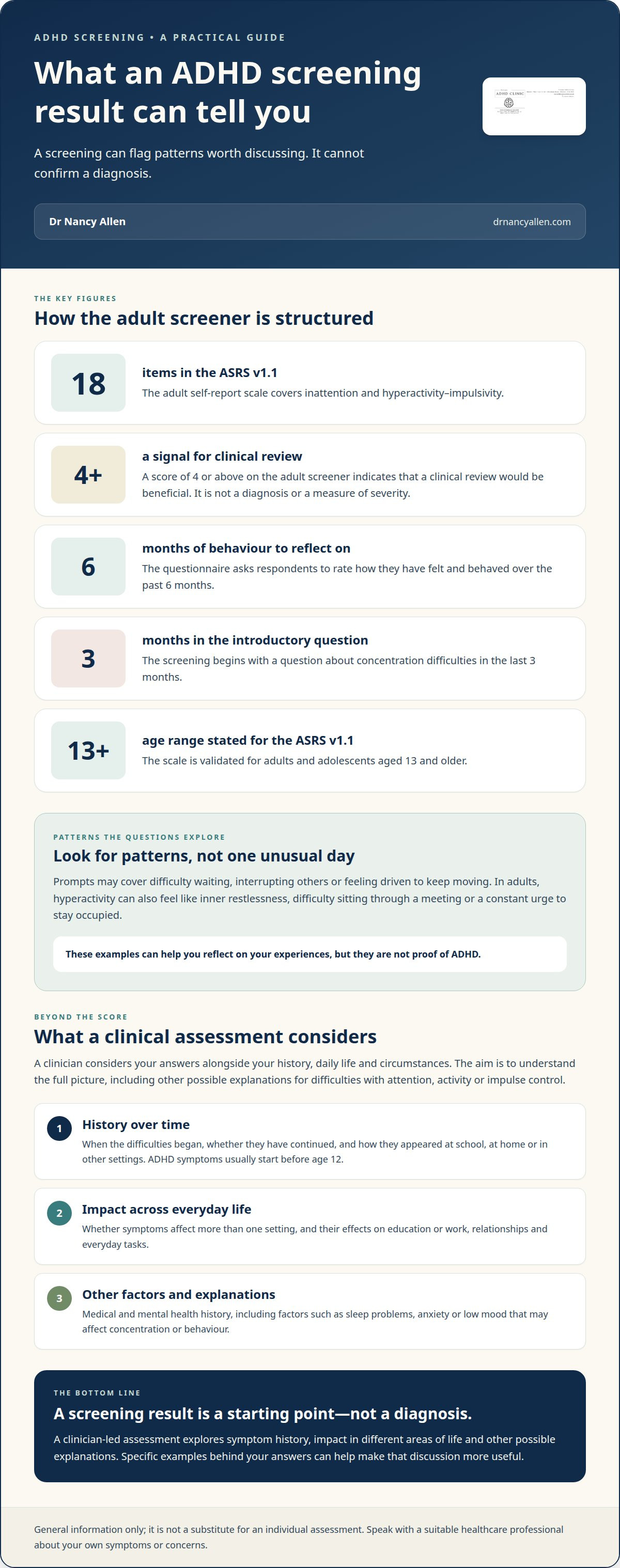
The Adult ADHD Self-Report Scale, known as the ASRS v1.1, is a self-report tool for assessing ADHD in adults. It contains 18 items covering inattention and hyperactivity-impulsivity. The version is based on the diagnostic criteria in the Diagnostic and Statistical Manual of Mental Disorders, Fourth Edition, Text Revision. The ASRS v1.1 is validated for adults and adolescents aged 13 and older.
Questionnaires ask about patterns, not isolated moments. The screening includes an introductory question about concentration difficulties in the last 3 months, and asks respondents to rate how they have felt and behaved over the past 6 months. A prompt might ask about difficulty waiting, interrupting others or feeling driven to keep moving. Consider how often a pattern occurs, rather than treating one unusual day as representative.
Self-diagnosing ADHD from an online test can lead to a mistaken conclusion because a score cannot assess your history, daily functioning or other possible explanations. It may also create false certainty or unnecessary concern. Use the result as a prompt to talk with a healthcare professional, not as a diagnosis.
In adults, hyperactivity can be less visible than in children. It may feel like inner restlessness, difficulty sitting through a meeting or a constant urge to stay occupied. Impulsivity may involve speaking before someone finishes, making quick decisions or finding it hard to wait. These examples are prompts for reflection, not proof of a hyperactivity disorder.
A screening score is best understood as a signal to consider further review. A score of 4 or above on the adult screener indicates that a clinical review would be beneficial. It does not show how severe symptoms are, establish that ADHD is present or account for how symptoms affect work, relationships and everyday responsibilities. A clinician considers those details alongside the reported answers.
For a useful discussion, note specific examples behind your answers, such as repeatedly losing track during conversations or acting before considering consequences. Bring the questionnaire result and any questions to a healthcare professional. If persistent difficulties are affecting your life, a clinician-led adult ADHD assessment can explore your symptoms and history in greater depth.
Inattentive, hyperactive and impulsive symptoms
Attention deficit hyperactivity disorder involves patterns of inattention, hyperactivity and impulsivity. The Diagnostic and Statistical Manual of Mental Disorders, Fifth Edition (DSM-5), recognises three presentations: predominantly inattentive, predominantly hyperactive-impulsive and combined. Most people with ADHD experience symptoms from both inattentive and hyperactive-impulsive groups, although one group may be more noticeable.
Symptoms can affect everyday routines in different ways. Inattention may make it difficult to follow instructions or finish a task, while hyperactivity can involve restlessness or excessive movement. Impulsivity can affect conversations and decisions. A missed detail or occasional interruption alone does not establish a disorder; the overall pattern and its impact matter.
Notice attention difficulties. Losing track during instructions or repeatedly leaving tasks unfinished can show how attention affects daily responsibilities.
Look for restlessness. Fidgeting, difficulty remaining seated or feeling driven to move are examples of hyperactivity.
Consider conversational timing. Interrupting before another person finishes may reflect difficulty pausing, rather than deliberate rudeness.
Observe waiting and decisions. Struggling to wait a turn or acting quickly can illustrate impulsivity in everyday situations.
Compare different activities. Trouble staying focused on paperwork but not a preferred hobby can help describe how attention varies by task.
Record the effect. A symptom is more informative when linked to a practical consequence, such as unfinished work or tension with friends.
Hyperactivity and impulsivity can look different across ages and circumstances. A child may be visibly active in class, while an adult may experience inner restlessness, speak rapidly or find meetings difficult. These examples help describe a presentation, but symptoms must be considered in context, including the person’s development, environment and everyday demands.
The DSM-5 criteria described for ADHD require symptoms across two or more settings, such as home and school, or work and relationships. They also need to persist over time and affect functioning. For adults aged 17 and older, the criteria described require at least five persistent symptoms of inattention and/or hyperactivity-impulsivity. A checklist can prompt reflection, but it cannot establish whether these criteria are met.
To make observations useful, describe what happened, where it happened and what followed. For example, “I interrupted twice during a team discussion and missed the next instruction” gives more context than “I’m impulsive”. Specific examples help a healthcare professional explore whether attention, hyperactivity or impulsivity forms a consistent pattern.
What are the Main Symptoms of ADHD?
Signs of hyperactive ADHD can include constant movement, difficulty staying seated and interrupting others. In children, this may be noticeable during lessons or meals. Adults may experience inner restlessness, rapid speech or difficulty waiting.
Inattention can involve losing track of instructions, overlooking details, forgetting appointments or leaving tasks unfinished. For example, an adult may start several household jobs without completing them, while a child may struggle to follow a classroom task from beginning to end.
ADHD screening questionnaires commonly ask people to rate symptoms over the past six months. This timeframe helps show whether difficulties form a persistent pattern rather than reflecting a short-lived response to a busy period or a particular change.
During a UK ADHD assessment, questions may cover when symptoms began, how often they occur and how they affect school, work, home life and relationships. A clinician may ask for examples of inattention, restlessness or impulsive behaviour, as well as relevant medical and mental health history.
For an NHS assessment, a GP is a practical first point of contact to discuss concerns and referral options. Parents and carers can raise concerns about a child with their GP. In England, a GP may also help explore the NHS Right to Choose route.
Specific examples make a symptom history easier to understand. Rather than saying “I’m forgetful”, describe missing a planned appointment despite setting a reminder, or repeatedly needing instructions repeated at work. For a child, note whether unfinished classwork also occurs during homework or other activities.
Track attention lapses. Record examples such as losing belongings, overlooking details or needing frequent prompts to complete tasks.
Describe activity levels. Note fidgeting, getting up repeatedly or feeling unable to settle during quiet activities.
Explain impulsive moments. Give examples such as answering before a question ends, interrupting a conversation or struggling to wait.
Connect symptoms to their impact. Explain whether difficulties affect learning, work, friendships, family routines or responsibilities.
ADHD symptoms usually begin in childhood, and an assessment considers their development over time. A teenager’s current restlessness, for instance, may be discussed alongside earlier school experiences and how behaviour has changed with age. The clinician also considers whether symptoms appear across settings, rather than only during one activity.
Focus on observable experiences, not labels. A missed deadline, repeated interruption or difficulty following a multi-step instruction gives a healthcare professional something concrete to explore. These examples support a fuller discussion; they do not, by themselves, establish attention deficit hyperactivity disorder.
ADHD and mental health
Restlessness and impulsive behaviour can also occur with stress, disrupted sleep, anxiety or other mental and physical health conditions. A clinician considers when symptoms began, how they change and how they affect daily life, rather than treating one behaviour as proof of ADHD.
ADHD and mental health can influence one another. Some people with ADHD also experience depression, though the relationship between the two can vary. This association does not mean ADHD causes depression or that a person with depression necessarily has ADHD. It underscores the importance of considering the broader clinical picture.
For example, low mood may affect concentration, motivation and the ability to complete tasks. Anxiety can make someone feel restless or unsettled in particular situations. These experiences may overlap with ADHD symptoms, so an assessment explores their timing, persistence and impact alongside the person’s developmental and medical history.
A screening tool can identify reported patterns, but it cannot assess every mental health concern or explain why symptoms occur. The Diagnostic and Statistical Manual of Mental Disorders describes ADHD criteria. A clinician uses those criteria as part of a wider assessment, not as a substitute for understanding the person’s circumstances.
Describe changes over time. Note whether restlessness or difficulty concentrating began in childhood, appeared recently or varies with mood and sleep.
Explain the impact. Give examples from work, study, home routines and relationships, such as missed deadlines or repeated conflict.
Mention other concerns. Share relevant changes in mood, anxiety, sleep or physical health during an assessment.
Separate observation from conclusion. “I struggle to sit through meetings” is more useful than deciding that one symptom proves ADHD.
This broader view can help distinguish ADHD symptoms from other contributing factors and identify difficulties that may need attention in their own right. It also matters for children: a parent’s observations at home can be considered alongside behaviour and learning at school, rather than treating one setting as the whole picture.
If you are concerned about persistent symptoms alongside changes in mood or wellbeing, raise both with a suitable healthcare professional. Discussing the full picture can help clarify what assessment may be appropriate and what support to consider. An individual ADHD assessment can explore symptom history and circumstances in depth.
Dr Nancy Allen
Dr Nancy Allen can help adults, parents and carers move from screening questions towards a clearer understanding of possible ADHD symptoms. A self-test may offer useful observations, but it cannot replace an individual clinical assessment or explain how symptoms relate to someone’s history and circumstances.
Her practice offers adult and child ADHD assessments. An assessment explores reported difficulties and their effects, helping inform a discussion about appropriate next steps. Consider seeking professional input if restlessness, impulsivity or attention difficulties affect everyday life, learning, work or relationships.
Online information cannot determine whether you or your child has ADHD. If you would like to discuss your concerns and possible assessment options, you can contact Dr Nancy Allen.
Take the next step with confidence
Let an ADHD hyperactive test be a starting point for a considered conversation, not a label you have to settle on alone. Think about what you want help understanding, such as how attention or restlessness affects daily routines, and bring that priority to a discussion with a healthcare professional.
Dr Nancy Allen offers Adult ADHD Assessment and Child ADHD Assessment, alongside Peri-menopause & Menopause Specialist Care. An individual consultation provides space to discuss your concerns and consider appropriate next steps in the context of your circumstances.
If you’re ready to discuss your concerns, contact Dr Nancy Allen. Taking that first step can help you move towards a clearer, more individual understanding of what support may be appropriate.
Frequently Asked Questions
Can this screening provide a formal ADHD diagnosis?
No. Use the result to organise what you want to discuss, rather than as a conclusion. Keep a copy of your answers and mark any questions you found difficult to interpret. Beside each marked item, add a brief example from everyday life. This can help a professional understand what you meant and where you would value further discussion.
How do you get tested for ADHD?
To start the conversation, describe the difficulty that prompted you to seek help and how it affects a particular part of daily life. For example, explain how often missed appointments disrupt your routine, rather than saying only that you feel disorganised. You can also ask what information the referral process needs and how you will hear about the next step.
What if the results say I have ADHD?
After a positive result, save the completed questionnaire and note which answers feel most important to you. Consider whether your responses change across situations, such as busy days or quieter routines, and record any uncertainties. This gives you a practical starting point for discussing the result, without feeling you need to resolve every question before seeking advice.
ADHD Test Online | Quiz For ADHD?
An online quiz can help you organise your observations. Choose a structured questionnaire intended for the age group completing it, read each item carefully and answer consistently. If a question seems unclear, note that rather than guessing what it means. A completed quiz is most useful when you can explain the experiences behind your answers, including what happened and where.
How accurate is it?
There is no single accuracy figure that applies to every online questionnaire. Results can be influenced by how clearly you understand an item, how well you remember past experiences and whether the questions suit your age group. For instance, interpreting “often” differently from one day to another may affect your answers. Treat the score as one piece of information, not a measure of certainty.
Is there a reliable online ADHD hyperactivity test or screening questionnaire?
Structured questionnaires can help people describe experiences consistently, but online tools differ in their questions and intended users. Before completing one, check whether it is designed for adults or young people and read its instructions. Avoid comparing scores from different questionnaires as though they were directly equivalent. Instead, keep the responses and examples that best describe your concerns.
How is ADHD hyperactive-impulsive presentation diagnosed in the UK?
The hyperactive-impulsive presentation is considered as part of an ADHD assessment, not inferred from a single behaviour such as fidgeting or interrupting. A useful distinction is whether examples form a broader pattern, such as difficulty waiting, speaking before others finish and acting quickly in different situations. The assessment outcome can describe the presentation that best fits the person’s overall symptoms.
How long are NHS ADHD assessment waiting times in the UK?
Waiting times depend on the NHS service handling the referral, so ask the relevant GP practice or referral service how to check progress. It may also help to ask what to do if your contact details change or symptoms significantly affect daily life while you wait. Keep a note of whom you spoke to and any instructions given, so you can follow up clearly.



Comments