


Rejection Sensitivity Disorder: Understanding Emotional Intensity in ADHD and Menopause

Updated: 2 hours ago
Imagine receiving a minor piece of constructive feedback at work, only to feel as though you've been physically struck. The pain radiates through your chest whilst your mind spirals into a dark loop of inadequacy, leaving you wondering why you can't just "toughen up" like everyone else. For many women, this isn't a character flaw or a lack of resilience; it's a clinical reality known as Rejection Sensitivity Disorder (RSD). This intense experience of emotional dysregulation adhd menopause creates a perfect storm where neurodivergence meets hormonal transition, often leading to strained relationships and career stagnation.
You've likely spent years feeling "too sensitive" or "dramatic," but your pain is valid and deeply rooted in your biology. You aren't alone in this struggle. This article explores the profound link between your brain chemistry and fluctuating hormones, providing the clinical validation you've been seeking. We'll examine why the perimenopause often amplifies these feelings and, most importantly, offer actionable strategies to regulate these intense emotional waves. We'll move from understanding the science of your symptoms to reclaiming your sense of calm and confidence.
Table of Contents
What is Rejection Sensitivity Disorder (RSD)?
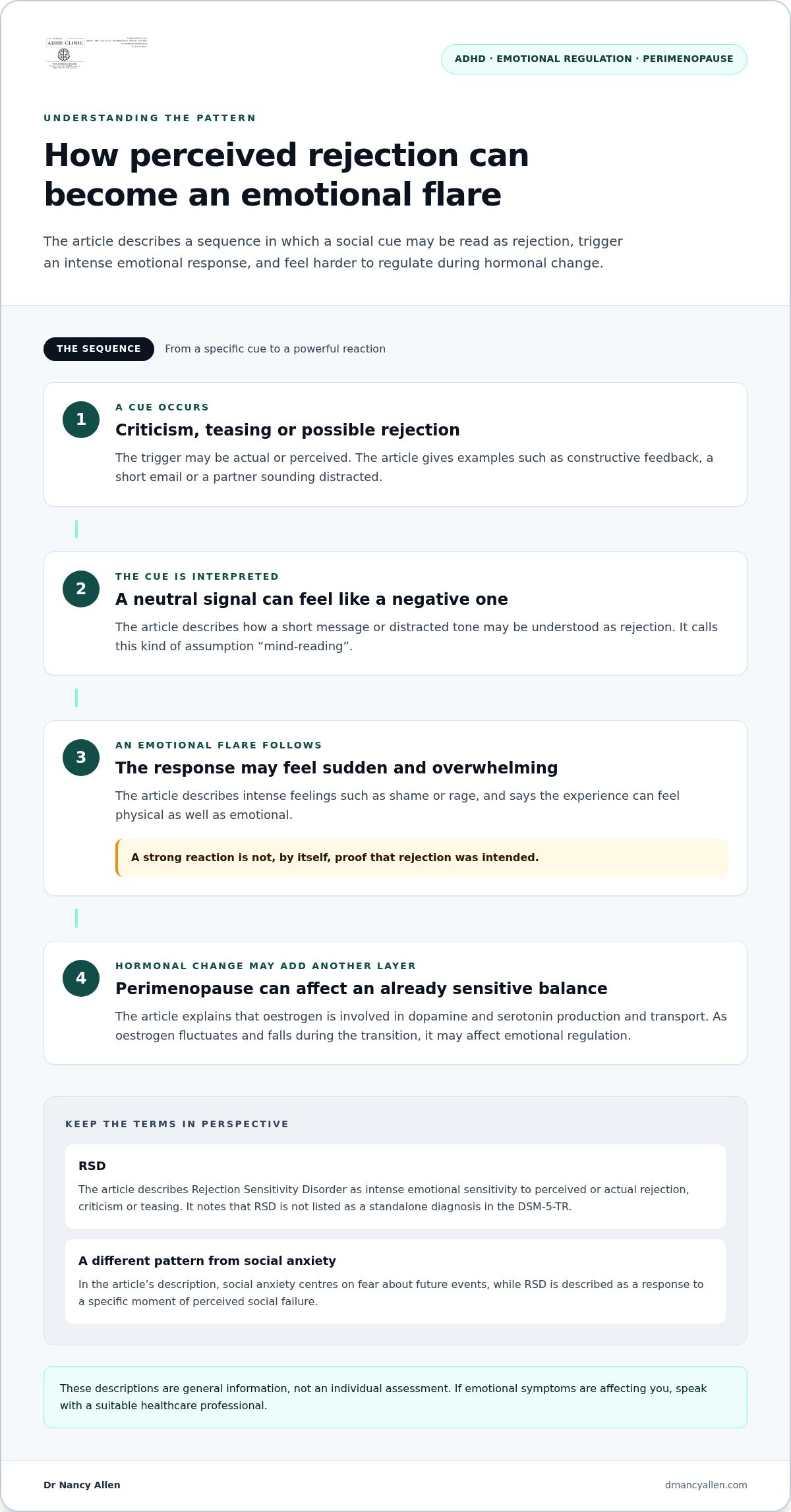
Rejection Sensitivity Disorder is an extreme emotional sensitivity and pain triggered by the perception, or the reality, of being rejected, criticised, or teased. It's not merely a case of being "thin-skinned" or overly sensitive. Rather, it's a clinical phenomenon where the individual experiences an intense, often uncontrollable emotional reaction that feels completely out of proportion to the event itself. Whilst RSD is not currently listed as a standalone diagnosis in the DSM-5-TR, it's widely recognised by specialists as a core component of the ADHD experience, particularly amongst adults.
To understand the depth of this experience, we must look at the word "dysphoria." Derived from the Greek word for "unbearable," it perfectly captures the essence of the RSD flare. Historically, similar clinical observations were sometimes referred to as Hysteroid dysphoria, though modern medicine now views these intense reactions through the lens of neurobiology and executive function. It is distinct from social anxiety, which is a state of fear regarding future events, and Borderline Personality Disorder, which involves a more pervasive pattern of instability in relationships and self-image. RSD is typically episodic, triggered by a specific moment of perceived social failure.
The Physicality of Emotional Pain
For many women, the experience of emotional dysregulation adhd menopause is not just "in the head." It's a visceral, physical event. Patients often describe the onset of RSD as a sudden blow to the chest or a literal wound in the solar plexus. This isn't an exaggeration or a dramatic flourish. It's a neurological reality. The brain's pain centres react to social rejection in much the same way they react to physical injury. These flares are sudden and overwhelming, often leaving the person feeling temporarily incapacitated by a wave of shame or rage. Validating this as a biological response is the first step toward management; you aren't being dramatic, your nervous system is simply over-reacting to a perceived threat.
For those seeking medical clarity on these physical sensations, healthcare providers like Poliklinika Dr. Nabil provide detailed information on cardiac monitoring that can help distinguish between neurobiological flares and physical heart health.
Perceived vs. Actual Rejection
The ADHD brain often struggles with "top-down" regulation, meaning it's difficult for the rational mind to quieten the emotional centres. This leads to a tendency to misinterpret neutral signals as negative ones. A short email from a colleague or a partner's distracted tone can be instantly translated by the brain as total rejection. This "mind-reading" creates a cycle of anticipation where the individual expects a negative outcome before it has even occurred. Because this sensitivity is rooted in how the prefrontal cortex filters information, traditional advice to "toughen up" or "let it go" is fundamentally ineffective. You cannot simply think your way out of a neurological sensitivity, but you can learn to navigate the storm once it arrives.
The Link Between RSD, ADHD, and Hormonal Changes
The connection between Rejection Sensitivity Disorder and ADHD is deeply rooted in the brain's architecture. Specifically, the prefrontal cortex, which acts as the executive control centre, often struggles to modulate the intense signals coming from the emotional centres of the brain. When this regulation fails, the result is a profound experience of emotional dysregulation adhd menopause that can feel entirely outside of one's control. It's not a choice to feel this way; it's a structural reality of how your brain processes the world.
Dopamine plays a crucial role in this dynamic. Often misunderstood as merely the "pleasure chemical," dopamine is actually the neurotransmitter responsible for processing social rewards and punishments. In an ADHD brain, chronic dopamine deficiency means the system is already primed for sensitivity. A neutral comment isn't just ignored; it's registered as a significant social punishment. This chemical imbalance makes the "sting" of perceived rejection feel far more acute than it would for a neurotypical individual.
ADHD and the Sensitive Brain
Neurodivergent individuals often describe their world as having "no filter." This applies to emotions as much as it does to sensory input like sounds or lights. Without an effective emotional gatekeeper, every perceived slight enters the consciousness with full force. This lack of a buffer is a hallmark of emotional dysregulation in adult ADHD. For many women, seeking an Adult ADHD Assessment provides the first clinical explanation for why they've always felt so much more deeply than their peers. It's a moment of profound clarity that moves the conversation from "what's wrong with me?" to "how does my brain work?"
Oestrogen and Emotional Regulation
The transition into perimenopause adds a complex, often overwhelming layer to this existing neurobiology. Oestrogen is a key player in the production and transport of dopamine and serotonin. As oestrogen levels begin to fluctuate and eventually fall, the brain's already precarious chemical balance is disrupted. This "ADHD-Menopause Overlap" explains why women who previously managed their symptoms through sheer willpower may suddenly find themselves drowning in RSD flares. If you find that your emotional resilience has plummeted as you've entered midlife, it's vital to look at the combined neuro-hormonal picture. Understanding how your hormones interact with your ADHD traits is the key to finding a targeted solution. If you're struggling to navigate these changes, Dr Nancy Allen offers specialist Peri-menopause & Menopause Specialist Care to help restore your emotional equilibrium and quality of life.
Recognising the Symptoms: How RSD Manifests in Daily Life
Identifying Rejection Sensitivity Disorder is often a moment of profound relief for women who have spent decades feeling "too much." Because the symptoms are so internalised, they are frequently mistaken for mood disorders or general anxiety. However, RSD is distinguished by its sudden onset and its specific trigger: the perception of being unwanted or criticised. When you understand how these patterns manifest, you can begin to separate your identity from your neurological responses. This clarity is especially vital when navigating the intersection of emotional dysregulation adhd menopause, where hormonal shifts can make these behaviours feel more frequent and intense.
The symptoms of RSD typically fall into several distinct behavioural patterns:
Sudden emotional shifts: A minor perceived slight, such as a friend not replying to a text immediately, can trigger a "drop" into intense sadness or a "flare" of defensive rage.
Social withdrawal: To protect yourself from the unbearable pain of potential rejection, you might stop attending social events or avoid sharing your true thoughts.
Chronic people-pleasing: You become a social chameleon, constantly monitoring the moods of others and adjusting your behaviour to ensure total approval.
Protective perfectionism: The belief that if you can achieve total perfection in your work or appearance, you will be safe from the sting of criticism.
The Impact on Relationships and Career
In professional settings, RSD often presents as a "quit before you can fire me" mentality. If a woman with ADHD perceives that her boss is slightly dissatisfied, she may resign abruptly to avoid the anticipated pain of a formal critique. This leads to career stagnation and a fragmented professional history. Within romantic relationships, the impact is equally profound. A partner's request for an hour of alone time can be misinterpreted as a sign that the relationship is ending. This triggers a cycle of conflict or clinginess that creates the very distance the individual fears. Following these intense flares, many experience an "RSD Hangover," a state of lingering physical and mental exhaustion that can last for days.
Internalised vs. Externalised RSD
Practical Strategies for Navigating Emotional Sensitivity
Managing the intersection of emotional dysregulation adhd menopause requires a shift from self-criticism to strategic self-care. The "Wait and Validate" technique is your first line of defence. When an emotional flare begins, your objective isn't to suppress the feeling but to delay your reaction. By acknowledging the physical pain whilst refusing to act on it immediately, you allow the physiological spike to pass through your system. This creates space for cognitive reframing. Before accepting a perceived rejection as a fact, look for objective evidence. If a colleague's tone seems short, list three neutral reasons for their behaviour before concluding that they're dissatisfied with your work.
Biological foundations are just as critical as cognitive tools. Chronic stress and poor sleep significantly lower your "RSD threshold," making your nervous system far more reactive to social stimuli. For many, medication also plays an essential role. By addressing the dopamine deficiency common in ADHD, clinical treatments from a Women’s Mental Health Specialist strengthen the prefrontal cortex, providing a much-needed buffer between an external event and your internal response.
Immediate Coping Mechanisms
When the physical sting of rejection hits, grounding techniques can pull your brain out of a "fight or flight" state. Try focusing on three things you can hear and three things you can feel to anchor yourself in the present moment. It's also helpful to pre-arrange an "Emotional First Aid Kit" with one or two trusted people who can provide quick validation when you're spiralling. You must learn to recognise the sudden physical sensation of rejection as a temporary brain glitch rather than an objective truth.
Communication Strategies
Sharing your sensitivity with partners or colleagues is a sign of clinical insight, not personal weakness. In digital communication, where tone is easily lost, make a habit of asking for clarification. A simple phrase like, "My brain is reading this as a bit sharp; could you clarify if that was your intent?" can prevent hours of unnecessary pain. Setting clear boundaries around your energy levels also helps prevent the sensory overload that often triggers emotional instability. If you're struggling to manage these symptoms alone, book a specialist consultation with Dr Nancy Allen to explore a personalised treatment plan for ADHD and hormonal health.
Seeking Clarity: The Role of Specialist ADHD and Menopause Assessments
For many women, the journey through midlife feels like an uphill battle against an invisible force. If you've spent years internalising the pain of Rejection Sensitivity Disorder, a professional diagnosis acts as the ultimate permission slip to stop the cycle of self-blame. It moves the conversation away from perceived character flaws and towards clinical realities. By seeking a specialist assessment, you gain a clear framework for your experiences, allowing you to finally understand why your brain reacts so intensely to social stimuli. This validation is often the first step in reducing the shame that has shadowed your personal and professional life.
Dr Nancy Allen specialises in this exact intersection of neurodivergence and hormonal health, bringing over 25 years of clinical experience to every consultation. Her approach avoids the clinical detachment of traditional medical institutions, offering instead a supportive environment where your lived experience is truly heard. This holistic view is essential because the symptoms of emotional dysregulation adhd menopause cannot be treated in isolation. When you address both the dopamine-starved brain and the oestrogen-depleted body, you create a foundation for genuine restoration and long-term stability.
The Path to a Private ADHD Diagnosis
In the UK, the wait for an NHS assessment can be prohibitively long, often leaving women in a state of limbo during their most vulnerable years. Private care offers a swifter, more personalised path to clarity. Through a secure online consultation, you can access expert assessment from the comfort of your own home, removing the stress of travel and clinical waiting rooms. One of the most significant benefits of this route is the speed of clarity. Appointments are often available within days. Understanding your neurodivergence doesn't just provide a label; it changes the narrative of your entire life, reframing past struggles as part of a manageable neurological profile.
Hormonal Support for Emotional Wellbeing
Stabilising your mood often requires looking beyond ADHD medication alone. For women in perimenopause, Hormone Replacement Therapy (HRT) can be a vital tool in reducing the frequency and intensity of RSD flares. Because oestrogen supports the very neurotransmitters that the ADHD brain lacks, specialist menopause care is particularly crucial for neurodivergent women. You deserve a care plan that recognises these nuances rather than dismissing them as general "moodiness." If you're ready to move from feeling "too sensitive" to being fully supported, book a private consultation with Dr Nancy Allen to explore your path to clarity and reclaim your emotional well-being.
Reclaiming Your Emotional Equilibrium
Rejection Sensitivity Disorder is a visceral, biological response that has likely shaped your experiences for years. Recognising that your intense reactions are rooted in the complex interplay of emotional dysregulation adhd menopause is a pivotal moment of transformation. By understanding how falling oestrogen levels disrupt your brain's already delicate dopamine balance, you can finally replace self-criticism with clinical insight. You aren't "too sensitive" or "dramatic"; you are navigating a significant neuro-hormonal transition that requires specialist care.
For those interested in how integrative wellness can support hormonal and emotional health, read more about the holistic services offered by Dr. Tiffany Yeo-Reddy.
You don't have to manage this overwhelming emotional pain in isolation. Dr Nancy Allen provides a unique bridge between ADHD expertise and menopause specialist care, offering secure online consultations for women across the UK. Appointments are often available within days. This professional validation is the foundation upon which you can rebuild your confidence and stabilise your relationships. Book your private specialist consultation with Dr Nancy Allen today to begin your journey toward a more balanced and supported future. You deserve to feel like yourself again.
Frequently Asked Questions
Is Rejection Sensitivity Disorder a real medical diagnosis?
Rejection Sensitivity Disorder is not currently listed as a standalone diagnosis in the DSM-5-TR, but it is a widely recognised clinical phenomenon amongst neurodivergence specialists. It describes a specific pattern of intense emotional pain triggered by perceived or actual rejection or criticism. Whilst it lacks a formal diagnostic code, identifying it is a crucial step in creating effective, personalised treatment plans for adults with ADHD.
Can you have RSD without having ADHD?
Whilst RSD is most frequently associated with ADHD, it is not exclusive to it. Some neurotypical individuals may experience similar sensitivities due to past trauma, though the specific biological "flare" of RSD is most characteristic of the ADHD brain's structure. Understanding this link helps clinicians distinguish between general emotional sensitivity and the neurobiological reality of rejection sensitivity that requires targeted support.
How does menopause make rejection sensitivity worse?
The transition into perimenopause involves a significant drop in oestrogen, which directly impacts the production of dopamine and serotonin in the brain. This hormonal shift often exacerbates emotional dysregulation adhd menopause, making existing sensitivities feel far more acute and difficult to manage. For many women, this is the period when their previously managed symptoms become overwhelming, necessitating a combined neuro-hormonal approach to care.
What is the difference between RSD and social anxiety?
Social anxiety is typically characterised by a persistent fear of being judged in the future, often leading to the chronic avoidance of social situations. In contrast, RSD is a sudden, intense emotional response to a specific perceived event in the present. Whilst social anxiety builds up over time, an RSD flare is immediate and feels like a physical wound, often resolving as quickly as it arrived.
Can medication help with rejection sensitivity?
Yes, clinical evidence suggests that certain medications can significantly reduce the intensity of RSD flares. ADHD medications help by strengthening the prefrontal cortex's ability to regulate emotional signals, whilst Hormone Replacement Therapy (HRT) can stabilise the mood fluctuations associated with emotional dysregulation adhd menopause. A specialist can help you determine the most effective combination to restore your emotional equilibrium.
How do I explain RSD to my partner or employer?
Explain RSD as a neurological sensitivity rather than a character trait or a choice. You might describe it as a "brain glitch" where your nervous system over-reacts to perceived criticism, much like an allergy or a physical reflex. Framing it as a clinical aspect of your ADHD helps others understand that your reactions aren't intentional or personal, but a biological reality that you are actively learning to navigate.
Is RSD a symptom of autism as well as ADHD?
Whilst historical research has focused heavily on ADHD, many modern clinicians recognise that rejection sensitivity is a common thread across the broader neurodivergent spectrum, where providers like
offer person-centred support for those navigating these complex disability and care needs.
For those navigating the intersection of neurodivergence and gender-diverse experiences, specialised support such as gender identity therapy Arizona can be an essential resource for managing emotional sensitivity and fostering self-acceptance.
Can therapy cure rejection sensitivity?
Rejection sensitivity is a neurobiological trait rather than a condition that can be "cured," but it can certainly be managed with the right tools. Therapy, particularly Cognitive Behavioural Therapy (CBT), provides essential strategies for emotional regulation and cognitive reframing. These techniques, when combined with specialist clinical support, allow you to significantly reduce the impact of RSD on your quality of life and professional relationships.



Comments