


Popcorn Brain Explained: Effective Ways to Improve Focus

Difficulty settling into one task can feel unsettling, but it doesn’t automatically mean you have ADHD. ‘Popcorn brain’ is an informal, non-medical term for a scattered state of mind, when thoughts or attention seem to jump quickly from one thing to another. Understanding what ‘popcorn brain’ is and how to help it starts with recognising that it isn’t a diagnosis. ADHD, by contrast, is a recognised condition that can affect attention, behaviour and regulation in different areas of life.
Frequent notifications, scrolling and switching between tasks may make quiet or slower activities harder to engage with. The experience is real, but it can have different explanations. This article explores common signs associated with popcorn brain, how it differs from ADHD, and why multitasking can make stillness feel difficult. It also covers practical ways to reduce digital interruptions and make more room for focused attention, and when ongoing difficulties affecting everyday life may be worth discussing with a healthcare professional.
Table of Contents
What is popcorn brain?
‘Popcorn brain’ is an informal term for attention that seems to jump rapidly between thoughts, tasks or digital inputs. Notifications and frequent task-switching can contribute to a feeling of mental overstimulation. Understanding what popcorn brain is and how to help it starts with noticing the patterns that affect your focus.
Digital stimulation and attention
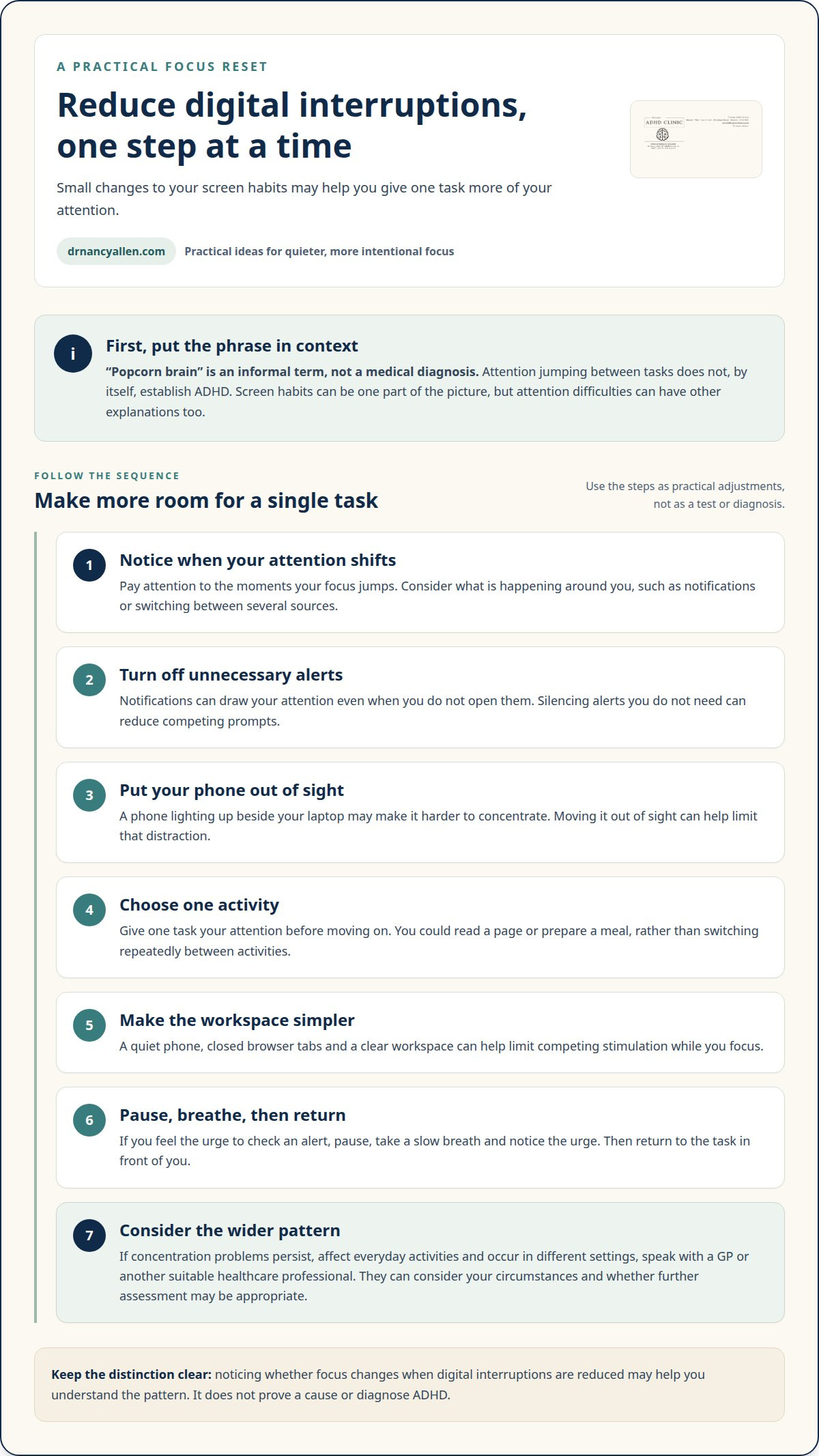
Digital stimulation means repeated input from screens, such as alerts, messages, videos and app updates. An interruption can draw your attention away, even if you don’t open the notification. For example, a phone lighting up beside your laptop may make it harder to concentrate on a work document.
Fast-changing content can make slower activities, such as reading or listening to a conversation, feel less engaging. Technology isn’t inherently harmful; the pattern and context of use matter. Turning off unnecessary alerts and placing your phone out of sight while you focus on one task can reduce competing prompts. These small changes may help you see whether digital interruptions are part of the problem.
Novelty and shifting attention
Novelty means new or changing information, and digital platforms can provide a steady stream of it through fresh posts, messages and clips. Switching repeatedly between email, social media and a conversation redirects your attention each time. The next alert may feel compelling because it offers something different from the task in front of you.
This pattern can make single-tasking feel unfamiliar, particularly if you’re used to checking several sources at once. Choose one activity, such as reading a page or preparing a meal, and give it your attention before moving on. A quiet phone, closed browser tabs and a clear workspace can help limit competing stimulation.
Persistent concentration problems
Persistent concentration problems continue over time and interfere with everyday activities, such as work, study, relationships or household responsibilities. If attention remains difficult in different settings, speak with a GP or another suitable healthcare professional. They can consider your circumstances and whether further assessment may be appropriate.
Mindfulness can help you notice distraction without immediately following it. When you feel the urge to check an alert, pause, take a slow breath, notice the urge, then return to the task. This offers one practical way to respond to mental overload. If you need urgent advice in the UK, call NHS 111; if you think you have a medical emergency, call 999, according to the NHS.
Definition of popcorn brain
The expression has a specific history: computer scientist and professor David M. Levy coined “popcorn brain” in 2011. He used it to describe a scattered state of mind associated with electronic multitasking. The date and origin help explain why the phrase is often used in discussions about digital life, rather than as a clinical term developed for diagnosing or treating a health condition.
“Popcorn brain” is not a medical diagnosis or a recognised mental health condition. The American Psychological Association and the American Psychiatric Association do not recognise it as a diagnosis. There are no diagnostic criteria attached to the phrase, so using it cannot establish why someone is struggling or determine what support they need. It is informal language, not a clinical conclusion.
This distinction matters because the phrase can mean different things to different people. One person may use it to describe feeling restless after a demanding day; another may mean difficulty sticking with routine tasks. The words alone don’t show how long the experience has lasted, which areas of life are affected, or whether an underlying health condition is involved.
Digital platforms can provide social feedback, such as likes and comments, which may engage the brain’s reward-processing system. This is one possible part of the wider context, not a complete explanation of someone’s behaviour. For example, someone may keep returning to a post in anticipation of a response, while another person’s attention may be shaped by work pressures or disrupted routines.
Use the term as a starting point for a more precise description. Rather than relying only on “popcorn brain”, explain what you notice, where it happens and what consequences follow. For instance, say whether the difficulty is limited to online activities or also affects learning, work and relationships. This detail gives a healthcare professional a clearer picture; the phrase itself cannot distinguish digital habits from ADHD or another concern.
Differences between popcorn brain and ADHD
Popcorn brain describes an experience of attention jumping between tasks; ADHD is a recognised condition. The NHS describes ADHD as affecting attention, behaviour and regulation across different areas of life. This distinction matters: checking a screen often or feeling mentally hooked by new content doesn’t, by itself, establish ADHD. The experience may relate to digital habits, but attention difficulties can have other explanations too.
One useful difference to notice is how broadly and consistently the difficulties appear. You might struggle to focus mainly when notifications arrive or several browser tabs are open. If concentration improves after you silence alerts and focus on one activity, that offers information about the role of your environment. It doesn’t prove a cause, but it helps describe when the difficulty occurs.
ADHD is a neurodevelopmental condition with genetic and neurobiological roots; it isn’t caused simply by screen use or modern technology. Difficulties with attention and self-regulation may be present across settings, such as school, home and conversations. For example, a young person who loses track of classroom instructions as well as homework may show a wider pattern than distraction during gaming alone.
Time and context are useful clues, but they don’t provide a diagnosis. Popcorn brain is a circumstantial phrase associated with habits, surroundings and frequent digital stimulation, so a change in routine may affect the experience. ADHD tends to be more persistent across situations and over time. However, being able to focus on a favourite activity doesn’t rule ADHD in or out; concentration can vary with interest and circumstances.
Try describing specific examples rather than choosing a label. Note where your attention slips, what was happening beforehand, and whether the same difficulty occurs without a screen. A parent might record missed instructions at school, unfinished chores and difficulty following conversations. An adult might notice recurring problems with planning work, remembering appointments or completing everyday tasks. These observations give a healthcare professional clearer information than the word “distracted” alone.
If ongoing attention problems affect education, work, relationships or daily responsibilities, discuss them with a GP or another suitable healthcare professional. Explain when the difficulties began, where they occur and how they affect your life. An ADHD assessment considers the wider pattern, rather than relying on one habit or a brief period of screen-related distraction. Popcorn brain is not a diagnosis, and noticing it cannot establish whether someone has ADHD.
Multitasking and reduced tolerance for stillness
Multitasking often means switching rapidly between activities, rather than completing them simultaneously. Moving from a spreadsheet to social media and then to a work conversation makes your attention adjust repeatedly. After a busy stretch of videos, messages and tasks, quiet activities may feel harder to stick with. Thoughts can keep turning towards the next source of stimulation, even during a pause.
Stillness can feel uncomfortable when your mind expects regular input, such as music on every journey or scrolling during meals. That response doesn’t mean you’ve lost the ability to relax. Try a small, defined pause, such as drinking a cup of tea without a screen. Notice your thoughts or the urge to reach for your phone, then bring your attention back to the tea.
Frequent switching may also make multi-step directions harder to follow. For example, someone preparing dinner might read a recipe, answer a message and forget whether they added an ingredient. Reduce competing demands by writing down the steps, completing one and then moving to the next. For spoken instructions, repeating the first action aloud can help keep the task clear.
Grouping similar tasks can reduce the urge to check constantly. Set aside time for emails and instant messages, then choose a separate period for focused work. Turn off automatic alerts where possible and check messages at planned times. This gives others a predictable window for replies while protecting your attention for the task in front of you.
A timer can make focused work feel more manageable. The Pomodoro method uses 25-minute work stretches followed by five-minute breaks; after four consecutive stretches, the break is usually 15 to 30 minutes. During a work stretch, keep only the relevant document open. Use the break to stand, stretch or get water, rather than filling every pause with social media.
These changes are ways to manage everyday demands, not a test of character or a mental health treatment. If keeping up with tasks remains difficult at home, work or school, note examples and discuss them with a suitable healthcare professional. Missing one direction after a distracted day differs from a persistent pattern that affects daily life. A clear record of situations can help explain what is happening.
Parents can create small pockets of calm, such as screen-free time before bed. Encourage teenagers to try slower activities and hobbies they enjoy, keep conversations open, and explore do not disturb functions together. Setting planned times to check email and messages can reduce the temptation to check a phone constantly.
Common experiences associated with popcorn brain
For a teenager, this experience might show up during homework: they open a workbook, check a message, then move between videos without completing the assignment. They may lose track of what a friend is saying or feel uncomfortable relaxing without music or scrolling. These examples can help describe what’s happening, but they aren’t a diagnostic checklist. A difficult evening alone doesn’t show whether attention problems are persistent.
Unfinished activities at home can create friction. A young person might start tidying their room, notice a notification, then forget what they were doing. An adult might begin preparing dinner, switch to a work message and leave a pan unattended. Consider the impact and context: does this happen mainly during screen use, or does it also affect routines when devices aren’t involved?
Feeling expected to respond constantly can add pressure. Someone may interrupt a family conversation to answer a group chat, then worry about missing the next message. Over time, this can make shared moments feel fragmented. Agreeing to put phones away during a meal can create space for conversation without requiring anyone to stop using technology altogether.
Slower activities may feel less compelling alongside rapidly changing online content. For example, reading a chapter or working on a jigsaw may seem difficult to start after an evening of short videos. Interest, tiredness and surroundings also shape attention, so one experience doesn’t explain the whole pattern. Choosing an offline activity the person genuinely enjoys may make it easier to spend time away from a screen.
Phone use can also compete with a bedtime routine. A teenager might plan to watch one video, then keep scrolling as new content appears. Families can discuss a calm period before bed and agree where devices will be kept overnight. A collaborative conversation gives young people a chance to explain what makes stopping difficult and helps parents understand which boundaries feel workable.
If these patterns disrupt school, work, relationships or everyday responsibilities, keep a few concrete examples to discuss with a suitable healthcare professional. Note what was happening, what became difficult and how it affected the day. For instance, a parent might describe missed homework instructions alongside difficulties during family conversations. Examples from different situations over time give a more useful account than a label or a single incident.
Dr Nancy Allen
Dr Nancy Allen can help you explore persistent attention difficulties and consider whether further assessment may be appropriate. ‘Popcorn brain’ itself isn’t a diagnosis, so the focus is on understanding your symptoms, history and circumstances rather than applying that label.
If concentration challenges affect everyday life in different settings, an Adult ADHD Assessment or Child ADHD Assessment may help clarify whether ADHD could be contributing. Dr Nancy Allen takes an individualised approach, discussing your concerns and appropriate options with you. This can help distinguish a pattern of attention difficulties from distraction linked to daily habits, while recognising that each person’s experience is different.
If you’d like to discuss ongoing attention concerns for yourself or your child, contact Dr Nancy Allen.
Take the next step towards clearer focus
Understanding what popcorn brain means and how to help it can be a starting point, not a label you need to carry. If concentration difficulties continue to affect work, learning, relationships or daily routines, a conversation with a healthcare professional can help you explore the pattern and decide what support may be appropriate.
Dr Nancy Allen offers Adult ADHD Assessment and Child ADHD Assessment for people seeking a clearer understanding of persistent attention concerns. Her practice also provides Peri-menopause & Menopause Specialist Care. An individual assessment considers your circumstances and history, rather than drawing conclusions from screen habits alone.
You can contact Dr Nancy Allen to discuss your concerns and the next step that feels right for you. Taking time to understand what is affecting your focus can open a thoughtful path forward.
Frequently Asked Questions
What does “popcorn brain” mean?
“Popcorn brain” is an informal description of feeling mentally scattered or pulled between things. It can help you name an experience, but it doesn’t explain its cause. For instance, you might use the phrase after losing your place in a book because you kept switching between messages. Treat it as a prompt to notice what affects your attention, rather than as a medical label or a conclusion about your health.
Can social media, smartphones and frequent notifications contribute to “popcorn brain”?
Notifications and scrolling can contribute to interrupted attention. A notification may draw your awareness even if you leave it unanswered, while scrolling offers a changing stream of posts and comments. For example, try placing your phone face down during a conversation and notice whether you feel less pulled to check it. This may help you understand how your digital routines relate to focus, without assuming screens are the only influence.
What are common signs and effects of “popcorn brain” on concentration, sleep and wellbeing?
People may describe repeatedly checking their phone, switching tasks before finishing, or finding it difficult to listen without background stimulation. A teenager might struggle to complete homework after moving between apps; someone else may feel restless during a quiet evening. Late-night scrolling can also crowd out a calming bedtime routine. These experiences can affect connection and wellbeing, but they don’t establish a diagnosis or identify a single cause.
How can you reduce digital distractions and improve attention step by step?
Start with one task and make its next action clear. For example, write “reply to the meeting email” on paper, silence non-essential alerts and close unrelated tabs. Keep your phone beyond arm’s reach while you work, then check messages at a planned time. If you lose focus, briefly note the distraction and return to the written task. Adjust the setup to suit your responsibilities and circumstances.
Do screen-time limits, notification settings or digital detoxes help attention?
These steps may help some people reduce interruptions, but a complete break from technology isn’t necessary for everyone. Try turning off non-essential notifications or setting app timers for the platforms that most often interrupt your work. A short screen-free period during meals may be easier to maintain than a sudden, strict detox. Notice whether the change helps with your routine, and adapt it rather than treating a limit as a test of success.
What mindfulness, exercise or sleep habits may help with attention and mental overload?
A brief breathing pause can help you notice a distraction before returning to what you were doing. A walk or another enjoyable form of movement can offer a break from screens, while a consistent wind-down routine may support better sleep. For example, put your phone aside before bed and choose a quieter activity, such as reading. These habits support general wellbeing; they aren’t a substitute for assessing persistent attention problems.
How is “popcorn brain” different from ADHD, anxiety or burnout?
“Popcorn brain” is an informal phrase, whereas ADHD is a recognised neurodevelopmental condition. Anxiety and burnout are different concerns, although difficulty concentrating can feature in more than one experience. A busy week of screen use alone can’t distinguish between them. If attention problems persist across settings or affect daily life, tell a suitable healthcare professional when they happen, how long they’ve been present and what else is going on.



Comments