


Overcoming Imposter Syndrome After Adult ADHD Diagnosis

Updated: 2 hours ago
What if the persistent fear that you are merely 'lazy' or 'unfocussed' is actually the most compelling evidence of your ADHD? For many, the relief of a professional assessment is quickly eclipsed by a nagging, intrusive question: am I faking it?-overcoming imposter syndrome after adult diagnosis often feels like a second, more exhausting battle. This internal conflict isn't a sign of dishonesty. Instead, it's the natural residue of decades spent masking your true self to survive in a neurotypical world.
It's understandable to feel like an intruder in your own life when you've spent years overcompensating just to keep up. You've likely been told that you just need to try harder, which makes accepting support feel like a personal failure rather than a clinical necessity. This article explores the evidence-based reasons why self-doubt follows a late-life diagnosis and provides practical tools to help you silence your inner critic. We'll look at how your brain's executive functions contribute to these feelings and how you can finally integrate your neurodivergent identity with the quiet confidence you deserve.
Table of Contents
The 'Fraud' Feeling: Why Adult Diagnosis Often Triggers Imposter Syndrome
Receiving a formal ADHD diagnosis in adulthood is often described as a 'lightbulb moment' that finally illuminates years of unexplained struggle. However, for many, that initial clarity is quickly followed by a period of intense self-scrutiny. Impostor syndrome in the context of ADHD is the persistent belief that your neurodivergent traits aren't biological realities but rather character flaws or carefully 'faked' behaviours. You might find yourself trapped in a cycle of asking, "am I faking it?-overcoming imposter syndrome after adult diagnosis" becomes the next significant hurdle in your journey toward self-acceptance.
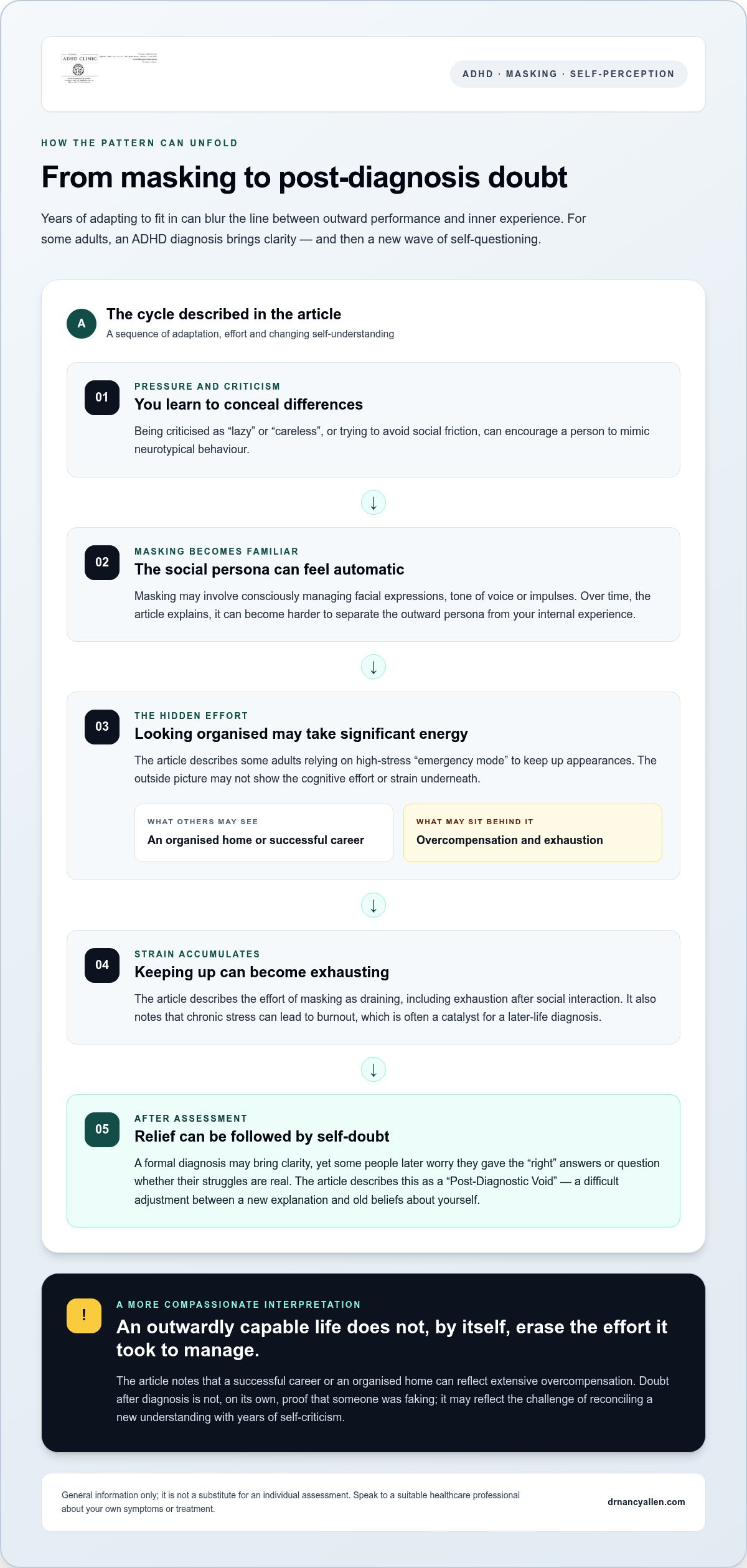
Once the consultation ends and the clinical setting is replaced by your usual routine, a 'Post-Diagnostic Void' often emerges. The professional validation you received can start to feel fragile. You may worry that you inadvertently manipulated the assessment by subconsciously providing the 'correct' answers to the clinician. It's vital to recognise that this doubt is a common, almost universal milestone. It isn't a sign that the diagnosis was wrong. Instead, it's a sign that your brain is trying to reconcile a new medical reality with decades of old, painful narratives. When a diagnosis is delivered with the efficiency of a modern specialist practice, the speed of the transition can sometimes intensify this whirlwind of doubt.
The Psychology of 'Not ADHD Enough'
Many adults struggle because their experience doesn't mirror the classic stereotype of the hyperactive schoolboy. If you were 'twice-exceptional', possessing a high intelligence that allowed you to mask executive dysfunction, your ADHD might have remained hidden for years. Having a successful career or an organised home doesn't invalidate your diagnosis. These outcomes are often the result of extreme, exhausting overcompensation rather than an absence of ADHD. You aren't 'less neurodivergent' just because you've developed sophisticated survival strategies.
Internalised Ableism and the 'Lazy' Label
When you've spent thirty or forty years being told you're 'lazy', 'careless', or 'not living up to your potential', those labels become a core part of your self-identity. Replacing a decades-old character flaw narrative with a medical explanation takes time. Internalised ableism often manifests as 'should' statements that trigger guilt. You might think, "I should be able to do this without support" or "I should just try harder." Recognising these thoughts as symptoms of internalised stigma is the first step toward healing. Your diagnosis isn't an excuse; it's the explanation that allows you to finally trade guilt for effective, neuro-affirmative strategies.
The Neurobiology of Doubt: How Masking Shapes Your Self-Perception
Masking is the unconscious, often automatic effort to mimic neurotypical behaviour to avoid social friction or criticism. It is a survival strategy. After decades of camouflaging, the lines between your authentic self and your social persona become blurred. When you find yourself spiralling into the question, "am I faking it?-overcoming imposter syndrome after adult diagnosis" becomes a necessary part of your psychological recovery. Whilst seeking Practical Strategies to Silence Your Inner Critic, it's essential to understand that this camouflaging is a biological response to an environment not built for your brain.
The ADHD brain is wired to seek stimulation, and in the absence of external novelty, it may turn its focus inward. This can result in 'problem-solving' your own diagnosis, where your mind treats your recent clinical assessment as a puzzle to be debunked. This internal debate is often fuelled by a dopamine deficit. Your brain is essentially looking for a hit of stimulation by over-analysing the validity of your struggles. If you feel lost in this cycle of doubt, a professional Adult ADHD Assessment can provide the objective evidence needed to anchor your new identity.
The sheer cognitive energy required to maintain a mask is, in itself, the most profound proof of your ADHD. A neurotypical person does not need to consciously manage their facial expressions, tone of voice, or impulse control to 'pass' as normal. If you were truly 'faking it', you wouldn't feel the crushing weight of exhaustion that follows a day of social interaction. The effort you've put into appearing 'fine' is the very evidence that your brain functions differently.
The High Cost of Camouflaging
Many adults sustain their executive function through high-stress hormones like cortisol. This 'emergency mode' allows you to appear organised whilst your internal system is red-lining. Eventually, this chronic stress leads to profound burnout, which is often the catalyst for a late-life diagnosis. Masking is a survival mechanism that eventually becomes a barrier to self-acceptance. It creates a disconnect where you feel like a performer in your own life, making the diagnosis feel like just another part of the script.
Why Your Brain Rejects the Good News
Your brain often prefers 'familiar misery' over an unfamiliar path. For decades, you've viewed yourself as 'lazy' or 'broken'; adopting a neurodivergent identity creates intense cognitive dissonance. This mental discomfort occurs because the new information (you have ADHD) conflicts with your long-held belief (you are just failing). Rejection Sensitive Dysphoria (RSD) further complicates this, as you may fear that others will eventually 'unmask' you as a fraud, leading to social exclusion or shame.
The Hormonal Factor: Why Menopause Can Worsen ADHD Imposter Feelings
For many women, the arrival of perimenopause acts as a chemical catalyst that strips away decades of hard-won coping strategies. This biological shift creates a 'perfect storm' for self-doubt. You might wonder if your symptoms are entirely new, or if you've simply lost the ability to 'try hard enough' as your responsibilities mount. This confusion is a primary driver for the nagging thought, "am I faking it?-overcoming imposter syndrome after adult diagnosis" becomes particularly difficult when your internal landscape is shifting so rapidly and unpredictably.
Oestrogen, Dopamine, and Executive Function
Oestrogen acts as a vital modulator for dopamine in the brain. It assists with both the production of this neurotransmitter and the sensitivity of the receptors that receive it. When oestrogen levels decline during perimenopause, the ADHD brain loses its primary chemical support system. This can cause symptoms that were once manageable to 'explode' in severity. A 2025 study found that 54.2% of women with ADHD experience severe perimenopausal symptoms, compared to just 30.1% of women without the condition. This stark difference explains why brain fog and memory lapses can suddenly feel debilitating. Untangling these menopause symptoms from your neurodivergent traits requires a specialist who understands this unique clinical intersection.
The Double Burden of Midlife Diagnosis
Receiving a diagnosis in midlife often brings a double burden of grief and doubt. You may mourn the life you could have had whilst simultaneously questioning if you are merely 'jumping on a trend' to explain away the natural ageing process. This is often exacerbated by the pressures of the 'sandwich generation', where women are typically the primary caregivers for both children and ageing parents. The sheer exhaustion of meeting these societal expectations makes masking almost impossible, yet the guilt of needing support remains. Reclaiming your mental health through a private adhd assessment is not an act of fraud; it is an act of clarity. It allows you to move past the 'shoulds' and embrace a treatment plan that respects your specific biology and life stage.
Practical Strategies to Silence Your Inner Critic
Silencing the internalised voice of doubt requires more than just positive thinking; it requires a structured, evidence-based approach to your own history. One of the most effective tools is an 'Evidence Log'. By documenting specific moments from your childhood where ADHD traits were present, you can prove to yourself that these behaviours existed long before you had the vocabulary to 'fake' them. Reflecting on school reports of being 'away with the fairies' or constantly losing jumpers provides objective data that your neurodivergence is a lifelong reality.
Adopting 'neuro-affirmative' reframing is another vital step in shifting your self-perception. Instead of attributing a mistake to a character flaw, such as thinking "I forgot the keys because I'm stupid," try reframing it clinically: "I forgot the keys because my working memory is struggling today." This shift doesn't excuse the challenge, but it correctly identifies the source, which reduces the shame that fuels the question, "am I faking it?-overcoming imposter syndrome after adult diagnosis." If you struggle to apply this compassion to yourself, utilise the 'Third-Person Perspective'. Ask yourself what you would say to a dear friend who just received this diagnosis. You would likely offer them validation and support, not scrutiny and doubt.
Building Your Neuro-Affirmative Toolkit
When faced with friends or family who dismissively claim that 'everyone is a bit ADHD these days', it's helpful to have scripted responses ready. You might say, "I understand it can seem that way, but for me, these traits are debilitating and required a specialist clinical assessment." Remember that you don't owe anyone an exhaustive explanation of your medical history. Clinical validation serves as a powerful shield against social stigma, providing a foundation of truth that external opinions cannot shake. To begin building this foundation of clarity, you can book an adult ADHD assessment with a specialist who understands your unique journey.
Moving from 'Faking It' to Flourishing with Expert Support
A formal diagnosis isn't a finish line. It's the moment you stop fighting your biology and start working with it. For many, the nagging question of "am I faking it?-overcoming imposter syndrome after adult diagnosis" is finally silenced not by the assessment report itself, but by the tangible experience of improvement. When a personalised treatment plan begins to take effect, the shift in your daily functioning becomes the objective evidence your inner critic can no longer ignore. You begin to see that your struggles were never a choice, but a consequence of a brain that simply requires a different set of tools to navigate a neurotypical world.
The Path to Long-Term Clarity
Medication often acts like a volume knob, lowering the background noise of an overstimulated mind. This clarity allows you to observe your ADHD traits in action without being overwhelmed by them. Follow-up appointments are essential during this phase; they provide a vital space to process the emotional impact of your diagnosis whilst fine-tuning your support. Reclaiming your future means using this new-found insight to organise your life around your natural strengths. You can move away from the exhausting cycle of overcompensation and begin to build a routine that respects your energy levels and cognitive style.
Partnering with a Specialist GP
Holistic care requires a practitioner who understands that ADHD doesn't exist in a vacuum. A GP with expertise in both neurodivergence and women's health is essential, especially as hormonal shifts can significantly alter how ADHD symptoms manifest. You deserve the reassurance of a thorough, secure online consultation that respects your time and your history. By partnering with a specialist, you ensure that your management plan evolves alongside your life stages. You are the ultimate expert on your lived experience; a specialist's role is to provide the clinical authority and compassionate guidance that turns that experience into a path forward. Book your private ADHD assessment with Dr Nancy Allen today to move from doubt to lasting clarity.
Embracing Your Authentic Neurodivergent Self
The transition from a lifetime of masking to a future of self-acceptance is rarely a straight line. By understanding the neurobiology of doubt and the significant impact of hormonal changes, you can begin to see your struggles not as character flaws, but as biological realities. Recognising that the question "am I faking it?-overcoming imposter syndrome after adult diagnosis" is a common milestone allows you to trade persistent guilt for evidence-based strategies. You aren't lazy or broken; you're simply operating in a world that wasn't designed for your unique brain, whilst managing the complexities of neurodivergence.
Expert validation provides the foundation for this new identity. With over 25 years of clinical experience and a deep understanding of the ADHD-menopause overlap, Dr Nancy Allen offers the compassionate, patient-centric care you need to move forward. Appointments are often available within days. Book a Private ADHD Assessment for Clarity and Support today and start your journey toward flourishing. Your lived experience is valid, and you deserve a life built around your strengths.
Frequently Asked Questions
Why do I feel like I manipulated my ADHD assessment?
This feeling often stems from years of masking, where you've subconsciously learned to present as neurotypical to avoid criticism. You might worry you provided the 'correct' answers to fit a narrative, but a specialist clinician is trained to look beyond verbal responses to observe underlying cognitive patterns. This intrusive thought is a common symptom of the am I faking it?-overcoming imposter syndrome after adult diagnosis cycle, rather than evidence of actual deception.
Is it normal to feel worse after an adult ADHD diagnosis?
Yes, it's common to experience a period of grief or a 'post-diagnostic void' once the initial relief fades. You're essentially mourning the life you might've had if you'd received support earlier. This emotional dip doesn't mean the diagnosis is incorrect; it reflects the weight of decades spent struggling without an explanation. Processing these feelings with an experienced practitioner can help you move from grief toward self-affirmation and flourishing.
How can I tell if my symptoms are ADHD or just perimenopause?
Distinguishing between the two requires clinical expertise because falling oestrogen levels directly impact dopamine, often causing ADHD symptoms to intensify. If your challenges with focus and memory are lifelong but worsened recently, it's likely ADHD exacerbated by hormonal shifts. A 2025 study noted that over half of women with ADHD experience severe perimenopausal symptoms. A specialist GP can untangle these overlapping conditions to provide a comprehensive, holistic treatment plan.
What if I was a high achiever in school? Can I still have ADHD?
Academic success doesn't rule out ADHD, especially if you possess high intelligence that allowed you to compensate for executive dysfunction. Many 'twice-exceptional' individuals excel in structured environments but find themselves overwhelmed by the less-structured demands of adult life. Your achievement was likely fuelled by intense, exhausting effort and high-stress hormones like cortisol, which eventually leads to the profound burnout often seen in adults seeking a late-in-life diagnosis.
Does imposter syndrome ever go away for neurodivergent adults?
Whilst the 'fraud' feeling may not disappear overnight, it typically diminishes as you gain more evidence through successful management and community connection. As you implement neuro-affirmative strategies and see tangible improvements in your quality of life, internalised stigma loses its power. Over time, you stop viewing your traits as character flaws and start seeing them as biological facts. This shift is the key to silencing the inner critic permanently and embracing your identity.
How do I explain my diagnosis to people who think I'm 'making it up'?
You don't owe anyone a detailed medical history, but having scripted responses can help manage social pressure. You might explain that ADHD is a neurobiological condition confirmed by a specialist clinical assessment, not a lack of willpower. Focus on how the diagnosis provides a framework for effective support rather than an excuse for behaviour. Clinical validation from an experienced GP serves as a powerful shield against external scepticism and social stigma.
Can medication help with ADHD imposter syndrome?
Medication can indirectly reduce imposter feelings by providing objective proof that your brain functions differently. When a personalised treatment plan 'lowers the noise' and makes daily tasks feel less Herculean, it becomes harder to maintain the belief that you were just being lazy. This tangible change in your executive function acts as evidence, helping you reconcile your internal experience with your clinical diagnosis and finally integrate your neurodivergent identity with confidence.
What happens if I feel like I'm 'faking' my symptoms during a consultation?
It's very common to feel like a fraud whilst describing your struggles to a doctor, especially if you're having a 'good day.' An experienced clinician understands that ADHD symptoms are inconsistent and context-dependent. They aren't just listening to your list of symptoms; they're evaluating your developmental history and cognitive style. Trust that the assessment process is designed to account for these feelings of doubt and provide the objective clarity you need.



Comments