


Don't Fully Relate to Autism? ADHD Could Be Why

Not fully recognising yourself in descriptions of autism doesn’t, by itself, confirm or rule out autism. If you’re asking why you don’t fully relate to just autism, it may be because autistic traits vary, or because ADHD or another factor could also be part of the picture. Online descriptions can’t establish what explains your experience.
It can be confusing when some accounts of autism feel familiar and others don’t. Autism can affect social communication and may involve repetitive behaviours, intense interests or sensory differences, but people experience these in different ways. There is no single profile shared by every autistic person.
This article explains how autism traits, social communication, repetitive behaviours, strengths and support needs can vary, and what ASD means in relation to autism. It also explores why ADHD may be relevant when autism alone doesn’t seem to describe your experience. The aim is to help you consider the possibilities without trying to diagnose you from a checklist.
Table of Contents
Autism spectrum and variation in symptoms
Autism spectrum disorder describes a pattern of differences, not one fixed set of traits. Its name reflects how social communication and repetitive behaviours can vary between people.
Autism as a Spectrum
Autism is a form of neurodivergence, meaning a person’s brain processes and responds to the world differently. The spectrum describes varied combinations of traits and support needs, rather than a line from “a little” to “a lot” autistic. For example, one person may find conversation difficult but manage sensory input comfortably; another may experience the reverse.
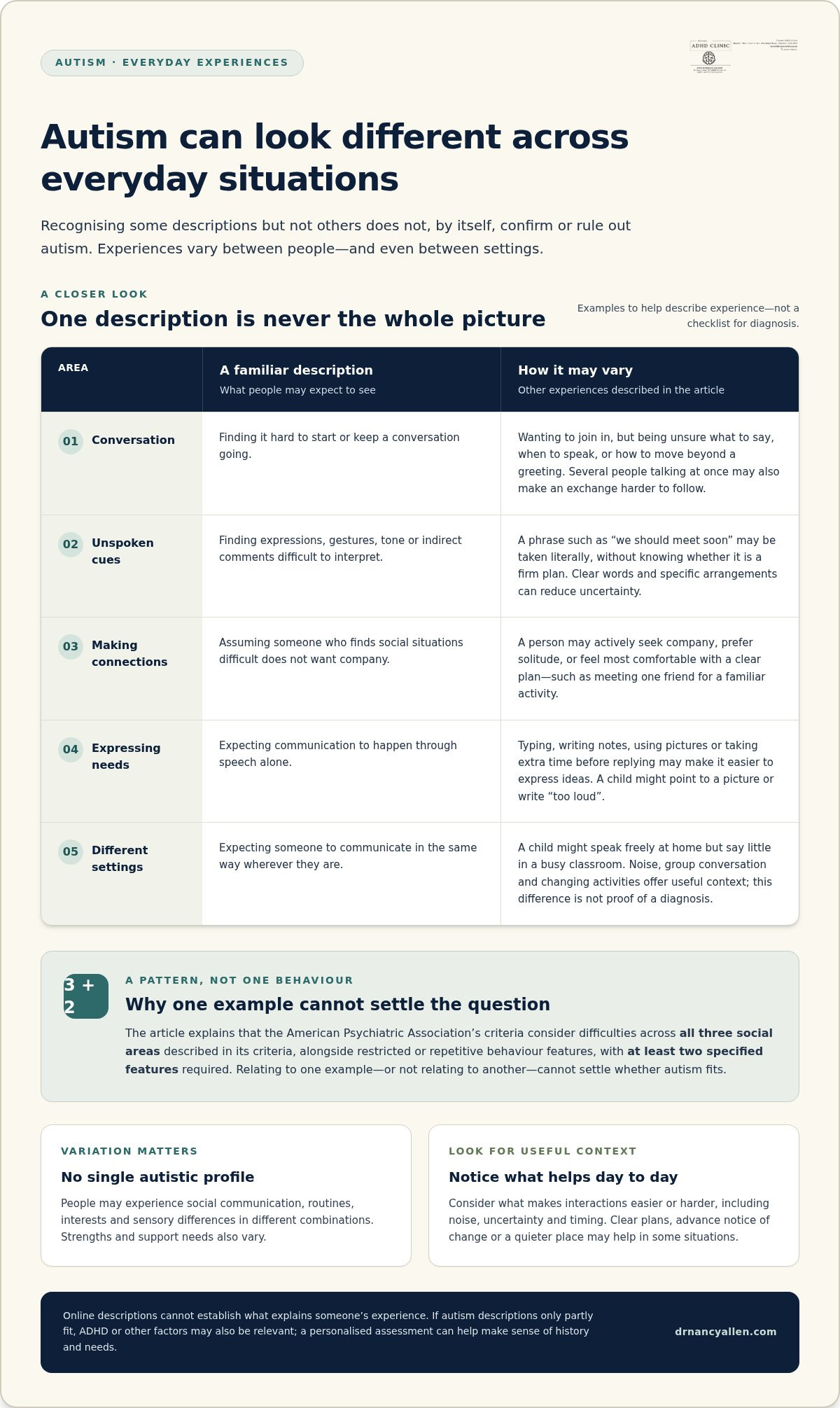
Diagnosis considers patterns across areas, not a single behaviour. According to the American Psychiatric Association, autism diagnosis requires difficulties in all three social areas described in its criteria. The criteria also include restricted or repetitive behaviour features, with at least two specified features required. This helps explain why relating to one example, or not relating to another, cannot settle whether autism fits.
The terminology can also be confusing. In 2013, the American Psychiatric Association combined several separate diagnoses into autism spectrum disorder. The DSM-5-TR lists autism spectrum disorder as the clinical diagnostic term used in the United States. ASD is its abbreviation; “autism” is commonly used in everyday language. In the UK, readers may encounter both terms in information and discussions.
Variation in Autism Descriptions
Common descriptions highlight some experiences, but no short list captures every autistic person. Someone may recognise a strong need for routine yet not identify with a description of avoiding social contact. Another person may enjoy friendships while finding unspoken expectations or sudden changes difficult. Not matching one popular account does not, by itself, explain someone’s full profile.
Strengths and support needs also differ. Some autistic children have a particular skill or exceptionally strong ability in one area; approximately 10 percent show savant skills or extremely high abilities in specific areas. Some may read words before five years old without necessarily understanding what they have read. Such examples illustrate variation, not a test for autism or a measure of someone’s overall abilities.
Autism support is better understood as help tailored to a person’s needs, rather than a way to remove neurodivergence. Practical support may focus on communication, daily activities, sensory needs or adapting environments. For example, clearer plans and advance notice of a change may make a transition easier for someone who relies on predictability. The useful question is which difficulties affect daily life and what adjustments help.
Social communication and interaction characteristics
Social communication differences can shape how someone starts, follows or interprets an interaction. They don’t mean a person lacks interest in others. An autistic person may actively seek company, prefer solitude, or feel most comfortable with a clear plan, such as meeting one friend for a familiar activity.
Starting a conversation can take effort. An autistic young person might want to join classmates but feel unsure what to say, when to speak, or how to move beyond a greeting. In a group, several people talking at once can make it harder to follow the exchange. Attention may shift to one voice, a detail in the room, or the effort of working out what others mean.
Non-verbal communication includes facial expressions, gestures, posture and tone of voice. Some autistic people find these cues difficult to interpret, so a smile, pause or indirect comment may not communicate what another person expects. For example, someone may take “we should meet soon” literally without knowing whether it is a firm plan. Clear words and specific arrangements can reduce that uncertainty.
Communication doesn’t have to rely on speech alone. A person may express ideas more easily by typing a message, writing notes, using pictures, or taking extra time before replying. For example, a child who struggles to explain discomfort aloud might point to a picture or write “too loud”. These methods can make needs clearer, particularly when sensory input or the mental effort of conversation makes speaking harder.
Friendship brings its own unwritten expectations. Someone may be unsure how often to message, worry when a friend doesn’t reply, or find speaking to a close friend more stressful than talking to a stranger. Previous negative experiences can shape how they approach new relationships. Another person may become attached quickly and seem over-friendly, even though their intention is to connect.
For children, social skills can look different across settings. A child might speak freely at home but say little in a busy classroom, where noise, group conversation and changing activities compete for attention. This difference is useful context, not proof of a diagnosis. Looking at what helps, such as a quiet place or a clear invitation to join an activity, gives a fuller picture than judging one interaction.
Keeping a brief note of a specific interaction can help clarify what made it easier or harder. Record the setting, who was present, what was said, and whether noise, uncertainty or timing played a part. Comparing examples from home, school and other familiar settings can reveal useful patterns to discuss with an appropriate healthcare professional.
Restricted and repetitive behaviours, interests and activities
Restricted or repetitive patterns can involve actions, interests, routines or responses to sensory input. For example, someone may repeat a movement, return to the same topic, or arrange objects in a particular order. These patterns can have personal meaning, such as providing comfort or helping someone concentrate. Their presence alone doesn’t explain why they occur.
The clinical criteria described by the American Psychiatric Association require at least two specified restricted or repetitive behaviour features for an autism diagnosis. Examples include repetitive movements or speech, a strong preference for sameness, highly focused interests, and unusual responses to sensory input. Someone might repeat a phrase, feel distressed by an unexpected change, or focus intensely on a particular subject. The wider pattern matters, not one isolated habit.
Routines can make the day more predictable. A familiar journey or set order of activities may reduce anxiety; a late change to plans can feel difficult to manage. Interests can also be absorbing, from memorising train routes to learning detailed facts about an animal. These behaviours don’t automatically cause harm. Consider whether they support wellbeing, restrict activities, or make daily tasks harder.
Prader-Willi syndrome is a distinct condition, estimated to affect approximately 1 in 10,000 people. A repeated action or strong preference for routine can have different meanings across individuals and conditions. For example, noticing a repetitive pattern doesn’t establish autism. A clinical assessment considers the person’s developmental history, communication and other behaviours alongside the circumstances in which patterns appear.
Fragile X syndrome can also involve autistic-type behaviours. The CDC estimates that Fragile X syndrome affects roughly 1.4 in 10,000 males and 0.9 in 10,000 females. Approximately 15% to 20% of people with Fragile X syndrome exhibit autistic-type behaviours. This overlap shows why a behaviour cannot identify its cause on its own. The full picture includes development, communication, sensory responses and the person’s support needs.
Other conditions can share individual features with autism, while anxiety, environment and daily demands can shape how someone responds. For instance, repeating an action may help someone manage uncertainty, while a highly focused interest may bring enjoyment and expertise. Similar outward behaviours don’t necessarily have the same function or meaning. Looking at when a pattern occurs, what happens around it, and how it affects life offers more useful context than a label alone.
If you’re reflecting on your own traits, note a few specific examples: what happens, when it occurs, and whether it affects daily activities. A pattern across settings and over time can offer clearer information than a single behaviour. This context helps distinguish familiar habits from wider support needs, while keeping overlapping conditions in view.
Variation in autistic traits, strengths and support needs
Autistic traits can affect daily life in different combinations, from sensory differences to communication or routine-related challenges. Adults, women and people who mask may not show the same traits others notice in children; masking means consciously hiding or adjusting behaviours to fit social expectations. You can be autistic without relating to stereotypes or online descriptions, because those accounts cannot represent everyone’s experience.
Differences in Traits and Support Needs
Autistic characteristics and support needs vary between individuals and across settings. Diagnostic levels run from Level 1 to Level 3 and refer to the support a person may need, not how severe their autism is. Someone at Level 1 may function independently with minimal support, whilst someone at Level 3 may need more consistent help with communication or adapting to change.
Support needs can also differ within one person’s life. A pupil might manage lessons but need a quiet space after a noisy school day. Sensory input, stress, changes in routine and the demands of a particular task can all affect what feels manageable. Considering these circumstances helps describe practical needs more accurately than relying on one label or snapshot.
Strengths and Support
Autistic strengths can include detailed knowledge, sustained attention to an interest, or noticing patterns others overlook. For example, a pupil may remember extensive facts about a favourite subject yet need help organising a school timetable. Recognising strengths alongside challenges gives a more balanced account of how someone learns, communicates and functions.
Support works best when it addresses a person’s goals and environment. A therapist might help someone develop strategies for a specific daily challenge, whilst adjustments at school could include clearer instructions or a predictable routine. Support isn’t about erasing autistic differences. It can reduce barriers, build independence and make everyday activities, including eating, easier to manage.
Different Presentations and Masking
In adults, autism may become more apparent through the effort of managing work, relationships or daily demands. Women and girls may be missed when their traits don’t match familiar stereotypes, or when they’ve learned to copy social behaviours. Masking can include rehearsing conversations, hiding distress or consciously copying others; it may make outward behaviour look different from the person’s internal effort.
For example, someone may appear comfortable at work yet need considerable recovery time afterwards. They might follow social scripts while finding spontaneous conversation tiring. These examples don’t establish autism, but they show why observations from one setting may not capture the whole picture. Childhood experiences, current circumstances and the cost of coping can all add useful context.
Stereotypes and Online Descriptions
Online descriptions often focus on recognisable examples, such as avoiding eye contact or having one intense interest. A person may not identify with those examples, or may experience them differently. That doesn’t settle whether autism fits. Stereotypes are shortcuts, not a complete account of the range of autistic traits, strengths and support needs.
Try comparing descriptions with specific experiences instead. Note which situations create difficulty, what helps, and whether a pattern appears at school, work or home. A person can relate to some traits and not others. This fuller picture is more useful than deciding from a viral checklist, a single anecdote or whether someone else’s experience looks familiar.
Why might someone not relate to common descriptions of autism?
Common descriptions simplify a varied experience, so a person may recognise some traits but not others. One autistic adult might enjoy socialising yet struggle with sudden changes; another may prefer predictability but communicate comfortably. The question, “why don’t I fully relate to just autism?”, can also arise when ADHD or another influence seems to explain parts of someone’s experience better.
ADHD may be relevant if difficulties with attention, organisation or impulsive actions feel prominent alongside traits associated with autism. These experiences can overlap in daily life, making them hard to separate using online lists alone. For example, someone might lose track of a conversation because their attention has shifted, rather than because they have missed a social cue. The distinction depends on the wider pattern and personal history.
Descriptions can also miss experiences that are less visible to other people. Someone may learn social scripts, copy a colleague’s conversational style, or hide discomfort in a busy setting. They might appear at ease during a meeting, then need quiet time afterwards. Looking only at outward behaviour can leave out the effort involved and its effect on everyday life.
Anxiety can further shape social experiences. It may lead an autistic person to avoid social situations, limiting opportunities to build friendships; negative self-talk may also affect confidence and beliefs about social ability. For instance, a person who has been excluded before may expect rejection, even when they want connection. That history adds context, but anxiety alone cannot explain every trait.
It can help to move from broad labels to specific examples. Note what happens, where it happens, what makes it easier, and how it affects work, home or relationships. Compare a demanding group meeting with a relaxed conversation between friends. Include experiences from earlier life, since a current snapshot may not show how patterns developed or changed over time.
Then consider what you hope to understand: attention, sensory experiences, social communication, routines, or how these affect daily tasks. A suitable professional can explore these questions alongside your symptoms, personal history and circumstances. Before speaking with them, organise your notes by setting and describe what support or adjustments have helped. This gives the conversation a clear starting point without relying on one online checklist.
Dr Nancy Allen: Adult ADHD Assessment
Dr Nancy Allen’s Adult ADHD Assessment may be a useful next step when ADHD could help explain experiences that autism descriptions don’t fully capture. The assessment explores ADHD symptoms, personal history and circumstances, helping you discuss appropriate options with a clinician. It doesn’t determine whether you are autistic, but can focus on whether ADHD may also be relevant.
Consider an assessment if difficulties with attention, impulsivity or organisation affect your everyday life and you want a clearer understanding of them. Bring examples from different settings, such as work, home or relationships, to help explain your experience. General information cannot replace an individual assessment, so speak with a suitable healthcare professional about your needs.
If you’d like to discuss an Adult ADHD Assessment, contact Dr Nancy Allen or visit drnancyallen.com.
Choose a next step that fits your questions
If you’re asking why you don’t fully relate to just autism, you don’t need to settle on an explanation from online descriptions. Consider what you’d most like to understand, then note a few examples from everyday life. This can help you explain your concerns clearly and decide what questions to raise with a healthcare professional.
Exploring why you don’t fully relate to just autism may mean considering several parts of your experience together. An individual consultation can consider your symptoms, history and circumstances, then discuss appropriate options. General information can help you prepare, but it can’t replace advice tailored to your situation.
Contact Dr Nancy Allen to discuss your concerns. Taking time to seek clarity is a constructive step towards understanding what may support you.
Frequently Asked Questions
Is it Autism?
It may be, but recognising a few traits cannot establish an autism diagnosis. A clinician considers how experiences developed over time, their effect on daily life, and whether another explanation may fit better or also be present. For example, note whether a difficulty occurs across work, home and relationships, or mainly during stressful periods. This context is more informative than matching yourself to a single online description.
Can autistic traits vary in severity and across situations?
Yes. The same person may manage a familiar one-to-one conversation but find an unexpected group discussion much harder. Noise, fatigue, stress and changes in routine can affect how manageable a situation feels. Rather than judging a trait as simply mild or severe, consider its practical effect: does it make a task take longer, require recovery time, or lead someone to avoid an activity they value?
What other conditions can overlap with autism, such as ADHD, anxiety or trauma?
ADHD, anxiety and trauma can each shape attention, communication and responses to everyday demands, sometimes in ways that resemble particular autistic traits. For instance, anxiety may make a person withdraw from a social event, while attention difficulties may make a conversation hard to follow. These experiences can also coexist with autism. Their presence alone neither confirms nor rules out autism, so the wider history and circumstances matter.
How can someone tell whether they may be autistic or have another explanation?
Look for patterns over time, not just what happened during one difficult week. Write down a specific event, what was happening beforehand, what felt difficult, and what helped afterwards. You might compare a familiar work task with a new one, or a quiet visit with a crowded gathering. Share these examples and relevant childhood history with a suitable healthcare professional, who can explore possible explanations with you.
What should I do if I am unsure about an autism diagnosis or self-identification?
If you’re unsure, treat your current understanding as a question to explore, not a decision you must make immediately. If you have a diagnosis, ask the clinician who assessed you to explain how the findings relate to your experiences and support needs. If you’re self-identifying, discuss your questions with your GP or another appropriate professional, especially if difficulties are affecting daily life.


Comments