


How to Manage Demand Avoidance: Practical Support Tips

Updated: 1 day ago
What if the persistent "refusal" you encounter daily isn't actually a sign of defiance, but a survival mechanism triggered by a nervous system under siege? For many neurodivergent adults and parents, the cycle of power struggles and subsequent burnout feels inescapable. You might find yourself walking on eggshells, fearing that a simple request will spark a total shutdown or an explosive meltdown. When navigating demand avoidance-how to manage the immediate anxiety often becomes more important than the task itself. It's vital to recognise that this resistance isn't a choice or a lack of discipline; it's a physiological response to a perceived threat to autonomy.
You deserve a home environment that feels like a sanctuary rather than a battleground. This article shares empathetic, evidence-based strategies to help you reduce anxiety-driven resistance whilst fostering independence and dignity. We'll explore practical tools to adapt your communication, shift from compliance to collaboration, and implement support tips that prioritise long-term emotional well-being. By reframing your approach through a clinical yet compassionate lens, you can move away from the exhaustion of constant conflict and toward a lifestyle built on mutual trust and genuine connection.
Table of Contents
Understanding Demand Avoidance: Beyond 'Difficult' Behaviour
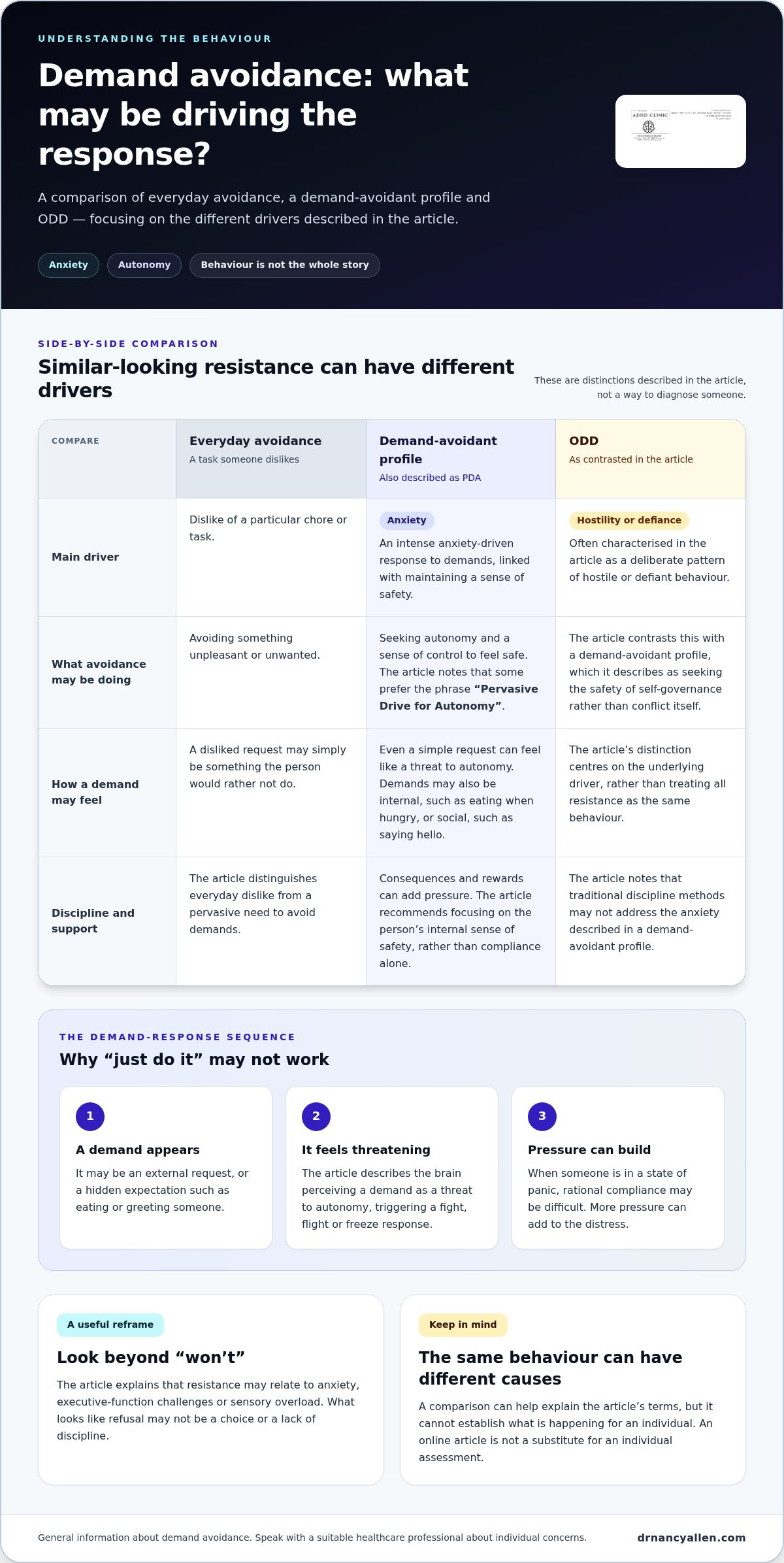
Living with demand avoidance often feels like navigating a minefield where the triggers are invisible to the naked eye. It's essential to understand that this isn't a choice or a calculated attempt to be "difficult". Instead, it's a profound, anxiety-driven neurological response. While most people experience "simple" avoidance when faced with a chore they dislike, Pathological Demand Avoidance (PDA) is different. It's an all-encompassing need to avoid demands to maintain a sense of safety. Many clinicians and advocates now prefer the term "Pervasive Drive for Autonomy" because it reframes the behaviour as a positive search for control rather than a negative refusal to comply. If you've felt like a failure as a parent or an adult, let this be your validation: your struggle is rooted in biology, not character flaws.
The Anatomy of a Demand: Why 'Simple' Tasks Feel Threatening
To a neurotypical brain, a request is just information. To someone with a demand-avoidant profile, a request can feel like a physical assault on their autonomy. The brain's amygdala perceives the demand as a threat, instantly triggering a fight-flight-freeze response. This isn't limited to external instructions like "put your shoes on". Demands can be "hidden", such as the internal pressure to eat when hungry or the social expectation to say "hello". When you look at demand avoidance-how to manage the daily friction requires recognising that the person is effectively in a state of panic, making rational compliance impossible. For families navigating these complex reactions, Firststep Psychology & Child Development Centre provides specialised support to help manage a child's growth and mental well-being.
The Difference Between PDA and ODD
It's common for demand avoidance to be misidentified as Oppositional Defiant Disorder (ODD), yet the underlying drivers are vastly different. ODD is often characterised by a deliberate pattern of hostile or defiant behaviour. In contrast, PDA is fundamentally powered by extreme anxiety. Traditional discipline methods that rely on "consequences" or "rewards" usually backfire for those with PDA because they add more pressure to an already overloaded nervous system. Whilst an individual with ODD might seek the conflict itself, an individual with a demand-avoidant profile is simply seeking the safety of self-governance. Ultimately, whilst traditional discipline focuses on the outcome of compliance, managing demand avoidance requires focusing on the internal state of safety.
The Neurodiversity Connection: Why ADHD and Autism Drive Avoidance
Demand avoidance isn't an isolated trait; it's often the visible tip of a complex neurodivergent iceberg. While it's frequently associated with autism, there's a significant and often overlooked connection with ADHD. When we examine the clinical features of PDA, we see a profile that thrives on autonomy but is frequently sabotaged by a nervous system that's easily overwhelmed. Dr Nancy Allen, with over 25 years of clinical experience, specialises in identifying these overlapping profiles. She recognises that for many, demand avoidance isn't just about "won't", but "can't" due to the specific way their brain processes information, emotion, and sensory input. Understanding these links is the first step in learning demand avoidance-how to manage the daily friction that neurodivergent individuals face.
Executive Function and the 'Wall of Awful'
Difficulties with task-switching and prioritisation are core challenges for the ADHD brain. What looks like simple procrastination is often a "Wall of Awful", a psychological barrier built from past failures and current overwhelm. The dopamine-seeking brain naturally resists tasks that feel "boring" or "necessary", perceiving them as painful constraints. This makes starting even a minor chore feel like an insurmountable demand. Obtaining a professional adult adhd assessment is often transformative in these cases. It provides the clinical framework needed to stop the cycle of self-blame and start implementing strategies that actually work for your brain type.
Sensory Overload and Environmental Demands
For autistic individuals, sensory processing issues can make an environment feel like a constant, aggressive demand. A loud office, flickering lights, or the texture of certain clothes aren't just minor annoyances; they're sensory inputs that the brain must constantly "manage". This leads to significant "masking", where the individual uses all their cognitive energy to appear neurotypical. By the time a spouse or parent asks them to "just do the washing up", their capacity is entirely depleted. The request becomes the final straw. Identifying triggers that are environmental rather than social is a vital part of demand avoidance-how to manage your energy levels. If you’re struggling to untangle these traits, a specialist child or adult assessment can offer the clarity you need to move forward with confidence.
Rejection Sensitive Dysphoria (RSD) also plays a critical role. The intense emotional pain associated with perceived failure or criticism means that avoiding a task becomes a protective shield. If you don't attempt the demand, you cannot fail at it, and you cannot be rejected for your performance. This creates a cycle where the fear of the emotional fallout is far greater than the effort of the task itself.
Moving from Compliance to Collaboration: A Management Framework
Traditional parenting and management styles often rely on a "top-down" hierarchy where authority is expected to be met with immediate obedience. For a neurodivergent individual, this dynamic feels like an immediate, visceral threat to their safety. When considering demand avoidance-how to manage the daily friction, the goal must shift from forced compliance to mutual regulation. By adopting a "side-by-side" approach, you signal to the individual that you aren't an adversary, but a partner in their success. Co-regulation is the foundation of this framework. If a person's nervous system is in a state of high alert, they cannot process instructions or solve problems. You must first help them feel safe before you can ever expect them to engage with a task.
The 'Low Demand' Approach Explained
A "Low Demand" lifestyle is a strategic tool used to lower the baseline anxiety within a household or workplace. It involves intentionally reducing the number of non-essential requests to preserve the individual's mental energy for critical tasks. This means picking your battles with clinical precision. Is it more important that your child wears matching socks, or that they feel regulated enough to attend a medical appointment? By stripping away social conventions that don't impact safety or health, you reduce the perceived volume of demands. This isn't about removing all boundaries. Instead, it's about making the remaining boundaries feel meaningful and manageable. When the "noise" of constant demands is silenced, the individual's capacity to handle essential requests naturally increases.
Collaborative Proactive Solutions (CPS)
Solving problems with an individual rather than for them is the core of Collaborative Proactive Solutions. This method starts with deep empathy. You must validate why a task feels difficult before you can ever hope to find a solution. Instead of saying "you must do this", you might say, "I've noticed you find it hard to start your report on Mondays. What's going on there?" This partnership dynamic removes the threat to autonomy. When the individual is part of the solution-building process, they're far more likely to engage with the outcome. Providing genuine choice is your most powerful tool here. It's not about offering a "false choice" between two things they don't want to do. It's about offering autonomy over the "how", the "when", and the "where". Restoring their sense of control is the most effective way to bypass the avoidance response and foster genuine, long-term success without the burnout associated with masking.
Practical Strategies for Daily Management: Home and Work
Implementing practical changes in your daily environment can significantly lower the temperature of interactions. When exploring demand avoidance-how to manage the friction at home or work, the most immediate tool at your disposal is the way you use language. Shifting from a directive style to an observational one can bypass the brain's threat detection system before it has a chance to trigger a shutdown. This approach acknowledges the need for autonomy whilst still ensuring that necessary tasks are brought to the individual's attention. It's about planting a seed rather than giving an order.
Communication Tweak: Declarative vs. Imperative Language
Imperative language uses commands like "do this" or "go there", which the demand-avoidant brain often interprets as a direct loss of control. In contrast, declarative language shares information or makes observations without an explicit demand for action. This invites the individual to problem-solve and decide on their next step, which preserves their sense of agency. For adults in the workplace, demand avoidance-how to manage professional expectations involves a high degree of self-advocacy and environment modification. Try these phrase swaps to reduce the pressure:
Instead of: "Go and brush your teeth." Try: "The toothbrushes are ready in the bathroom for whenever you're ready."
Instead of: "You need to send that email now." Try: "I noticed that client is still waiting for a response to their query."
Instead of: "Clean your room." Try: "I'm worried about the trip hazard on the floor near your bed."
Adult Strategies: Managing Your Own Avoidance
Neurodivergent adults often face a unique set of challenges in professional environments where demands are constant and non-negotiable. Strategies like "body doubling", where you work in the presence of another person to maintain focus, can be incredibly effective. Choice-mapping, which involves breaking down a large demand into smaller, autonomous choices, also helps maintain a sense of agency. It's also vital to recognise that physiological changes can alter your capacity. For many, managing menopause symptoms is a key part of this journey, as hormonal fluctuations can exacerbate executive dysfunction and make every request feel like a heavy burden.
Whether you're dealing with workday burnout or the "post-school collapse" seen in children, the solution lies in reducing the cognitive load and allowing for periods of total autonomy. If you're ready to stop the cycle of resistance and burnout, a specialist ADHD assessment can help you identify the specific drivers of your avoidant response and unlock a more peaceful way of living.
Seeking Professional Clarity: How Assessment Aids Management
Whilst practical strategies provide immediate relief, a formal clinical diagnosis often serves as the essential key to long-term success. Many individuals spend years cycling through different discipline methods or productivity hacks, only to find that their resistance remains unchanged. When exploring demand avoidance-how to manage the complex interplay between ADHD and anxiety, professional clarity replaces guesswork with a structured, evidence-based roadmap. A formal assessment validates your experience, confirming that the challenges you face are rooted in your unique neurobiology rather than a lack of effort or "bad" character. This shift in perspective is often the most significant catalyst for reducing the shame and burnout that so often accompany avoidant traits.
Waiting lists for public assessments can be prohibitively long, often leaving families and individuals in a state of prolonged distress. Dr Nancy Allen provides private specialist assessments for ADHD in adults and children, with comprehensive diagnoses and treatment plans delivered in as little as 72 hours. This speed is vital for those in crisis, allowing you to move from a state of constant conflict to a managed, supportive environment almost immediately. By identifying the specific neurodivergent profile at play, you can access targeted interventions, such as medication to regulate the underlying anxiety or specialist therapy to address executive dysfunction, that are tailored specifically to your needs.
The Power of a Personalised Treatment Plan
A consultation with Dr Nancy Allen is a deep dive into the nuances of your history, sensory profile, and daily challenges. It's a collaborative process where your lived experience is prioritised alongside clinical expertise. The resulting personalised treatment plan moves you away from generic advice and toward strategies that respect your need for autonomy. This evidence-based approach helps you recognise that demand avoidance-how to manage your life effectively depends on working with your brain, not against it. Validation is a powerful clinical tool; knowing exactly why your brain reacts the way it does allows for a restoration of confidence that is often lost during years of misunderstood struggle.
Taking the Next Step to Clarity
Taking the next step doesn't have to be a source of further anxiety. The diagnostic journey is conducted via secure online consultations, ensuring you can seek help from the comfort of a familiar, safe environment. This modern, advocate-led approach prioritises your emotional safety throughout the process, from the initial intake to the final diagnostic report. If you're ready to end the cycle of avoidant-related distress and unlock the right management strategies for your family or yourself, you can Book a specialist consultation with Dr Nancy Allen today. Gaining professional insight is the first step toward a more peaceful, autonomous, and fulfilling life.
Restoring Peace and Autonomy to Your Daily Life
The journey toward a calmer household or a more sustainable professional life begins with a fundamental shift in perspective. By recognising that resistance is a physiological signal of distress rather than a deliberate act of defiance, you can start to implement the collaborative frameworks that truly work. Shifting to declarative language and prioritising co-regulation are essential steps in demand avoidance-how to manage the daily pressures of neurodivergent life. However, these strategies are most effective when built upon a foundation of clinical clarity.
Dr Nancy Allen offers secure online consultations across the UK, providing compassionate, patient-centric care backed by over 25 years of experience. You don't have to wait months for answers. Our private assessments deliver expert diagnosis and personalised treatment plans within 72 hours. This rapid turnaround allows you to end the cycle of burnout and begin a more supportive, evidence-based chapter for yourself or your child.
Book a Private Specialist ADHD Assessment with Dr Nancy Allen today to reclaim your sense of control and foster a future defined by understanding rather than conflict. You're not alone in this, and clarity is closer than you think.
Frequently Asked Questions
Is demand avoidance a choice or 'bad behaviour'?
Demand avoidance is an involuntary neurological response to anxiety, not a choice or "bad behaviour". When someone experiences this, their brain's threat detection system perceives a request as a loss of safety or autonomy. This triggers a physiological fight-flight-freeze reaction. Labelling it as defiance often worsens the distress. Instead, viewing it as a survival mechanism allows for more compassionate and effective management strategies that prioritise emotional regulation over compliance.
How can I tell the difference between PDA and ADHD?
Whilst ADHD and PDA often overlap, the primary drivers differ. ADHD is typically characterised by difficulties with focus, hyperactivity, and impulsivity due to dopamine regulation. PDA is defined by an obsessive need to avoid demands to maintain a sense of control. An individual with ADHD might forget a task, whereas someone with PDA feels a visceral need to resist it to feel safe. A specialist assessment is vital to untangle these complex, intersecting profiles.
Can demand avoidance be cured or outgrown?
Demand avoidance is a lifelong neurodivergent profile and cannot be "cured" or outgrown. However, the associated distress and resistance can be significantly reduced through environmental adaptations and supportive strategies. As individuals grow, they often develop better self-awareness and find ways to advocate for their need for autonomy. The goal isn't to change the person's nature, but to create a lifestyle where their nervous system feels safe enough to engage with the world.
What is declarative language and how do I use it?
Declarative language involves sharing observations, thoughts, or information rather than issuing direct commands. Instead of using imperative sentences like "put your coat on", you might say, "I notice it's raining outside". This approach removes the immediate "demand" and invites the individual to problem-solve independently. By providing the "why" without the pressure of "must", you respect their autonomy and reduce the likelihood of a defensive neurological response.
Why do traditional rewards and charts make demand avoidance worse?
Traditional reward charts and star systems often fail because they impose an external demand for performance. For someone with a demand-avoidant profile, the pressure to "earn" a reward can be just as threatening to their autonomy as a direct command. It creates a "performance" expectation that heightens anxiety. When the focus is on a reward, the individual feels controlled by the system, which can trigger further resistance or a complete shutdown.
Can adults have Pathological Demand Avoidance?
Yes, adults can and do have Pathological Demand Avoidance. It's a lifelong neurodevelopmental profile that doesn't disappear with age. In adulthood, it may manifest as extreme difficulty with workplace hierarchies, relationship friction, or "self-demands" like basic self-care. Many adults only discover they have this profile after their own children receive a diagnosis. Understanding demand avoidance-how to manage these traits in a professional setting is essential for preventing long-term burnout and maintaining employment.
How does a private ADHD assessment help with managing avoidance?
A private ADHD assessment provides a clinical framework for demand avoidance-how to manage the specific neurological drivers behind the resistance. Dr Nancy Allen's 72-hour turnaround offers immediate clarity, moving families away from the stress of the unknown. By identifying whether avoidance is driven by executive dysfunction, sensory overload, or a pervasive need for autonomy, you can implement evidence-based management strategies. This professional validation is often the first step toward restoring peace at home.
What should I do if my child refuses to go to school due to demand avoidance?
What should I do if my child refuses to go to school due to demand avoidance?
If your child refuses school, it's vital to prioritise their emotional safety and nervous system regulation over attendance. School environments are often filled with sensory triggers and constant, non-negotiable demands that can lead to total burnout. Forcing attendance often causes long-term psychological distress. Focus on co-regulation at home and seek a specialist assessment to identify the necessary adjustments. Collaboration with the school should focus on reducing demands rather than increasing pressure to comply; you can also explore High School Assemblies that help educational institutions better understand and support teen mental health.



Comments