


Autistic Inertia vs ADHD Paralysis: How to Tell

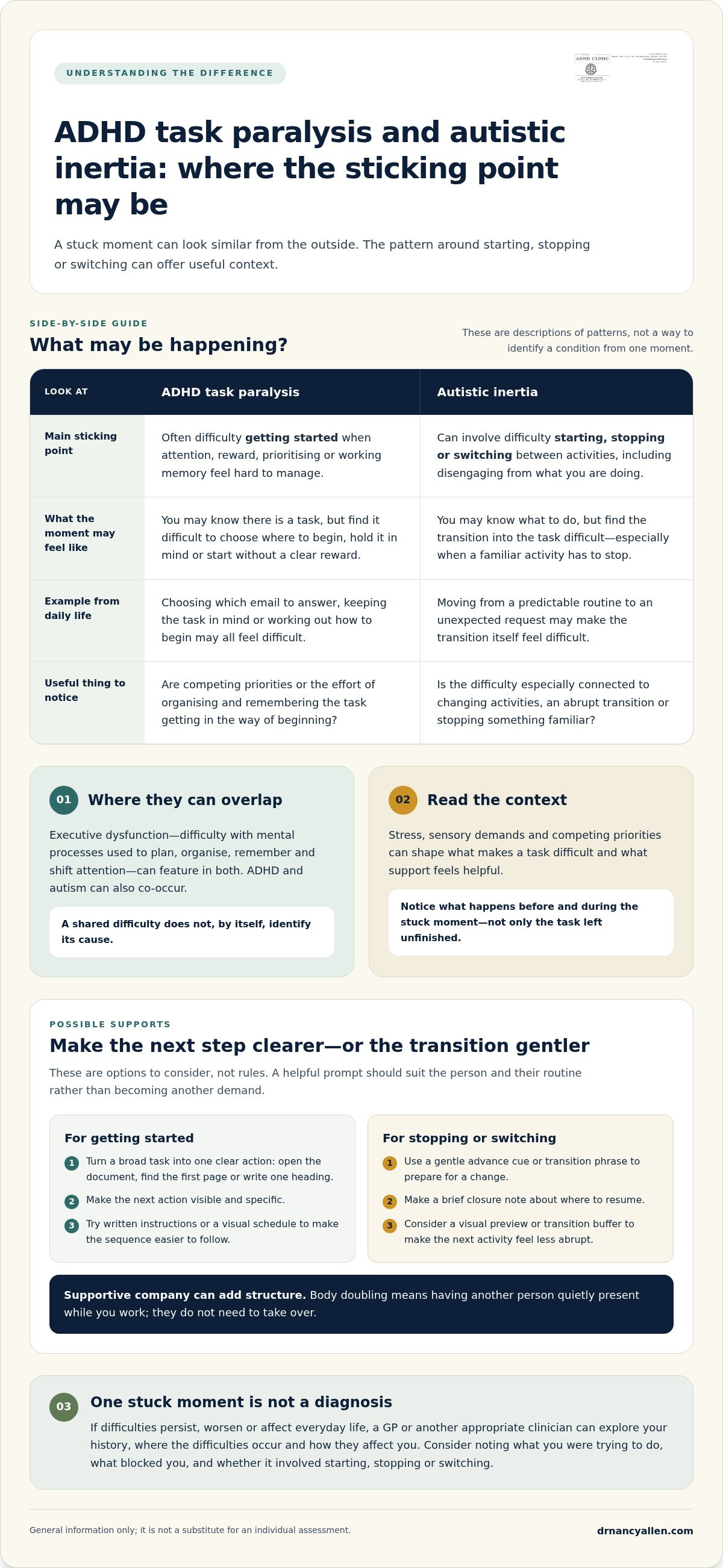
The key difference is often what makes starting, stopping or switching difficult. Autistic inertia commonly describes getting stuck between activities or finding it hard to disengage. ADHD task paralysis is a colloquial term for difficulty getting started when attention, prioritising or working memory feel overloaded. These patterns can overlap, and neither one alone shows whether someone is autistic or has ADHD. To understand whether autistic inertia or ADHD task paralysis is blocking your focus, look at the context and pattern, not just the moment you feel stuck.
Knowing what you want to do but still being unable to begin can be frustrating, and it’s easy to blame yourself. The difficulty is real and can have more than one explanation. This article explains how autistic inertia and ADHD-related task paralysis may differ, which signs can help you understand your experience, and how gentle prompts, external support and smaller first steps may make tasks more manageable.
You’ll also learn why overlap, stress and other factors can complicate the picture, and when it may help to discuss persistent difficulties with a healthcare professional.
Table of Contents
What Is ADHD Task Paralysis?
ADHD task paralysis is a colloquial term for feeling unable to begin, often when attention, reward, prioritisation or working memory become difficult to manage. Autistic inertia can involve starting, stopping or switching activities. The experience may look similar, but the pattern can differ.
Distinguishing Task Paralysis from Inertia
ADHD task paralysis describes difficulty initiating an activity; autistic inertia describes difficulty starting, stopping or switching between activities. The distinction matters because the same unfinished task can have different sticking points.
For example, an adult with ADHD may struggle to choose which email to answer, keep the task in mind or begin without a clear reward. An autistic person may know what to do but find the transition into the task difficult, especially when a familiar activity has to stop. These patterns can overlap, and autism and ADHD can co-occur. Notice what happens before and during the stuck moment, rather than judging yourself by the task left undone.
Overlap with Executive Dysfunction
Executive dysfunction means difficulty with mental processes used to plan, organise, remember and shift attention. It can feature in both ADHD and autistic inertia. A shared difficulty does not, by itself, identify its cause.
With ADHD, competing priorities or working-memory demands may make a task hard to hold in mind and organise. With autistic inertia, the sticking point may centre more on the transition itself, such as moving from a predictable routine to an unexpected request. In either case, make the next action visible and specific: open the document, find the relevant page or write one heading. To make stopping easier, use a gentle advance cue and a brief closure ritual, such as noting where to resume. A visual preview or transition buffer can make the next activity feel less abrupt.
Separating Inertia from Depression and Burnout
Autistic inertia describes feeling stuck when beginning, stopping or switching activities. Depression involves a change in mood, while burnout describes prolonged energy depletion. This distinction matters because persistent difficulties may need a broader explanation than task transitions alone.
Notice whether the challenge centres on particular activities or transitions, or whether low mood and reduced interest affect everyday life more widely. Burnout can involve long-term exhaustion associated with chronic stress and masking, and may intensify autistic inertia. These experiences can overlap, so the pattern and its impact matter more than one difficult day. If task difficulties are new, worsening or affecting daily functioning, discuss them with a GP or another appropriate clinician. The World Health Organization identifies the Adult ADHD Self-Report Scale (ASRS) as a validated adult ADHD screening scale. Screening can guide further discussion, but it is not a diagnosis.
Gentle prompts, external support and smaller first steps
Useful support makes the next action clearer or reduces the effort of changing activities. Notice which prompts fit your routine, rather than treating one strategy as right for everyone.
If difficulty starting tasks is new, worsening or disrupting daily life, speak with a GP or another appropriate clinician. Discuss whether autism, ADHD, anxiety, depression, burnout, physical health or sleep could help explain the pattern.
Gentle Prompts and Smaller First Steps
A gentle prompt turns a broad task into one clear action, making it easier to approach without demanding the whole task at once. This can help when “finish the paperwork” feels mentally heavy but “open the envelope” feels possible.
Name the next physical action: put the laptop on the table, open the document or find the first page. A transition phrase, such as “in five minutes, I’ll save this and move to lunch”, can prepare you to stop. If reminders feel pressuring, try a written cue or predictable routine instead.
Environmental Adjustments and External Support
Environmental adjustments change your surroundings or add structure, reducing the demands competing for attention. They can help when noise, clutter, lighting or an abrupt transition makes starting or switching harder.
Try clearing one workspace, reducing background noise or using a visual schedule to show what comes next. Body doubling means having another person quietly present while you work. Their company can provide structure without taking over. Written instructions can also make the sequence of a task easier to follow.
For example, a student might agree on a clear starting point with a tutor, then work nearby while the tutor completes separate tasks. At home, someone could give a calm prompt before a routine changes, rather than interrupting without warning. These supports work best when they respond to the person’s needs, not when they become extra demands.
A professional assessment can explore how difficulties developed, where they occur and how they affect everyday functioning. It can also consider co-occurring conditions and alternative explanations. Before speaking with a clinician, note a few examples: what you were trying to do, what blocked you, and whether the difficulty involved starting, stopping or switching.
If stuck states take up much of the day or affect work, relationships or self-care, arrange a conversation with a GP or appropriate clinician. Consider doing so if difficulty has recently increased alongside exhaustion or sensory overwhelm. A body double can offer company for an ordinary task, but it is not emergency care. If there’s an immediate safety concern, seek urgent help through local emergency services rather than relying on a prompt or routine.
What Is Autistic Inertia?
Autistic inertia is a community-informed term for difficulty starting, stopping or switching activities. It may relate to executive functioning, sensory demands, uncertainty or transitions. To understand what blocks you, notice the activity, change, surroundings and feelings involved, rather than assuming laziness.
Difficulty Starting, Stopping and Switching
Autistic inertia describes feeling stuck at the beginning, middle or end of an activity. It can affect both starting a task you want to do and stopping one you enjoy.
For example, you might intend to prepare lunch but remain seated, despite knowing each step. Later, you may find it hard to leave a book or computer task when another activity is due. At work, switching from one assignment to an unexpected email can also take effort. These experiences can look like avoidance from the outside, but that label doesn’t explain the difficulty or mean it is laziness.
Initiating Tasks and Navigating Transitions
Initiating a task means moving from intending to act to taking the first step. Transitions involve changing activities, settings or expectations. Either can be difficult when the next action feels unclear or a familiar sequence changes.
Imagine getting ready to leave home: locating your keys, putting on a coat and stepping outside each require a shift. If one part is uncertain, the whole routine may stall. A predictable sequence can reduce the effort: place essentials together, use a visual preview or agree on what happens next. Stress and sensory discomfort, such as a noisy room, may add further obstacles.
Monotropism and Shifting Focus
Monotropism describes attention being drawn strongly towards a narrower range of interests or activities. It can help explain why switching focus may feel demanding, especially when interruptions break concentration.
For instance, you may be deeply engaged in researching a subject, then struggle to respond when someone asks a question. The challenge may involve disengaging from your current focus, processing the interruption and beginning something new. A clear cue before the change, followed by time to finish or note your place, can make the shift more manageable. The experience varies between people and situations.
Transitions, Uncertainty and Starting Tasks
Uncertainty about what a task involves or how long it will take can make starting or switching harder. What appears to be unwillingness may instead be difficulty working out the next step.
To understand what’s blocking you, notice what happens just before you pause. Is the instruction vague, the environment uncomfortable or the next activity unexpected? For example, “sort the paperwork” gives less direction than “put the letters in date order”. Anxiety may accompany uncertainty, but task difficulty alone doesn’t establish its cause. Try adding a clear transition cue or written sequence, then notice whether that changes the experience.
ADHD task paralysis and executive-function overload
ADHD task paralysis is a colloquial description, not a formal diagnosis. It can describe feeling unable to act when several mental demands compete, such as choosing a priority, remembering steps and getting started.
Executive Function and Task Initiation
Executive function refers to mental skills used to organise actions, hold information in mind and shift attention. These skills matter when a task has several parts, because getting started may depend on choosing and sequencing them.
For example, completing a booking form might involve finding details, opening a website and answering questions. If the first action feels unclear, the whole task can seem inaccessible. Make one action explicit, such as finding the appointment letter, then decide what comes next. This doesn’t establish why getting started feels difficult, but it can show which part of the task is getting in the way.
Someone may know the next step yet still struggle to focus on it. A visible checklist can keep the sequence outside working memory, while a clear deadline or agreed structure may help make the task feel more immediate. Notice whether this changes the pattern across different activities, rather than judging yourself by one difficult task.
Executive-Function Overload and Regulation
Executive-function overload describes a task feeling unmanageable when demands on planning, attention or memory build up together. It matters because the barrier may be the number of decisions or distractions, rather than a lack of interest in the outcome.
Imagine preparing a meal while messages arrive and someone asks questions. Choosing what to cook, finding ingredients and responding to interruptions all compete for attention. Reduce those competing demands: silence notifications, put ingredients in view and focus on the next action. Sensory distractions, such as persistent noise or bright lighting, can add another demand for some people.
Stress, anxiety, poor sleep, physical health and medication effects can also influence someone’s ability to begin, continue or change tasks. These factors don’t prove ADHD is the cause. Track what’s happening around the difficulty: the task, the environment, your energy and any recent changes. This can help distinguish a recurring pattern from short-term strain.
Here, regulation means supporting yourself to become ready for an action, rather than forcing productivity. A brief pause, quieter surroundings or a smaller demand may help you re-engage. For instance, instead of clearing a whole desk, move one item into its place. If the difficulty continues across everyday activities or begins affecting work and relationships, record examples to discuss during a professional assessment. An assessment considers your history and functioning, not one moment of feeling stuck.
How autistic inertia differs from ADHD paralysis
The main difference is the pattern behind feeling stuck, not how visible the delay looks. Autistic inertia commonly describes difficulty starting, stopping or switching activities. ADHD task paralysis is a colloquial term for being unable to act amid demands on attention, prioritisation or working memory.
These descriptions can overlap. For example, an autistic person with ADHD may find both task transitions and prioritising difficult. Neither term is a diagnosis, and procrastination describes delay without explaining its cause. The useful question is what happens around the stuck point.
Compare a few real situations rather than relying on one frustrating moment. For each, note what you were doing, what changed and what made the next action hard to reach.
Starting: Is the task unclear, or are there too many possible first actions? A person facing several competing emails might struggle to choose a priority.
Switching: Did an interruption or unexpected change make it difficult to leave the current activity? Note whether a preview or transition cue changes the experience.
Stopping: Is it hard to disengage once absorbed, even when another activity is due? Record what helped you pause and resume later.
Context: Does the difficulty appear across settings, or mostly during fatigue, anxiety, sensory strain or a particular routine?
These clues can help explain your experience, but they cannot identify autism or ADHD on their own. A pattern centred on transitions may be consistent with autistic inertia. Difficulty organising, prioritising or holding task steps in mind may fit ADHD-related executive-function challenges. Either pattern can occur for other reasons, and both can be present together.
Try recording examples from work, home and social activities. Include tasks you wanted to do, tasks you found uninteresting and unexpected changes. Notice whether a clear sequence, fewer distractions or an external cue affected your ability to begin or switch. This gives a more specific account than calling yourself lazy or saying you simply lack motivation.
If difficulties persist or affect daily functioning, a professional assessment can consider your developmental history, functioning across settings, co-occurring conditions and other explanations. You deserve an account that takes your specific pattern seriously, rather than assuming every delay is the same. An assessment is not based on one task or one questionnaire alone.
If you want to explore whether an ADHD assessment may help clarify persistent difficulties, learn about ADHD assessment as a possible next step.
Dr Nancy Allen: Adult ADHD Assessment
Dr Nancy Allen’s Adult ADHD Assessment can help explore whether ADHD may be contributing to persistent difficulties with starting, organising or completing tasks. Consider it when these challenges affect everyday life and form part of a wider pattern, rather than relying on one episode of feeling stuck.
An assessment considers your symptoms, history and circumstances, including how difficulties affect you across settings. This broader discussion can help distinguish ADHD-related challenges from other possible explanations and inform appropriate options. Autistic inertia and ADHD can overlap, so difficulty switching activities alone cannot establish a diagnosis.
Bring examples that show what happens before a task stalls, what makes it harder, and what support helps. These details can make your experience clearer during a clinical discussion. An assessment is an opportunity to explore your concerns, not a promise of a particular outcome. You’re welcome to contact Dr Nancy Allen to discuss whether an Adult ADHD Assessment may be a suitable next step.
Take a thoughtful next step
Understanding whether autistic inertia or ADHD task paralysis is affecting your focus can help you describe what happens, but you don’t have to settle on a label by yourself. If you decide to seek advice, bring a few examples of when tasks become difficult and what was happening around you. This gives a clinician a useful starting point to discuss your concerns and consider what further assessment may be appropriate.
Dr Nancy Allen offers Adult ADHD Assessment and Child ADHD Assessment, as well as Peri-menopause & Menopause Specialist Care. An assessment is a chance to explore your experiences and circumstances, not a promise of a particular diagnosis or outcome. Find out more or make an enquiry at a pace that feels right for you.
Contact Dr Nancy Allen to discuss a suitable next step. Your experience deserves careful attention, and asking for support can be a constructive place to begin.
Frequently Asked Questions
Inertia or something else?
It can be difficult to tell from one episode, because concentration and energy change with circumstances. Consider whether the experience is familiar or unusual for you, and whether it began after a change in health, responsibilities or routine. If it feels markedly different from your usual pattern, mention that change to a GP. A clear account of what has changed can be more useful than choosing a label first.
What Happens If Inertia Keeps Getting Called Laziness?
“Lazy” is a judgement, not an explanation of why an action feels difficult. Hearing it repeatedly can make someone doubt their own effort or feel reluctant to discuss their needs. Try describing what you observe, such as “I lose momentum after interruptions” or “I need time to move between activities”. Specific language can make conversations about expectations more constructive, without requiring you to prove how hard you’re trying.
When Should You Seek Help?
Consider seeking help when the difficulty affects an important part of life, such as keeping up with education, work, relationships or personal care. You can describe the practical consequences without deciding which condition explains them. For instance, explain that unfinished tasks are causing missed deadlines or conflict at home. A clinician can discuss what assessment or support may suit your circumstances.
When should I speak with a doctor about feeling stuck?
Speak with a doctor if the experience is new for you, has changed noticeably or is accompanied by other changes in your health or wellbeing. You can also raise it if you’re unsure whether it relates to attention, mood or another concern. It may help to explain what you’ve stopped doing or find harder than before. You don’t need to arrive with a diagnosis or a prepared explanation.
Why Doesn't "Just Start" Work?
“Just start” can add pressure without making the action clearer. It treats the problem as a choice, even when someone feels unable to move from intention to action. A more useful prompt might offer a choice between two small, acceptable options, such as opening the laptop or laying out the papers. If someone is helping, ask them to keep the prompt calm and specific.
What is autistic inertia and what does it feel like?
Autistic inertia is a term some autistic people use for difficulty moving into, out of or between activities. Someone might feel ready in principle but experience a gap before acting, or feel absorbed and unable to leave an activity easily. The phrase describes reported experiences; it isn’t a diagnosis. People describe it differently, so their own account matters.
What is ADHD task paralysis and what does it feel like?
ADHD task paralysis is an informal phrase for feeling unable to act on a task, often described as a frustrating gap between intention and action. Someone might repeatedly open a message, struggle to compose a reply, then leave it unanswered despite wanting to respond. The phrase can help describe that experience, but it doesn’t establish ADHD. A clinician considers the person’s wider history and functioning.
How do autistic inertia and ADHD task paralysis differ?
The terms describe overlapping experiences, so there isn’t a simple self-test that can reliably distinguish them. A useful question for discussion is whether the difficulty is part of a broader lifelong pattern of attention and organisation, or whether changes between activities are especially prominent. Both patterns can coexist, and other explanations may matter too. An assessment considers developmental history and functioning, not a label chosen from one example.



Comments