


ADHD Profiles Explained: Understanding Your Unique Needs

What if ADHD doesn’t always look like restlessness? The different ADHD profiles include inattentive, hyperactive-impulsive and combined presentations, so a child or adult may experience challenges that aren’t obvious to others.
It’s understandable to look for one familiar set of signs, but ADHD can appear in different ways. A child might struggle to stay focused, follow instructions or organise tasks; another may fidget, interrupt or find it hard to wait. Some people experience a mixture of these traits. No single behaviour, on its own, confirms ADHD.
This article explains the three presentations and how inattentive and hyperactive-impulsive traits may affect everyday life. It also explores how signs can appear in children, why difficulties may look different across settings, and how ADHD presentations can change over time. The aim is to offer a clear, balanced starting point for understanding what you’re noticing, without treating a description as a diagnosis.
Table of Contents
What Does Each Type of ADHD Look Like in Daily Life?
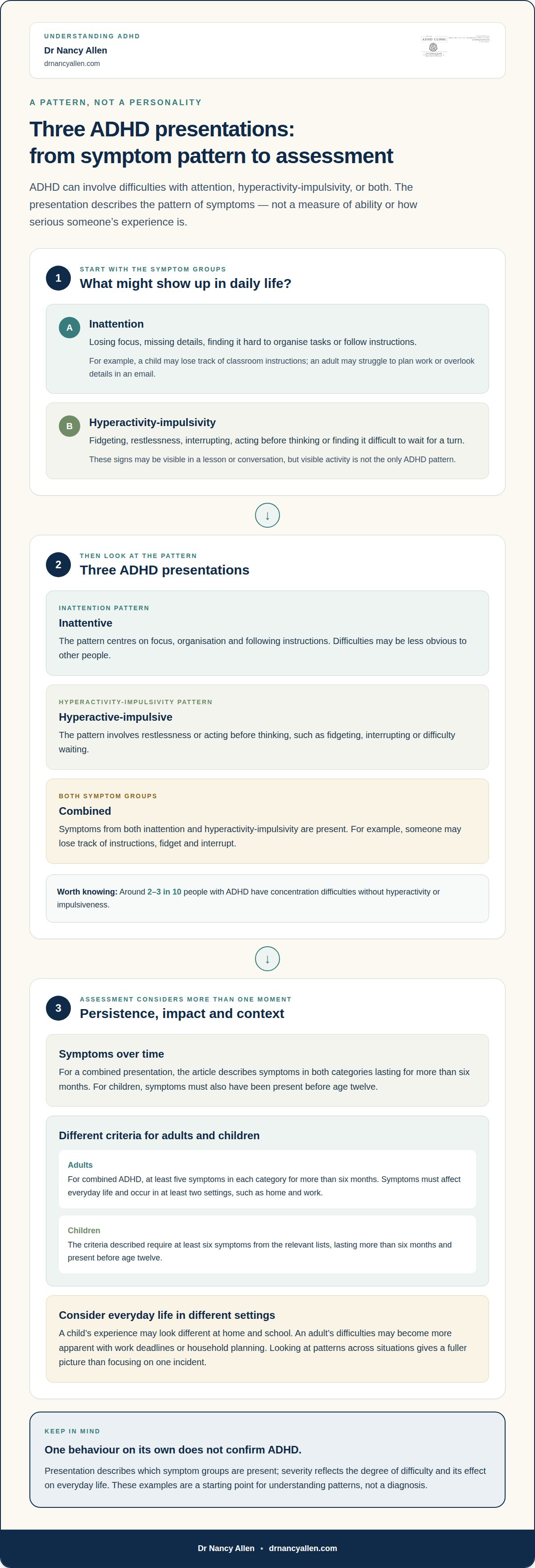
ADHD has three presentations: inattentive, hyperactive-impulsive and combined. The combined presentation includes signs from both symptom groups, so its effects may be noticeable in more than one part of daily life.
Combined Presentation Symptoms
Combined presentation means a person has symptoms of both inattention and hyperactivity-impulsivity. For example, a child might lose track of classroom instructions, repeatedly leave their seat and interrupt classmates. An adult might struggle to organise work, fidget during meetings and speak before others have finished.
These examples help explain why the combined presentation is often recognised, but behaviours vary between people. Many children with ADHD have the combined presentation. One child may find schoolwork difficult because they miss details, while another may struggle to wait, stay seated or keep track of belongings. Anxiety or another challenge can also shape a child’s experience, so one behaviour alone doesn’t tell the whole story.
Daily routines can show how symptom groups overlap. A child may forget their packed lunch, become distracted while getting ready and rush out without checking what they need. At school, they might miss part of a task and call out before hearing the full instruction. At home, a parent may notice similar difficulties during homework, meals or conversations.
For adults, this combination can affect work and relationships. Someone may overlook details in an email, struggle to plan a task and interrupt during a discussion. A structured routine or therapy may help some people find practical ways to manage behaviour, but support needs vary. These examples describe possible patterns, not a diagnosis.
Combined Presentation Diagnosis
Combined ADHD is diagnosed when a person meets the criteria for both inattentive and hyperactive-impulsive symptoms. Adult criteria require at least five symptoms in each category for more than six months. For children, the criteria require at least six symptoms from the relevant lists, lasting more than six months and present before age twelve.
Symptoms must affect everyday life, and adult criteria require them to occur in at least two settings, such as home and work. Occasional forgetfulness or restlessness alone does not establish a persistent pattern. Assessment considers how symptoms appear across situations and affect functioning.
The difference between inattentive, hyperactive-impulsive and combined presentations is the pattern of symptoms, not a measure of how serious someone’s experience is. Inattentive signs can include losing focus or struggling to organise tasks. Hyperactive-impulsive signs can include fidgeting, interrupting and difficulty waiting for a turn. Combined presentation includes both groups.
Children may behave differently at home and school, so context matters. A quiet child who repeatedly misses instructions may need attention just as much as a child whose restlessness is more visible. Considering examples from different settings gives a fuller picture than focusing on one incident or assuming every child’s ADHD looks alike.
What Are the Different Types of ADHD?
ADHD has three presentations: inattentive, hyperactive-impulsive and combined. The different ADHD profiles describe symptom patterns, not fixed personalities or measures of a person’s ability.
The Three ADHD Presentations
The inattentive presentation centres on difficulties with focus, organisation and following instructions; hyperactive-impulsive ADHD involves restlessness or acting before thinking. Combined presentation includes symptoms from both groups. Recognising these different ADHD profiles can explain why two people with attention deficit hyperactivity disorder may face different challenges at school, work or home.
In the hyperactive-impulsive presentation, a child might fidget through a lesson, interrupt classmates or find waiting for a turn difficult. An adult might feel restless during a meeting or speak before considering the consequences. Around 2-3 in 10 people with ADHD have concentration difficulties without hyperactivity or impulsiveness, showing why visible activity isn’t the only sign to consider.
Variation Across People and Women
ADHD presentations vary between individuals, and behaviour can look different across settings. For instance, a pupil may manage a structured classroom task but struggle to start homework independently. Girls are diagnosed with inattentive ADHD more often than boys, and difficulties may be less obvious, such as repeatedly losing track of instructions rather than disrupting a lesson.
These examples matter because visible hyperactivity is not the only pattern that can affect learning or daily routines. A child’s experience at school may differ from what parents observe at home, while an adult’s challenges may become more apparent with work deadlines or household planning.
Executive functioning describes the mental skills involved in planning, organising, remembering instructions and managing time. These skills may be affected differently across all three presentations. Someone with inattentive symptoms might forget a school deadline; someone with hyperactive-impulsive symptoms might start several tasks before finishing one. A person with combined symptoms may experience both patterns.
Presentation and severity are different concepts. Presentation describes which symptom groups are present; severity reflects the degree of difficulty and its effect on everyday life. For example, two people with inattentive symptoms may differ in how much missed paperwork or unfinished schoolwork disrupts their routines.
Common challenges may include distraction, unfinished tasks or difficulty waiting, depending on the presentation. ADHD doesn’t determine a person’s strengths: one person may be creative or energetic, while another prefers careful, quiet work. A presentation label alone cannot tell you about someone’s abilities or support needs.
Medication and other treatments aren’t selected solely by presentation. Clinicians consider the person’s symptoms, their impact on daily life and individual circumstances. Options may include medication or behavioural support, such as therapy. An approach that helps one person may not suit another.
Inattentive symptoms
Inattentive symptoms can be easy to miss because they may appear as quiet distraction rather than visible restlessness. Their effects often become clearer through repeated examples, such as unfinished tasks or missed details.
Predominantly Inattentive Presentation
The predominantly inattentive presentation describes persistent difficulties with attention, organisation and following detailed instructions, without meeting the symptom criteria for hyperactive-impulsive behaviour. Recognising this pattern matters because someone may struggle considerably without disrupting a classroom or conversation.
For example, a pupil might understand a lesson but forget several steps in the homework instructions. An adult may start a household task, become distracted and leave it unfinished. These patterns can affect school, work and daily routines, although each person’s experience is individual.
Inattentive symptoms can include overlooking details, losing focus during tasks, seeming not to listen and struggling to organise activities. A child might pack the wrong books after missing a timetable change. An adult might overlook a key detail in a work email or repeatedly misplace items needed for an appointment.
Some people describe these difficulties as mental drifting or trouble keeping track of time. They can affect relationships, too: someone may forget an agreed plan despite caring about the person who arranged it. These examples describe possible effects, not a diagnosis on their own.
Inattentive Characteristics and Diagnosis
Inattentive characteristics are assessed as a pattern of symptoms and their impact, rather than as isolated lapses. Adult criteria require at least five inattentive symptoms for more than six months, without meeting the criteria for hyperactive or impulsive behaviour.
For children up to age 16, the described criteria require at least six symptoms in an applicable symptom domain. Symptoms must affect day-to-day life, and an adult’s symptoms must occur in at least two settings, such as home and work. These details help distinguish persistent difficulties from an occasional missed deadline.
The language has changed over time. In 1994, the term “ADD” was removed from medical terminology and replaced by “ADHD” as a catch-all. Today, “predominantly inattentive presentation” describes the symptom pattern; it is not a separate disorder from ADHD.
Inattentive and combined presentations differ in whether hyperactive-impulsive symptoms also meet diagnostic criteria. A presentation can describe someone’s symptom pattern, while diagnosis considers symptoms and their impact. Medication decisions aren’t based on the label alone; clinicians consider the person’s wider circumstances and needs.
When difficulties arise, useful examples include repeatedly missing instructions, forgetting commitments or leaving tasks incomplete despite trying to finish them. A clinician considers how long these experiences have lasted, their pattern and their impact. Specific examples can make it easier to explain what happens at school, work or home.
Hyperactive-impulsive ADHD characteristics and diagnosis
Hyperactive-impulsive traits can affect how someone manages activity and pauses before responding. Their impact depends on the person’s circumstances, not simply on how energetic they seem.
Hyperactive-Impulsive Characteristics
This presentation involves a pattern of high activity or impulsive responses that can make everyday expectations harder to manage. Understanding the impact matters because behaviour that appears deliberate may reflect difficulty regulating actions in the moment.
For example, someone might find it hard to stay settled during a quiet activity or respond quickly before weighing up a choice. A child may need to move during a long assembly; an adult may find a lengthy, uninterrupted task uncomfortable. These examples are not diagnostic on their own.
Hyperactivity can become less obvious as people grow older. Rather than moving around a room, an adult might experience an internal sense of restlessness or feel driven to stay busy. Outward behaviour can change, while the effort needed to manage it remains relevant to daily life.
Impulsivity may affect decisions as well as conversations. Someone might agree to a commitment before checking their schedule, then struggle to fit it in. Considering the consequences, such as repeated disruption to plans, gives a more useful picture than judging a single action.
Changes in Presentation Over Time
An ADHD presentation can shift over a person’s life, so an earlier description may not capture their current experience. This matters when support that once suited someone no longer matches the demands they face.
A clinician can consider what has changed and whether the person’s needs call for a fresh discussion. There is no universal reassessment timetable; changes in circumstances or difficulties are useful reasons to review support.
Adults may seek assessment after recognising longstanding difficulties in a new context, such as managing independent living or a demanding role. A useful account gives specific examples, such as repeatedly committing to overlapping plans, rather than simply describing oneself as “impulsive”. The aim is to understand the pattern and its impact, not to judge character.
In the UK, NHS and NICE approaches place diagnosis within a clinical assessment, with care considered in light of individual needs. A discussion can cover what is difficult now, what has helped before and what support may be appropriate. Treatment decisions are not determined by the presentation label alone.
Preparing a few clear examples can make an assessment conversation more focused. Describe what happened and its practical consequence, such as a missed commitment or difficulty completing a quiet activity. For a child, observations from everyday routines can help adults explain what they have noticed without relying on a single incident.
Can ADHD presentation change over time, and how often should it be reassessed?
Yes. The DSM-5 describes ADHD types as presentations rather than subtypes because the way symptoms appear can change over time. Reassessment focuses on current needs and how symptoms affect daily life, rather than assuming a childhood pattern remains unchanged.
For example, a child who often leaves their seat may be less physically restless as an adult. Difficulties with organisation, attention or impulsivity may still affect work, relationships or household routines. A change in visible behaviour doesn’t necessarily mean ADHD has disappeared; symptoms and their impact can shift as environments and responsibilities change.
Childhood and adult experiences can differ because daily demands differ. A pupil may rely on reminders from a parent or teacher, while an adult may need to organise appointments, bills and deadlines independently. A new job, education course or change in family responsibilities can make previously manageable difficulties more noticeable.
ADHD can continue into adulthood. An estimated 65% of children with ADHD retain some impairments in adulthood. This describes a group pattern, not what will happen for every individual. For one person, difficulties might centre on planning; for another, impulsivity may affect conversations or decisions. The relevant question is how symptoms affect this person’s life now.
There is no single reassessment interval that suits everyone. A review may be useful when symptoms change, everyday demands increase or existing support no longer addresses the person’s difficulties. For instance, a student moving into further education may face more independent deadlines than at school, making organisation harder.
Changes in circumstances can also affect what support is appropriate. Someone moving from a structured workplace to remote work may find it harder to maintain routines. A child changing schools may face different expectations around concentration, transitions and completing tasks. These changes provide useful context for considering current needs.
Reassessment doesn’t mean starting from nothing. A clinician can consider the person’s developmental history alongside current examples from home, education or work. For a child, parent and school observations may help describe differences across settings. For an adult, missed deadlines or difficulties managing household tasks can show how symptoms affect daily life.
Tracking specific changes can make conversations about support more focused. Note what has become harder, when it happens and its effect, such as repeatedly missing appointments after a change in routine. This information helps distinguish a shift in circumstances from a change in symptom patterns, and supports a discussion about whether care needs reviewing.
Dr Nancy Allen
Dr Nancy Allen offers ADHD assessments for adults, young people and children seeking a clearer understanding of their symptoms and their effects on everyday life. Each assessment considers the person’s history, circumstances and experiences across settings, rather than relying on a profile description alone. It can help explore whether ADHD may explain the difficulties and discuss appropriate options together.
If you’re considering an assessment for yourself or your child, it may be a useful next step after learning about ADHD presentations. General information can help you recognise patterns, but it can’t replace an assessment of individual needs.
For a thoughtful conversation about your circumstances, contact Dr Nancy Allen.
Take the next step towards clarity
Understanding the different ADHD profiles can help you describe what you or your child experiences, but making sense of those experiences requires an individual assessment. Consider what might make everyday life easier and which questions you’d like to discuss with a clinician.
Dr Nancy Allen offers ADHD assessments for adults and young people and children. She also provides menopause consultations and HRT reviews. An assessment can explore symptoms, history and circumstances, then consider appropriate options together. This article offers general information, not a diagnosis or a substitute for personal medical advice.
For practice information or to contact the clinic, visit Dr Nancy Allen’s website. A clear conversation can help you consider what may be useful for you or your child.
Frequently Asked Questions
What is happening in the ADHD brain?
ADHD is understood as a neurodevelopmental condition involving how the brain develops and supports everyday mental processes. No single brain scan or biological explanation can confirm ADHD in an individual. A person’s experience is understood through their history and the effects of difficulties in daily life, rather than assumptions about brain chemistry or a particular brain image.
What are the three ADHD presentations: predominantly inattentive, predominantly hyperactive-impulsive, and combined?
The presentations are predominantly inattentive, predominantly hyperactive-impulsive and combined. These terms describe how ADHD symptoms are grouped for clinical understanding, rather than defining someone’s personality or potential. A presentation label is not a complete account of a person’s support needs. Two people with the same label, for example, may find different parts of daily life difficult and benefit from different kinds of practical support.
How do ADHD symptoms differ across the three presentations in adults and children?
Age and surroundings shape how difficulties are noticed. For a child, adults may hear about challenges from school as well as home; an adult may be better placed to describe how difficulties affect work, relationships or independent routines. These perspectives add context to an assessment. A change in setting, such as moving to a new class or taking on different responsibilities, can also make previously less noticeable difficulties easier to recognise.
How does ADHD present differently in women and girls compared with men and boys?
There isn’t one presentation that applies to every woman, girl, man or boy. Social expectations can influence which behaviours adults notice, so a quiet child may receive less attention than one whose behaviour is more disruptive. Describe the person’s own experiences and their effects rather than relying on gender stereotypes. Assessment should consider individual needs, including difficulties that may not be obvious to others.
How do ADHD profiles affect diagnosis and assessment in the UK?
A presentation helps organise information gathered during assessment; it doesn’t replace a full clinical evaluation. A short timeline of concerns, with examples of when they began and how they affect everyday responsibilities, can be useful. For a child, parents or carers can describe changes they have observed; adults may reflect on how concerns have appeared at different stages of life.
What conditions can resemble or coexist with different ADHD presentations?
Anxiety, depression and learning disorders can occur alongside ADHD, and some difficulties may overlap. For example, concentration problems could be linked to anxiety, a learning challenge, ADHD or more than one factor. A clinician considers the wider picture, including which difficulties started first and where they arise. Sharing relevant health and learning history helps clarify overlapping needs and consider appropriate support without assuming one explanation accounts for everything.



Comments