


ADHD Job Hopping vs Chronic Burnout: How to Break the Cycle

Updated: 2 hours ago
Imagine reviewing a CV that lists twenty different roles in just seven years. To an outsider, this looks like a lack of commitment, but for the neurodivergent professional, it's often a frantic search for air whilst drowning in exhaustion. You likely feel a deep sense of shame over your employment history, fearing that you're simply incapable of the stability your peers manage so effortlessly. The constant cycle of high-energy starts and crushing resignations creates a pattern of financial instability and physical fatigue that feels impossible to escape, often manifesting as chronic neck or back tension that can be managed through specialist care at enrichchiro.com.
If these experiences resonate, it's vital to understand the link between job hopping vs chronic burnout in ADHD (one of my patients had 20 jobs in 7 years!). This article will help you distinguish between a temporary loss of interest and the physiological reality of chronic burnout that many adults with ADHD face. We'll explore the neurological drivers behind these career shifts and provide a clear path towards the specialist assessment and support you need to find professional peace. Your career history is a symptom of a brain that works differently, not a character flaw, and gaining that clarity is the first step towards recovery.
Table of Contents
The ADHD Career Carousel: Why 20 Jobs in 7 Years is a Medical Signal
The "ADHD Career Carousel" describes a relentless cycle where a professional starts a new role with intense focus and optimism, only to face a sudden, overwhelming urge to quit. This isn't merely a lack of grit or professional discipline. It's a medical signal that the brain's executive functions are struggling to keep pace with the environment. Whilst others might see a lack of commitment, this pattern is often a frantic attempt to find a workplace that doesn't trigger a total cognitive shutdown.
In my clinical practice, I often see how the distinction between job hopping vs chronich burnout in adhd ( one of my patients had 20 jobs in 7 years ! can be the difference between a life of shame and a life of clarity. Such a fragmented history isn't a choice; it's a sign of a system under constant, unsustainable pressure. When executive dysfunction is left unmanaged, the mental energy required to perform basic organisational tasks becomes so high that the individual eventually hits a wall, leaving them with no choice but to leave for the sake of their health.
The shame cycle associated with this pattern is profound. Many adults avoid seeking help because they've internalised the idea that they're simply "bad at working". They view their behaviour as a character flaw rather than a manifestation of novelty seeking or overload avoidance. Whilst novelty seeking drives the initial excitement of a new role, overload avoidance is what triggers the resignation. When the cognitive load of a job exceeds the brain's capacity to manage it, the only way to stop the mental pain is to remove the source of the stress entirely.
The Difference Between Impulsivity and Survival
Many observers label the decision to leave a job as "impulsive". However, for the neurodivergent individual, quitting is often a survival response to an internal environment that has become toxic due to sensory or cognitive overload. During the "honeymoon phase" of a new role, the novelty provides a natural dopamine surge that masks underlying difficulties. As the novelty fades and the routine executive demands of the role increase, the brain's reward system stops firing. Without that chemical support, the effort required to maintain performance becomes physically exhausting, leading to a crash that feels like the only escape.
Validating the Neurodivergent Experience
Validation is the first step toward breaking the cycle. Clinical insight helps shift the perspective from "lazy" or "unreliable" to "neurodivergent and unsupported". A fragmented CV is not a record of failure, but a roadmap of a brain fighting for its own equilibrium. Understanding the complexities of Adult attention deficit hyperactivity disorder allows you to replace shame with strategy. Seeking a professional adult adhd assessment provides the clinical evidence needed to access workplace adjustments and medical support. This clarity transforms your career history from a source of embarrassment into a data set for future success.
The Anatomy of Chronic ADHD Burnout: Why You Cannot Just Push Through
Burnout for the neurodivergent brain is not merely a state of being "very tired". It is a physiological event that represents a total system failure. Whilst neurotypical professionals might experience burnout as a result of long hours, those with ADHD often reach this point because of the sheer biological effort required to function in a world not designed for them. This creates a cycle of job hopping vs chronich burnout in adhd ( one of my patients had 20 jobs in 7 years ! where the individual is perpetually trying to outrun a nervous system that is completely overdrawn.
At a neurotransmitter level, chronic work-related stress leads to sustained high cortisol levels. Over time, this depletes already scarce dopamine reserves, making it physically impossible to focus or find motivation. The ADHD brain operates on an "interest-based nervous system" which requires engagement and novelty to function. When corporate pressure forces you to prioritise "importance" over "interest" for too long, the system simply shuts down to protect itself. This is compounded by the "masking tax", the immense cognitive energy spent suppressing symptoms and acting neurotypical to avoid professional stigma.
The ADHD-Menopause Overlap in Burnout
For women, the path to burnout often accelerates during mid-life. Oestrogen plays a critical role in dopamine production and regulation. As levels decline during perimenopause, ADHD symptoms that were previously manageable through coping strategies often become overwhelming. Many women hit a "career wall" during this time, finding that their usual methods of "pushing through" no longer work. Addressing menopause symptoms with specialist care is frequently the missing piece in restoring professional stability and mental clarity.
Signs You Are in a Burnout Loop, Not a Boredom Loop
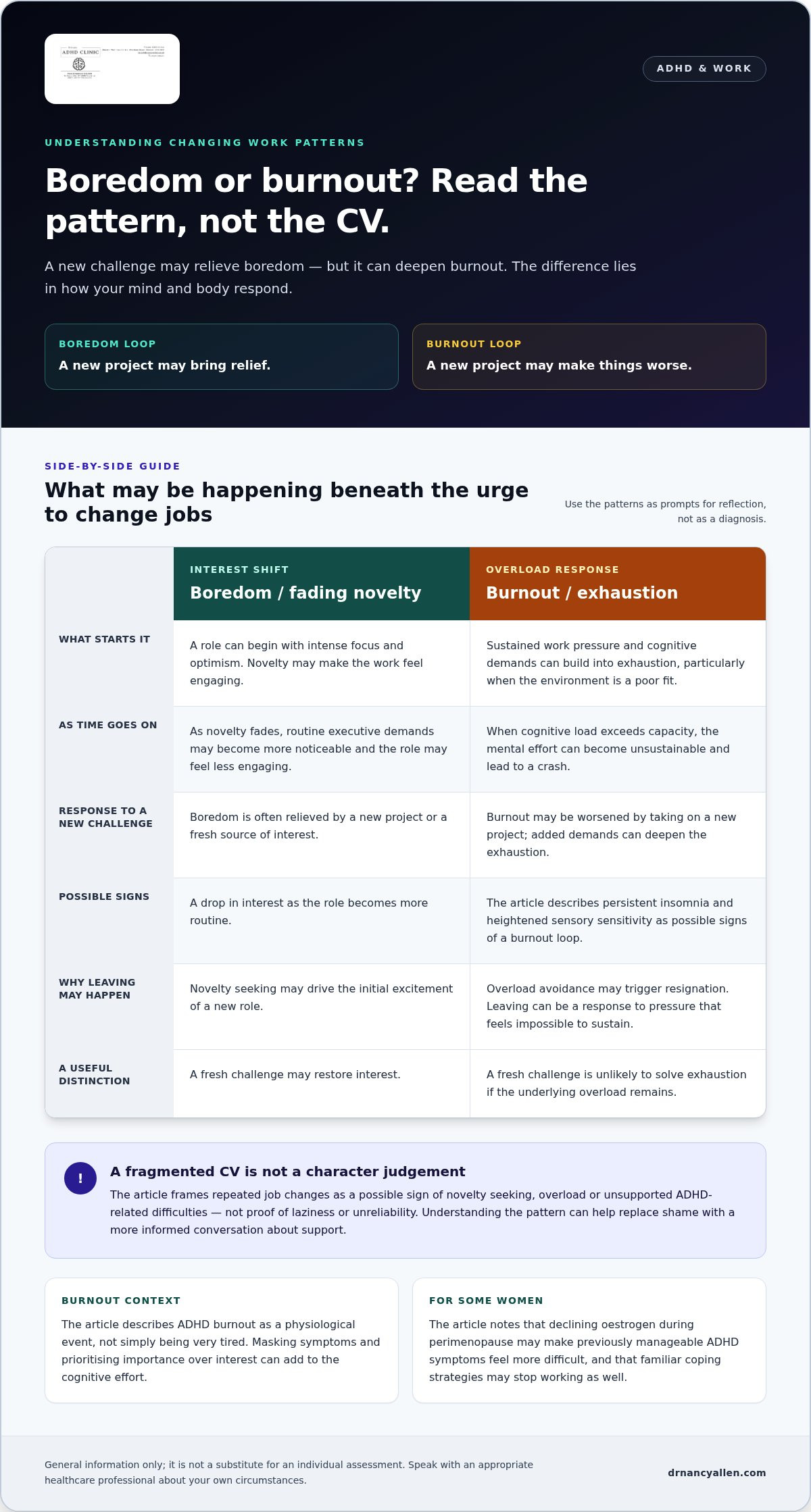
It is vital to distinguish between needing a new challenge and being in a state of clinical exhaustion. Boredom is often relieved by a new project, but burnout is worsened by it. If you are in a burnout loop, you may experience persistent insomnia, heightened sensory sensitivity, and a "brain fog" that rest does not clear. This is often referred to as an "ADHD shutdown". Understanding ADHD workplace challenges can help you recognise these signs early. When you reach this stage, the brain is in a protective mode, and the only way out is through clinical validation and structured support. If this cycle feels familiar, you can find guidance on beginning your recovery at Dr Nancy Allen.
Job Hopping as a Survival Strategy: Escaping the Overload
When an individual with ADHD resigns for the third or fourth time in as many years, the outside world often labels them as flighty or undisciplined. From a clinical perspective, we see something entirely different: a subconscious reset button being pressed by a brain in distress. For many, quitting is a desperate attempt to stop the noise and clear the cognitive slate. This survival mechanism is at the heart of the tension surrounding job hopping vs chronich burnout in adhd ( one of my patients had 20 jobs in 7 years ! and it explains why traditional career advice so often misses the mark.
The act of resigning provides an immediate, powerful surge of relief. For a few weeks, the pressure of deadlines, sensory overload, and executive demands vanishes. This relief phase is dangerously addictive because it's often the only time a burnt-out individual feels they can breathe. However, the "Reset Cycle" carries a heavy toll. Beyond the obvious financial instability and loss of pension contributions, each resignation chips away at self-esteem, reinforcing the belief that stability is simply out of reach.
It's helpful to distinguish between the "Boredom Quitter" and the "Burnout Quitter". The former leaves because the novelty has worn off and they seek a new dopamine hit. The latter leaves because they are in a state of physiological collapse. Recent research on ADHD and burnout suggests that the inability to sustain employment is often less about a lack of interest and more about the accumulation of unmanaged stress.
The Sensory Toll of the Modern Workplace
Modern office environments are frequently hostile to the ADHD nervous system. Open-plan layouts, flickering fluorescent lights, and the expectation of "constant connectivity" through digital platforms create a background hum of sensory static. For those struggling with the digital demands of the modern workplace, the Achieve With Nate Movement provides guidance on mastering communication tools to reduce this mental friction. For many, quitting isn't about the work itself; it's the only way to "stop the noise". A sustainable environment for ADHD usually involves high levels of autonomy and quiet zones, whilst unsustainable roles demand constant switching and high sensory input.
ADHD brains often excel in high-stakes "crisis" environments where urgency provides the necessary stimulation to focus. However, once a role moves into the "maintenance" phase, the administrative friction begins to build. Tasks like filing timesheets, managing an overflowing inbox, or attending repetitive meetings become insurmountable obstacles. I define executive dysfunction as the gap between knowing what to do and being able to do it. When these small tasks pile up, they create a sense of impending failure that eventually triggers the urge to escape. In some cases, finding a more autonomous and rewarding career path is the answer; for example, Active Health Group offers accredited training for those looking to qualify as health coaches and build a career that works with their unique strengths.
For healthcare professionals, managing the administrative side of a practice can be particularly draining on executive function; to streamline these processes, you might learn more about LD Collective Group and their expertise in provider enrollment and credentialing.
Strategies for Career Stability Whilst Managing Neurodiversity
Breaking the cycle of resignation requires a shift from crisis management to a "Stability First" framework. This progression starts with a formal diagnosis, moves into personalised treatment, and concludes with workplace accommodations. Alongside these steps, physical nervous system support can be invaluable; you can discover Restore Chiropractic Center to see how specialised upper cervical care serves as a model for managing the body's response to burnout. Without this clinical foundation, even the most robust productivity systems will eventually fail. Understanding the tension of job hopping vs chronich burnout in adhd ( one of my patients had 20 jobs in 7 years ! is the first step toward building a sustainable career path that respects your brain's unique wiring.
In the UK, the Equality Act 2010 provides significant protection for employees with ADHD. Under this legislation, ADHD is often classified as a disability if it has a substantial and long-term adverse effect on your ability to carry out normal day-to-day activities. This gives you the legal right to request "reasonable adjustments". Many professionals fear that disclosing their neurodivergence will lead to being fired, but these protections are designed to foster inclusion and prevent discrimination. Requesting support is a proactive professional step, not a sign of weakness.
Practical Workplace Adjustments
Meaningful changes often involve altering the sensory or organisational environment. You might request the following adjustments to improve your daily experience:
Flexible start times: This helps accommodate "sleep inertia" or the delayed sleep phase common in ADHD.
Noise-cancelling headphones: A simple tool to manage sensory overload in open-plan offices.
Task-batching: Grouping similar cognitive activities together reduces the "switching cost" that drains executive function.
Body Doubling: Working alongside a colleague or via a digital platform to increase focus and accountability.
When communicating these needs, focus on how they enhance your productivity rather than just listing your difficulties. This keeps the conversation professional and outcome-oriented.
Managing the "Urge to Quit"
The next time the urge to resign strikes, use a "Pause and Assess" checklist before making a final decision. Ask yourself if the problem is the job itself or if you are simply in a state of sensory or cognitive overload. "Job Crafting" is a powerful alternative to quitting; it involves working with your manager to redesign your current role to better fit your strengths. This might mean delegating administrative "friction" or shifting toward more project-based, high-novelty work. ADHD coaching and therapy also play a vital role in developing the resilience needed for career longevity. If you are ready to move from burnout to professional clarity, you can book a private ADHD assessment to begin your journey toward stability.
Seeking Clarity: How a Private Adult ADHD Assessment Changes the Narrative
For many professionals, a clinical diagnosis is the missing piece of the career puzzle. It transforms a history of perceived failures into a clear, biological explanation. Rather than viewing an assessment as a restrictive label, it is more accurate to see it as a "user manual" for your specific brain. Gaining this insight allows you to stop fighting against your nature and start working with it. This shift in perspective is essential when addressing the cycle of job hopping vs chronich burnout in adhd ( one of my patients had 20 jobs in 7 years !. Without this clarity, you are essentially trying to navigate a complex landscape with an outdated map; to begin finding support tailored to your needs, you might check out Prague Integration.
Dr Nancy Allen brings 25 years of clinical experience to every consultation, offering an approach that is compassionate, unhurried, and deeply evidence-based. In a landscape where NHS waiting times for adult ADHD assessments can exceed five years in certain regions, the speed of private care becomes a vital lifeline. Dr Nancy Allen offers secure online and in-person consultations, with appointments often available within days. For an individual currently in the middle of a burnout crisis or on the verge of another impulsive resignation, this rapid turnaround offers immediate relief and a tangible path forward.
The Path to Personalised Treatment
A formal assessment opens the door to targeted interventions that address specific executive function gaps. Medication can often stabilise the "interest-based nervous system," making routine tasks less physically draining, whilst specialised therapy helps build resilience against the "masking tax" discussed earlier. Structured support through collinspsychology.com can be a vital component of this recovery process. Dr Allen’s expertise is particularly valuable for women, as she provides a holistic plan that considers the intersection of ADHD and hormonal health. Restoring your confidence requires more than just productivity tips; it requires a physiological strategy that accounts for how your brain and body interact. When you understand why your brain seeks novelty or shuts down under pressure, the shame associated with your work history begins to dissolve.
The process for reclaiming your professional life is straightforward and designed to reduce further stress. Once you book a private consultation, the resulting formal diagnosis letter serves as a powerful tool. You can use this document to secure immediate workplace support and "reasonable adjustments" under the Equality Act 2010, providing you with the legal and clinical standing to request the changes you need to thrive. You don't have to wait for the next burnout cycle to begin before seeking help. Taking action now provides the stability required to turn a fragmented CV into a story of resilience and specialised skill. Book your private ADHD assessment with Dr Nancy Allen today to begin the transition from surviving to succeeding in your career.
Reclaiming Your Professional Future
Breaking the cycle of job hopping vs chronich burnout in adhd ( one of my patients had 20 jobs in 7 years ! begins with replacing self-criticism with clinical insight. Your career history is not a record of failure, but a physiological signal that your environment has not yet matched your neurological needs. By understanding the mechanics of executive dysfunction and the sensory toll of the modern workplace, you can move away from the "reset button" of impulsive resignations and toward sustainable professional growth. For leaders seeking a deeper shift, Jannine Barron provides mentorship on transitioning from extractive work models to nature-aligned, sustainable practices that better support long-term well-being.
Dr Nancy Allen provides the expert guidance needed to navigate this transition. With 25 years of clinical experience and specialist expertise in the ADHD-menopause connection, she offers a compassionate, unhurried assessment process. Appointments are often available within days. You possess unique talents that deserve a stable platform to flourish.
Begin your journey to career clarity with a private ADHD assessment
The path to a more settled and rewarding career is within reach. Once you understand the user manual for your brain, you can stop surviving the workday and start building a future that respects your unique strengths and supports your long-term well-being.
Frequently Asked Questions
Is job hopping a common symptom of ADHD in adults?
Yes, frequent career changes are a recognised pattern for many adults with ADHD. Research indicates that neurodivergent individuals are significantly more likely to quit a role impulsively or experience termination. This behaviour is often driven by an interest-based nervous system that thrives on novelty but struggles with the administrative maintenance of a long-term role. Understanding the link between job hopping vs chronich burnout in adhd ( one of my patients had 20 jobs in 7 years ! helps reframe these shifts as a search for a sustainable environment rather than a character flaw.
How can I tell the difference between career boredom and chronic ADHD burnout?
Career boredom is typically resolved by a new project or role that provides a fresh dopamine hit. In contrast, chronic ADHD burnout is a physiological shutdown that rest does not easily fix. If you are experiencing persistent brain fog, insomnia, and heightened sensory sensitivity that worsens with new demands, you are likely in burnout. Whilst boredom seeks more input, burnout requires a clinical intervention and a period of cognitive recovery to restore your executive function.
Can I be fired for having ADHD in the UK?
Under the UK Equality Act 2010, you cannot be legally dismissed solely because you have ADHD. Employers are required to provide reasonable adjustments to support you if your condition meets the legal definition of a disability. However, if performance issues arise and you haven't disclosed your diagnosis or requested support, your legal standing is less secure. A formal assessment provides the evidence-based documentation needed to protect your rights and foster a more inclusive working relationship.
How does an ADHD assessment help me stay in a job longer?
An assessment provides a clinical foundation for stability by identifying your specific executive function gaps. It acts as a "user manual," allowing you to implement strategies that actually work for your brain. By understanding the triggers of job hopping vs chronich burnout in adhd ( one of my patients had 20 jobs in 7 years !, you can access medication or therapy that stabilises your focus. This reduces the daily friction that leads to the overwhelming urge to quit your role.
What are reasonable adjustments for ADHD in a UK workplace?
Reasonable adjustments are tailored changes designed to remove barriers to your performance. Common examples in UK workplaces include flexible start times to manage sleep issues, the use of noise-cancelling headphones in open-plan offices, and task-batching to reduce cognitive switching. You might also request "body doubling" support or clear, written instructions for complex tasks. These adjustments are not "favours" but legal entitlements that help you maintain professional standards whilst managing your neurodivergent traits.
Does menopause make ADHD career burnout worse?
Yes, the hormonal shifts during perimenopause and menopause can significantly exacerbate ADHD symptoms. Oestrogen is closely linked to dopamine regulation; as levels drop, the executive function challenges you previously managed may become unmanageable. Many women find they hit a "career wall" during this phase of life. Addressing both neurodiversity and hormonal health through specialist care is essential for preventing a total professional shutdown and restoring your sense of competence at work.
Why do I feel so much shame about my work history?
Shame often stems from internalising the "lazy" or "unreliable" labels imposed by a society that values neurotypical consistency. When you don't know your brain works differently, you interpret every resignation as a personal failure. This emotional weight is compounded by financial instability and the fear of judgement from future employers. Clinical validation is the most effective tool for dissolving this shame, as it proves your history is a symptom of an unsupported medical condition.
How quickly can I get a private ADHD diagnosis for work support?
Whilst NHS waiting lists for adult assessments can currently exceed five years in many parts of the UK, private options offer a much faster path to clarity. Dr Nancy Allen offers secure online and in-person consultations, with appointments often available within days. This rapid turnaround is crucial for professionals currently in a burnout crisis who need formal documentation to secure workplace adjustments or begin medical treatment before their career is further impacted.



Comments