


ADHD Explained: Why You Watch Movies and Scroll Instagram

The pull to like watching a movie and then scrolling on Instagram often comes from the contrast between the two: a film asks you to stay with one story, while an endless feed offers quick changes and small rewards. Autoplay can keep the next episode coming with little effort, and scrolling gives you a steady stream of new things to notice. This habit alone doesn’t mean you have ADHD.
If this pattern feels familiar, it doesn’t mean you’re careless or lack willpower. Attention can shift towards what feels immediately rewarding, and switching between a film and your phone can make it harder to settle into either. ADHD can affect attention and impulse control, but this behaviour alone cannot establish a diagnosis.
This article explores how autoplay, quick rewards and attention interact, why it can feel difficult to stop scrolling, and how the habit may affect your focus and enjoyment. It also offers practical ways to make screen time more intentional and explains when it may be worth discussing broader attention concerns with a healthcare professional.
Table of Contents
Dopamine and quick rewards from short videos
Dopamine plays a role in how the brain responds to rewards and anticipates what might come next. It isn’t simply a “pleasure chemical”, and scrolling doesn’t mean your brain is addicted to dopamine. A short video can still feel rewarding: a funny clip, a familiar song or a useful tip each offers something different.
Instagram offers a stream of possible rewards, but you don’t know what each one will be until you choose. Before opening a Reel, you might wonder whether the next clip will be amusing, surprising or relevant. That uncertainty can keep you browsing. Each swipe offers another chance to find something satisfying.
Short videos change the scene quickly. One clip might show a recipe, the next a comedy sketch, then a friend’s update. This variety can hold your interest because there’s always new content to assess. A film, by contrast, usually develops one story with fewer immediate choices.
Autoplay can keep a show running without requiring you to select every episode. On a streaming service, the next instalment may begin while you’re still deciding whether to continue. Instagram’s feed works differently: each swipe brings a new post or video, prompting repeated small choices about what deserves your attention.
These differences can make switching between a film and Instagram feel effortless. Imagine a quieter scene in a drama just as your phone lights up. A message or Reel offers an immediate change, so you might pick up your phone before deciding whether you really want to stop watching.
This pattern isn’t proof of ADHD. Enjoying novelty, checking your phone or losing interest in a film can happen for many reasons. ADHD involves more than one screen habit: a clinician considers your wider experiences and how attention affects everyday life. One evening of switching between a film and Reels cannot establish a diagnosis.
Notice what prompts you to swipe. Is it a slower scene, a notification or not knowing what to watch? For example, if you reach for Instagram during quiet moments, pausing or changing activities may help you make a more deliberate choice.
You don’t need to treat every quick reward as a problem. Instead, notice the difference between choosing a clip for enjoyment and scrolling automatically while a film plays. During your next viewing, observe when your attention shifts and what happened just before. This can help you decide whether you want both screens competing for your attention.
The “popcorn brain” effect and attention
“Popcorn brain” describes attention jumping rapidly between digital content and other activities. The phrase can help describe the experience, but it isn’t a diagnosis.
Attention after switching to Instagram
Imagine pausing a film to check an Instagram notification, then watching several Reels. Your attention has moved between a developing story and rapidly changing posts. “Popcorn brain” is an informal label for this restless switching, not a clinical condition. It matters because returning to the film may mean piecing together its characters, mood and plot again.
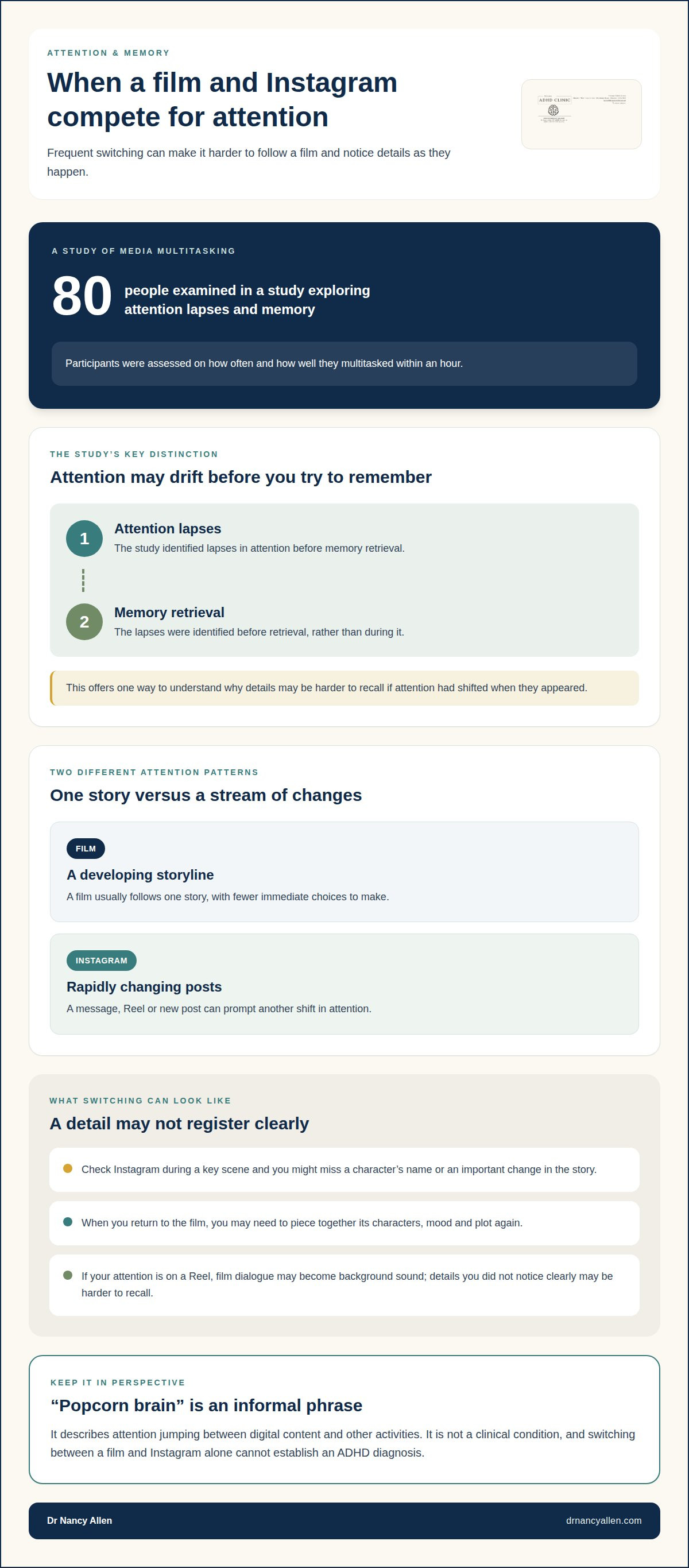
A study examined 80 people to explore links between media multitasking, attention lapses and memory. Participants were assessed on how often and how well they multitasked within an hour. The study identified attention lapses before memory retrieval, rather than during retrieval itself. That distinction suggests that missed information can begin with attention drifting away, before you later try to remember it.
In everyday viewing, you might miss a character’s name or an important change in the story. If you check Instagram during a key scene, you may not fully register what happened. The next scene could then be harder to follow, even when you’re looking back at the screen.
Repeated switching also means repeatedly redirecting your attention. A film gives you one continuous storyline; Instagram may offer a message, a Reel and a new post in quick succession. For example, after replying to a message, you may have to recall where the film left off. That mental shift can make viewing feel less settled.
Remembering a film while scrolling
Scrolling can affect what you remember from a film if it draws your attention away at important moments. That doesn’t mean every glance erases a scene. Rather, details you didn’t notice clearly may be harder to recall. Missing a brief conversation while reading a caption, for example, could leave a gap in your understanding of the plot.
Memory depends partly on noticing information in the first place. If your eyes and thoughts are on a Reel, the film’s dialogue may become background sound. Findings about attention lapses before memory retrieval offer one way to understand this: you may struggle to recall a detail because your attention had shifted when it appeared.
Compare how you feel after watching one film without phone interruptions and another alongside Instagram. Can you describe the main events, recall a character’s decision or explain how the ending connects to earlier scenes? This simple observation won’t diagnose an attention condition, but it can show whether multitasking affects your enjoyment.
Phone habits can also vary between people and situations. Brian Blake says he checks his phone about every 19 seconds during conversations, illustrating how frequent checking may interrupt attention beyond film-watching. The example isn’t a measure of everyone’s behaviour. It does show why noticing your own pattern, such as reaching for your phone during quieter scenes, can be more useful than judging yourself.
People under 35 have often grown up with activities such as texting during class or watching YouTube while eating. Familiarity with multitasking doesn’t necessarily make attention-switching effortless. During a film, choosing to focus on the story gives its details more room to register, instead of asking your attention to follow two streams at once.
How does switching from a film to Instagram affect attention and mood?
A film usually asks you to follow one storyline, while Instagram invites you to choose what comes next. Watching a quiet conversation in a drama involves less active input than selecting Reels, reading captions or checking comments. Switching between them changes the task: you move from following a director’s sequence to making decisions about new content.
If you watch a movie and then scroll on Instagram, returning to the film may take a moment. Imagine pausing during a scene to reply to a message, then opening a Reel suggested beneath it. When you return, you may need to work out who is speaking or why a character looks upset. The story hasn’t changed, but your attention has moved away from its details.
Your mood can shift with the content, too. A tense thriller scene may be followed by a cheerful cooking clip, then a friend’s holiday photo. Those sudden changes can interrupt the film’s emotional continuity. You might feel less immersed in its suspense or find that the next Reel leaves you in a different mood.
The effect varies from person to person. A familiar sitcom may be easy to follow after a brief check, while a complicated mystery may depend on small clues. Missing a character’s explanation, for example, could make a later reveal confusing. The type of film, what you’re viewing on Instagram and how often you switch all shape the experience.
Some people enjoy using both screens at once. A viewer might message a friend about a football match while watching the highlights together. In that case, the phone activity relates to the programme. Scrolling through unrelated videos during a serious drama is different: your attention has to shift between separate subjects.
Notice when you reach for your phone. Is it during a slow scene, after a notification or when the film becomes emotionally intense? Naming the trigger can help you decide whether the switch is intentional. You could also watch one scene without checking your phone, then compare how clearly you follow its dialogue and emotional tone.
If you watch a movie and then scroll on Instagram, try pausing after the credits before opening the app. Stand up, stretch or get a drink. A clear transition between screens can help you avoid adding another stream of content while your attention is still moving between the film and Instagram.
Switching screens now and then doesn’t, by itself, indicate ADHD. A more useful question is whether attention difficulties persist across settings, such as conversations, study, work or household tasks. A pattern affecting several parts of daily life differs from occasionally checking Instagram during a film. That wider context matters when deciding whether to discuss attention concerns with a healthcare professional.
Does scrolling social media after a movie affect sleep?
It can, particularly if Instagram keeps you looking at a screen close to bedtime. According to the NHS, prolonged exposure to blue light, especially before bedtime, may disrupt sleep patterns by suppressing melatonin production. Melatonin is a hormone involved in the body’s sleep-wake cycle. The timing and length of your screen use matter, as does what keeps you scrolling.
One episode can lead straight into another, followed by a quick check of Instagram. Then one Reel leads to the next, while new posts and notifications keep drawing your attention. This can delay the moment you put your phone down. For example, finishing a film late and then browsing in bed adds another screen activity before sleep.
The content itself can keep your mind engaged. A lively debate in the comments, an exciting video or a message from a friend may leave you thinking about what you’ve just seen. This varies between people and evenings. Notice whether you feel ready to settle after a film or more alert after opening Instagram.
A practical starting point is to choose a screen-time boundary that suits your routine. For example, you might aim to avoid phone use after 10 p.m. If that feels difficult, begin by ending Instagram before getting into bed. The useful measure is whether the boundary creates a calmer transition, not whether you follow it perfectly.
Phone-free areas can make boundaries easier to maintain. Keep your device away during bedtime, meals or family time, rather than relying on willpower whenever it lights up. For example, leave it charging outside the bedroom while you get ready for bed. A designated place for your phone gives you another routine to follow.
You could also schedule social media breaks earlier in the evening. An app reminder can signal when it’s time to log off, while a replacement activity gives you something specific to do. Try journalling, gentle exercise, a hobby or an offline chat with a friend. These choices offer a stopping point beyond simply closing one Reel.
If scrolling after films regularly disrupts your rest, notice the pattern over several evenings. Record when you stop watching, put your phone away and feel settled at bedtime. This isn’t a test or a diagnosis. It can help you see whether a phone-free wind-down suits you or whether wider attention concerns are worth discussing with a healthcare professional.
How can you stop automatically opening Instagram after a film?
Make the moment after the credits a deliberate transition instead of an automatic phone check. Before pressing play, decide whether you’ll watch another episode, put your phone away or choose an offline activity. A clear next step gives you an alternative to opening Instagram without thinking.
Autoplay can keep episodes running without another selection. If you want to stop after one film or episode, turn off autoplay where the service allows it, or leave the screen when the credits begin. This creates a pause before choosing what to do next. You can then decide whether you want Instagram or simply reached for your phone out of habit.
Set a specific screen-time boundary that fits your evening. One example is avoiding phone use after 10 p.m. Another is putting your device away as soon as the film ends. A clear time or event is easier to remember than a general intention to scroll less. Choose a boundary that leaves room for your routine, such as finishing a message before starting the film.
Change your surroundings, too. Put your phone in another room during a film or leave it charging away from the sofa. If it works for your household, keep it outside the bedroom at bedtime. Phone-free moments during meals and family time can also make reaching for a device less automatic.
Scheduled breaks and reminders can give you an external prompt to stop. Set a reminder for when you want to log off, or use an app that alerts you when your planned break begins. When it appears, close Instagram rather than watching one more Reel. Pairing the reminder with a simple action, such as making tea, gives your attention somewhere else to go.
Choose a replacement activity before the film ends. You might journal, stretch, read, take a walk or arrange to meet a friend offline. For example, leave a notebook beside the sofa and write down a thought about the film instead of opening the feed. Having an option ready makes the change easier than deciding what to do with your phone in hand.
Keep your plan manageable. Try one change first, such as putting your phone out of reach during a film, then notice what made it easier or harder. If a notification triggers the habit, silence notifications while viewing. If the credits do, plan a specific activity afterwards. These observations can help you adjust your routine without treating a lapse as failure.
If attention difficulties extend beyond evening scrolling and affect everyday life, consider discussing them with a healthcare professional. One screen habit alone cannot establish ADHD, but describing when it happens, including during films, conversations or tasks, can help explain your concern. If you’d like to explore wider attention concerns, contact Dr Nancy Allen to discuss an Adult ADHD Assessment.
Dr Nancy Allen
Dr Nancy Allen offers ADHD assessments to explore attention concerns in their wider context. Automatically opening Instagram after a film cannot, on its own, establish ADHD. An assessment considers symptoms, history and how difficulties affect everyday life. It may be a helpful next step if attention or impulse-control concerns also arise at work, school, home or in relationships.
Dr Nancy Allen offers Adult ADHD Assessment and Child ADHD Assessment. An individual assessment provides space to discuss your concerns and consider appropriate options. General information about scrolling habits cannot replace a personal discussion.
If you’d like to discuss attention concerns for yourself or your child, you’re welcome to contact Dr Nancy Allen.
Choose what you want your attention to do next
If you find that you like watching a movie and then scrolling on Instagram, pause before treating the habit as a diagnosis. Consider whether attention difficulties also affect conversations, work, study or family life. That wider picture can help you decide whether a professional conversation would be useful.
An individual assessment can explore attention concerns alongside your symptoms, history and everyday circumstances. This is a more considered way to understand persistent difficulties than drawing conclusions from one screen habit.
If you’re concerned about your attention, or a child’s, you’re welcome to contact Dr Nancy Allen to discuss the next step. You can begin with the questions that matter most to you, at a pace that feels manageable.
Frequently Asked Questions
So why are you really scrolling while streaming?
You may be looking for something more engaging, responding to a notification or following a familiar phone habit. Streaming and Instagram offer different kinds of involvement: a film sets the pace, while a feed lets you choose what to view. For example, you might pick up your phone during a quieter scene without deciding to stop the film. Noticing the trigger can help you choose whether to keep watching or switch activities.
Why does scrolling Instagram after watching a movie feel less enjoyable?
Moving between a film and Instagram can leave you only partly engaged with each. You may miss a detail in the story, then find the next post less satisfying because you’re still thinking about the film. After a tense ending, for example, unrelated comedy clips might feel jarring rather than relaxing. Try letting the credits finish before opening another app, then notice which transition feels better for you.
What are healthier things to do after watching a movie?
Choose an activity that suits how you feel after the film instead of opening another feed by default. You could talk about a scene with someone you watched it with, listen to music, prepare for bed or sit quietly for a few minutes. If the film raises a question, write it down for later. A chosen activity can make the end of viewing feel distinct from another screen session.
What does research say about multitasking between films and social media?
A study of 80 people examined media multitasking, attention lapses and memory. Participants were assessed on how often and how well they multitasked within an hour. The study found attention lapses occurred before memory retrieval, rather than during retrieval itself. This helps explain how missed information may affect recall, but it wasn’t specifically a test of watching films while using Instagram, so it can’t establish that exact effect.


Comments