


ADHD Diagnosis When Already Autistic: Is It Worth It?

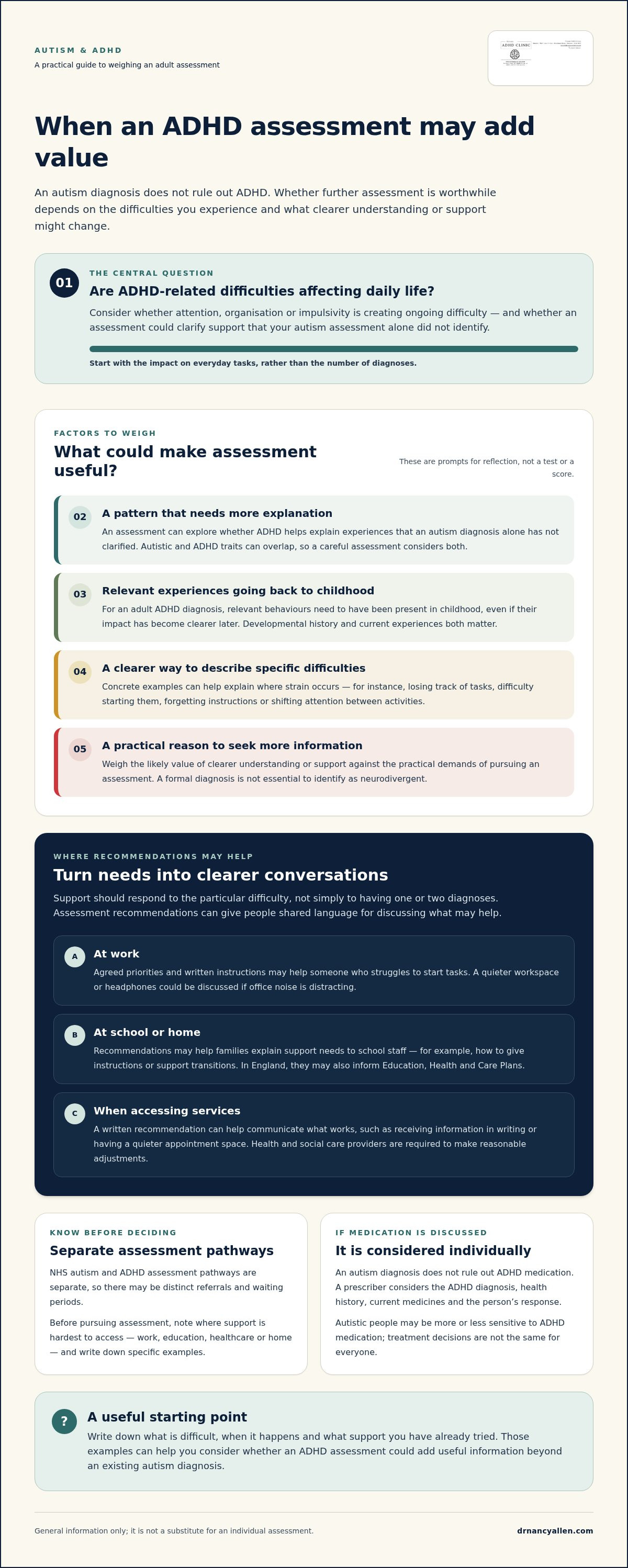
An autism diagnosis doesn’t rule out ADHD. Whether it’s worth getting an ADHD diagnosis when you’re already diagnosed autistic depends on whether ADHD-related difficulties are affecting your daily life and whether an assessment could clarify what support may help. For an adult diagnosis, ADHD behaviours must have been present in childhood, even if their impact has become clearer later in life.
It’s understandable to wonder whether another diagnosis would add anything, especially because some autistic and ADHD traits overlap. A careful assessment considers your developmental history and current experiences, including whether ADHD may help explain difficulties that your autism diagnosis alone doesn’t.
This article explains how an ADHD assessment may affect self-understanding, support and workplace adjustments, and what an adult diagnosis involves. It also covers when assessment may be useful and what to consider before deciding whether to pursue one.
Table of Contents
Access to formal support and workplace adjustments
Autistic people can also be assessed for ADHD, and an autism diagnosis does not rule out ADHD medication. A prescriber considers the ADHD diagnosis, health history, current medicines and the person’s response, because autistic people can be more or less sensitive to ADHD medication.
A separate ADHD diagnosis can clarify support needs that an autism assessment may not have identified. NHS assessment pathways for autism and ADHD are separate, so a person may encounter distinct referrals and waiting periods. Assessment recommendations can explain how attention, organisation or impulsivity affect daily tasks alongside existing autistic support needs.
For formal rights, the Equality Act 2010 is cited by UK Parliament as protecting autistic people from unfair treatment based on protected characteristics. Health and social care providers are legally required to make reasonable adjustments, according to UK Parliament. These adjustments address barriers to accessing services, rather than changing a person’s diagnosis. A written recommendation can help communicate what works, such as receiving information in writing or having a quieter appointment space.
At work, useful adjustments depend on the specific difficulty, not simply on having two diagnoses. Someone who struggles to start tasks might benefit from agreed priorities and written instructions. A person distracted by office noise could discuss a quieter workspace or headphones. Assessment recommendations can give an employee and employer shared language for discussing experiences and possible adjustments, though they don’t determine what a particular workplace will put in place.
For children and young people, recommendations can help families explain support needs to school staff. A plan might, for example, set out how to give instructions or support transitions between activities. Schools can use recommendations to inform individual support plans; in England, they may also inform Education, Health and Care Plans. Families can compare what helps at school and home rather than treating every difficulty as the same.
Formal services are only one part of support. A diagnosis can help someone describe their needs when joining a peer group, speaking with a university disability service or asking a manager for a workplace conversation. Community groups focused on autism, ADHD or both can offer practical strategies and shared understanding. Look for networks that respect different communication styles and recognise that experiences vary.
Before pursuing an assessment, identify where support is hardest to access: work, education, healthcare or home. Note specific examples, such as missed deadlines despite careful planning or difficulty following verbal instructions. These details can focus a conversation about support and show whether an ADHD assessment could add useful information beyond an existing autism diagnosis.
Benefits of an ADHD diagnosis for someone already diagnosed autistic
A second diagnosis can explain difficulties that an autism diagnosis alone hasn’t clarified. If you’re already diagnosed autistic, whether an ADHD diagnosis is worth pursuing often depends on what you hope to understand or change. Its value may lie in recognising patterns, making sense of past experiences and considering support better suited to your needs.
Greater self-understanding
An ADHD diagnosis can help someone make sense of behaviours that have felt confusing or difficult to change. For example, repeatedly losing track of tasks may reflect challenges with attention or organisation, rather than a lack of care or effort. That distinction can matter when reviewing work habits, relationships or routines. It can also help someone explain their needs more clearly to family, colleagues or a clinician, using specific examples instead of self-criticism.
Benefits of both diagnoses
Receiving both diagnoses can offer a fuller account of how autism and ADHD traits interact. Someone may value structure yet struggle to maintain routines, or want social connection but find planning difficult. Considering both sets of experiences can help explain why a strategy works in one situation but not another. It can also support more individualised conversations about practical changes, without treating either diagnosis as a complete account of someone’s identity.
Adult diagnosis benefits
An adult diagnosis can offer new context for a long history of behaviour, from childhood through later responsibilities. One author described receiving an ADHD diagnosis in their forties after an autism diagnosis. They reported that having both diagnoses made life calmer and happier. For adults already diagnosed autistic, recognising longstanding patterns may help make sense of past difficulties with greater understanding rather than judging themselves by outcomes alone.
Diagnosis can turn broad concerns into specific questions. Instead of saying, “I can’t keep on top of things”, someone might identify difficulty starting tasks, remembering instructions or shifting attention between activities. These examples clarify where strain occurs and what changes could help. Discussing concrete situations with a clinician can help distinguish persistent patterns from difficulties linked to a particular environment or period of life.
For some people, the benefit includes discussing treatment options. An author with both diagnoses described ADHD medication as creating a pause in which they could consider how to respond, rather than reacting impulsively. That account illustrates one possible experience, not a prediction for others. Treatment decisions depend on assessment findings and personal health circumstances, and medication isn’t the only possible outcome of an assessment.
The practical value of seeking a diagnosis depends on what you hope to address. You might want to understand recurring difficulties, communicate your needs or explore whether ADHD-focused treatment is appropriate. Writing down examples from home, relationships, education and work can clarify your priorities before an assessment conversation. The aim is a more useful understanding of the individual, not simply another label.
Validation, self-understanding and neurodivergent identity
An ADHD assessment can clarify how someone’s experiences fit with an existing autism diagnosis. For some, that clarity supports self-acceptance; for others, understanding their traits without another formal diagnosis is enough.
A diagnosis can offer a framework for reflecting on past and present experiences. Someone who has long struggled to organise tasks, for example, may recognise a pattern their autism diagnosis alone didn’t explain. This insight can replace self-blame with more specific questions: which situations are difficult, what helps, and what support might be useful? The answers can also shape conversations about mental health with family or a clinician.
Formal assessment isn’t the only way to explore neurodivergent identity. Someone may identify with ADHD or autistic traits without a diagnosis, and connecting with neurodivergent communities can offer shared language and practical ideas. Online self-screening tools can prompt reflection, but they cannot establish a diagnosis or explore someone’s full history. Treat a score as a starting point for questions, not a conclusion.
A professional assessment is the route to a formal diagnosis, because it considers developmental history and current experiences together. For ADHD, childhood behaviours are relevant even when someone recognises their impact only in adulthood. Where access barriers delay assessment, self-identification shouldn’t be dismissed: it can still help someone describe their needs and look for supportive strategies.
Choosing whether to seek an assessment means weighing its possible value against your circumstances. If traits cause significant distress or interfere with everyday life, a formal evaluation may clarify support or treatment options, including whether medication is appropriate. If you mainly want language for your experiences, peer support and self-education may be useful without a diagnosis. Neither choice makes your experiences less real.
Self-care can begin with noticing what restores energy and focus. Someone might protect time for a special interest, such as drawing, coding or gardening, and plan a quiet break after a demanding social event. These personal strategies don’t prove ADHD or autism. A short record of what helps, what drains energy and where difficulties arise can make reflection more grounded.
Identity can remain personal and flexible. One person may value both diagnostic labels; another may prefer to describe particular needs without labels. Before deciding, consider what you hope an assessment will change: your understanding, access to support or a discussion about treatment. That purpose can help you judge whether formal diagnosis is the right next step.
What are the signs of ADHD that may be distinct from autism?
ADHD and autism can involve overlapping experiences, so one behaviour rarely tells the whole story. An assessment explores whether ADHD, autism or both best explain someone’s pattern, and how the traits interact in daily life.
ADHD-related difficulties may involve attention, activity levels or impulse control. Someone might lose track of a conversation as their attention shifts, struggle to finish routine tasks or act before considering the consequences. These examples can prompt reflection, but don’t establish a diagnosis on their own. The broader pattern matters, including how often difficulties occur and whether they affect different parts of life.
Autistic and ADHD traits can appear together, and the same situation may have more than one explanation. A person might find a busy meeting difficult because of sensory demands, difficulty sustaining attention or both. Someone may value predictable plans yet struggle to follow through with them. Rather than assuming one diagnosis explains every experience, an assessor considers the context and the person’s overall presentation.
It can help to notice what happens before and during a difficulty. If a task is left unfinished, consider whether the person lost interest, became overwhelmed by changing instructions, forgot the next step or faced several barriers at once. A short record of the situation, what happened and its impact gives a clinician more useful detail than a broad label such as “distracted”.
Patterns across settings can make experiences clearer. Someone may struggle to follow spoken instructions at work but manage better when the same information is written down. Another person might become absorbed in a preferred activity yet find it hard to switch tasks when plans change. These examples help describe how attention, sensory needs and transitions affect everyday activities.
Clinicians also consider whether another factor could contribute to the same experience. Anxiety and mood disorders can overlap with features associated with autism and ADHD, which may complicate assessment. Concentration, for example, may become difficult during a period of intense worry. A careful assessment explores timing, context and impact rather than attributing every attention difficulty to ADHD.
Before an appointment, write down examples from different parts of life, such as home, relationships and work. Note what was happening, what made the situation harder and whether anything helped. For example, record whether written reminders supported task completion or interruptions made it difficult to return to an activity. These observations help focus the conversation on the person’s individual pattern, rather than a single trait.
What are the risks or downsides of seeking an ADHD diagnosis as an autistic adult?
An ADHD assessment can bring useful clarity, but pursuing one takes time, energy and planning. For an autistic adult, the decision may involve practical barriers, overlapping experiences and uncertainty about what a diagnosis would change. Weighing these factors alongside your reasons for seeking assessment can help you decide whether to proceed now.
Access can be difficult. NHS ADHD assessment waiting times are lengthy, and private diagnosis is unaffordable for many people. Separate autism and ADHD pathways can also mean separate referrals and appointments. If unfamiliar settings or repeating your story feel tiring, prepare a brief account of key experiences to make appointments easier to manage and keep the assessment focused on the questions that matter most.
Assessment can involve a financial commitment, especially through private care. Weigh affordability against the value you expect from a clearer explanation, support recommendations or a treatment discussion. Don’t decide based on speed alone. A thorough assessment explores developmental history and current difficulties, rather than relying on a short checklist or one recent example.
There is also a risk of confusing ADHD traits with experiences linked to another difficulty. Anxiety and mood disorders can overlap with features associated with autism and ADHD, complicating assessment. Concentration, for example, may become difficult during a period of intense worry. An assessment should consider when difficulties began, where they occur and how they affect daily life, rather than treating one symptom as proof.
The outcome may not be what someone expects. An assessment may find that ADHD criteria aren’t met, or that another explanation better fits the person’s experiences. That can feel disappointing after a long wait or preparation, but the discussion may still help identify relevant difficulties and questions for future care. Consider what information would help, even if ADHD isn’t diagnosed.
There may be an emotional cost, too. Revisiting childhood experiences, school feedback or difficult work situations can bring up frustration or sadness. Before an appointment, choose a manageable way to gather examples, such as notes on missed deadlines, unfinished tasks or impulsive decisions. If you’re comfortable, you could also identify someone you trust to help recall childhood patterns.
To judge whether assessment is worthwhile, list the difficulties you want explained and what you hope might follow. If you’d like to discuss your circumstances and the assessment process, arrange a conversation about your concerns.
To judge whether an assessment is worthwhile, consider whether a comprehensive evaluation is accessible and affordable, rather than choosing based on speed alone. Overlapping anxiety or mood symptoms can also complicate diagnosis.
Dr Nancy Allen: Adult ADHD Assessment
Dr Nancy Allen’s Adult ADHD Assessment gives adults a structured opportunity to explore whether ADHD may help explain their experiences alongside an autism diagnosis. The assessment considers symptoms, personal history and circumstances, with time to discuss appropriate options. It may be a useful next step if attention, organisation or impulsivity continue to affect everyday life and you want a clearer understanding of these difficulties.
Appointments are available online where appropriate, with care tailored to the individual. With your consent, relevant care may involve communication with your NHS GP or other healthcare professionals. An assessment is individual, and general information cannot determine whether you meet diagnostic criteria or which treatment may suit you.
If you’d like to discuss an assessment, you’re welcome to contact Dr Nancy Allen.
Choose the next step that fits your needs
Deciding whether it’s worth getting an ADHD diagnosis when you’re already diagnosed autistic starts with what you want to understand or change. You might want a clearer explanation for a recurring difficulty, or simply want to consider your experiences without pursuing another label. Make the decision based on your priorities, not pressure to reach a particular outcome.
If you’re considering an assessment, write down the questions you want to discuss and examples of difficulties affecting everyday life. Bring these to a conversation with Dr Nancy Allen to explore whether an assessment feels like a suitable next step. An individual assessment is needed to determine whether ADHD criteria are met and which options are appropriate.
Contact Dr Nancy Allen to discuss an assessment. Taking time to understand your options is a constructive step towards care that reflects your needs.
Frequently Asked Questions
How common is co-occurring ADHD and autism in adults in the UK?
Around 50-70% of people with autism also have ADHD, but this estimate isn’t specific to UK adults. It describes overlap across people with autism, rather than the likelihood that any one person has both conditions. If you’re comparing this figure with your own experiences, remember that prevalence can’t confirm a diagnosis; an individual assessment considers your pattern and history.
What benefits can an ADHD diagnosis provide when already diagnosed autistic?
A diagnosis may help you give a fuller account of your needs in future healthcare conversations. To make an assessment useful, note what you hope its outcome will clarify, then gather relevant records, such as a previous autism assessment report or school documents. These materials can add context and help the assessor understand what has already been explored.
How can an ADHD diagnosis affect treatment, medication and support in the UK?
A diagnosis can inform a discussion about ADHD treatment, but medication isn’t automatically prescribed. Bring a current list of medicines and relevant health information to the appointment so they can be considered alongside your assessment. If care involves your NHS GP or another healthcare professional, information can be shared with your consent. Prescriptions are issued at clinical discretion and supplied by an external pharmacy; medication isn’t prescribed specifically to treat autism itself.



Comments