


ADHD and Sleep: Why Your Brain Struggles to Switch Off

Updated: 1 day ago
What if the reason you can't switch off at night has nothing to do with your willpower and everything to do with your biology? You are likely familiar with that frustrating "tired but wired" sensation, where your body is heavy with fatigue but your mind decides to start its most productive thinking session just as you turn out the lights. If you've spent years feeling guilty for failing at basic sleep hygiene, it's time to understand why the adhd brain struggles to sleep from a neurological perspective.
It's common to feel like this inability to rest is a personal shortcoming, but the reality is far more complex than a lack of discipline. We'll move past the standard advice about blackout curtains to discover the biological reasons why ADHD makes switching off so difficult. By looking at how dopamine and your internal clock interact, you can start to view your rest through a clinical lens rather than a moral one. This guide provides specialist insight into reclaiming your sleep through strategies that actually respect how your brain is wired.
Table of Contents
The Biological Basis: Circadian Rhythm and the ADHD Brain
For those living with Attention deficit hyperactivity disorder, the struggle to fall asleep is rarely a matter of poor willpower or "bad habits". It's a fundamental mismatch between the brain's internal rhythm and the demands of a traditional schedule. We often speak about the "internal clock", which is the master pacemaker in the brain that regulates everything from body temperature to hormone release. In neurodivergent individuals, this clock doesn't just tick differently; it often operates on a significant delay. This biological timing failure is a primary reason why the adhd brain struggles to sleep, as the body remains in "daytime mode" long after the sun has set.
Validation is essential here. If you've spent your life being labelled a "night owl" or accused of being lazy in the mornings, it's vital to recognise these as biological traits. These aren't lifestyle choices you've made; they're reflections of a nervous system that reaches its peak arousal at a different time than the rest of the population. This misalignment isn't just an inconvenience; it's a chronic neurological state that requires specialist understanding rather than simple "sleep hygiene" tips.
Melatonin Delay and the ADHD Sleep-Wake Cycle
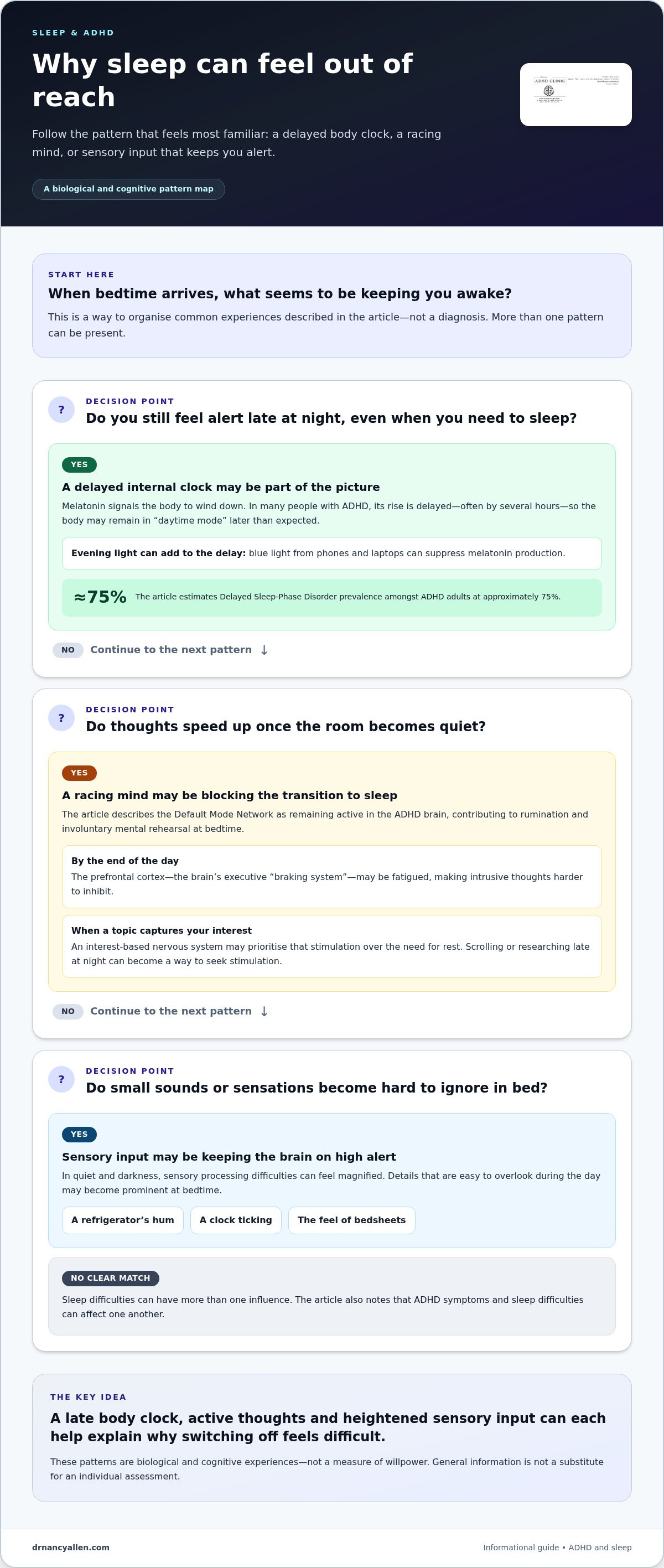
Melatonin acts as the brain's "dimmer switch", signalling to the body that it's time to wind down. In neurotypical brains, melatonin levels begin to rise as daylight fades. However, for many with ADHD, this chemical signal is significantly delayed, often occurring several hours later than expected. This means that whilst your colleagues are feeling drowsy at 10pm, your brain is still chemically convinced it's mid-afternoon.
This delay is frequently exacerbated by a heightened sensitivity to evening light. Blue light from smartphones and laptops doesn't just keep you awake; it actively suppresses the already sluggish production of melatonin in the ADHD brain. Amongst ADHD adults, the prevalence of Delayed Sleep-Phase Disorder (DSPD) is estimated to be approximately 75%, making it a near-universal experience within the community.
The "Tired but Wired" Phenomenon
The "tired but wired" sensation is a paradoxical energy surge that many experience late at night. As your executive functions fatigue throughout the day, the brain's ability to regulate impulses and "brake" racing thoughts diminishes. When the world finally goes quiet, the ADHD brain often feels a sense of relief from the overstimulation of the day. This nighttime solitude provides a psychologically safe space where you can finally think without interruption, which ironically makes the brain feel more functional and alert.
This surge isn't just mental; it's often a dopamine-seeking behaviour. When the brain is exhausted, it looks for quick hits of stimulation to stay "online", leading to late-night scrolling or sudden bursts of productivity. Understanding that why the adhd brain struggles to sleep is linked to this search for stimulation can help shift the perspective from frustration to biological insight.
The Racing Mind: Executive Dysfunction at Bedtime
Whilst the biological clock sets the stage for rest, the cognitive "racing mind" often acts as the final barrier to sleep. Clinical research highlights a significant bidirectional association between sleep and ADHD, where the very symptoms of the condition make the transition to slumber nearly impossible. Central to this struggle is the Default Mode Network (DMN). In a neurotypical brain, this network, responsible for self-referential thought and daydreaming, quietens as you prepare for rest. In the ADHD brain, the DMN remains hyperactive, triggering a cascade of rumination and "Involuntary Mental Rehearsal" just as the lights go out.
This mental hyperactivity is often why the adhd brain struggles to sleep despite physical exhaustion. By the end of the day, the prefrontal cortex, which acts as the brain's executive "braking system", is completely fatigued. It loses its ability to inhibit intrusive thoughts or dismiss irrelevant ideas. Consequently, you might find yourself mentally rehearsing a conversation from three years ago or planning a complex new project at 2am. Without the cognitive energy to suppress these thoughts, the brain stays in an aroused, problem-solving state that is entirely incompatible with sleep.
The Failure of the "Off Switch"
The ADHD brain operates on an interest-based nervous system rather than one driven by importance or schedule. If a particular thought or "rabbit hole" captures your interest late at night, your brain will prioritise that stimulation over the biological need for rest. The prefrontal cortex simply cannot find the "off switch" for a topic that provides a hit of dopamine. This often leads to "revenge bedtime procrastination", where you scroll through social media or research niche topics to satisfy a depleted reward system. If these patterns feel familiar and are impacting your quality of life, pursuing a formal adult adhd assessment can provide the clinical clarity needed to manage these cognitive demands.
Sensory Overload and Sleep Disturbances
In the quiet and darkness of a bedroom, the ADHD brain’s sensory processing issues are often magnified. Without the competing stimuli of the daytime, minor environmental factors that others might ignore become impossible to filter out. You might find yourself unable to look past the slight "hum" of a refrigerator in another room, the rhythmic ticking of a clock, or the specific texture of your bedsheets.
This inability to habituate to sensory input means your brain remains on high alert. Thermal sensitivities also play a role; many find that being slightly too warm or too cold triggers a level of physical restlessness that prevents the transition into deeper sleep stages. These sensory distractions further explain why the adhd brain struggles to sleep, as the nervous system remains stuck in a state of hyper-vigilance rather than relaxation. To explore how neurofeedback can help retrain the brain's arousal levels for better rest, you can visit Neurobics.
Understanding the complexity of neurodivergent rest requires looking beyond the core symptoms of inattention or hyperactivity. For many, the reason why the adhd brain struggles to sleep is compounded by co-occurring physical conditions and hormonal shifts that create a perfect storm of wakefulness. Research indicates a high prevalence of ADHD and sleep problems occurring together, often creating a cycle where one exacerbates the other. It's not just a matter of a busy mind; it's often a body that refuses to settle due to underlying physiological factors that demand specialist attention.
The ADHD-Menopause Sleep Trap
For women and individuals assigned female at birth, hormonal health is a critical, yet often overlooked, factor in neurodivergent rest. Oestrogen plays a vital role in the production and regulation of dopamine, which is the primary neurotransmitter involved in ADHD. As oestrogen levels decline during perimenopause and menopause, dopamine levels often drop in tandem, causing ADHD symptoms to flare significantly. This hormonal transition introduces a new layer of difficulty, as common menopause symptoms like night sweats and thermal dysregulation disrupt an already fragile sleep architecture. The intersection of perimenopausal insomnia and neurodivergent brain fog creates a "sleep trap" that requires integrated clinical care to address both the endocrine and nervous systems simultaneously.
Physical Restlessness and Periodic Limb Movement
Physical hyperactivity doesn't always cease when you lie down. There is a documented correlation between ADHD and Restless Legs Syndrome (RLS), a condition characterised by an irresistible urge to move the limbs, particularly in the evening. This is often linked to low iron levels or dysfunction in dopamine pathways, which are already central to the ADHD profile. For individuals seeking to manage these physiological factors through targeted nutrition, Enas Wellness provides specialist dietitian services for insomnia. Additionally, specialist assessment frequently reveals a link between ADHD and Sleep-Disordered Breathing or Apnoea. When your breathing is interrupted, your brain is forced into micro-awakenings to keep you safe, preventing you from reaching the deep, restorative stages of sleep.
Consider these physical red flags that may require a separate clinical investigation:
An "aching" or "creeping" sensation in the legs that only improves with movement.
Waking up feeling unrefreshed or with a headache, despite being in bed for eight hours.
Involuntary limb movements that wake you or a partner during the night.
Effectively managing these physical symptoms often requires a combination of clinical insight and physical rehabilitation. If you are looking for ways to support your body's ability to relax, learn more about RED Physiotherapy.
Identifying these comorbidities is essential to understanding why the adhd brain struggles to sleep. Treating the ADHD in isolation may not be enough if a physical sleep disorder or hormonal imbalance remains unaddressed. A holistic approach, which considers the overlap of these conditions and how the nervous system can be supported by specialists such as Restore Chiropractic Center, is often the only way to achieve lasting, restorative rest.
Standard sleep hygiene advice often suggests that everyone should avoid screens for at least an hour before bed to limit blue light exposure. Whilst well-intentioned, this rigid approach often ignores the fundamental reason why the adhd brain struggles to sleep. For a neurodivergent individual, lying in a dark, silent room doesn't necessarily lead to relaxation; instead, it can create a sensory vacuum. This under-stimulation often forces the brain to generate its own internal noise, leading to the racing thoughts and rumination that make rest impossible.
Rather than deprivation, many find success with "Dopamine-Friendly Sleep Prep". This involves using gentle, predictable stimulation to anchor the mind. Brown noise, which has a deeper, bassier frequency than white noise, is often more effective at masking distracting environmental sounds without being overstimulating. Similarly, listening to a familiar audiobook or podcast can act as a form of "audio body doubling". This provides just enough interest to keep the brain from wandering into anxiety-inducing territory whilst being repetitive enough to allow the nervous system to settle.
Managing the "Dopamine Cliff" at Night
The "dopamine cliff" refers to the physically distressing drop in stimulation when you suddenly stop all evening activities to go to bed. To avoid this, it's helpful to implement "bridge activities". These are low-stakes, repetitive tasks that provide a gentle trickle of dopamine without being highly arousing. Examples include:
Engaging in repetitive crafts like knitting or crochet.
Playing a familiar, low-stakes puzzle game on a device with a heavy blue-light filter.
Listening to a "sleep story" or a podcast you have already heard many times.
These activities act as a cognitive buffer, allowing the brain to descend into a state of rest more gradually rather than being forced into a sudden, jarring silence.
The Role of Medication in ADHD Sleep
There is a common misconception that stimulant medication always prevents rest. In reality, for many patients, a correctly timed dose can actually quiet the internal chatter and reduce the cognitive hyperactivity that keeps them awake. By improving executive function late in the day, medication can help the brain engage its "off switch" more effectively. However, this is a delicate balance that requires professional guidance. If your current routine is failing you, seeking a specialist Adult ADHD Assessment can help you develop a personalised management plan that respects your unique neurochemistry.
Seeking Clarity: When to Consult an ADHD Specialist
If you have spent years cycling through different herbal remedies, weighted blankets, and rigid routines only to remain staring at the ceiling at 3am, it's time to consider a different approach. Chronic sleep disturbances are rarely an isolated issue; for many, they're the most visible sign of an underlying neurodivergent profile. Recognising why the adhd brain struggles to sleep is the first step toward moving away from the "try harder" mentality. When your biology is the barrier, willpower isn't the solution; clinical insight is.
Identifying the red flags that suggest your sleep struggles are part of a wider ADHD profile is essential. These often include a lifelong history of being a "night owl", significant difficulty waking up regardless of how much sleep you've had, and a mind that only feels truly "online" when the rest of the world is quiet. If these patterns have consistently interfered with your career, relationships, or mental well-being, consulting a specialist can provide the validation you've been seeking. Whilst NHS wait times for neurodivergent assessments can often stretch into years, a private clinical assessment offers a path to clarity and a personalised treatment plan within 72 hours.
The Path to a Personalised Treatment Plan
A specialist GP doesn't just provide a diagnosis; they act as a guide to untangle the complex overlap between ADHD, sleep architecture, and hormonal health. This is particularly vital for those navigating perimenopause or menopause, where declining oestrogen can make ADHD-related insomnia feel insurmountable. A holistic approach ensures that your management plan isn't just about a prescription. It's about a combination of medical support and behavioural strategies that actually work with your brain's interest-based nervous system rather than against it.
Gaining this clinical clarity also has practical implications beyond the bedroom. Understanding is adhd a disability in the UK can help you access essential workplace or educational adjustments. These might include flexible start times to accommodate a delayed circadian rhythm or designated quiet spaces to manage daytime sensory overload. Recognising your rights ensures that your rest isn't just a personal goal but a supported part of your professional life.
Reclaiming Your Quality of Life
Restorative sleep isn't a luxury; it's the foundation of your cognitive and emotional health. Moving from a state of constant exhaustion to one of regulated rest changes everything from your focus at work to your patience with loved ones. Through secure online telehealth consultations, you can access expert assessment from the comfort of your home, ensuring the process is as low-stress as possible. You don't have to navigate this journey alone or continue to settle for "tired but wired" as your default state. If you're ready to understand your brain and reclaim your rest, book a private ADHD assessment today and start your journey toward specialist-led care.
Reclaiming Your Right to Rest
Understanding the biological reality of your neurodivergent brain is the first step toward genuine restoration. Throughout this guide, we've explored how delayed melatonin release, sensory sensitivities, and the hyperactive Default Mode Network explain why the adhd brain struggles to sleep. These aren't character flaws or signs of a lack of discipline; they're physiological traits that require a nuanced, clinical approach. By shifting from a mindset of "trying harder" to one of specialist management, you can finally find the quiet your mind deserves.
Dr Nancy Allen provides the expert guidance needed to navigate these complexities, especially where ADHD and hormonal health overlaps. You don't have to wait years for support. We offer secure online consultations across the UK, providing a full diagnosis and personalised treatment plan within 72 hours. Book a private ADHD assessment with Dr Nancy Allen to find clarity and support and begin your journey toward restorative sleep. You deserve a life where rest is no longer a nightly battle.
Frequently Asked Questions
Can ADHD cause permanent insomnia?
ADHD does not cause permanent insomnia in a physiological sense, but it often leads to chronic sleep onset difficulties that can feel lifelong. These issues are typically rooted in a delayed circadian rhythm rather than a complete inability to sleep. With the right clinical intervention and personalised management, these patterns can be shifted. It's important to view these struggles as a manageable neurological trait rather than an irreversible condition.
How does ADHD medication affect sleep patterns?
The impact of medication on sleep is highly individual and depends on the specific compound and timing. Whilst stimulants are designed to increase alertness, they can paradoxically help some individuals fall asleep by quieting the cognitive noise that prevents rest. However, if the dosage or timing is incorrect, it may lead to increased wakefulness. A specialist consultation is essential to ensure that your treatment plan supports your sleep architecture.
What is the best way to quiet a racing ADHD brain at night?
Quieting a racing mind often requires replacing internal chatter with gentle, external stimulation. Using sensory anchors like brown noise or repetitive audiobooks can provide the brain with just enough data to prevent it from generating its own intrusive thoughts. Many find that externalising their to-do lists before bed helps offload the executive burden. This reduces the need for the brain to perform involuntary mental rehearsal whilst you are trying to drift off.
Is there a link between ADHD and night terrors?
There is a documented link between ADHD and various parasomnias, including night terrors and sleepwalking. These disruptions occur when the brain struggles to transition smoothly between different sleep stages. Because neurodivergent individuals often have fragmented sleep architecture, they may experience these intense episodes more frequently than the general population. Managing overall sleep quality through specialist support can often reduce the frequency and intensity of these distressing nighttime events.
Why do I feel more productive and alert at 2am?
This late-night alertness is usually the result of a delayed internal clock combined with a lack of external noise. At 2am, the absence of social demands and sensory distractions creates a low-pressure environment where the ADHD brain can finally find its flow. This is a primary reason why the adhd brain struggles to sleep on a conventional schedule. Your nervous system is simply reaching its peak arousal several hours later than is considered standard.
Can menopause make ADHD sleep problems worse?
Yes, the hormonal shifts during menopause and perimenopause can significantly exacerbate neurodivergent sleep issues. Declining oestrogen levels directly impact dopamine regulation, which often leads to a spike in ADHD symptoms like restlessness and racing thoughts. When combined with physical symptoms like night sweats, the result is often a severe disruption of rest. Integrated care that addresses both your neurodiversity and your hormonal health is often the most effective path forward.
Should I seek a private ADHD assessment if I cannot sleep?
If chronic sleep struggles are accompanied by other traits like impulsivity, focus issues, or emotional dysregulation, an assessment is highly recommended. Understanding why the adhd brain struggles to sleep can be the key to unlocking better mental health and daily functioning. A private assessment provides a rapid route to clarity, allowing you to bypass long waiting lists and begin a personalised treatment plan that addresses the root cause of your insomnia.
What is the difference between ADHD and a standard sleep disorder?
A standard sleep disorder, such as primary insomnia, is often related to stress or poor habits. In contrast, ADHD-related sleep issues are rooted in a neurological delay of the circadian rhythm and executive dysfunction. Whilst a standard disorder might respond well to generic hygiene tips, ADHD-related rest struggles usually require a more specialised approach. This often includes dopamine management and strategies that respect the brain's unique need for stimulation and structure.



Comments