


ADHD and Menopause: Why Symptoms Worsen & What Helps

ADHD can feel harder to manage during perimenopause and menopause. Understanding why ADHD symptoms may get worse during perimenopause and menopause starts with changing oestrogen levels, which play a role in regulating dopamine and serotonin, chemicals involved in attention, mood and memory. These changes can make existing ADHD difficulties more noticeable, while menopause symptoms can create similar challenges.
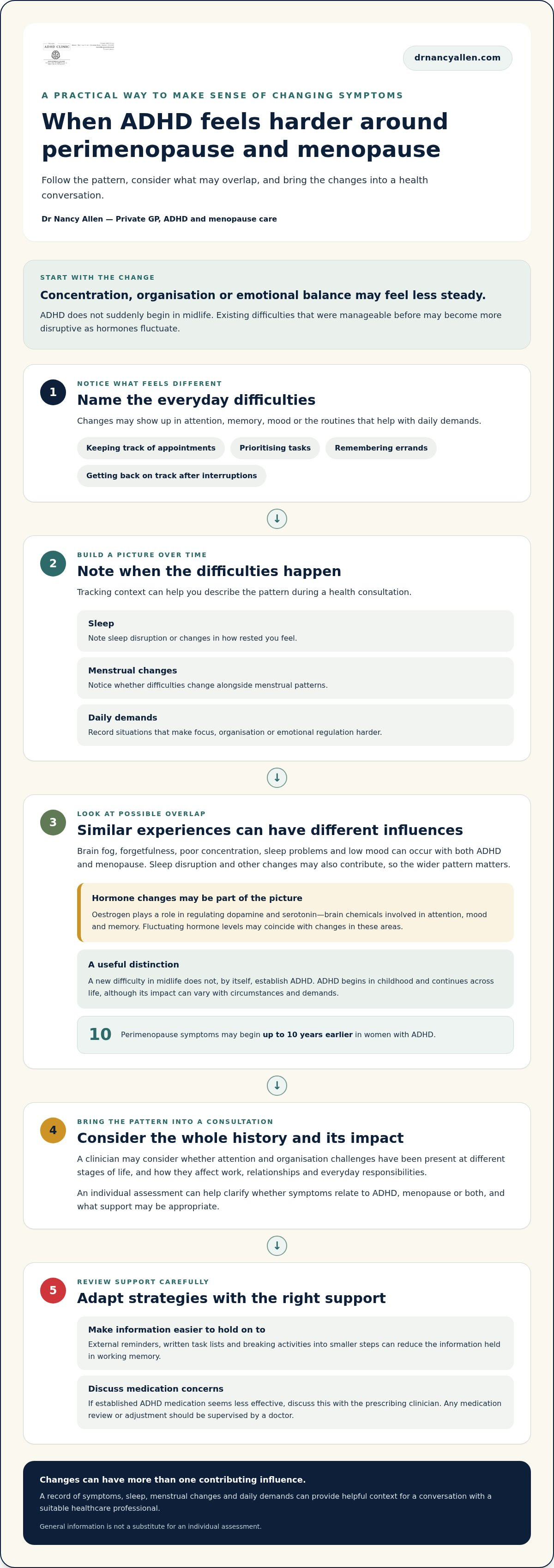
If your concentration, organisation or emotional balance feels less steady, take that change seriously. ADHD does not suddenly begin in midlife, but symptoms that were manageable before may become more disruptive as hormones fluctuate. Brain fog, forgetfulness, poor sleep and low mood can also overlap with ADHD, so it may not be clear what is contributing.
This article explains how ADHD can affect women, why symptoms may change around menopause and which experiences can overlap. It also covers practical approaches that may support focus, sleep and wellbeing, and when an individual assessment or care review could help clarify your options.
Table of Contents
How does menopause impact ADHD?
A practical answer to why ADHD symptoms get worse during perimenopause and menopause is that fluctuating hormone levels may make existing difficulties more noticeable. Changes can affect attention, memory, mood and the routines that help manage daily demands.
Changes in attention and executive function
Executive function refers to the mental skills used to plan, organise, remember and complete tasks. When these skills feel less reliable, familiar responsibilities can take more effort, such as keeping track of appointments or finishing one task before starting another.
Working memory helps you hold information in mind while using it, so difficulties can make multi-step tasks harder. A routine that once supported organisation may also feel less effective if focus, emotional regulation or sleep changes.
Hormonal and neurotransmitter changes
Oestrogen interacts with brain systems involved in attention, learning, memory and mood. It also plays a role in regulating serotonin, which is associated with these functions. Fluctuating hormone levels may therefore coincide with changes in concentration or emotional wellbeing.
Acetylcholine is another chemical messenger involved in attention and memory. Its relationship with menopause-related ADHD symptoms is less clear, so it should not be treated as a proven explanation for an individual’s changes.
ADHD begins in childhood and continues across life, although its impact can vary with circumstances and demands. Some women recognise longstanding patterns only when changing hormones or new pressures make their coping strategies harder to sustain. Perimenopause symptoms may begin up to 10 years earlier in women with ADHD.
For example, someone who previously relied on a detailed routine may find it harder to remember errands, prioritise work or get back on track after interruptions. These changes can reflect several overlapping influences, including ADHD traits, sleep disruption and menopause symptoms, rather than a sudden onset of ADHD. This helps explain why some women notice ADHD symptoms more during perimenopause and menopause.
Existing strategies may need adapting. External reminders, written task lists and breaking activities into smaller steps can reduce the information held in working memory. If established ADHD medication seems less effective during perimenopause or menopause, discuss this with the prescribing clinician. Any medication review or adjustment should be supervised by a doctor.
Changes in concentration or mood can have different causes. Tracking when difficulties occur alongside sleep, menstrual changes and daily demands can help you describe the pattern during a health consultation. This context supports a more considered discussion about ADHD and menopause care.
How does ADHD affect women?
ADHD can affect women’s attention, emotional regulation and executive function, and its symptoms may be overlooked or misunderstood. During perimenopause, changing oestrogen and progesterone levels may coincide with changes in focus and coping, although their effects vary.
Oestrogen and dopamine regulation
Oestrogen interacts with dopamine systems involved in attention, motivation and learning. Fluctuating or declining oestrogen may affect how these systems function, making existing attention difficulties more noticeable.
For example, someone who previously managed routine paperwork might struggle to get started or stay focused. This does not mean hormone levels alone explain ADHD. It illustrates why changes in focus can emerge alongside other midlife changes.
Hormones and attention
Hormonal changes involve shifts in oestrogen and progesterone during the perimenopause transition. Oestrogen also plays a role in regulating serotonin, which is associated with mood, learning, memory and sleep.
Progesterone levels fluctuate too, but the direct relationship between these changes and ADHD symptoms is less established. Noting whether concentration or emotional regulation changes alongside menstrual or sleep patterns can provide useful context for a clinical conversation.
ADHD is a lifelong neurodevelopmental condition, but its impact can change as expectations and circumstances change. A woman may manage deadlines through careful planning, for instance, then find that the same routine takes more effort when attention or working memory feels less reliable.
Women’s ADHD can be missed when difficulties are less visibly hyperactive. Inattentive symptoms, such as losing track of conversations, forgetting appointments or struggling to prioritise tasks, may be mistaken for stress or low confidence. Some girls also mask difficulties through perfectionism, overcompensation or people-pleasing, making earlier signs harder to recognise.
These patterns matter because a new difficulty in midlife does not, by itself, establish ADHD. A clinician considers whether attention and organisation challenges have been present at different stages of life, as well as their impact on work, relationships and everyday responsibilities.
For someone with existing ADHD, hormonal fluctuations may coincide with familiar strategies, such as using a diary or setting aside quiet time, becoming less effective. Reviewing which situations have become harder and what changed around them can help distinguish longstanding traits from newer challenges.
Women exploring changes linked to menopause can discuss how symptoms fit together in a consultation. A menopause specialist consultation can provide space to consider hormonal symptoms and their effect on daily function.
Lifestyle approaches, including exercise, diet, sleep and mindfulness
Everyday routines can support attention, mood and sleep during perimenopause, alongside appropriate clinical care. They do not replace ADHD treatment, but practical adjustments can make familiar tasks easier, such as preparing breakfast or settling for bed.
Food: include a source of protein with meals or snacks, such as eggs, yoghurt, beans or nuts. Protein-rich choices can support sustained energy. Oily fish, seeds and nuts provide omega-3 fatty acids, which are associated with cognitive and mood support. These foods are part of a balanced eating pattern, not a treatment for ADHD or menopause.
Sleep: Hot flushes, night sweats or racing thoughts can interrupt rest, making daytime attention harder to manage. A consistent bedtime, a relaxing wind-down routine and avoiding screens before bed are practical sleep-hygiene measures. For example, prepare clothes and essentials earlier, then use the final part of the evening for a quieter activity.
If night-time symptoms repeatedly disrupt sleep, note what wakes you and how you feel the next day. A brief record can reveal patterns, such as difficulty settling after late screen use or waking during night sweats. These specific examples can help you discuss the issue with a suitable healthcare professional.
Stress and sensory load: Mindfulness can mean pausing to notice your breathing or surroundings, rather than trying to empty your mind. A few slow breaths before switching tasks may help create a calmer transition. Reducing sensory input can also help: dim the lights or use noise-cancelling headphones during a demanding task.
Small organisational supports can make routines easier to maintain. Put reminders in one calendar, keep keys in a designated place or divide a larger job into short, visible steps. If standing still makes it harder to focus, try a brief movement break between tasks instead of expecting uninterrupted concentration.
Some people benefit from cognitive behavioural therapy (CBT), which can help develop strategies for distractions, planning and anxiety. Someone diagnosed with ADHD can discuss with their clinician how therapy, medication and lifestyle approaches might work together. Record which changes help, and introduce one adjustment at a time so its effect is easier to notice.
Overlap between menopause and ADHD symptoms
ADHD and perimenopause can affect concentration, memory, sleep and emotional regulation in similar ways. Looking at when symptoms began and how they change can help make sense of the overlap.
Shared ADHD and perimenopause symptoms
Symptom overlap means different conditions can cause similar difficulties, such as forgetfulness or poor focus. For example, losing track of a conversation may relate to ADHD, disrupted sleep or menopause-related brain fog.
Women with ADHD may find these shared difficulties harder to separate when hormonal symptoms are also present. A 2025 population-based cohort study reported that the difference in perimenopause symptom severity between women with and without ADHD peaked at ages 35 to 39. That finding describes a group pattern, not an explanation for one person’s symptoms.
Lifelong ADHD and perimenopause differences
Lifelong ADHD involves patterns that begin in childhood, while perimenopause symptoms emerge during hormonal transition. A history of repeated difficulty with attention, organisation or impulsivity at school, work and home can help distinguish longstanding traits from newer changes.
By contrast, cognitive difficulties that appear suddenly in a woman’s 40s or 50s, alongside other perimenopausal symptoms, may be related to hormone fluctuations. The timing is useful context, not a diagnosis. Menopause is reached after 12 consecutive months without a menstrual period.
Consider a practical example: forgetting appointments throughout school, employment and family life suggests a longer pattern than memory problems that began alongside night sweats and disrupted sleep. Both experiences deserve attention, but their timelines can point to different contributing factors.
Write down when a difficulty first appeared, where it occurs and what else changed. For instance, note whether misplaced items happen in different settings or mainly after poor sleep. Include changes in menstrual patterns, mood and daily function so a clinician can consider the full picture.
Hormone replacement therapy (HRT) may be considered for menopause symptoms, but it is not an ADHD assessment. If attention or memory concerns persist, discuss both hormonal changes and any lifelong difficulties with a suitable healthcare professional. The distinction matters because treatment discussions depend on the symptoms being addressed.
Some women receive an ADHD diagnosis for the first time in midlife, after increased demands or changing hormonal symptoms make familiar coping methods less effective. An assessment considers childhood history as well as current difficulties. It does not rely solely on memory problems or brain fog that are present now.
ADHD symptoms that may worsen in perimenopause and menopause
Hormonal fluctuations can coincide with greater difficulty managing ADHD symptoms. Changes may be most noticeable in mental effort, attention, emotional regulation and everyday tasks that previously felt manageable.
Overwhelm: in a survey, 70 percent of women said overwhelm had a life-altering impact during their 40s and 50s. A busy morning involving work messages, family plans and forgotten errands can feel harder to organise when several demands compete for attention.
Distractibility and task management: 59 percent of women in their 40s and 50s called distractibility life-altering during perimenopause and menopause. Time-management difficulties and procrastination were each called life-altering by 63 percent in the same age range. For example, a person may intend to complete one form, then lose time switching between unfinished tasks.
Memory and mental effort: Losing track of instructions or walking into a room without remembering why can disrupt work and home routines. When working memory is under strain, a three-part request may be harder to hold in mind while completing each step. Written notes and a single task list can provide reminders instead of relying on recall.
Emotional regulation: Irritability, anxiety or low mood may add to the effort of managing competing demands. An unexpected appointment, for example, may trigger intense frustration when sleep has been disturbed or the day already feels overloaded. Noting the situation, emotion and sleep pattern can help describe what has changed.
ADHD medication may also seem less effective during the menopause transition. If focus or daily function has changed, discuss the pattern with the prescribing clinician; medication adjustments require medical supervision. Do not change a dose independently. Note which symptoms have shifted and whether this affects work, relationships or routine tasks.
Seek advice from your GP or an appropriate clinician when worsening ADHD symptoms interfere with everyday function, or menopause symptoms feel severe or difficult to manage. Explain what has changed, when it began and how it affects daily life, including sleep, memory or emotional wellbeing.
For support with menopause symptoms and their impact on day-to-day wellbeing, explore peri-menopause and menopause specialist care.
Dr Nancy Allen: Adult ADHD Assessment
Dr Nancy Allen’s Adult ADHD Assessment offers a way to explore longstanding attention and organisation difficulties that have become harder to manage during menopause. The assessment considers symptoms, history and personal circumstances, helping distinguish lifelong ADHD patterns from changes that may relate to menopause.
If you already have an ADHD diagnosis and notice changes in how symptoms affect daily life, an individual discussion can help clarify what support to consider. Dr Nancy Allen also offers Peri-menopause & Menopause Specialist Care, where you can discuss menopause symptoms and their impact.
Consultations are thoughtful and individualised, with appropriate options discussed together. Contact Dr Nancy Allen to explore an ADHD assessment or menopause care.
Choose a clear next step for your wellbeing
Understanding why ADHD symptoms get worse during perimenopause and menopause can help you describe what has changed and identify the support you want to explore. Before speaking with a clinician, consider what matters most to you now: clearer focus at work, steadier routines at home or help understanding menopause symptoms. You do not need to have every answer prepared.
Dr Nancy Allen offers Adult ADHD Assessment, Child ADHD Assessment and Peri-menopause & Menopause Specialist Care. These services provide an opportunity to discuss ADHD or menopause concerns in an individual consultation, with care shaped around symptoms, history and circumstances.
If you’d like to discuss your situation, contact Dr Nancy Allen for support. Taking time to explain what you’re experiencing is a constructive step towards understanding your options and finding a way forward that feels right for you.
Frequently Asked Questions
What can help?
Different kinds of support may help, and the right combination depends on which difficulties affect daily life. Before an appointment, choose one priority, such as completing work reliably or managing household commitments, and describe what currently gets in the way. This gives a clinician a clear starting point to discuss ADHD-focused support, menopause care or both, rather than trying to address every concern at once.
What evidence links falling oestrogen to attention, working memory and executive function in women with ADHD?
There is a biological rationale: oestrogen plays a role in regulating dopamine and serotonin, which are involved in attention, memory and mood. However, this does not establish that falling oestrogen directly causes worsening ADHD in every woman. Evidence on the specific relationship remains limited, and hormone changes do not explain every cognitive difficulty. A careful assessment considers symptoms and history together, rather than relying on hormone levels alone.
Which ADHD symptoms commonly worsen during perimenopause and menopause?
There is no fixed set of symptoms that worsens for everyone. The change may be less about developing a new difficulty and more about an existing challenge interfering with life more often. For instance, someone may need more effort to keep up with usual responsibilities or recover after an interruption. Describing what has changed in practical terms can help a clinician understand the impact without assuming every difficulty has the same cause.
When do ADHD symptoms typically change during perimenopause and menopause?
Changes can arise at different points in the menopause transition, and there is no universal timetable. Some people notice a gradual shift, while others experience variable symptoms that come and go. The timing may not match a predictable cycle. Recording when changes occur and whether they persist can help distinguish a continuing pattern from a short-lived fluctuation, and provide useful context for discussing support with a clinician.
How can menopause symptoms such as poor sleep, hot flushes and mood changes mimic or worsen ADHD?
One useful distinction is whether a concentration problem appears mainly after a particular menopause symptom or persists across different situations. For example, difficulty following a discussion after repeated night waking may have a different context from a longstanding pattern across work, home and social settings. Both can occur together. Sharing when the problem happens and what came before it helps a clinician consider possible contributing factors.
Does hormone replacement therapy improve ADHD symptoms during perimenopause or menopause?
HRT is a treatment for menopause symptoms, not an established ADHD treatment. In one survey, 26 percent of respondents who took or had taken HRT said it helped their ADHD symptoms. This is a report of personal experience, not proof that HRT improves ADHD for everyone. Suitability depends on a person’s menopause symptoms and health circumstances, so discuss potential benefits and risks with a healthcare professional.
Can HRT be used alongside ADHD medication, and are there interactions or risks?
Whether HRT and ADHD medication can be used together depends on the individual medicines and personal health history. Bring an up-to-date list of prescribed medicines, non-prescription products and supplements to a medication review. A clinician or pharmacist can assess the specific combination and explain relevant risks. Do not start, stop or change either treatment without discussing it with the professional responsible for your care.
How can ADHD medication effectiveness change during the menstrual cycle or menopause?
People’s experiences differ, and a medication’s perceived effect may not change in the same way for everyone. In a survey, 40 percent of respondents said stimulant medication was effective or very effective for ADHD symptoms during menopause. This does not predict an individual response. If the benefit seems different, discuss the change with the prescriber, who can consider the treatment and wider symptom picture before advising on next steps.



Comments