


Why Children With ADHD Appear to Lie: An Expert Guide

Updated: 2 hours ago
What if the "lie" your child just told wasn't a deliberate choice, but a neurological survival strategy? It's a heavy burden to carry when you feel you cannot trust your child's words, and the exhaustion of constant "detective work" at home can leave any parent feeling depleted. You might worry about their future moral development or wonder where you went wrong. Please know that you're not a "bad parent," and your child is likely not trying to deceive you.
There's a clinical explanation for this behaviour. The surprising reason some children with ADHD appear to lie even when they don't mean to often stems from challenges with working memory rather than a lack of integrity. In this guide, we'll explore the medical "why" behind these fabrications and how "gap-filling" happens in a neurodivergent brain. You'll discover how to support your child with empathy and clarity, using techniques that reduce these occurrences whilst protecting the vital bond you share.
Table of Contents
The surprising reason some children with ADHD appear to lie even when they don't mean to: An introduction
Living with a child who frequently tells untruths is emotionally taxing. You might find yourself constantly checking their homework, looking for hidden wrappers, or questioning their account of a playground incident. It feels like a breach of trust, yet the surprising reason some children with ADHD appear to lie even when they don't mean to is often found in the architecture of their brain, not in a desire to be deceptive. We must distinguish between malicious lying, which is intended to manipulate or gain advantage, and "apparent lying," which is an involuntary byproduct of neurodivergence.
The ADHD brain processes information differently, often leading to what clinicians call "truth gaps." These are not intentional fabrications. Instead, they are the result of a brain trying to make sense of a world that moves too quickly for its executive functions to manage. This isn't a character flaw or a sign of poor moral development. It's a physiological issue that requires a clinical perspective rather than a disciplinary one.
The difference between defiance and dysfunction
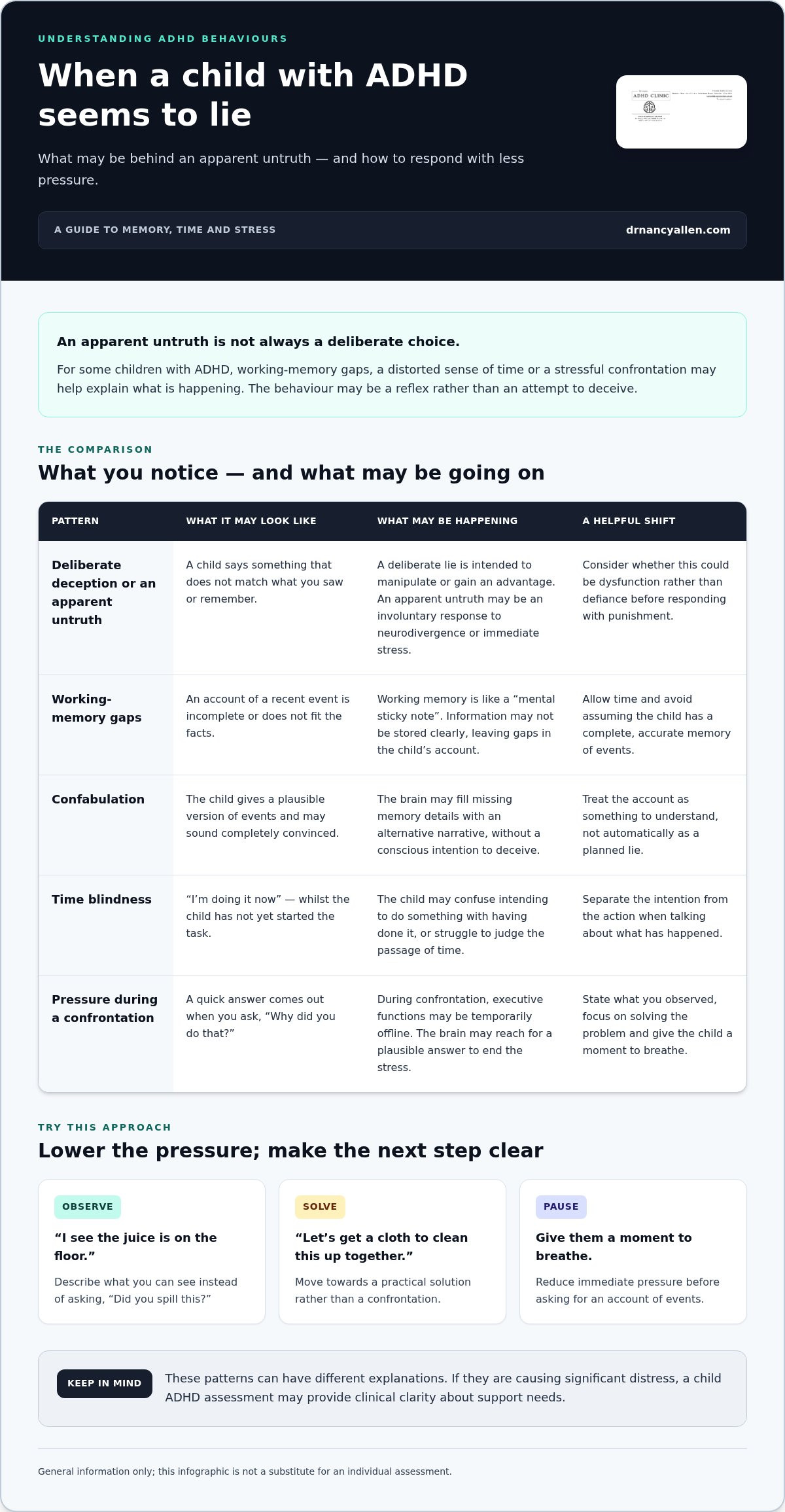
In neurotypical development, a lie is often a calculated choice. However, for a child with ADHD, an untruth is frequently a reflexive response to an immediate stressor. This is dysfunction, not defiance. Whilst some children might lie to get a reward, the ADHD brain often seeks a quick "dopamine hit" of relief from a high-pressure situation. The impulse to avoid immediate discomfort is so strong that the words leave their mouth before the truth can even register. Traditional punishments, such as grounding or taking away screens, usually fail here because the behaviour isn't a planned strategy. You cannot punish a child out of a neurological short-circuit.
Why "Why did you do that?" is the wrong question
When you ask a child "Why did you do that?", you're asking them to access executive functions that may be temporarily offline. During a confrontation, the prefrontal cortex, the brain's command centre, can effectively shut down. The child literally does not know why they acted. Their brain then provides the first plausible answer it can find to satisfy the adult and end the stress. This isn't a moral failing; it's a physiological gap. Shifting to observation-based communication helps bridge this gap. Try these approaches instead:
State the obvious: "I see the juice is on the floor," rather than "Did you spill this?"
Focus on the solution: "Let's get a cloth to clean this up together."
Reduce the pressure: Give them a moment to breathe before asking for an account of events.
By moving towards observation, you allow the child to engage with reality without the immediate need for a defensive shield. This approach fosters a collaborative environment where the truth feels safe to express.
The medical reality: Working memory deficits and confabulation
To understand why these untruths occur, we must look at the brain's executive functions, specifically working memory. Think of working memory as a "mental sticky note" that holds onto information long enough for us to use it. In children with ADHD, this sticky note often lacks adhesive. Information enters the brain but isn't stored correctly, leaving significant gaps in their narrative of recent events. This is the surprising reason some children with ADHD appear to lie even when they don't mean to; they are simply trying to navigate a world where their "mental notes" have gone missing.
When a child is asked about something they don't fully remember, their brain treats the missing information as a problem to be solved. Instead of admitting they don't know, which can feel vulnerable or confusing, the brain performs a protective neurological reflex. It overwrites the actual event with a plausible alternative. This process ensures the child feels a sense of continuity, even if the resulting "truth" doesn't match reality. If you find these patterns are causing significant distress, a child ADHD assessment can provide the clinical clarity needed to support your family.
Confabulation: When the brain fills in the blanks
Confabulation is a neurobiological phenomenon where the brain fabricates memories to fill in gaps without the conscious intention to deceive. It's an automatic response. The child isn't choosing to lie. Instead, their brain is providing a narrative to make sense of a fragmented experience. You might compare the ADHD brain to a computer with a corrupted save file. When the system tries to open the file, it fills the missing data points with whatever logic it can find. Because this happens at a subconscious level, the child often believes their own "lie" with absolute conviction. They aren't being stubborn; they are reporting what their brain has told them is true.
Time blindness and the "I haven't done it yet" lie
A distorted sense of time, often called time blindness, frequently leads to apparent lying. Children with ADHD often struggle to perceive the passage of time or sequence tasks effectively. When you ask if they've brushed their teeth, they might say "I'm doing it now" whilst still sitting on their bed. In their mind, they have already started the mental process of the task, and their brain has failed to distinguish between the intention and the action. They believe they have more time than they truly do, leading to fabrications about their progress that feel like blatant lies to a parent but feel like reality to the child.
Impulsivity and the "Flight or Fib" response
Whilst working memory gaps explain many untruths, impulsivity drives a different type of "apparent lying." This is the "Impulse-Lie-Regret" cycle. In this scenario, a child doesn't have time to weigh the consequences of their words. The "no" or the "it wasn't me" leaves their mouth before the logical part of their brain has even processed the question. This is a primary component of the surprising reason some children with ADHD appear to lie even when they don't mean to; their verbal response system is simply faster than their cognitive filter.
When a child is confronted with a mistake, their amygdala, the brain's emotional alarm system, often perceives the situation as a threat. This triggers a "flight or fib" response. To the child, the lie is not a moral choice but a survival tool used to escape immediate discomfort. This often overlaps with "Magical Thinking," where the child desperately hopes that by denying the event, they can somehow make the mistake disappear. They aren't trying to trick you as much as they are trying to wish a better reality into existence.
The "I didn't do it" reflex
The "I didn't do it" reflex is a split-second reaction designed to avoid immediate negative stimulation, such as a parent's disappointment or an impending sanction. Even when presented with clear evidence, like a broken vase at their feet, a child might stubbornly hold onto the lie. This isn't necessarily defiance. Once the lie is spoken, a "shame spiral" often takes hold. The child feels the weight of the initial mistake compounded by the weight of the lie; the internal pressure becomes so great that they cannot find a safe way to retract their statement without losing face entirely.
Emotional dysregulation and defensive lying
Intense emotions can make it physically impossible for a child to access their logical, truth-telling brain. When a child is dysregulated, their prefrontal cortex is effectively offline, leaving the emotional brain in charge. This is often linked to Rejection Sensitive Dysphoria (RSD), a common experience amongst neurodivergent individuals where the perceived pain of being "bad" or "wrong" feels almost physically unbearable. To avoid this crushing sense of rejection, the brain defaults to defensive lying. Lowering the emotional temperature of the household is essential here. By reducing the perceived threat of a mistake, you make it safer for the child's logical brain to remain engaged, eventually reducing the need for these reflexive, defensive untruths.
Practical strategies to organise a shame-free home
Once we accept that these untruths are often neurological rather than moral, we can pivot our parenting strategy. Instead of punishing a symptom, we begin to support the system. The surprising reason some children with ADHD appear to lie even when they don't mean to is frequently a lack of executive scaffolding. By building this scaffolding ourselves, we move away from a punitive model and towards restorative justice, where the focus is on making things right rather than assigning blame. This shift reduces the child's internal pressure and, consequently, the need for defensive fabrications.
Visual prompts and checklists are essential tools in a shame-free home. Since working memory acts like a "mental sticky note" that often fails, physical sticky notes or digital checklists can take over that burden. When a child can see a list of morning tasks on the bathroom mirror, they don't have to guess or confabulate an answer when asked if they are ready. They have the data right in front of them. If you feel your family needs more tailored support to manage these dynamics, you can book a child ADHD assessment to gain professional clarity.
The "No-Interrogation" policy
One of the most effective ways to reduce apparent lying is to stop asking questions you already know the answer to. When you see a wet patch on the carpet and ask, "Did you spill this?", you are inadvertently setting a trap for an impulsive brain. The "no" will likely be out of their mouth before they've even looked at the floor. Instead, use observation-based communication. Try saying, "I see there's a spill on the carpet; let's get the towels and clean it up together." By removing the opportunity to lie, you remove the habit and the shame that follows.
Creating a "Truth Pass" system
Honesty requires significant courage for a neurodivergent child who is used to getting things "wrong." A "Truth Pass" system actively rewards this bravery. It signals to the child that the relationship is more important than the mistake. You can implement this system today using these three steps:
Define the rule: Tell your child that if they come to you and admit a mistake before you discover it, the usual consequence will be halved or completely removed.
Praise the bravery: When they do tell the truth, your first words should always be, "Thank you for being so brave and telling me the truth." This reinforces the positive behaviour.
Focus on restoration: Instead of asking "why," ask "how can we fix this?". This teaches problem-solving skills whilst bypassing the shame-driven need to hide the truth.
This collaborative approach fosters an environment where the truth feels safe. Over time, as the child realizes that mistakes don't lead to a "shame spiral," the neurological reflex to lie begins to fade, replaced by a sense of security and trust.
Seeking clarity through a private child ADHD assessment
Understanding the surprising reason some children with ADHD appear to lie even when they don't mean to is often the first step towards healing the parent-child bond. However, moving from suspicion to certainty requires a clinical framework. A formal diagnosis serves as a "user manual" for your child's brain, allowing you to move beyond guesswork and into a space of targeted support. Dr Nancy Allen brings over 25 years of clinical experience to this process, offering a path that prioritises both medical precision and deep-seated empathy.
Choosing a private assessment provides the speed and specialist validation that families often desperately need whilst navigating the complexities of the UK healthcare landscape. It's a way to bypass the anxiety of long waiting lists and gain immediate insight into your child's neurodivergent profile. This isn't about applying a restrictive label; it's about opening doors to personalised treatment plans that restore confidence for the whole family. By identifying the specific executive function deficits at play, we can replace the exhaustion of "detective work" with a clear, evidence-based strategy.
Appointments are often available within days.
The journey to clarity is designed to be as unhurried and supportive as a traditional consultation, yet it utilises secure online technology to reach families across the UK. Dr Nancy Allen offers secure online and in-person consultations, with appointments often available within days. To prepare, parents are encouraged to gather school reports and a detailed developmental history, which help form a complete picture of the child's unique challenges. This evidence-based approach ensures that the surprising reason some children with ADHD appear to lie even when they don't mean to is fully explored within the context of your child's specific neurological profile.
Personalised management and support
Once a diagnosis is confirmed, the focus shifts to restoration and practical implementation. You'll receive a personalised management plan that can be shared with schools to secure the necessary adjustments and support. It's also common for parents to recognise their own traits whilst learning about their child's neurodiversity. If you find yourself identifying with the struggles of working memory or impulsivity, you may find value in exploring an Adult ADHD Assessment to gain your own sense of clarity. Remember, you aren't a "bad parent," and your child isn't "bad." You are simply a family learning to navigate a different kind of brain architecture together, and professional support is the steady hand that guides you toward a more harmonious home life.
Moving from frustration to family clarity
Understanding that your child's untruths are often a neurological survival mechanism rather than a character flaw is the first step toward restoring peace in your home. By recognising the surprising reason some children with ADHD appear to lie even when they don't mean to, you can replace the exhaustion of constant detective work with collaborative, evidence-based support. Transitioning from punitive measures to strategies like the "Truth Pass" allows your child to feel safe enough to be honest, protecting the vital bond you share. Gaining a deeper perspective on these dynamics often requires practical, real-world insights, such as those found in Dr. Grant Johnson - Common Sense Psychology for Everyday Living, which offers story-driven psychological guidance to help parents understand the "why" behind behaviour and navigate daily life with more confidence.
If you're ready to move beyond the guesswork and gain a professional "user manual" for your child's brain, specialist help is available. Dr Nancy Allen, a specialist GP with over 25 years of clinical experience, offers secure and compassionate online consultations nationwide. Appointments are often available within days. Book a private child ADHD assessment with Dr Nancy Allen today and begin this new chapter with confidence. You aren't alone in this journey, and a brighter, more connected future is within reach.
Frequently Asked Questions
Is lying a symptom of ADHD in children?
Lying is not a primary diagnostic symptom of ADHD, but it's a very frequent secondary behaviour driven by executive function challenges. Children don't usually tell untruths because of a character flaw; they do so because of impulsivity or memory gaps. Understanding this distinction helps parents move from a place of anger to one of empathy whilst seeking the appropriate clinical support for their child's neurodivergence.
Why does my child with ADHD lie about things that are obviously true?
Your child likely lies about obvious truths because their brain is prioritising immediate emotional safety over factual accuracy. When faced with a mistake or a confrontation, the "flight or fib" response kicks in to avoid the perceived pain of disappointment. They might also be experiencing confabulation, where the brain fills in memory gaps with a plausible narrative that the child genuinely believes to be true in that moment.
What is the "surprising reason" for ADHD lying mentioned in clinical studies?
The surprising reason some children with ADHD appear to lie even when they don't mean to is often rooted in significant working memory deficits. Clinical insights show that when a child's "mental sticky note" fails, their brain automatically generates a narrative to fill the gap. This neurological reflex ensures they feel a sense of continuity and logic, even if the information they provide doesn't match the reality of the situation.
How should I punish my ADHD child for lying without making it worse?
Traditional punitive measures often backfire because they increase the intense shame that triggers defensive lying. Instead of focusing on punishment, lean towards restorative justice and the "Second Chance" rule. Encourage your child to "rewind" the conversation and tell the truth without fear of an immediate penalty. This approach lowers the emotional temperature and makes it much safer for them to be honest in the future.
Can ADHD medication help reduce frequent lying or untruths?
ADHD medication can often reduce the frequency of untruths by improving impulse control and executive function. When a child's brain is better regulated, they are less likely to experience the split-second "fib" reflex. Whilst medication isn't a "truth serum," it helps the prefrontal cortex stay engaged during stressful moments. This allows the child to process the actual truth before their mouth has a chance to speak.
What is confabulation and how does it relate to neurodiversity?
Confabulation is an involuntary neurobiological process where the brain creates false memories to fill in gaps caused by working memory failure. In the context of neurodiversity, it's a common coping mechanism for an ADHD brain that struggles to sequence events or retain instructions. The child isn't choosing to deceive you; their brain is simply providing the most logical narrative it can find to make sense of a fragmented memory.
How do I know if my child is lying on purpose or because of their ADHD?
Distinguishing between intentional deception and ADHD-driven "apparent lying" involves looking closely at the intent and the potential gain. Intentional lies are usually calculated to gain a specific advantage or manipulate a situation. ADHD-driven untruths are often reflexive, illogical, or told in situations where the child has nothing to gain. If the lie seems impulsive or covers a clear memory gap, it's likely a symptom of their neurodivergence.
When should I seek a professional ADHD assessment for my child's behaviour?
You should seek a professional assessment when untruths and impulsive behaviours begin to damage the parent-child bond or impact your child's social and academic life. A formal diagnosis provides the clinical clarity needed to understand the surprising reason some children with ADHD appear to lie even when they don't mean to. Early intervention with a specialist provides your family with a tailored "user manual" for your child's unique brain architecture.



Comments