


Why ADHD Makes Your House a Mess: Executive Dysfunction

Updated: 2 hours ago
You stand in the middle of your kitchen, surrounded by half-finished cups of tea, unopened mail, and laundry that has been sitting in the machine for three days. It feels like a personal failure, a character flaw that you simply cannot "tidy away" no matter how many planners you buy. You find yourself searching for answers as to why my house is a hot mess in adhd, wondering why the simple act of putting an object back in its place feels like climbing a mountain. This isn't a lack of discipline; it's a direct result of how your brain is wired to process information and prioritise tasks.
We understand the exhausting weight of "house-proud" guilt and the sensory overload that comes from living amongst constant clutter. This article explores the neurological reality of executive dysfunction, explaining how ADHD affects your ability to organise and maintain your environment. You'll learn how to transition from a cycle of chronic shame to a mindset of self-compassionate organisation. We will also provide practical, neurodivergent-friendly strategies to help you reclaim your space and outline how a professional diagnosis can provide the clarity you need to move forward with confidence.
Table of Contents
Why Your 'Hot Mess' House is a Symptom of ADHD Executive Dysfunction
When you look at your home and wonder why my house is a hot mess in adhd, you aren't looking at a lack of willpower or a character flaw. You're looking at a breakdown of the brain's "CEO" functions. Think of your brain's executive functions as a high-level manager responsible for delegating tasks and managing resources. In an ADHD brain, this CEO is often overwhelmed and fails to delegate effectively, leaving the "employees" confused and the "office" in total disarray. This biological reality, known as Executive Dysfunction, acts as a persistent barrier to the organisation most people take for granted.
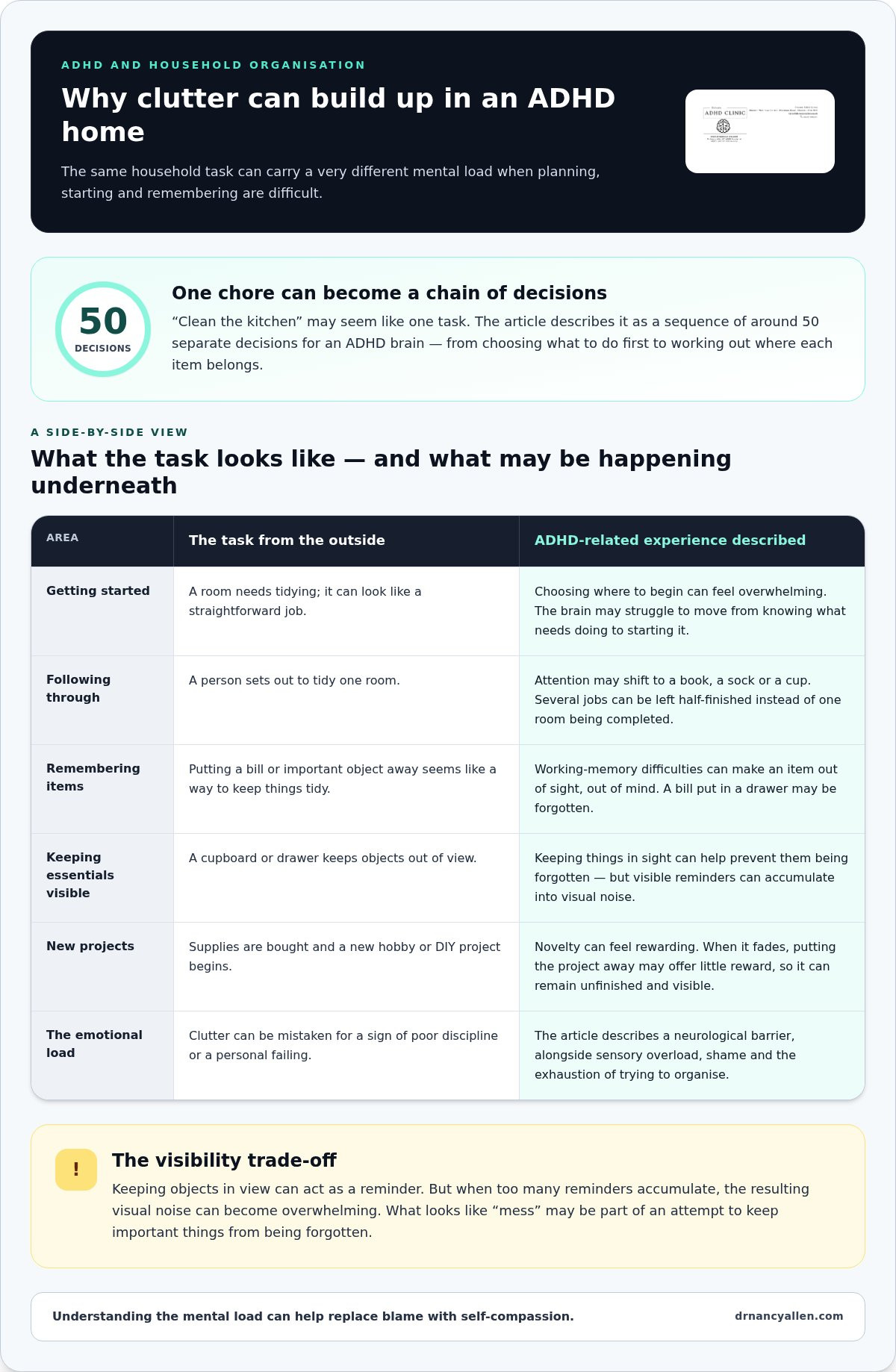
To most people, "cleaning the kitchen" is a single task. To an ADHD brain, it is a chaotic sequence of fifty separate decisions. Should you do the dishes first, or clear the table? Where does this random piece of post go? Because these mundane chores offer zero dopamine reward, the brain struggles to find the "fuel" needed to initiate them. Whilst a neurotypical person might leave a mess because they are busy, someone with ADHD is often frozen by paralysis, unable to choose where to begin amongst the clutter. This is a primary reason why my house is a hot mess in adhd; it is a neurological disconnect between knowing what needs to be done and being able to physically start it.
To better understand how these neurological challenges manifest in daily life, watch this helpful video:
The Breakdown of Task Initiation and Follow-Through
Starting a chore often feels like facing a "wall of awful," a psychological barrier built from past failures and current anxiety. You might walk into a room to tidy, only to get distracted by a book, then a stray sock, and finally a half-empty coffee cup. You end up with several half-finished projects rather than one clean room. Executive dysfunction is a biological barrier to organisation that impairs the brain's self-regulation system. This makes the transition from "thinking" to "doing" feel physically exhausting, often leading to total task avoidance as a coping mechanism. To help navigate these challenges, learn more about Collins Psychology and their structured therapy programs for adults with ADHD.
Working Memory and the 'Out of Sight, Out of Mind' Trap
Many people with ADHD rely on "DOOM" piles, which stands for "Don't Organise, Often Money." These piles exist because of significant challenges with working memory. If you put a bill in a drawer, your brain may genuinely forget it exists, leading to missed payments and financial stress. Tidying often feels risky because "putting things away" is synonymous with losing them forever. This creates a cycle where clutter becomes a visual reminder of things you mustn't forget, even whilst the resulting "visual noise" creates sensory overload and deep-seated shame.
The ADHD Brain: Object Permanence, Dopamine, and Clutter
The struggle to maintain an organised home often stems from a specific neurological quirk known as "out of sight, out of mind." Whilst infants develop object permanence early in life, many adults with ADHD struggle with object constancy. This is the ability to maintain a mental representation of an item once it is no longer in your direct line of sight. If you put your car keys in a decorative bowl inside a cupboard, your brain may genuinely stop registering their existence. This leads to a survival strategy where everything must remain visible, creating a landscape of "visual noise" that eventually becomes a background hum you can no longer see. It's a key reason behind the question of why my house is a hot mess in adhd; your brain is trying to prevent you from losing your life's essentials by keeping them in plain view.
Dopamine also plays a central role in the accumulation of clutter. The ADHD brain is constantly seeking a hit of this reward chemical, which is why starting a new hobby or DIY project feels so exhilarating. You buy the supplies, set them out on the dining table, and dive in. However, once the initial novelty wears off, the dopamine supply dries up. Putting the project away offers no neurological reward, so the half-finished craft or dismantled appliance remains on the table for weeks. Over time, this physical clutter leads to sensory overstimulation, contributing to irritability and eventual ADHD burnout. If you find these patterns are impacting your quality of life, a private ADHD assessment can provide the clinical clarity needed to manage these symptoms effectively.
The 'Doom Pile' Phenomenon Explained
Many people with ADHD rely on "Doom Piles" (Don't Organise, Often Money). These aren't just random heaps of rubbish; they are often a collection of items you didn't know how to categorise in the moment. Because traditional filing systems feel too restrictive or invisible, you create a pile that acts as a physical bookmark. However, these piles carry a heavy emotional weight. Every time you walk past one, it triggers a micro-dose of shame and avoidance behaviour. This is where the "ADHD tax" accumulates, as lost bills, expired vouchers, or misplaced library books result in actual financial loss.
Hyperfocus and the 'All-or-Nothing' Cleaning Cycle
Household management for the neurodivergent brain often follows an "all-or-nothing" pattern. You might find yourself unable to wash a single plate for days, only to suddenly spend six hours in a state of hyperfocus deep-cleaning the grout in the bathroom with a toothbrush. Whilst productive in the moment, this "burn and crash" cycle is unsustainable. The intense mental and physical exertion of a hyperfocused cleaning binge often leaves you completely depleted, making it impossible to maintain basic daily habits for the rest of the week.
Why the Mess Gets Worse: The ADHD-Menopause Overlap
For many women, the sudden realisation of "why my house is a hot mess in adhd" only occurs during the transition into perimenopause. This isn't a coincidence; it is rooted in the complex interplay between sex hormones and neurotransmitters. Oestrogen plays a vital role in the production and regulation of dopamine, the very chemical that the ADHD brain lacks. As oestrogen levels begin to fluctuate and eventually decline, dopamine production often follows suit. This creates a neurological deficit that makes previously manageable household tasks feel insurmountable.
A 2025 study highlighted that women with ADHD are nearly twice as likely to experience perimenopausal symptoms compared to those without the condition, with 54% reporting significant issues. Amongst these women, 59% experienced psychological symptoms like anxiety and low mood. When you combine these hormonal shifts with the peak responsibilities of midlife, such as managing a career and a family, you face a "perfect storm." The cognitive load becomes too heavy to carry, and the domestic environment is often the first thing to suffer. This period frequently reveals a lifetime of "masking," where you worked twice as hard as others to appear organised, only for that facade to crumble under hormonal pressure.
Brain Fog and Executive Function in Midlife
The cognitive impairment often described as "brain fog" is a hallmark menopause symptom that directly compounds existing ADHD traits. If your executive function was already strained, the addition of midlife forgetfulness can make the simplest organisation system fail. You may find that your favourite coping mechanisms, like using high-pressure deadlines to motivate a cleaning binge, no longer work because the associated fatigue is too great. This loss of control over your environment often leads to a resurgence of the "hot mess" narrative, but it's important to recognise this as a clinical shift rather than a personal failure.
Seeking Specialist Clinical Care
Navigating this overlap requires a nuanced, combined approach to both ADHD and hormonal health. Dr Nancy Allen brings 25 years of clinical experience to this specific intersection, offering expertise in how menopause symptoms can mimic or exacerbate ADHD. Because traditional routes can involve wait times of up to fifteen years in some parts of England as of May 2026, seeking private care is often the most efficient path to relief. Appointments are often available within days. Personalised treatment plans are essential for women in midlife to restore their confidence and regain control over their daily lives.
How to Organise for the ADHD Brain You Have
Traditional organisation advice often fails because it demands the very executive function that your brain finds most taxing. Instead of trying to force yourself into neurotypical systems, you must design an environment that accommodates your specific cognitive needs. This approach is known as low-demand living. It focuses on reducing the number of steps required to complete a chore. If a bin has a lid, that's one extra step that might prevent you from using it. If your laundry basket is in a different room from where you undress, the floor becomes the default storage. By simplifying these micro-interactions, you can reduce the mental friction that leads to the question of why my house is a hot mess in adhd.
One of the most effective strategies is the "Point of Performance" rule. This involves keeping items exactly where they are used, even if it seems unconventional. For instance, if you always open post at the kitchen island, keep a recycling bin and a letter opener right there. Similarly, visual storage is essential for managing object constancy issues. Using clear bins and open shelving ensures that items remain within your mental map. If you can't see it, it doesn't exist; therefore, opaque cupboards are often where organisation goes to die. If these structural changes feel overwhelming, consider "body doubling." This is the practice of having another person present, either physically or via video call, whilst you work. Their presence provides a gentle anchor for your focus, making it easier to stay on task. For those who may require more comprehensive assistance with household management and daily living, professional services like earthangelshomecare.ca offer a model for how dedicated in-home support can help maintain a functional living space.
In the UK, if you find that you need more hands-on assistance to keep your environment manageable, NeeryVille Care offers professional domiciliary support tailored to your specific needs; find out more about how their home help services can assist you in maintaining a functional living space.
You must stop trying to organise like your neighbours or the influencers on your social media feed. Their brains are wired differently, and their standards may not be sustainable for you. Accepting a level of "controlled chaos" is often the first step toward genuine wellbeing. Redefine what a "clean" house looks like for you. It might mean that the surfaces are clear even if the drawers are a jumble, or that the dishes are done even if the laundry isn't folded. If you're ready to stop the cycle of shame, an Adult ADHD Assessment can help you understand your brain's unique wiring and find a path forward.
Practical Strategies for Daily Success
The common mantra "don't put it down, put it away" is a myth for the ADHD brain. In reality, you often don't have the immediate executive "fuel" to decide where "away" is. Instead, use a "launch pad" near your front door for essential daily items like keys, wallets, and bags. This single, designated spot reduces the morning panic of lost items. To prevent overwhelm during larger tasks, use timers to work in short "pockets" of activity. Setting a timer for just ten minutes makes a daunting task feel manageable and prevents the "burn and crash" cycle mentioned previously. By working in these bursts, you can maintain your home without the intense exhaustion of a hyperfocused cleaning binge.
From 'Hot Mess' to Clarity: The Path to a Private ADHD Diagnosis
Whilst these self-help strategies are valuable, some individuals may benefit from professional in-home assistance; you can check out Elleson Care to see how their person-centred support services can help you maintain a functional living environment.
For many, the persistent question of why my house is a hot mess in adhd is the catalyst for seeking professional help. A formal diagnosis is far more than a label; it is the ultimate tool for self-compassion. It provides a clinical framework that reframes years of domestic struggle as a manageable medical condition rather than a character flaw. This validation is often the first step in quietening the internal critic that equates a messy kitchen with a failed life. When you understand the neurological "why" behind the clutter, you can finally stop punishing yourself for symptoms you cannot simply "will" away.
Opting for a private adhd assessment allows you to bypass the significant barriers currently present in the public healthcare system. As of May 2026, it is estimated that over 800,000 people in England are waiting for an NHS assessment, with some regions reporting delays of over a decade. In contrast, our service prioritises your need for clarity and support without the exhaustive wait. Dr Nancy Allen combines 25 years of clinical expertise with a deep understanding of how ADHD impacts daily functioning, providing a steady hand through the diagnostic process whilst ensuring you feel heard and respected.
Clinical intervention, whether through medication or tailored therapy, can specifically improve household management by addressing the dopamine deficit at the heart of executive dysfunction. When the brain's reward system is supported, the "wall of awful" that prevents you from starting a chore begins to shrink. This medical support, combined with the neurodivergent-friendly organisation strategies we have explored, creates a sustainable path toward a calmer, more functional home environment. Understanding why my house is a hot mess in adhd is the beginning of a journey towards restoration and confidence.
What to Expect During Your Consultation
The journey from "suspected ADHD" to clinical clarity is handled with the utmost sensitivity. Your online consultation is a secure, private space to discuss your history and the specific ways executive dysfunction impacts your life. Dr Nancy Allen offers secure online and in-person consultations, with appointments often available within days. This rapid turnaround is designed to reduce the anxiety of the unknown and provide an immediate, actionable path forward for your wellbeing.
Taking the First Step Towards Support
Preparing for your assessment is simple and can be done from the comfort of your own home, which is often a significant relief for those already feeling overwhelmed by life's demands. You'll receive evidence-based guidance that respects your individual experience and prioritises your long-term quality of life. Reclaiming your home starts with understanding your brain's unique wiring. Book your path to clarity today and begin the transition from a "hot mess" to a life of insight and self-compassion.
Embracing Clarity and Reclaiming Your Home
Living with the constant question of why my house is a hot mess in adhd is emotionally draining; however, the answer lies in your biology rather than your character. Your struggles with executive dysfunction, object permanence, and the added complexity of hormonal changes are clinical realities that deserve a professional response. By shifting away from neurotypical standards and adopting strategies that work with your brain, you can begin to reduce the sensory overload and shame that clutter creates.
Professional support is the most effective way to transition from overwhelm to sustainable organisation. Dr Nancy Allen offers secure, compassionate online consultations with specialist expertise in the ADHD and menopause overlap. You don't have to wait years for answers. Appointments are often available within days. Book your private ADHD assessment with Dr Nancy Allen today and take the first step towards a calmer, more predictable life. You deserve a home that feels like a sanctuary rather than a source of stress.
Frequently Asked Questions
Is a messy house always a sign of ADHD?
No, a messy home is not always an indicator of ADHD. Clutter can result from various factors, such as a busy lifestyle, depression, or temporary stress. However, when messiness is chronic and accompanied by a struggle to start or finish tasks despite a strong desire to do so, it may be a symptom of executive dysfunction. A professional assessment is the only way to determine if your environment reflects a neurological condition.
Why do I feel so much shame about my messy home?
Shame often stems from internalising societal expectations that equate a tidy house with moral character and competence. When you live with ADHD, you might feel like a failure because "simple" chores feel impossible. This chronic guilt is often exacerbated by comparing your internal struggle to the curated lives of others. Recognising that your mess is a neurological symptom, not a character flaw, is the first step toward self-compassion and recovery.
Can ADHD medication help me keep my house cleaner?
Medication can significantly improve your ability to maintain an organised home by regulating dopamine and enhancing focus. It often reduces the "activation energy" required to start mundane tasks like folding laundry or washing up. Whilst it isn't a "cleaning pill," it provides the neurological support needed to follow through on organisation systems. Many find that medication helps them finally understand why my house is a hot mess in adhd and manage it better.
What is 'ADHD paralysis' and how does it affect cleaning?
ADHD paralysis occurs when you feel completely frozen by the sheer volume of tasks or decisions required to start tidying. Your brain perceives a cluttered room as one massive, undifferentiated project rather than a series of small, manageable steps. This cognitive overload leads to a state of shut down. You might spend hours sitting amongst the mess, wanting to move but physically unable to decide which single item to pick up first.
How does menopause make ADHD messiness worse?
Declining oestrogen levels during perimenopause directly impact dopamine production, which often causes ADHD symptoms to intensify. This hormonal shift introduces "brain fog," making it even harder to remember where items belong or to initiate domestic chores. If you have spent years "masking" your symptoms to keep a tidy house, the menopause transition can make those old coping strategies feel suddenly ineffective. This often leads to increased disarray and a feeling of losing control.
What are 'doom piles' and why do I make them?
"Doom piles" stand for "Don't Organise, Often Money." They are a common strategy for handling items when you're undecided on their permanent home. You create these piles because your brain prefers to keep items visible rather than "losing" them in a drawer or cupboard. Whilst they provide a temporary sense of order, they often become permanent fixtures that contribute to visual noise. These piles frequently contain important documents, which can lead to missed bills or financial costs.
How can I explain my ADHD messiness to my partner or family?
Use the "CEO of the brain" analogy to explain that your messiness is a result of executive dysfunction rather than a lack of care. Explain that whilst you value a tidy home, your brain struggles with the complex, multi-step process of organisation. Sharing clinical insights into why my house is a hot mess in adhd can help them understand that your environment is a map of your cognitive challenges. Emphasise that you need collaboration, not criticism.
What is the fastest way to get an ADHD diagnosis in the UK?
Seeking a private assessment is currently the most efficient route to clarity in the UK. Whilst NHS wait times can extend to several years in many regions, private providers offer a much faster alternative. Appointments are often available within days. This rapid access allows you to move from a state of overwhelmed confusion to professional support and tailored care.



Comments