


How to Use AI as Your ADHD Second Brain

Updated: 2 hours ago
What if the persistent "ADHD tax" on your time and energy wasn't an inevitable part of your life, but a challenge you could outsource to a digital partner? For many adults living with ADHD, the struggle with executive dysfunction often leads to a cycle of task paralysis and profound mental fatigue. It often feels as though your mind is attempting to process a vast amount of data without a reliable central filing system. Stop using AI like Google. Start using it as your ADHD second brain.
We understand that managing a neurodivergent mind in a fast-paced environment is a significant undertaking, particularly when global estimates suggest up to 85% of adults with ADHD remain undiagnosed. This article will show you how to transform tools like GPT-5.6 from simple search engines into powerful cognitive prosthetics that organise your thoughts and manage your daily schedule. You will discover practical ways to externalise your working memory and reduce the cognitive load that leads to burnout. We will explore how to build a personalised system that provides the clarity and control you need to thrive in both your professional and personal life.
Table of Contents
The Paradigm Shift: Why AI is a Cognitive Prosthetic, Not a Search Engine
Overcoming Executive Dysfunction: How AI Acts as Your External Frontal Lobe
Practical Frameworks: Prompting Strategies to Organise Your ADHD Mind
Beyond Productivity: Using AI to Reduce the 'ADHD Tax' and Emotional Labour
Integrating Technology with Clinical Support: The Path to Sustainable ADHD Management
The Paradigm Shift: Why AI is a Cognitive Prosthetic, Not a Search Engine
The way we interact with technology often dictates our mental energy levels. For those with neurodivergent minds, the traditional method of seeking information can be a source of significant exhaustion. Stop using AI like Google. Start using it as your ADHD second brain. While a search engine requires you to filter, rank, and synthesise disparate pieces of data, a "Second Brain" partnership allows the technology to do the heavy lifting of organisation. This shift isn't just about efficiency; it's about preserving your cognitive battery for the things that actually matter.
For individuals experiencing Executive dysfunction, the internal mechanisms for planning and working memory often feel overstretched. Think of AI not as a library, but as a cognitive prosthetic. Just as a physical prosthetic restores mobility, a cognitive one restores the ability to process and structure information without the usual mental friction. An ADHD Second Brain is an external system that handles the "how" so the brain can focus on the "what".
The Problem with Using AI Like Google
Traditional search engines are designed for discovery, but for the ADHD brain, they are often gateways to the "rabbit hole" effect. When you search for a simple solution, you're often presented with a wall of links. Each one requires a micro-decision: Is this relevant? Is it trustworthy? This constant evaluation drains your limited executive function before you've even started the task at hand. The friction of navigating multiple tabs can lead to task paralysis before you've found a single answer.
AI synthesis changes this dynamic entirely. Instead of giving you ten websites to read and compare, it processes vast amounts of information and provides a coherent, singular response. This reduces the cognitive load by removing the need to navigate through distracting adverts and irrelevant side-topics, allowing you to stay focused on your original intent.
Building a Partnership with Your LLM
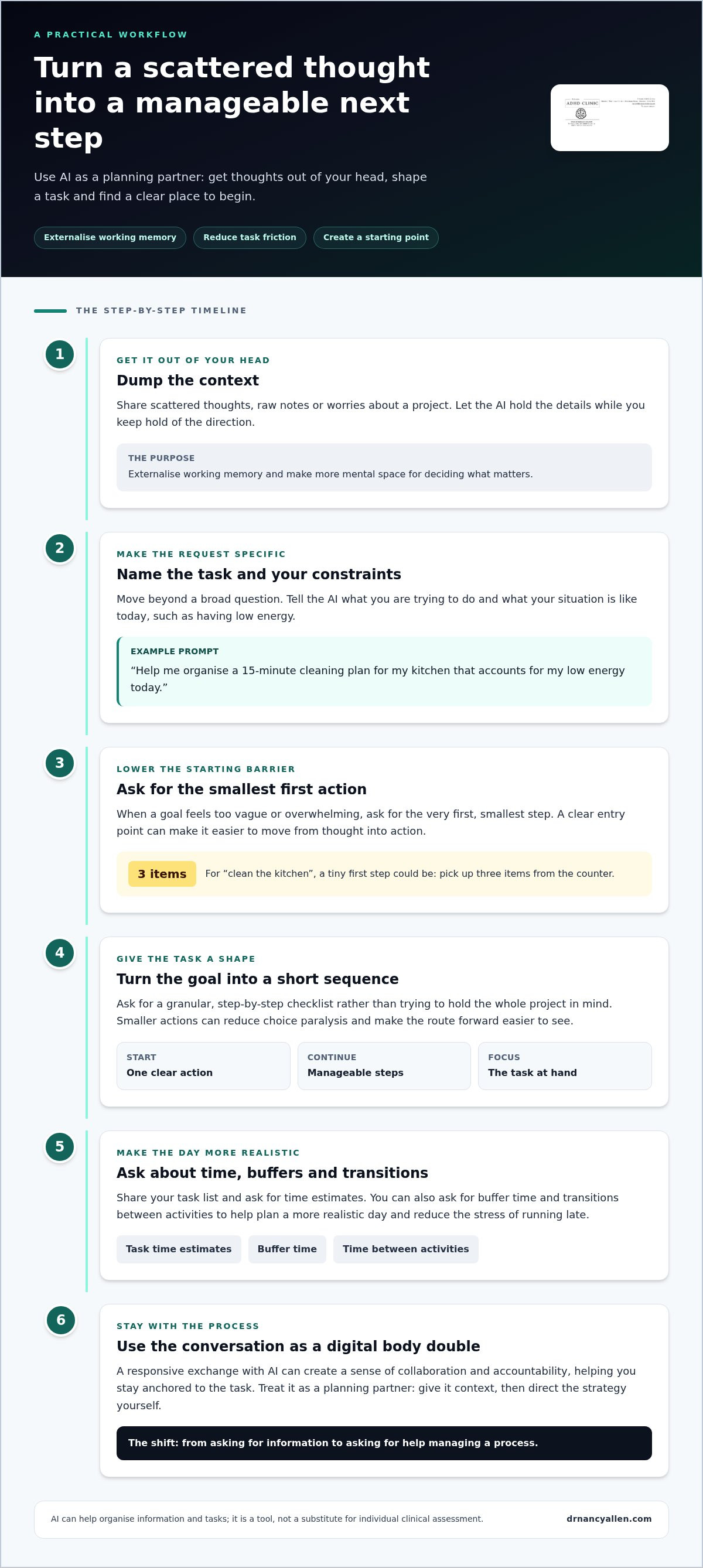
To truly benefit, you should view your Large Language Model (LLM) as a collaborative intern rather than a static encyclopaedia. An intern needs context to be useful. By "context-dumping"-sharing your scattered thoughts, worries about a project, or raw notes-you clear mental space. This externalises your working memory, letting the AI hold the details whilst you direct the strategy.
The shift in your results comes from changing your prompts. Move away from "What is the best way to clean a kitchen?" and towards "Help me organise a 15-minute cleaning plan for my kitchen that accounts for my low energy today." This transition from information seeking to process management is the core of the partnership. It turns a tool into a teammate that understands your specific needs and constraints.
Overcoming Executive Dysfunction: How AI Acts as Your External Frontal Lobe
The frontal lobe serves as the command centre of the brain, managing the complex "CEO" functions required for daily life. For those with ADHD, this centre can often feel under-resourced, leading to significant struggles with planning and organisation. Stop using AI like Google. Start using it as your ADHD second brain. By treating the interface as an external frontal lobe, you can delegate the heavy lifting of structure to a system that doesn't experience fatigue or distraction.
The conversational nature of modern AI provides a unique form of digital "body doubling". This technique traditionally involves having another person present to help maintain focus; interacting with a responsive AI can trigger a similar sense of accountability. It creates a collaborative environment where you aren't alone with your thoughts, making it easier to stay anchored to the task at hand.
Task paralysis, often called the "Wall of Awful", occurs when the emotional weight of a project becomes insurmountable. Given that an estimated 51.2% of adults with ADHD also experience an anxiety disorder, the fear of failing a task can be as debilitating as the task itself. AI reduces the activation energy required to start a task by providing a clear, low-friction entry point that bypasses the initial mental block. This technology offers essential support for managing executive functions, allowing you to move from stagnant thought into active movement.
Breaking Down Overwhelming Tasks
Vague goals like "clean the kitchen" are recipes for paralysis because they lack a clear starting point. AI can transform these into granular, step-by-step checklists that your brain can actually process. Using a "Micro-Tasking" approach, you can ask the AI for the very first, smallest step, such as "pick up three items from the counter." This eliminates choice paralysis and provides a manageable path forward that feels achievable rather than daunting.
Managing Time Blindness with Digital Assistance
Time blindness makes it difficult to gauge how long a project will take, often leading to over-commitment and subsequent burnout. You can ask AI to estimate time requirements for specific task lists, helping you build a realistic day. It can also suggest "buffer time" and transitions between activities to prevent the stress of running late. Prioritising tasks based on urgency versus importance becomes much simpler when an external system helps you visualise your schedule. Whilst these digital tools are invaluable, they are most effective when paired with clinical insight. A formal Adult ADHD Assessment can provide the necessary clarity to tailor these systems to your specific neurobiological needs.
Practical Frameworks: Prompting Strategies to Organise Your ADHD Mind
The effectiveness of any cognitive tool depends on how you interface with it. Stop using AI like Google. Start using it as your ADHD second brain by adopting structured frameworks that eliminate the guesswork of interaction. One of the most effective methods for neurodivergent users is the "Context-Task-Format" (CTF) framework. Instead of a vague query, you provide the background, the specific requirement, and the desired structure. This clarity reduces the mental friction of interpreting a response that doesn't quite fit your needs.
Prompt engineering for ADHD is about more than just getting the right answer; it's about reducing the cognitive load of the interaction itself. You can use AI to "translate" complex, wordy instructions from a manager or a client into a neurodivergent-friendly format. By asking the AI to "rewrite this email as a concise, numbered list of actions," you bypass the overwhelm of dense paragraphs. This allows you to focus your energy on the execution of tasks rather than the struggle of deciphering them.
The Brain Dump and Distil Method
ADHD often involves a "mental logjam" where too many ideas compete for attention simultaneously. The Brain Dump and Distil method provides an immediate release for this pressure. First, use voice-to-text to dump all your thoughts, worries, and half-formed ideas into the AI without any filter or concern for grammar. Once the mental clutter is externalised, ask the AI to identify the three most important actions from the text. Finally, request a brief summary of the remaining non-essential information to be stored for later, ensuring nothing is lost whilst keeping your immediate focus sharp.
Creating a Custom ADHD Instructions Set
Most AI platforms now allow you to set "Custom Instructions" that apply to every conversation. This is a powerful way to ensure the system always meets your cognitive needs without you having to repeat yourself. You might direct the AI to always provide concise, bulleted responses and to avoid long, flowery introductions. It's also helpful to request a supportive, non-judgemental tone to help manage the emotional sensitivity often associated with ADHD. Perhaps most importantly, you can instruct the AI to ask you only one clarifying question at a time. This prevents the "wall of text" effect and keeps the dialogue manageable, mirroring the pace of a steady, unhurried consultation.
Beyond Productivity: Using AI to Reduce the 'ADHD Tax' and Emotional Labour
Many individuals living with ADHD are familiar with the "ADHD tax", which refers to the financial and emotional cost of forgotten subscriptions, late payment fees, and wasted groceries. These costs are rarely just about money; they represent a significant drain on your mental energy and self-esteem. Stop using AI like Google. Start using it as your ADHD second brain to reclaim the hours and money lost to disorganisation. By delegating these repetitive, high-friction tasks to an AI, you reduce the decision fatigue that often leads to burnout.
Beyond logistics, AI can serve as a non-judgemental mirror for emotional processing, allowing you to articulate frustrations or anxieties in a safe, private space. When your internal dialogue becomes overwhelming, externalising those feelings to a responsive system can provide the distance needed to gain perspective. If the cumulative weight of the ADHD tax is affecting your quality of life, a professional Adult ADHD Assessment can help you identify the underlying patterns and build a more sustainable path forward.
Automating the Mundane to Save Mental Energy
Everyday admin often feels like an insurmountable hurdle for the neurodivergent mind. AI can automate these mundane tasks by drafting emails for service cancellations or managing your calendar with context-aware reminders. For instance, you can use AI to generate a bespoke meal plan and grocery list based entirely on the ingredients already in your fridge, eliminating the "what's for dinner?" decision loop. This type of proactive support ensures that your mental energy is reserved for more meaningful pursuits.
Social and Emotional Support Scripts
Navigating social nuances and setting boundaries can be exhausting. You can ask an AI to "tone-check" your communications, ensuring that a sensitive email sounds professional yet warm. It can also help you draft scripts for difficult conversations with friends or colleagues, providing a scaffold for your thoughts. To maintain motivation, you might even ask the AI to "gamify" a boring chore by creating a points-based system or a narrative quest. This turns a low-dopamine task into a more engaging experience, helping you overcome the initial resistance to start.
Integrating Technology with Clinical Support: The Path to Sustainable ADHD Management
Whilst digital tools provide an incredible level of support, they are most effective when they sit within a broader framework of professional clinical care. Stop using AI like Google. Start using it as your ADHD second brain, but remember that technology is a supplement to, not a replacement for, clinical insight. A formal diagnosis provides the "user manual" for your specific mind, allowing you to move from generic productivity tips to strategies that actually respect your unique neurobiology. This foundation of clarity is what makes technological adjustments sustainable in the long term.
Building an "AI Second Brain" is a significant step toward neurodivergent self-acceptance. It represents a shift from trying to "fix" your brain to instead partnering with systems that support your strengths. When you stop fighting against your executive dysfunction and start externalising your cognitive load, you create space for the creativity and insight that often accompany ADHD. This journey is about more than just task completion; it is about restoring your confidence and quality of life.
To support this journey, the Achieve With Nate Movement provides personalised digital confidence coaching and technology training, helping you to build and maintain the systems that work best for your unique neurodivergent profile.
Why an Expert Assessment is the First Step
Understanding your unique neurodivergent profile is essential for moving beyond generic symptoms. A private adhd assessment can provide clarity, with appointments often available within days. This professional validation is the difference between simply "hacking" your brain with the latest app and actually treating a recognised medical condition. An expert assessment identifies the specific areas where your executive functions need the most support, allowing you to tailor your AI systems with precision.
Creating a Holistic ADHD Management Plan
The most successful management plans combine medication, therapy, and technological tools for maximum efficacy. For many, especially women, it is also vital to consider the overlap between ADHD and hormonal health. Dr Nancy Allen specialises in the complex relationship between ADHD and the perimenopause or menopause, ensuring that your care is personalised and holistic. By addressing these biological factors alongside your "Second Brain" systems, you build a comprehensive strategy for well-being.
Dr Nancy Allen brings 25 years of clinical experience to help patients navigate this path. By providing a steady hand and an evidence-based approach, she supports you in building a clear, manageable future. Technology might provide the tools, but a collaborative relationship with a seasoned professional provides the map. This integrated approach ensures that you aren't just managing symptoms, but truly thriving with a brain that is finally understood and properly supported.
Embracing a New Partnership with Your Neurodivergent Mind
Transforming your relationship with technology is about more than just productivity; it's about reclaiming the mental space that executive dysfunction often occupies. By moving from a search-based mindset to a collaborative partnership, you can externalise your working memory and significantly reduce the daily friction of the "ADHD tax". Stop using AI like Google. Start using it as your ADHD second brain. This shift allows you to focus on your creative strengths whilst a digital prosthetic handles the logistical heavy lifting.
True clarity begins with a deep understanding of your unique neurobiology. A professional diagnosis provides the essential foundation for any management system you build. If you're ready to move beyond simple "brain hacks" and toward sustainable, personalised support, book a private ADHD assessment with Dr Nancy Allen to start your journey to clarity. Dr Nancy Allen offers secure online and in-person consultations, with appointments often available within days. You don't have to navigate this journey alone; expert help is available to ensure you feel in control of your future.
Frequently Asked Questions
Is it safe to put my personal data into an AI for ADHD management?
Data safety depends on the specific tool you choose and your individual privacy settings. Most general productivity apps are not covered by medical data regulations, so it is best to avoid inputting sensitive health or financial information. You can often improve your privacy by opting out of model training within the settings of platforms like ChatGPT to ensure your inputs remain private.
Can AI really help with ADHD forgetfulness and time blindness?
Yes, AI provides a digital scaffold that bridges the gaps in working memory and time perception. By asking an AI to estimate task durations or generate context-aware reminders, you externalise the mental effort required to track your day. This is a central reason to stop using AI like Google. Start using it as your ADHD second brain to manage your schedule proactively.
What is the best AI tool for someone with ADHD to start with?
ChatGPT is currently the most versatile starting point because of its intuitive, conversational interface. Its ability to process unstructured "brain dumps" and distil them into clear actions makes it highly accessible for neurodivergent minds. Other specialised tools like Reclaim.ai for scheduling or Notion AI for document organisation can also provide excellent support once you are comfortable with basic prompting.
How do I stop myself from getting distracted while using AI tools?
You can minimise distractions by using "Custom Instructions" to ensure the AI provides brief, bulleted responses that don't lead to over-reading. Using voice-to-text features is also beneficial, as it keeps you engaged in the dialogue and away from other tempting browser tabs. Setting a specific goal before you open the application helps prevent the tool itself from becoming a new source of distraction.
Does using an AI "second brain" mean I am not training my own memory?
No, using an external system is a legitimate management strategy for a biological difference rather than a sign of cognitive decline. Just as a person uses glasses to correct their vision, an individual with ADHD uses technology to support their executive functions. Offloading the "storage" aspect of your memory actually frees up significant mental energy for creative problem-solving and higher-level thinking.
Can I use AI to help explain my ADHD symptoms to my GP?
Yes, AI is an excellent tool for organising scattered thoughts into a coherent summary for a medical professional. By inputting your raw notes about daily challenges, the AI can help you identify recurring patterns and use professional terminology to describe your experience. This preparation ensures your consultation is methodical and that you don't forget to mention critical symptoms during the appointment.
How much does a private ADHD assessment cost in the UK?
The cost of a private ADHD assessment in the UK varies widely depending on the provider and the depth of the clinical evaluation. Fees typically reflect the level of specialist expertise and the inclusion of follow-up care or titration services. It is advisable to contact individual private clinics directly to obtain their current price lists and understand what is included in their diagnostic packages.
Will AI replace the need for an ADHD coach or therapist?
AI is a powerful logistical assistant, but it cannot replace the nuanced empathy and evidence-based strategies provided by a human professional. Stop using AI like Google. Start using it as your ADHD second brain to handle the organisation of your daily life, but continue to rely on clinical experts for emotional regulation and personalised treatment. A holistic management plan works best when technology and human expertise are combined.



Comments