


Habit Stacking for ADHD: Break Daily Barriers with Ease

Updated: 2 hours ago
Did you know that nearly half of adults with ADHD report feeling deeply embarrassed by their oral health, often facing a significant "ADHD tax" in the form of emergency dental bills? It is a heavy burden to carry, especially when you feel that your struggle to maintain a routine is a moral failing rather than a neurological hurdle. You likely find that the transition between tasks feels like an insurmountable barrier, leaving you stuck in a loop of executive dysfunction whilst your toothbrush remains untouched on the counter.
We understand that traditional advice to "just try harder" doesn't account for the sensory discomfort or task paralysis you experience daily. You can overcome these obstacles by tying flossing to brushing to break starting barriers, a method known as habit stacking that hitches a new action onto an established neural pathway. In this guide, we will explore how to build a friction-less dental routine using neuro-inclusive strategies and practical tool recommendations. You'll learn to replace chronic guilt with a sense of quiet confidence as we move from identifying the problem to establishing a sustainable, automatic path toward holistic well-being.
Table of Contents
Understanding the ADHD Starting Barrier in Daily Hygiene
For many adults living with ADHD, the bathroom mirror represents more than just a place to get ready; it's often the site of a daily struggle with task initiation. Task initiation is the neurological capacity to begin a goal-directed behaviour, and for the neurodivergent brain, this "start button" can feel physically jammed. It isn't a matter of simply forgetting to care for your teeth. Most people are acutely aware of the need to floss, yet they find themselves "stuck" on the sofa or distracted by other stimuli, unable to bridge the gap between intention and action. This experience is often misinterpreted as a lack of discipline, when it's actually a breakdown in the brain's internal signalling.
To a neurotypical mind, flossing is a single, minor step in a morning or evening routine. For someone with ADHD, the brain often perceives it as an overwhelming, multi-step project. This involves locating the floss, managing the physical tension of the string, and navigating the sensory feedback of the process. This cognitive load creates a high entry barrier before you even begin. The emotional toll is significant; 48.4% of adults with ADHD report feeling embarrassed by their oral health according to 2024 data from the CareQuest Institute for Oral Health. This "hygiene guilt" isn't just a fleeting feeling; it's a symptom of a neurological struggle that can impact your overall mental well-being, but finding a supportive practice like Blue Ridge Family Dentistry can help alleviate this stress by providing accessible resources and compassionate care.
The Role of Executive Dysfunction
The prefrontal cortex serves as the brain's command centre, responsible for managing complex sequences and transitions between activities. When executive dysfunction is present, even mundane repetitive tasks can feel like facing a "wall of awful". This concept describes the invisible barrier of anxiety and shame that builds up around tasks we find difficult to start. It's vital to understand that executive dysfunction is a biological barrier to task switching that cannot be solved by simply "trying harder". Instead, it requires strategies that work with your brain's unique architecture rather than against it.
Why Brushing is Easier Than Flossing
You might wonder why you can manage to brush your teeth relatively consistently but struggle so much with flossing. Brushing is often a deeply ingrained childhood reflex, whilst flossing is typically a habit we try to add as adults. Brushing also offers immediate sensory rewards, such as the minty freshness that provides a small but necessary dopamine hit. Flossing, however, has more "friction points" because of its stop-start nature. Every time you move to a new tooth, your brain has an opportunity to disengage. Strategies like The Science of Habit Stacking suggest that tying flossing to brushing to break starting barriers is effective because it hitches a difficult task to a more automatic one, bypassing the need for a fresh "start" command from the brain.
The Science of Habit Stacking: Tying Flossing to Brushing
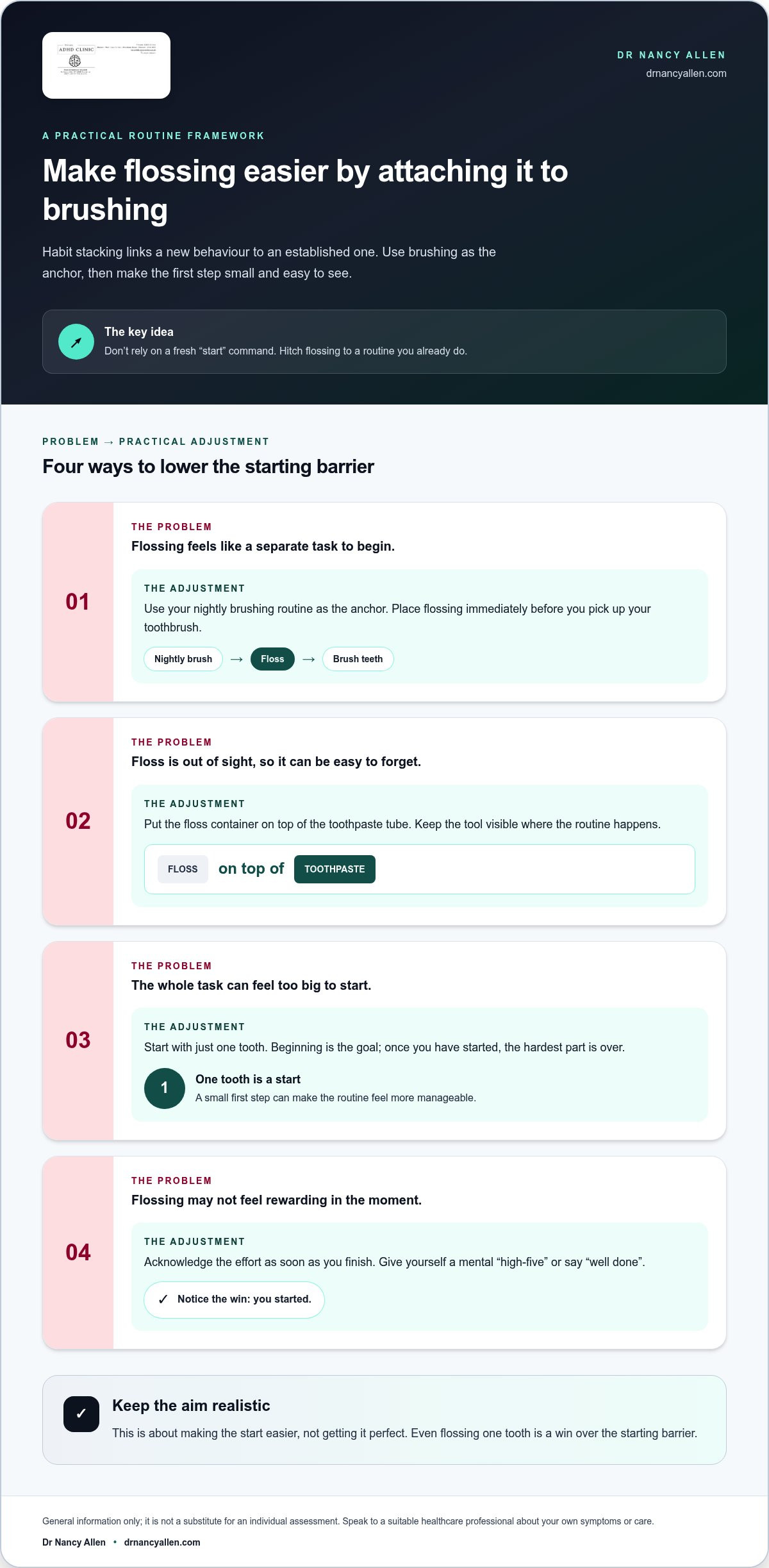
Building a new routine is rarely about a lack of willpower; it's about how we bridge the gap between knowing and doing. Habit stacking is a powerful strategy that involves "piggybacking" a new behaviour onto a habit that's already automatic. For most people, brushing their teeth is a deeply ingrained "anchor habit." By tying flossing to brushing to break starting barriers, you leverage the momentum of an existing neural pathway. This reduces the cognitive load required to initiate a separate task. Instead of seeing flossing as a new, daunting chore, your brain begins to view it as a natural extension of the brushing process.
Success often depends on starting small. The "Tiny Habits" philosophy suggests flossing just one tooth. It sounds almost too simple, yet it's incredibly effective for bypassing the "wall of awful" we discussed earlier. Once you've started, the hardest part is over. If you find yourself consistently struggling with these Common ADHD Hurdles, it might be helpful to seek professional insight through an Adult ADHD Assessment to understand your specific executive profile and gain clarity on your daily challenges.
The ADHD brain thrives on immediate rewards. Brushing provides that minty tingle, but flossing lacks an inherent "prize." You have to create your own. A simple mental "high-five" or a verbal "well done" after you finish can trigger a small dopamine release. Over time, this reinforces the behaviour and makes it feel less like a struggle. When we reward the effort of starting, we train the brain to see the routine as a positive experience rather than a source of shame.
A Step-by-Step Framework for Neurodivergent Success
Identify the anchor: Use your nightly brush as the trigger. It's a task you already perform, so it provides a reliable foundation.
Insert the new behaviour: Floss before you even pick up the toothbrush to ensure it doesn't get skipped when you're tired.
Simplify the setup: Leave your floss container on top of the toothpaste tube. Visibility is key; if it's tucked away in a drawer, it effectively doesn't exist to your brain.
Celebrate the win: Acknowledge the win immediately. Even flossing one tooth is a victory over executive dysfunction.
Pre-Brushing vs. Post-Brushing: Which is Better?
There is no "correct" order, only what works for your unique brain. Some find the "whilst-brushing" technique effective, using a flosser pick in one hand whilst the other manages an electric toothbrush. Others prefer flossing first to use their limited "starting energy" on the more difficult task. Placing the floss directly on the toothpaste acts as a physical prompt that's impossible to ignore. This removes the need for your brain to "remember" the task, as the environment does the work for you, significantly lowering the friction of getting started.
Lowering the Friction: Choosing Sensory-Friendly Tools
Sensory aversions are a common hurdle that shouldn't be dismissed as a lack of effort. The feeling of string wrapped tightly around fingers or the sharp discomfort of sensitive gums can trigger an immediate "no" from the brain. It's helpful to remember that gum health improves with consistency; the initial discomfort is often a sign that the routine is needed, not that you're doing something wrong. Shifting your focus from perfection to "good enough" allows you to find tools that accommodate your unique needs rather than fighting against them.
Flosser picks are often a superior choice for ADHD brains because they are one-handed. This simple change reduces the cognitive load of the task significantly. You don't have to worry about technique, finger tension, or reaching into the back of your mouth; you just move the pick between your teeth. Interdental brushes are another excellent alternative, especially for those who dislike the "snapping" sensation of traditional floss against the gums. Keeping these tools in multiple locations, such as by the computer or next to the sofa, allows for "incidental flossing." If you can't manage the full routine at the bathroom sink, doing it whilst watching a favourite programme is a valid and effective way to maintain your health.
Water Flossers: The ADHD Game-Changer?
Water flossers offer a high "gadget factor" that can provide a much-needed dopamine hit for an ADHD brain. The novelty of the device can turn a boring chore into an interesting activity, at least for a while. They require much less manual dexterity than traditional methods, making them ideal for those who find the physical mechanics of flossing frustrating. Whilst they can be messy, the sensory "splash" of water is often far more tolerable than the texture of string. If you find that tying flossing to brushing to break starting barriers still feels like an insurmountable struggle, the sheer ease of a water flosser might be the nudge your brain needs to maintain a consistent routine.
Overcoming Common ADHD Hurdles in Dental Care
ADHD challenges often extend well beyond the initial moment of starting a task. Once you are at the sink, the sensory "ick" factor of food debris or the sight of bleeding gums can cause immediate task paralysis. Whilst traditional dental advice suggests simply "powering through," for a neurodivergent brain, these sensory inputs can be physically distressing. Time blindness also plays a significant role; your brain might tell you that flossing is a twenty-minute ordeal when it actually takes less than two. This distorted perception makes the mental energy required to begin feel disproportionate to the activity, further cementing the barrier to care.
On low-energy days, your capacity for complex routines is naturally diminished. On these nights, it's helpful to give yourself permission to do the bare minimum. If you can only manage to floss your front teeth, that is a successful night. It keeps the neural pathway of tying flossing to brushing to break starting barriers active without exhausting your limited cognitive reserves. Understanding these hurdles as neurological rather than moral allows you to adapt your environment to suit your needs, and you can check out Dental11 to see how a modern dental practice can offer a more supportive and relaxed experience.
Many individuals with ADHD fall into the trap of perfectionism. If you miss a day, you might feel the entire habit is "broken" and give up entirely. We must reframe this: half-done is always better than not-started. Flossing three teeth is a genuine victory over executive dysfunction. Resetting your habit doesn't require an apology to yourself or a sense of shame; it simply requires a fresh start this evening. Practising self-compassion is a vital component in maintaining neurodivergent routines, as it allows you to move past "failures" without the emotional weight that often leads to total task abandonment.
Visual and Auditory Cues
Externalising your motivation helps bridge the gap when internal drive is low. Phone alarms or "body doubling" apps can provide the necessary external structure to initiate the bathroom routine. Some find that a specific "brushing song" or a favourite podcast provides the auditory stimulation needed to keep the brain engaged whilst flossing. This stimulation prevents the mind from wandering toward more "interesting" distractions. Habit trackers can also be effective, provided they focus on consistency over a long period rather than a perfect, unbroken streak.
If these daily barriers feel like a constant, exhausting struggle, gaining professional clarity can be a transformative experience. You can book an Adult ADHD Assessment to explore personalised management strategies that validate your experience and provide a clear path forward.
Seeking Clarity: When Executive Dysfunction Affects Quality of Life
Struggling with seemingly simple tasks like oral hygiene is often a canary in the coal mine for undiagnosed ADHD. When the executive cost of daily life becomes consistently overwhelming, it's rarely about a single missed habit. Instead, it's indicative of a brain that processes transitions and task initiation in a way that traditional routines don't accommodate. Whilst strategies like tying flossing to brushing to break starting barriers are invaluable for managing the day-to-day, they are often just one piece of a much larger neurological puzzle. For many, these daily barriers are the first sign that their unique brain wiring requires a different approach to life and self-care.
A formal diagnosis provides more than just a label; it offers a user manual for your own behaviour. It allows you to understand the biological reasons behind your task paralysis, transforming your perspective from one of perceived failure to one of informed management. Dr Nancy Allen brings over 25 years of clinical experience to this journey, offering a compassionate, patient-centric approach that prioritises validation. By understanding the "why" behind your struggles, you can begin to replace chronic shame with science-based strategies that actually work for your brain.
The Path to an ADHD Assessment
Choosing a private adhd assessment can provide the speed and clarity that many individuals find lacking in traditional pathways. During a specialist consultation with a neuro-aware GP, you can expect a thorough and unhurried evaluation that looks at the tangible impact of executive dysfunction on your quality of life. This process is designed to be supportive and calming, reducing the anxiety often associated with seeking medical help. Gaining this insight is a powerful step in reducing the "shame" around daily tasks, as it confirms that your struggles are neurological rather than a moral failing. It allows you to stop fighting your brain and start working with it.
Next Steps for Personalised Support
Once you have achieved clarity through an adult adhd assessment, the focus shifts to creating a tailored management plan. These plans go far beyond the unhelpful advice to "just try harder." Instead, they focus on neuro-inclusive strategies that respect your energy levels and sensory needs. By tying flossing to brushing to break starting barriers, you've already begun the work of accommodating your neurodiversity. Personalised support ensures that these small wins are part of a broader, sustainable strategy for long-term well-being. Viewing self-care as a collaborative process with an expert guide can help you restore your confidence and navigate your journey with a steady, informed hand.
Reclaiming Consistency Through Compassionate Strategy
Maintaining a consistent dental routine is not a test of your character; it is a challenge of executive function. By adopting neuro-inclusive strategies and choosing tools that respect your sensory needs, you can transform a source of daily anxiety into a friction-less, automatic habit. We've explored how tying flossing to brushing to break starting barriers allows you to bypass the "wall of awful" by hitching new behaviours onto established neural pathways.
If these daily hurdles feel like a symptom of a deeper struggle with task initiation, seeking professional clarity can provide the insight your brain deserves. Dr Nancy Allen offers specialist expertise in neurodiversity and hormonal health, providing validated support through secure online consultations available nationally. Appointments are often available within days. Book a Private ADHD Assessment with Dr Nancy Allen today to begin your journey. You don't have to navigate these neurological barriers alone; expert guidance is ready to help you thrive.
Frequently Asked Questions
Why do I find it so hard to start flossing even when I want to?
You struggle because of a neurological breakdown in task initiation, which is a core component of executive dysfunction. Your brain doesn't see flossing as a simple step; it perceives a complex, multi-step project that requires significant mental energy to begin. This "start button" failure often leads to task paralysis, where you remain stuck despite having a genuine desire to finish the chore. Understanding this as a biological hurdle rather than a moral failing is the first step toward self-compassion.
Does habit stacking actually work for people with ADHD?
Habit stacking is highly effective for the neurodivergent brain because it hitches a new, difficult task onto a deeply ingrained neural pathway. By tying flossing to brushing to break starting barriers, you use the momentum of an automatic habit to carry you through the transition. This significantly reduces the cognitive load required to initiate the second task. It bypasses the need for a fresh "start" command, making the entire routine feel like one continuous, fluid motion.
What is the best time of day to floss if I have executive dysfunction?
The best time to floss is whenever your executive function is at its peak or when your "anchor habit" naturally occurs. For many, this is during the evening brush, but if you find your energy levels are depleted by nightfall, morning flossing is just as valid. The goal is to find the point of least resistance in your day. If you find yourself consistently stuck, try flossing whilst watching a favourite programme to provide necessary stimulation and distraction.
Is flossing once a week better than not flossing at all?
Yes, flossing once a week is far superior to not flossing at all. In the neurodivergent community, we often say that anything worth doing is worth doing poorly. If a full daily routine feels impossible, doing it occasionally still provides significant health benefits and keeps the neural pathway for the habit alive. Consistency is a spectrum, not a binary choice between perfection and failure. Reducing the pressure to be perfect actually makes it easier to start the task.
How can I make flossing less of a sensory nightmare?
You can reduce sensory discomfort by switching to tools that accommodate your sensitivities. Traditional string floss can be aversive due to its texture or the way it wraps around fingers. Consider using flosser picks, interdental brushes, or a water flosser to change the physical experience. Additionally, using SLS-free toothpaste can reduce the overwhelming foaming sensation that many find distracting. Experimenting with different tools helps you find a method that feels neutral rather than distressing or painful.
Can ADHD medication help with daily hygiene routines like flossing?
ADHD medication can be a helpful tool in managing daily hygiene because it helps regulate dopamine and improves executive function. When your brain has better access to the neurotransmitters required for focus and task initiation, the "wall of awful" around mundane tasks like flossing often feels lower. Whilst medication isn't a cure for habit formation, it can provide the neurological stability needed to implement strategies like habit stacking and maintain a more consistent, sustainable routine over time.
What should I do if I forget to floss for several days in a row?
If you miss several days, the most important step is to resume without indulging in hygiene guilt. Shame is a major driver of task avoidance, so punishing yourself only makes it harder to start again. Treat each evening as a fresh opportunity rather than an extension of past failures. You don't need to make up for missed days; simply floss one tooth tonight to re-establish the connection and prove to your brain that the habit still exists.
Are flosser picks as effective as traditional string floss for people with ADHD?
Flosser picks are often more effective for those with ADHD because they significantly lower the executive cost of the task. Whilst some dentists prefer the wrap-around technique of string floss, that clinical advantage is lost if the tool is so frustrating that you never use it. Picks are one-handed and require less manual dexterity, making them much easier to use whilst distracted. The best tool is always the one that actually makes it into your mouth consistently.



Comments