


Comprehensive Care for ADHD: A Guide to Assessment and Holistic Management

Updated: 3 hours ago
For years, you may have felt like you were running a race with your shoelaces tied together. Perhaps you’ve been labelled as ‘disorganised’, ‘lazy’, or ‘too sensitive’, whilst internally, you’ve been struggling just to keep up. The constant mental chatter, the misplaced keys, the missed deadlines—it’s exhausting, and it can leave you feeling confused and alone. I want you to know that what you're experiencing is real, and you are not alone.
As a private GP with over 25 years of clinical experience, I’ve seen first-hand how expert clinical care for ADHD transforms lives. It’s not about finding a label; it’s about finding an explanation that finally makes sense of your life’s story. True care offers a path to clarity through timely diagnosis, compassionate support, and a personalised treatment plan that sees you as a whole person. It’s a partnership, and it starts with being heard.
Table of Contents
What is Comprehensive Care for ADHD in the UK?
When I talk about comprehensive care for ADHD, I’m referring to a journey that goes far beyond a simple diagnosis. It’s a multi-stage clinical partnership that prioritises your validation and well-being at every step. This process involves careful identification of symptoms, a thorough and empathetic assessment, and, most importantly, ongoing management tailored to your unique life.
A Multi-Stage Process: True care begins with listening to your story, proceeds to a robust clinical assessment, and evolves into a long-term strategy for managing your symptoms and harnessing your strengths.
Looking at the Whole Person: Your life isn’t a checklist, and neither is my approach. I look at how your symptoms interact with your work, your relationships, your physical health, and even your hormonal cycles, rather than just ticking boxes.
My Role as a Private GP: As a GP, I am positioned to be your consistent point of contact, providing a vital bridge between specialised psychiatric insight and your day-to-day primary care needs.
In my practice, I define ADHD care as a collaborative clinical partnership that prioritises patient validation and builds a sustainable framework for a better quality of life.
The Shift from Diagnosis to Long-term Support
Private vs Public ADHD Care: Understanding the Landscape
The reality for many in the UK is that NHS waiting times for an ADHD assessment can be painfully long, often stretching for years. Whilst pathways like 'Right to Choose' exist, the sheer demand can be overwhelming. This is where private care offers a crucial alternative. The primary benefits I provide are speed, consistency, and depth. You won't be passed between different clinicians; you will have me as your dedicated doctor. Our consultations are longer, allowing us the time to delve deeply into your experiences without feeling rushed. I ensure that every private assessment I conduct meets the rigorous NICE guidelines and clinical standards required for full recognition across the UK, providing you with a diagnosis that is robust, respected, and valid.
The Diagnostic Pathway: What to Expect During an ADHD Assessment
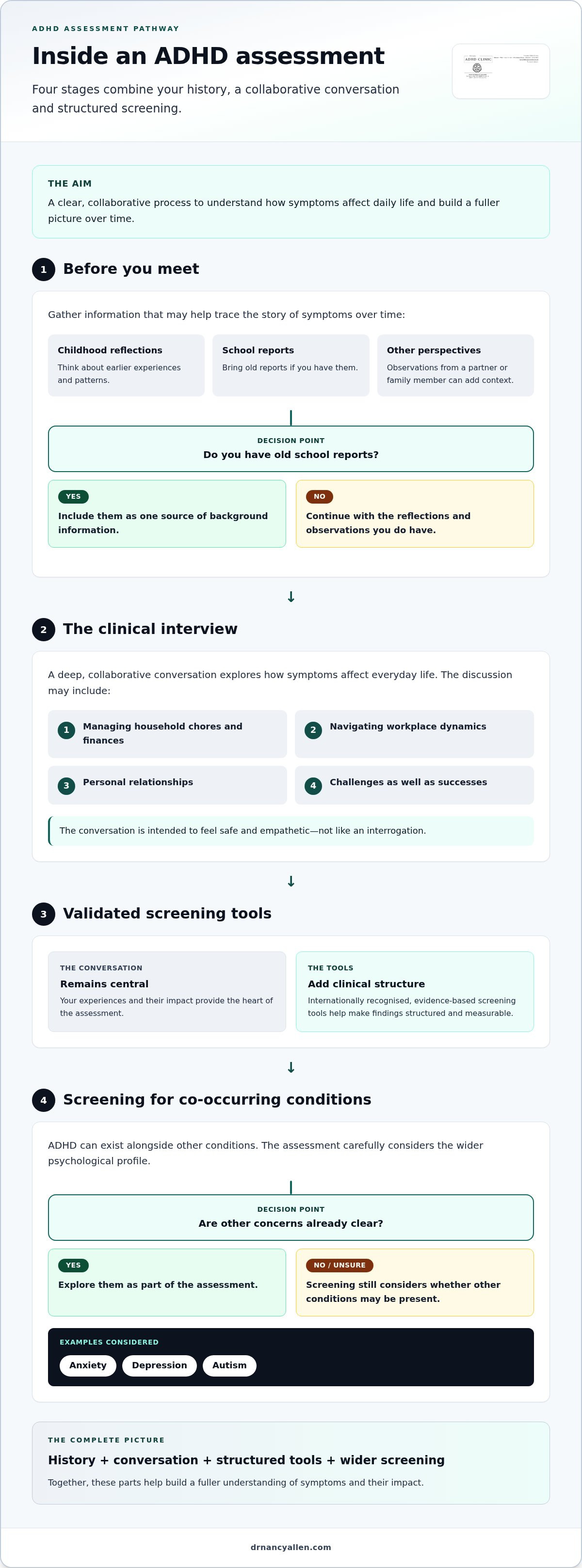
The thought of an assessment can be daunting, but my goal is to make it a process of discovery and validation, not an interrogation. I’ve refined my pathway to be as clear and stress-free as possible.
The Pre-Assessment Phase: Before we meet, I’ll ask you to gather information that helps build a complete picture. This often includes reflections on your childhood, old school reports if you have them, and observations from a partner or family member. This isn't about finding fault; it's about tracing the narrative of your symptoms over time.
The Clinical Interview: Our consultation is a deep and collaborative conversation. We’ll discuss how your symptoms impact your daily life—from managing household chores and finances to navigating workplace dynamics and personal relationships. My aim is to create a safe, empathetic atmosphere where you feel comfortable sharing your challenges and successes.
Validated Screening Tools: Whilst our conversation is central, I use internationally recognised, evidence-based screening tools to provide clinical structure to the assessment. This ensures our findings are robust and measurable.
Screening for Co-occurring Conditions: It is very common for ADHD to exist alongside other conditions like anxiety, depression, or autism. A crucial part of my assessment is to carefully screen for these, ensuring that your treatment plan addresses your complete psychological profile.
Adult ADHD Assessments: Finding Clarity in Midlife
ADHD in adults often looks very different from the stereotypical image of a hyperactive child. It can manifest as a constant, internalised restlessness, a feeling of being perpetually overwhelmed, or a chronic inability to relax. For many adults I see, particularly those in their 30s, 40s, and beyond, receiving a diagnosis is a profound 'Aha!' moment. It’s the validation for decades of feeling 'different', 'lazy', or not living up to your potential. My work with professionals and parents focuses on these specific challenges, providing strategies that bring clarity and restore a sense of control. For a more detailed look at this process, you may find my comprehensive guide to adult ADHD assessment helpful.
Child ADHD Assessments: Supporting the Whole Family
When a child is struggling, it impacts the entire family. My approach to child assessments is centred on reducing anxiety for everyone involved. I create a welcoming environment for the young person and work closely with parents to understand their concerns and observations. A diagnosis is only useful if it leads to practical change, which is why I actively collaborate with schools. My goal is to ensure the assessment translates into tangible support in the classroom. Appointments are often available within days.
Multimodal ADHD Management: Beyond Medication
A phrase I often use in my practice is, "pills don't build skills." Whilst medication can be a transformative and essential tool for managing the core neurochemical aspects of ADHD, it is rarely the whole solution. True, sustainable management comes from a multimodal toolkit that empowers you with strategies for life.
Psychoeducation: The first step is always understanding. I help you learn the science behind how your unique brain works, moving from shame or confusion to self-awareness and acceptance. This knowledge is the foundation for developing effective coping strategies.
ADHD Coaching and Therapy: Specialised coaching or therapy can be invaluable for tackling challenges with executive dysfunction—the brain-based skills needed for organisation, time management, and emotional regulation.
Habit Change Support: For individuals looking to overcome specific challenges like smoking, which can be linked to ADHD-related impulsivity, you can check out Achieve Hypnotherapy for expert guidance.
Lifestyle Interventions: We will explore the significant impact of sleep, nutrition, and exercise on your brain’s dopamine levels. Small, consistent changes in these areas can have a powerful stabilising effect on your symptoms.
Physical Alignment: Addressing physical tension and structural health can also play a role in managing the sensory sensitivities often associated with neurodivergence; you can find out more about how chiropractic care supports a balanced nervous system.
Pharmacological Options and Titration
If we decide together that medication is an appropriate part of your care plan, I will guide you through the options available in the UK, which typically fall into stimulant and non-stimulant categories. The next step is a careful process called titration. This involves starting with a very low dose and slowly, safely adjusting it under my close supervision to find the optimal level that maximises benefits while minimising side effects. Once you are on a stable and effective dose, I will work with you to establish a Shared Care Agreement, which allows your prescription to be transferred to your NHS GP for long-term management, making your care both seamless and affordable.
Environmental and Behavioural Adjustments
So much of managing ADHD involves shaping your environment to support your neurodivergent brain, rather than constantly fighting against it. We can work on practical techniques for organising your physical space to reduce distraction and create systems that work for you. We will also develop strategies for managing 'time-blindness' and navigating the intense feelings that can come with emotional dysregulation. For those in employment, I can provide guidance on how to work with your employer to implement 'reasonable adjustments' under the Equality Act 2010, ensuring you have the support you need to thrive professionally.
The Hormonal Connection: ADHD, Perimenopause, and Menopause
This is an area of medicine I am incredibly passionate about, as it sits at the intersection of my two specialisms and affects a huge, underserved population. I have seen countless women in my clinic whose ADHD symptoms suddenly worsened, or even appeared for the first time, during the hormonal shifts of perimenopause and menopause. This is not a coincidence; it is a clinical pattern rooted in neurobiology.
The relationship is clear: oestrogen plays a crucial role in regulating dopamine, a key neurotransmitter for focus, motivation, and executive function. As oestrogen levels decline during perimenopause, the dopamine system can become destabilised, making ADHD symptoms significantly more challenging to manage. In short, oestrogen depletion exacerbates executive dysfunction in neurodivergent women. Many of these women are misdiagnosed with anxiety or depression, when the root cause is the collision of their neurotype with this new hormonal landscape.
Specialist Care for Women in Midlife
Because of my expertise in both hormonal health and neurodiversity, I am uniquely positioned to create an integrated care plan. This often involves carefully combining Hormone Replacement Therapy (HRT) with ADHD management to achieve optimal results. HRT can help stabilise the hormonal foundation, which in turn can make ADHD medication more effective and life feel more manageable. Having a clinician who understands this complex interplay is vital. My goal is to help you move from the debilitating 'brain fog' so common in this life stage to a place of renewed cognitive clarity and confidence.
Pelvic Health and Neurodiversity
Another overlooked link I address in my holistic practice is the connection between ADHD, sensory processing, and pelvic health. The executive dysfunction associated with ADHD—particularly challenges with routine and interoception (the sense of the internal state of the body)—can make it difficult to consistently perform pelvic floor exercises. Furthermore, sensory sensitivities can impact intimacy and confidence. By taking a holistic approach, I help women navigate these challenges during the menopausal transition, ensuring their care plan addresses their physical, mental, and emotional well-being.
Choosing the Right Specialist for Your ADHD Journey
Embarking on this journey is a significant step, and finding the right person to guide you is paramount. When you're choosing a specialist, I believe you should look for a combination of deep clinical experience, genuine empathy, and a clear, transparent process. The benefit of my Private GP approach is that you have a single, consistent point of contact who understands your complete medical history and is invested in your long-term success.
In a world of long waiting lists, speed also matters. Not because care should be rushed, but because the psychological cost of waiting in uncertainty for years can be immense. My aim is to provide a path to clarity without delay, so you can begin the next chapter of your life sooner.
The Dr Nancy Allen Difference
My practice is built on a foundation of three core principles:
Experience and Expertise: I combine 25 years of clinical experience as a GP with modern, specialist expertise in neurodiversity and women's hormonal health.
Compassion and Validation: I am committed to providing evidence-based care within a framework of compassionate validation. Your story will be heard, and your struggles will be taken seriously.
Accessibility and Convenience: I offer secure, nationwide telehealth consultations, allowing you to access specialist care from the comfort and privacy of your own home.
Preparing for Your Consultation
To get the most from our first meeting, it’s helpful to think about a few things in advance. Consider what questions you want to ask me, and start gathering any evidence you think might be useful, like old school reports or notes on where you struggle most in daily life. The most important step, however, is the first one.
Book your private ADHD assessment with Dr Nancy Allen today
Frequently Asked Questions
Is a private ADHD diagnosis from Dr Nancy Allen recognised by the NHS?
Yes. All my assessments are conducted in strict accordance with NICE (National Institute for Health and Care Excellence) guidelines, the same standards used by the NHS. My diagnoses are fully recognised, and I facilitate Shared Care Agreements with NHS GPs for ongoing prescriptions.
How long does the ADHD assessment process take from start to finish?
My process is designed for efficiency and clarity. From your initial booking to receiving your comprehensive diagnostic report, the process can often be completed within a couple of weeks. Appointments are often available within days.
Can I get ADHD medication through a private GP in the UK?
Yes. As a qualified GP with a specialism in this area, I am able to prescribe and manage ADHD medication. We will go through a careful titration process to find the right treatment for you, before establishing a Shared Care Agreement with your NHS GP for long-term continuity.
What is the difference between ADHD and ADD in modern clinical care?
In the past, 'ADD' (Attention Deficit Disorder) was the term used for ADHD without the hyperactivity component. Today, modern clinical practice uses 'ADHD' as an umbrella term, with three sub-types: Predominantly Inattentive, Predominantly Hyperactive-Impulsive, and Combined Type. What was once called ADD is now diagnosed as ADHD, Predominantly Inattentive Presentation.
Do I need a referral from my regular GP for a private ADHD test?
No, you do not need a GP referral to book a private assessment with me. You can self-refer directly through my clinic, which simplifies the process and allows you to seek help as soon as you feel ready.
Can ADHD symptoms be mistaken for menopause or perimenopause?
Absolutely. There is a significant overlap in symptoms, including brain fog, memory problems, emotional dysregulation, and fatigue. This is why many women are misdiagnosed in midlife. It takes a clinician with expertise in both fields to accurately differentiate between them and understand how they interact.
What happens if my assessment does not result in an ADHD diagnosis?
My primary goal is to provide you with clarity, whatever the outcome. If the assessment concludes that your symptoms are not best explained by ADHD, I will provide a detailed report explaining the clinical reasoning and suggest alternative explanations or pathways for you to explore with your GP.
How much does a private ADHD assessment cost in the UK?
The cost of a private assessment can vary. My fee structure is transparent and reflects a comprehensive process that includes pre-assessment screening, extended consultation time, a detailed diagnostic report, and a post-diagnosis treatment plan. Please refer to my website's booking page for the most up-to-date fee information.



Comments