


ADHD and Depression: Understanding the Link and Support

What if the "depression" you have been treating for years is actually a symptom of a brain that simply processes the world differently? It's a heavy burden to carry the labels of "lazy" or "unmotivated" when you're actually working twice as hard as everyone else just to stay afloat. For many, the overlap between adhd and depression creates a cycle of chronic exhaustion and low self-esteem that standard antidepressants alone cannot seem to break. You aren't failing; you might just be navigating a neurodivergent landscape without the right map.
We understand how isolating this journey can feel, especially when your efforts don't seem to yield the focus or clarity you crave. In this guide, you'll discover how to distinguish between these two conditions and why they so frequently coexist. We will provide a clear roadmap for seeking a specialist private assessment, offering you the validation and clinical insight needed to finally move forward. By understanding how your unique mind functions, you can begin to restore your confidence and build a life that feels manageable and bright again.
Table of Contents
The Complex Relationship Between ADHD and Depression
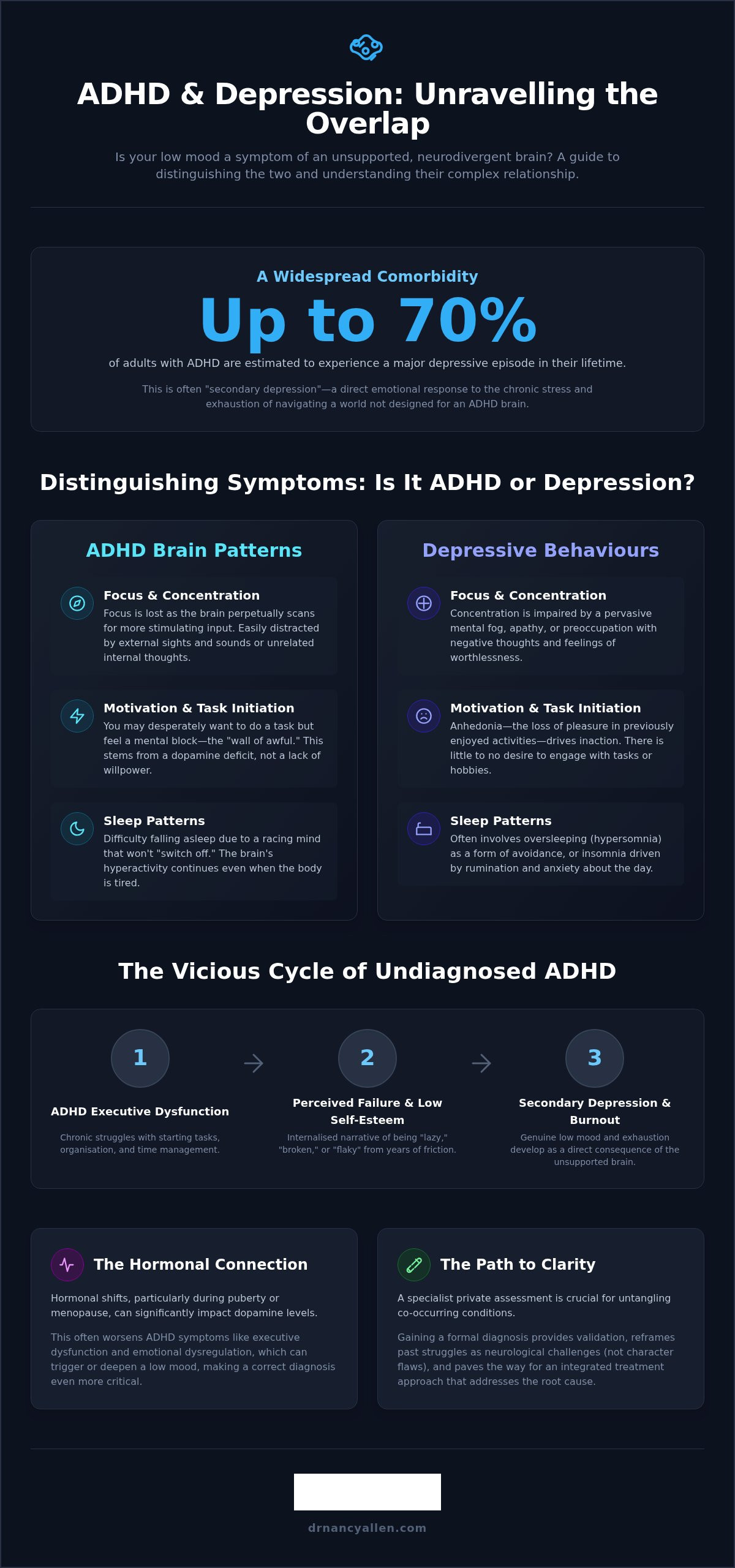
Living with neurodivergence often feels like running a race with invisible weights. When we discuss adhd and depression, we aren't just looking at two separate conditions that happen to exist in the same person. Instead, they are frequently woven together in a complex web of cause and effect. Clinical research indicates that a significant number of adults with ADHD experience major depressive episodes, with some estimates suggesting this affects up to 70% of the population. This high rate of comorbidity often stems from what we call "secondary depression," which is a direct emotional response to the chronic stress and friction of navigating a world not designed for an ADHD brain.
Unlike "primary depression," which might be driven by genetic factors or standalone life events, secondary depression is the fallout of years of missed deadlines, social misunderstandings, and the mental exhaustion of trying to "act normal." At the biological level, the role of dopamine is central. In an ADHD brain, the reward system is chronically under-stimulated. This lack of chemical "spark" can mimic the numbness or apathy associated with depression. When you can't find the motivation to start a simple task, it's easy to assume you're depressed, when your brain is actually just starved for stimulation. This often triggers the "ADHD burnout" cycle: task paralysis leads to perceived failure, which then creates a genuine low mood.
Misdiagnosis: When ADHD is Mistaken for Depression
It's common for adults to spend years being treated for depression with very little improvement in their quality of life. This happens because symptoms like brain fog, fatigue, and a lack of motivation overlap significantly between the two conditions. If a clinician only sees the low mood and ignores the underlying executive dysfunction, the root cause remains hidden. Many people rely on "masking," the exhausting process of hiding ADHD traits to fit in, which eventually leads to a total emotional collapse. Gaining a clear understanding of Adult attention deficit hyperactivity disorder is a vital step in determining whether your struggle is purely a mood disorder or a brain that is simply overtaxed by its environment.
The Impact of Undiagnosed ADHD on Self-Esteem
Without a diagnosis, you're left to find your own reasons for why life feels so much harder for you than it seems for others. This often leads to an internalised narrative of being "lazy," "flaky," or "broken." This chronic sense of failure creates fertile ground for depressive thoughts to take root. Identifying the link between adhd and depression allows for a powerful shift in perspective. It enables you to reframe your history, seeing "failures" not as character flaws, but as neurological challenges. Validation is the first step toward reclaiming your self-esteem and finding support that actually works for your specific brain type.
Distinguishing ADHD Symptoms from Depressive Behaviours
Distinguishing between adhd and depression is essential because the path to feeling better requires the right tools for the right problem. While both can leave you feeling stuck, the "why" behind the struggle is what matters most. For instance, consider focus. In depression, concentration is often lost to a mental fog or a preoccupation with negative thoughts. In ADHD, focus is lost because the brain is constantly scanning for any source of stimulation. The National Institute of Mental Health explains that ADHD involves a brain that is easily distracted by external stimuli or unrelated thoughts. Sleep patterns offer another vital clue. If you're lying awake with a racing mind, unable to "switch off," that's often the hyperactive component of ADHD. If you're oversleeping to avoid the day, that's more characteristic of a depressive episode.
Motivation vs. Executive Function
The struggle to "just get started" is frequently mislabelled as laziness or a lack of interest. In clinical depression, people often experience anhedonia, where things they once loved no longer bring pleasure. If you don't care about the task, you don't do it. However, with ADHD, you might desperately want to finish a project but feel physically unable to bridge the gap between thinking and doing. This is often called the "wall of awful." It's not a lack of willpower; it's a dopamine deficit. Your brain lacks the chemical "go" signal required for initiation. If you find yourself staring at a pile of laundry for three hours, feeling increasingly anxious but unable to move, you're likely dealing with executive dysfunction rather than a depressive lack of interest.
The Role of Rejection Sensitive Dysphoria (RSD)
Emotional regulation is another area where the lines between adhd and depression can blur. Many individuals with ADHD experience Rejection Sensitive Dysphoria, an intense, overwhelming emotional pain triggered by the perception of being rejected or criticised. Because these episodes are so sudden and deep, they can look exactly like a depressive crash. The difference lies in the duration and the trigger. RSD is usually a sharp, short-lived reaction to a specific event, whereas clinical low self-worth in depression is a constant, heavy background noise. Traditional antidepressants may not alleviate the specific sting of RSD, which is why an accurate diagnosis is so important. If these patterns feel familiar, exploring a specialist assessment can help you unpick these tangled threads and find clarity.
The Gendered Experience: Hormones, ADHD, and Low Mood
Hormones play a fundamental role in how neurodivergent traits manifest throughout a woman's life. Oestrogen is closely linked to the brain’s ability to produce and use dopamine. This is the very neurotransmitter that is already in short supply for those with ADHD. When oestrogen levels drop during puberty, pregnancy, or perimenopause, ADHD symptoms often intensify significantly. This biological shift explains why many women find themselves struggling with a heavy sense of adhd and depression during these transitional periods. The drop in dopamine doesn't just affect focus. It impacts emotional stability, leading to a pervasive low mood that standard mood-stabilising treatments might not fully address.
Perimenopause and the 'ADHD Flare'
For many women, the onset of perimenopause feels like a sudden, inexplicable loss of control. Coping mechanisms that once kept life organised begin to crumble under the weight of hormonal fluctuations. This "double hit" of brain fog from both menopause and ADHD can lead to profound mental exhaustion and a sense of being "broken." It's often at this stage that the link between adhd and depression becomes most apparent, as the inability to manage daily tasks leads to a spiral of low self-esteem and chronic stress. Seeking specialist care for Menopause Symptoms is often the first step in unpicking these complex layers and restoring a sense of agency.
Why Women are Frequently Misdiagnosed
The path to an ADHD diagnosis for women is often delayed by decades. A woman in her 40s might visit her GP feeling overwhelmed and tearful, only to be sent away with a prescription for antidepressants that doesn't quite hit the mark. Clinicians frequently label women's struggles as primary anxiety or depression because they don't look for the underlying neurodivergence that has been masked for years. Current research on ADHD and depression suggests that women are more likely to internalise their symptoms, manifesting as racing thoughts and emotional volatility rather than physical restlessness. This internalised hyperactivity is easily misread as a mood disorder. A gender-informed, specialist assessment provides the clarity needed to see that the low mood is often a symptom of an unsupported brain, finally offering a path toward genuine, holistic well-being.
Seeking Clarity: The Diagnostic Journey for Co-occurring Conditions
Unpicking the threads of adhd and depression requires more than a standard checklist. It demands a clinician with deep expertise in neurodivergent comorbidities who can see past the immediate symptoms of low mood. A comprehensive Adult ADHD Assessment is designed to do exactly this. It provides the space to explore your history in detail, looking for the lifelong patterns of executive dysfunction that often precede depressive episodes. Unlike a brief consultation, a specialist private assessment allows for a thorough investigation into how your brain has functioned since childhood. This depth is essential for disentangling neurobiology from reactive mood states, ensuring that the root cause of your struggle is identified and addressed.
Preparing for Your Assessment
Coming prepared can help you get the most out of your time with a specialist. It's helpful to gather evidence from your past, such as school reports or memories of childhood struggles with focus and organisation. You should also track how your current daily life is impacted. Try to notice if your low mood follows a period of intense overwhelm or "task paralysis." Being completely honest about your depressive symptoms is vital. It doesn't hinder an ADHD diagnosis; instead, it helps the clinician understand if the depression is a standalone condition or a secondary result of living with unsupported ADHD. This clarity is the foundation of an effective treatment plan.
The 72-Hour Path to Answers
One of the most significant advantages of a private medical consultation is the speed and clarity it offers. Whilst public health wait times can be extensive, our process prioritises your need for immediate insight. We provide a diagnosis and a personalised treatment plan in as little as 72 hours. This rapid turnaround reduces the anxiety of waiting and allows you to begin your recovery journey sooner. Receiving a formal diagnosis is often a transformative moment. It acts as the first step in restoring your confidence, replacing the label of "broken" with a clear, evidence-based understanding of your unique brain. If you're ready to find the clarity you deserve, you can book a private ADHD assessment today to begin your journey toward better mental well-being.
Integrated Treatment: Managing Both ADHD and Depression
Effective management of adhd and depression requires a clinical strategy that respects the nuance of both conditions. Often, when we address the underlying ADHD, the "secondary" depression begins to lift naturally. This happens because the daily friction, the failed tasks, and the chronic mental exhaustion are reduced, allowing your self-esteem to recover. However, a truly integrated plan looks at the whole person. It combines pharmacological support with tailored psychological strategies and lifestyle adjustments. By treating the neurobiological root alongside the emotional symptoms, we can create a sustainable path toward mental well-being.
Therapeutic approaches also need to be specific. Standard Cognitive Behavioural Therapy (CBT) often fails neurodivergent individuals because it assumes the primary issue is "distorted thinking." For someone with ADHD, the problem is more often executive dysfunction. Therefore, therapy must be "ADHD-adapted," focusing on practical systems, emotional regulation, and self-compassion rather than just challenging thoughts. This shift in focus ensures that you're not just learning to feel better, but learning to function in a way that suits your brain's unique architecture.
A Personalised Approach to Medication
Stimulants or non-stimulants are frequently the first line of support for those with ADHD. By regulating dopamine, these medications provide the "mental energy" needed to engage with other forms of recovery. It's safe and often highly effective to combine ADHD medication with antidepressants under specialist supervision. This dual approach ensures that both the neurobiological deficit and the emotional weight are managed simultaneously. Titration, the careful process of finding the right dose and combination, is essential. Ongoing medical management allows us to fine-tune your treatment, ensuring it remains effective whilst minimising any potential side effects.
Holistic Support and Wellbeing
The power of empathetic validation in the healing process cannot be overstated. For many, the simple act of being heard by a specialist who understands the adhd and depression link is the catalyst for change. Healing involves more than just clinical intervention; it requires creating a life that works for your brain, not against it. This might include refining your sleep hygiene, improving nutrition, and, most importantly, practicing radical self-compassion. Once you stop fighting your neurobiology, you can begin to build a life that feels manageable and bright. If you have spent years feeling "broken," remember that the right support can restore your clarity. We encourage you to reach out for an expert assessment to begin this transformative journey.
Reclaiming Your Mental Clarity and Well-being
Understanding the intersection of adhd and depression is often the turning point in a lifelong struggle with low mood and mental exhaustion. By unpicking the complex threads of neurobiology and hormonal shifts, you can finally move beyond the internalised narratives of being lazy or unmotivated. Your struggle isn't a character flaw; it's a brain that simply requires a different map. Identifying whether your depression is a standalone condition or a secondary response to unsupported ADHD is the first vital step toward an integrated treatment plan that actually works.
Dr Nancy Allen brings over 25 years of specialist clinical experience to help you find that map through compassionate, expert-led online consultations. We provide a thorough assessment and a personalised treatment plan in as little as 72 hours, offering the rapid clarity you need to start your recovery. You don't have to navigate this cycle of burnout alone any longer. Professional validation and tailored support are within reach. To take the first step toward a life that feels manageable and bright, Book a Private ADHD Consultation with Dr Nancy Allen today. You deserve to feel heard, understood, and supported.
Frequently Asked Questions
Can ADHD be mistaken for depression?
Yes, ADHD is frequently misdiagnosed as depression because symptoms like brain fog and lethargy overlap. When a clinician only sees the low mood, they may overlook the underlying executive dysfunction that causes it. If you've found that standard antidepressants don't improve your focus or drive, it's possible that undiagnosed ADHD is the root cause. A specialist assessment is necessary to disentangle these complex clinical presentations and ensure you receive the correct support.
Is it possible to have both ADHD and depression at the same time?
It's very common to experience both conditions simultaneously. Statistics indicate that up to 70% of adults with ADHD will face a major depressive episode at some point. This co-occurrence, or comorbidity, often stems from the chronic stress of living with an unsupported brain. Understanding the link between adhd and depression allows for a more targeted treatment plan that addresses both your neurobiology and your emotional well-being simultaneously.
Will ADHD medication help with my depression symptoms?
ADHD medication can significantly alleviate "secondary" depression by improving your ability to function and complete daily tasks. When you're no longer constantly fighting against task paralysis and failure, your self-esteem often begins to recover. Whilst stimulants aren't a direct treatment for primary mood disorders, they provide the mental energy required to engage with other therapeutic supports. Many patients find a combination of treatments under specialist supervision offers the most effective results.
Why does my depression feel worse when my ADHD is untreated?
Untreated ADHD creates a persistent cycle of missed deadlines, social friction, and mental exhaustion. This constant state of being overwhelmed feeds directly into depressive thoughts and feelings of inadequacy. Without the right support for your neurodivergence, the "wall of awful" becomes insurmountable, making your depression feel more intense and permanent. Addressing the ADHD helps break this cycle, reducing the life-friction that keeps your mood in a state of persistent decline.
How do I know if I have ADHD or just 'burnout'?
The primary difference lies in your history. ADHD is a neurodevelopmental condition present since childhood, whereas burnout is typically a situational response to prolonged stress. If you've always struggled with focus and organisation, but things have recently become unbearable, it's likely that undiagnosed ADHD is the underlying driver of your chronic burnout. A specialist assessment examines your lifelong patterns to determine if your exhaustion is a temporary state or a neurological trait.
Can menopause cause both ADHD symptoms and depression to worsen?
Hormonal shifts during menopause have a direct impact on brain chemistry. As oestrogen levels decline, dopamine production also drops, which can cause ADHD symptoms to flare up significantly. This "double hit" often leads to increased brain fog and a pervasive low mood. Many women find that their coping mechanisms fail during this time, making it essential to seek specialist care that understands the intersection of hormonal health and neurodiversity in the United Kingdom.
What is the best type of therapy for someone with both conditions?
Standard talking therapies often need to be "ADHD-adapted" to be effective. For those managing adhd and depression, a modified version of Cognitive Behavioural Therapy (CBT) is often recommended. This approach focuses on practical executive function strategies and emotional regulation rather than just challenging thought patterns. By building systems that work for your brain's unique architecture, you can reduce the daily overwhelm that contributes to your low mood and chronic anxiety.
How long does a private ADHD assessment take with Dr Nancy Allen?
Our private assessment process is designed for speed and clinical clarity. Dr Nancy Allen provides a comprehensive diagnosis and a personalised treatment plan in as little as 72 hours. This rapid turnaround avoids the long wait times often associated with public health services, allowing you to begin your journey toward recovery almost immediately. Every consultation is secure, online, and led by a specialist with over 25 years of clinical experience.


Comments